Mild Summer

Weather has been somewhat atypical.

(This article is recycled from a few years ago.)

Now that it is half way through September, it is impossible to ignore that tomatoes did not have a good season. Most of us who grow tomatoes were embarrassed by their performance until we realized that everyone else who grows them was also experiencing similar disappointing results. It was not because we did not water them properly. Nor was it because they lacked particular nutrients. They simply wanted warmer weather.

Plants that were put out early before the warm weather last spring did much better at first, but then decelerated as the weather became milder instead of warmer. Cool nights certainly did not help. Mildew, which typically slows a bit as weather becomes drier (less humid) though summer, instead continued to proliferate so that new foliage became infected almost as soon as it developed.

Earlier predictions that the weather would eventually get warm were not accurate enough for many of us who are only now getting enough tomatoes for fresh use, but not an abundance for canning, drying or freezing. There is still some time for most of the tomatoes that are on the vines now to ripen; but many will probably remain green by autumn. Some but not all of the last green tomatoes can ripen off the vine. Perhaps the only good news about all this is that there should be plenty of green tomatoes for pickling.

Sadly, tomatoes were not the only warm season vegetables to be dissatisfied with the weather. Green bean vines and bushes were generally healthy and made good beans, but did not produce very abundantly. Corn was likewise of adequate quality, but on smaller ears and less abundant. Even zucchini, which typically produces too much, was a bit subdued. Marginal vegetables that really prefer warmth, like eggplant and bell pepper, were downright disappointing.

Even if the weather gets warmer in the last days of summer, languishing tomato plants can not ketchup on production. They can be left to make a few more tomatoes, but will eventually need to get out of the way of cool season vegetables. Cabbage, kale, turnip greens, beets, radishes and all the slower growing vegetables that take their time through autumn, winter and early spring will want their space back soon. They will hopefully have a better season.

If possible, cabbage, broccoli, cauliflower and some of the larger cool season vegetable plants can be plugged in amongst the finishing warm season vegetable plants. Then, by the time the finishing warm season vegetable plants need to be removed, the next phase of cool season vegetable plants is already somewhat rooted and has a head start. This process works well in small spaces with good quality soil.

The main problem with this procedure is that it prevents potentially depleted soil from getting amended and well mixed between planting. It can also be a bit awkward to get the spacing of rows, furrows or mounds of the next phase of vegetable plants to match up with the previous phase. Smaller vegetable plants that get sown directly from seed into rows, like turnip greens, carrots, beets and radishes, really prefer customized bed preparation, after the warm season vegetables have been removed.

Warming Summer Weather

Dog Days!

My great grandfather could remember more summers in Sunnyvale than anyone else. He knew how unique every summer was and continues to be. Some summers are uncomfortably hot from beginning to end. Last summer though, was the coolest in recorded history!

Warm summers are of course best for the fruits and vegetables that like warmth. Peaches, grapes, tomatoes and rhubarb in my great grandfather’s garden always got the best flavor during warm weather. Warm but not too hot weather early in summer made the best ‘Bing’ cherries on my grandmother’s tree in Santa Clara.

Although cool summers are more comfortable for dogs, cats and people, they are not quite as conducive to growing fruits and vegetables. It is still too early to know what this summer will be like, but even though it is now getting warm, the warmth is developing late. The past spring was remarkably mild, with rain lingering later than it typically does.

Consequently, some fruits and vegetables, as well as some flowers and trees, are developing slowly. Peaches may be a bit smaller than they typically are, with slightly milder flavor. Rhubarb should have good flavor because of recent warm weather, but may develop a bit late because it got a late start.

Tomatoes are perhaps expressing the most dissatisfaction with the mild weather. Even tomato plants that were put out in the garden early in spring have grown slowly, and are not nearly as productive as they typically are by the beginning of summer. Some are not yet producing!

Fortunately and unfortunately, the weather has gotten significantly warmer. This may be uncomfortable for us; but is a party for the formerly bored tomato plants. Warmth of course promotes bloom and fruit production, and enhances flavor. If they get what they need, tomato plants that seemed sickly in the past may suddenly grow like weeds.

They should waste no time making up for lost time. Even if mild weather continues into summer like it did last summer, it will still get warmer than it has been. Maturing tomato plants will want more water and fertilizer (if used) as they get larger, and the weather gets warmer.

Tornado

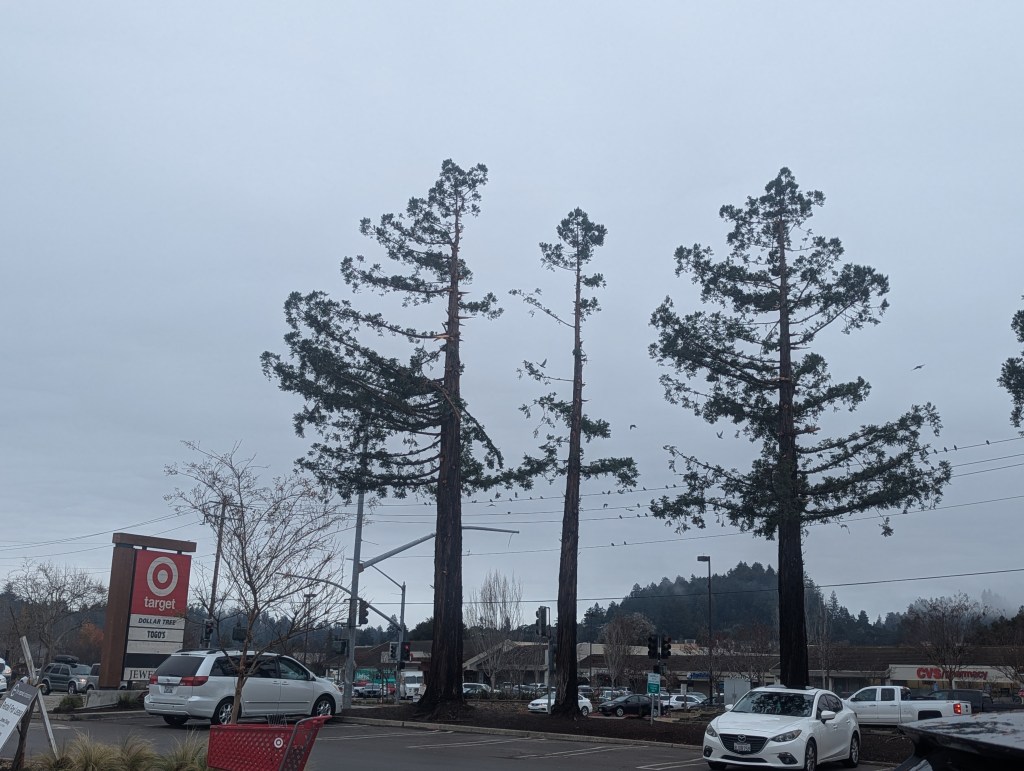
The tornado that stripped these redwoods landed right on Target. Notice the sign to the lower left.

The weather here may seem boring to those who are acquainted with other climates. It gets neither too warm nor too cold. Rain is limited to the relatively short rainy season. Humidity is minimal. Snow is so extremely rare that I can remember it only once in the Santa Clara Valley during my lifetime, and it was only half an inch deep. Tornadoes are about as rare, or at least they were. I can now remember two here, which is twice as many occurrences of snow that I can remember. Shortly after half past one last Saturday, rain, which had been falling for a while, suddenly became torrential, then instantly stopped, then instantly became torrential again. I stepped outside with Rhody to observe, and noticed Heather, Rhody’s feline ‘associate’ who prefers to stay inside during such stormy weather, had also come outside to observe, and was staring to the south. When I looked to see what she was looking at, I saw that not only were dark clouds speeding to the east, but that a portion of them was backtracking, as if swirling. My comment to Rhody and Heather was something like, “Well, at least tornadoes do not happen here.”. A few minutes later, a tornado did happen, right on Target, literally. It landed right on the Target store in Scotts Valley, less than two miles away. It was rated as an EF1 tornado, which apparently means that it was rather minor. It lasted for five minutes, though, while travelling only about a quarter of a mile. That is much slower than the clouds that we observed only a few minutes earlier. Fortunately, injuries were minimal, although a few cars were tossed. Utility cables, streetlamps and traffic signals were thrashed. So was much of the vegetation of the urban landscape.

Sunday Best – Rhody

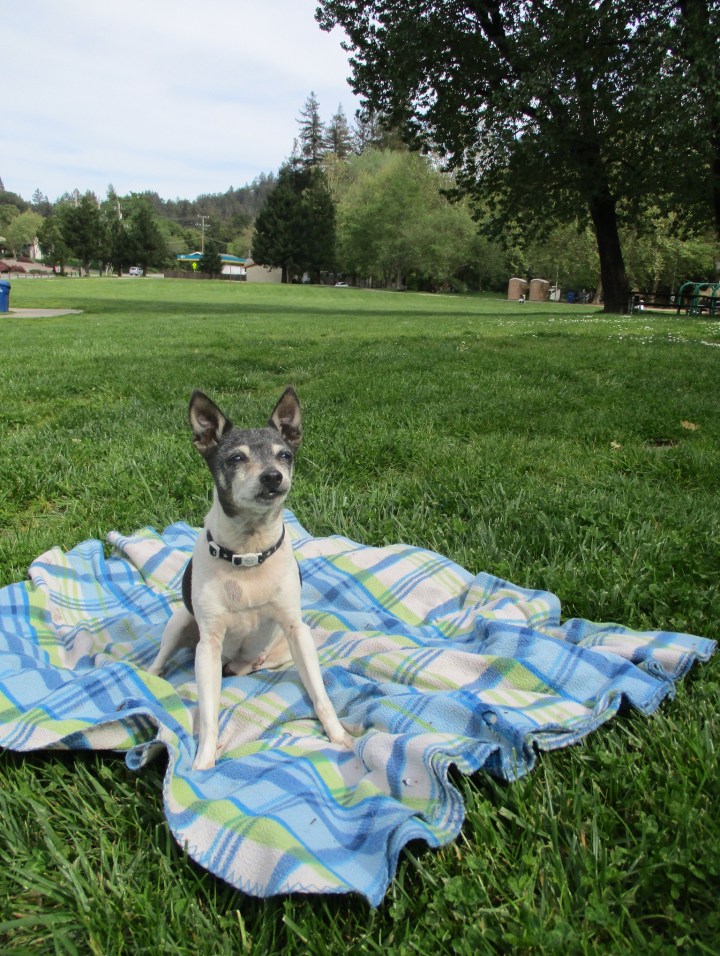
This is my first Sunday without writing anything more than this brief explanation about why I wrote nothing more than this brief explanation, . . . and why Rhody looks rather damp and concerned. A tornado landed less than two miles away, in Scotts Valley, just a moment before I got this picture. He knows about Toto of Kansas.

Nurseries Sell Some Marginal Species.

Heliotrope is available from nurseries in climates that get too frosty for it.

            Limiting selection of plants to those that are appropriate to the local climate is not as easy as it seems. Even in mild climates, plants that should be grown in even milder climates are just too tempting, and have sneaky ways of getting from nurseries into the garden. Consequently, when the weather gets cold, at least a few plants get damaged by frost.

            Geraniums, angel’s trumpet, daisies and many other perennials that are so reliable throughout the rest of the year were likely damaged when the weather recently got harshly cold so suddenly after being so mild. Sensitive plants that got some protection prior to the frost may have avoided damage this time, but will likely need protection again before the end of winter. The only sensitive plants that are reasonably safe are those that are located in sheltered spots or in pots that got moved to shelter.

            Now that the damage has been done, it is important to not rush corrective procedures. Even though frost damaged foliage is unsightly as it deteriorates, it insulates undamaged tissue below. Early removal of the damaged foliage exposes interior stems to frost later in the season. On rare occasion, exposed stems of some plants can be damaged by desiccating cold wind or sun scald. (Sun scald typically happens during summer, while sunlight is most intense.)        

            Early pruning of frost damage can also stimulate premature development of new growth, which is much more sensitive to later frost. Most moderately sensitive plants have no problem recovering from minor frost damage once annually. However, recovery is so stressful and takes so much effort that secondary frost damage to new growth can be much more damaging and even fatal to some plants.

            It is best to delay removal of frost damage until late winter when subsequent frost is unlikely. Large plants that are too unsightly to wait that long should be pruned as minimally as possible, and then pruned as necessary later. Minor distal damage known as ‘tip burn’ of avocado and lemon trees may not need to be pruned out at all if it first gets obscured by new growth that develops after winter.

            This may seem contrary to the importance of pruning most other plants while they are dormant during winter. The difference is that, unlike most plants that stay dormant while the weather is cold, plants that get damaged by frost are not so well adapted to cold winter weather, so do not know that they need to stay dormant until the weather is safe for new growth.      

            Burlap, plastic sheeting or any other coverings used to protect sensitive plants from frost should be removed when it is not needed. These protective coverings hold warmth within, which can stimulate premature development of sensitive new growth. Opaque materials shade the plants below and can eventually cause etiolation (stretching of the stems), which likewise makes plants even more susceptible to frost damage.

Frosty Weather Can Limit Gardening

Foliar frost damage can be unsightly.

Even here, climate is not perfect. It may sometimes seem to be too warm during summer. However, it might not be consistently warm and humid enough for some tropical species. Winter chill may be inadequate to vernalize some species or certain cultivars of species. However, recently frosty weather has already damaged some vegetation in some areas.

Frost limits what performs well in home gardens in two extremes. Some species prefer a bit more than they experience here. Others prefer less. For example, peony prefers more, while vanilla orchid prefers none. Peony is only marginal where weather is exceptionally frosty by local standards. Vanilla orchid can be offended by minor chill even without frost.

Climates and microclimates limit frost just as frost limits what performs in home gardens. Some coastal climates here only very rarely or perhaps never experience frosty weather. Other climates farther inland or at higher elevations experience frost almost every winter. Within such climates, eaves or canopies of big trees can provide shelter from minor frost.

Vegetation within home gardens should be appropriate to its particular climate. Varieties that are vulnerable to frosty weather are likely safe where frost never occurs. Conversely, they will obviously be susceptible to damage where frost does occur. The best means to avoid such damage is appropriate selection. Climate will not accommodate bad choices.

Gardening could be slightly less interesting without a few bad choices, though. Besides, some of such choices are justifiable with the right perspective. Canna, for example, dies back harmlessly to dormant rhizomes after frosty weather. It wastes no time regenerating as weather warms. Some tropical species may grow in pots to move to shelter from frost.

Tenting can shelter some specimens that are too big to move, or are in the ground. Outer foliage that already succumbed to frosty weather can shelter inner growth. Therefore, if it is not too unsightly, it should remain through winter. Besides, premature pruning is likely to stimulate new growth. Such growth would innately be vulnerable to subsequent frosts.

Precipitation Should Continue Through Winter

Red sky at morning, meteorological warning.

Deciduous foliage gets colorful with autumn chill. Then, it gets messy. Then, with a bit of precipitation, it gets even messier! It seems like a waste as it all succumbs to rain and, in other climates, snow. It is sensible, though. Deciduous vegetation will be less vulnerable to stormy weather without it. Weather will be getting increasingly stormy through autumn.

This is how the Mediterranean climate here operates. The dry season that begins during spring continues until autumn. The relatively shorter rainy season centers around winter. Therefore, most precipitation occurs during winter. Spring and autumn are brief transition seasons that tend to favor the dry season. Almost no precipitation occurs during summer.

Spring and autumn transitions between rainy and dry seasons are innately variable. The rainy season tends to finish early during spring, but may not. It sometimes pauses before resuming. It may do so more than once. Conversely, the rainy season tends to begin late during autumn, but may begin earlier. Occasionally, precipitation begins disturbingly late.

Generally, the first significant storm with significant precipitation begins the rainy season. This may be difficult to believe with typically significant time between the first few storms. Yet, with cooler weather, elevated humidity, and shorter daylength, moisture lasts longer. Precipitation, even if merely drizzling fog, will likely dampen gardens before they get dry.

Irrigation obviously does not need to be as generous as it was during summer. Until next spring, some vegetation will require none at all. Not only will weather provide and retain more moisture, but vegetation uses much less. Refraining from manual irrigation is easy. Adjustment of automated irrigation systems actually requires more effort and awareness.

As deciduous species defoliate for winter, some other species might get more vivacious. Cacti, agave, and some yuccas that lack irrigation become more turgid with precipitation. Remaining palo verde foliage is likely to become greener and fresher prior to defoliation. Most xeric species utilize moisture from precipitation as it becomes available seasonally.

Six on Saturday: Red Flag Warning

A Red Flag Warning that began Thursday night continues at least until five this evening. Arid wind severely increases the risk of wildfire during this time. The strong wind can be hazardous, even without fire. Big trees become big problems.

1. Wind developed soon after sunrise yesterday. I tried to get a picture of foliar debris as it fell from the forest canopy, but took only this. Sequoia sempervirens, coastal redwood makes the background, with Quercus agrifolia, coast live oak in the lower left quadrant.

2. Turkeys should hide from such wind. This one was alone and in a hurry, likely to find a sheltered situation with others, and just as likely, after shredding the red berries of the firethorn, Pyracantha coccinea. I saw no others as the wind continued through the day.

3. Sequoia sempervirens, coastal redwood is remarkably stable but structurally deficient where exposed to wind, which is why it grows in dense and mutually sheltering colonies. These big fractured limbs are very heavy, and fell with deadly velocity from very high up.

4. Umbellularia californica, California bay is often destabilized by structural deficiency. In other words, although its trunks and limbs are generally not structurally deficient, rot often compromises the structural integrity of the roots, which then become destabilized.

5. Two California bay trunks that destabilized and blocked the road in the picture above are obscured on the ground by their own foliage here. The fractured trunk that is visible was not structurally deficient, but was pulled down by the other two as they destabilized.

6. Hedychium coccineum X coronarium ‘Peach Delight’ ginger is likely too late to finish blooming. I would like to see it bloom to confirm its identity, but may need to wait until next year. Although irrelevant to the wind, I thought I should feature at least one bloom.

This is the link for Six on Saturday, for anyone else who would like to participate: https://thepropagatorblog.wordpress.com/2017/09/18/six-on-saturday-a-participant-guide/

Six on Saturday: Fire Season

Fire season can begin as early as May and continue as late as November. It is defined by the rainy season. It is a long season because the rainy season is not. Summer is naturally warm and arid. Native vegetation is consequently desiccated. It is no coincidence. Fire is unfortunately a natural component of the ecosystems here, and native vegetation knows it. Many exotic species also react to the meteorological influences that affect fire season. Some are from similar chaparral ecosystems. However, some are from other ecosystems that are likely less adapted to fire. Perhaps their native ecosystems are less relevant than associated meteorological influences, which is what they are actually reacting to. A forty percent chance of rain on Monday morning is the first chance of rain in a long time.

1. Sequoia sempervirens, coastal redwood is always messy and gets even messier when a breeze dislodges foliage which got desiccated by arid warmth. It is a bad combination.

2. Adiantum capillusveneris, maidenhair fern also reacted to arid warmth. In the wild, foliar desiccation through summer is normal. It is not so normal in irrigated landscapes.

3. Musa acuminata X balbisiana ‘Blue Java’ banana would enjoy sustained warmth with more humidity. While humidity is inadequate, wind more easily shreds its flimsy foliage.

4. Musa acuminata ‘Kokopo’ or ‘Patupi’ banana is more sheltered from breezes and more generously irrigated, so can exhibit guttation overnight and into the cool early morning.

5. Amaryllis belladonna, naked lady is generating seed as it typically does by now. Seed is very perishable, but grows in soil that is damp from the first rain that ends fire season.

6. Solidago rugosa ‘Fireworks’ goldenrod is only fiery by name. It was a gift from Tangly Cottage Gardening. It is the only bloom I will brag about today, and our first goldenrod!

This is the link for Six on Saturday, for anyone else who would like to participate: https://thepropagatorblog.wordpress.com/2017/09/18/six-on-saturday-a-participant-guide/