Wintry Weather Can Damage Trees

(This posted in 2011.)

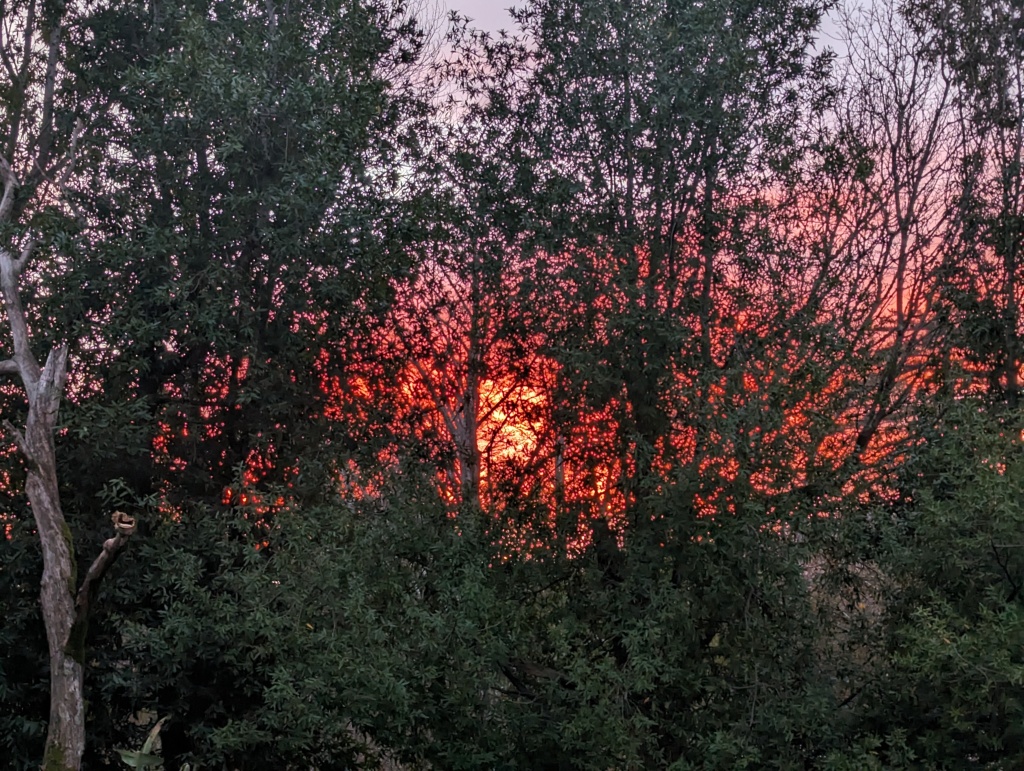
Wind brings out the worst in trees.

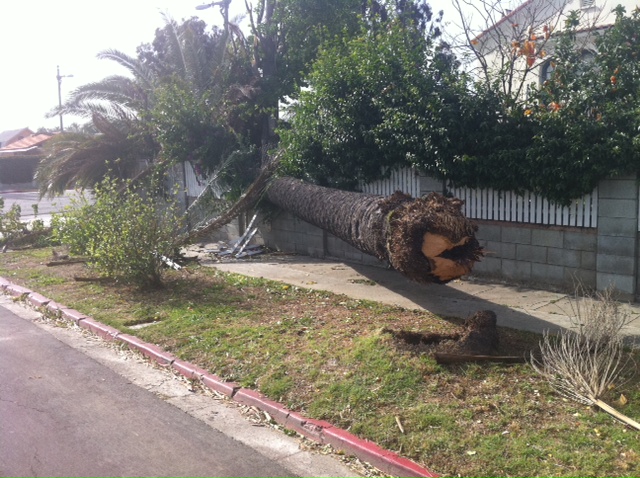
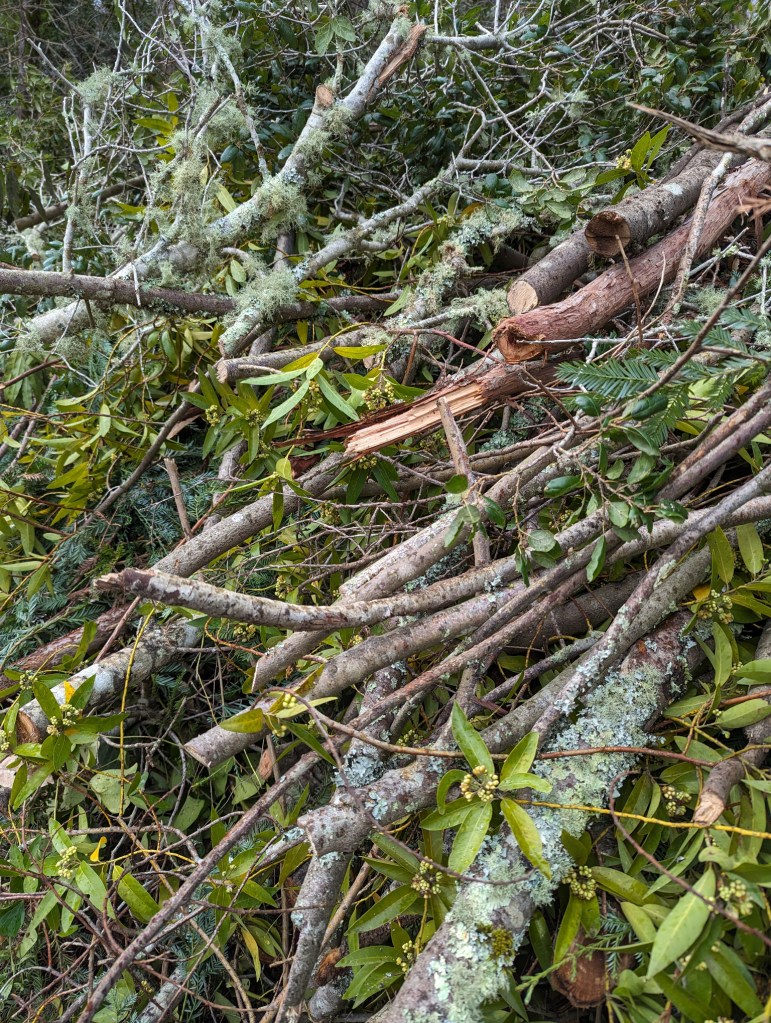
Pasadena sustained the worst of the damage caused by the strongest Santa Ana Winds in three decades. Huge piles of debris from broken trees are much more than can be removed any time soon. Falling debris and trees damaged many roofs, cars and anything else that happened to get in the way.

Other towns and neighborhoods throughout the area, particularly those at the base of mountains, also sustained major damage. At the same time, severe winds ravaged the San Francisco and Monterey Bay Areas as well, particularly in the Santa Cruz Mountains and the hills of the East Bay.

Some of the damage caused by wind in urban areas might have been less disastrous if trees had gotten the respect and attention that they deserve. Some trees develop structural deficiencies that need to be corrected by pruning, either to eliminate the problems, or at least to decrease the strain exerted onto the structurally deficient parts. A few trees that become unstable as they mature may likewise need to be pruned or even removed.

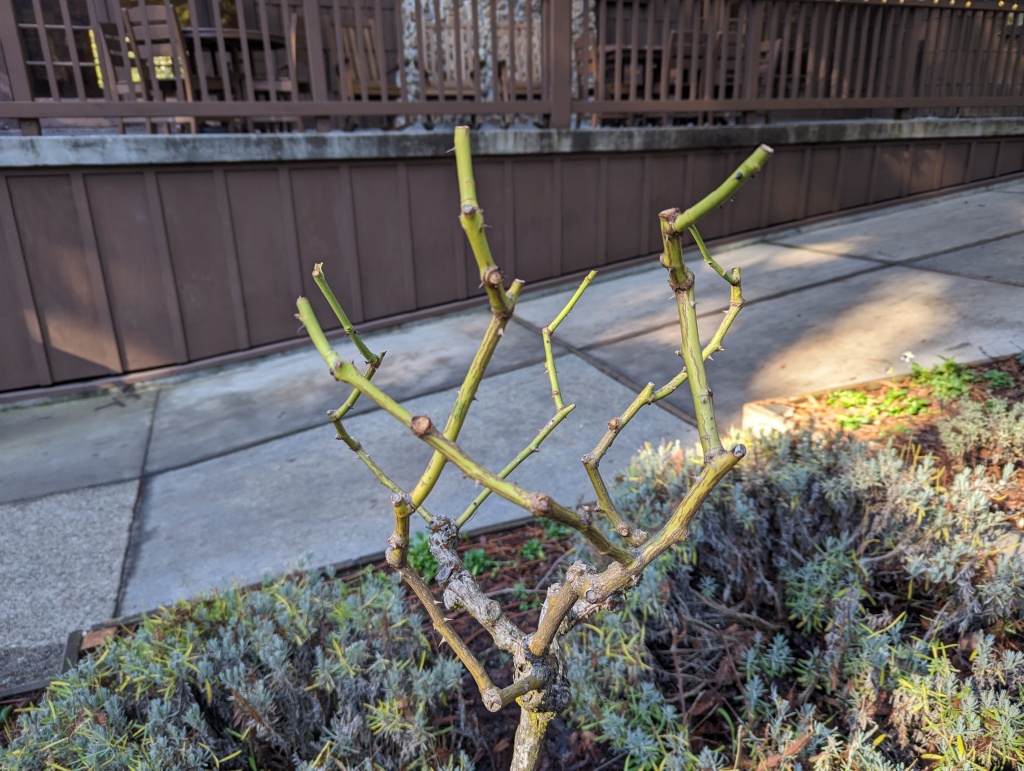
It is not always possible to prune trees to remove all structural deficiencies without damaging the affected trees more, or causing more structural problems to develop. For example, major pruning to remove all parts that may get blown down by wind, such as pollarding or ‘topping’, may seem to be effective for the short term, but actually stimulates the development of vigorous secondary growth or watersprouts that are disproportionately heavy and even more likely to tear off from the older limbs.

Structural pruning more often involves thorough reduction of weight and wind resistance. Weight of foliage and stems directly applies leverage against unions where smaller stems are attached to the larger stems from which they originate. Wind resistance adds more leverage as foliage gets blown about by wind. Thinning obviously removes significant weight, and also decreases wind resistance to allow wind to blow though the affected canopies.

Besides helping to compensate for structural deficiency, structural pruning is also beneficial to potentially unstable trees for the same reasons. However, unstable trees typically need even more reduction of weight and wind resistance. Some of the most unstable trees and those that are deteriorating need to be removed because their instability cannot be accommodated.

During winter, while deciduous trees are bare, evergreen trees are more susceptible to wind damage, obviously because they retain their weight and wind resistance through winter while the weather is the most severe. Unstable trees become even more destabilized as rain softens the soil. Regardless of the potential for susceptibility to wind damage, this would be a good time of year to get any needed tree maintenance done, prior to any more windy and rainy winter weather.

Arborists certified by the International Society of Arboriculture are the most qualified to identify potential structural problems or instability, and to prescribe corrective procedures. A list of certified arborists can be found at the website of the International Society of Arboriculture at http://www.isaarbor.com.

Frost Is Simply Too Chill

Some minor frost damage is acceptable.

Chill can be good. Frost can be bad. The difference is thirteen degrees Fahrenheit. Chill is at or less than forty-five degrees. Frost is at or less than thirty-two degrees. Chill helps some flora to maintain its seasonal schedule. Frost causes some flora to freeze. Both are limiting factors of home gardening. Both are weather patterns that are limited by climate.

Many species from climates with more pronounced seasons rely on chill. They know that it occurs only during winter, and that they should bloom afterwards. Duration of such chill is more important than temperature. Any temperature at or less than forty-five degrees is equally sufficient. Within that, different species require different durations, or ‘chill hours’.

This limits the selection of many species, like various fruit trees. Citrus orchards formerly grew within the San Fernando Valley. They require no chill. Stone fruit orchards formerly grew within the Santa Clara Valley. They require a bit of chill. Pomme fruit orchards grow in the Willamette Valley. Many cultivars of pomme fruit perform best with significant chill.

Frost also limits the selection of many species. Pomme fruits do not mind it. However, if it happens late, it can ruin stone fruit bloom or developing fruit. It might damage citrus trees whenever it happens. Some climates here experience frost annually. Some experience it only rarely or mildly. Several coastal climates experience merely minor chill without frost.

Many garden enthusiasts grow a few species that are vulnerable to frost. Of course, such species are safe within frostless climates. Elsewhere, they may need shelter during cold weather. Potted vegetation may benefit from seasonal relocation. Temporary tenting can shelter imobile vegetation in the ground. Some vegetation is too large to shelter, though.

Vegetation that sustains frost damage is unsightly. However, it is best to delay pruning or grooming until subsequent frost is unlikely. Damaged outer growth insulates undamaged inner growth. Besides, pruning stimulates new and more vulnerable growth. Some types of vegetation should want only superficial grooming. Others might require major pruning.

The Hedge on the Ledge

Perhaps no one will notice.

I can explain. Firstly, I should mention that this is an industrial building at work, not a home garden; so no one else cares what it looks like. Secondly, although this building is outfitted with an abundance of external electrical lighting, it lacks external electrical outlets. Thirdly, I brought a ‘Double Mahoi’ banana tree back from the Los Angeles region less than a month ago, so divided its pups at the most inconvenient time, as autumn weather was getting cooler. Fourthly, I should stop numbering all these individual statements, and get on with a simple explanation of this visually unappealing contraption.

The banana tree went to its permanent home already, where it can hibernate through winter. However, its pups languished and immediately began to deteriorate here. Because they will not grow much until warmer weather after winter, their rudimentary corms can rot faster than they can recover from their division. Therefore, I purchased an electrical heating mat to warm their media from below, and accelerate root and corm growth. It was not a pleasant purchase, since I object to reliance on such technology, but that is another topic for later.

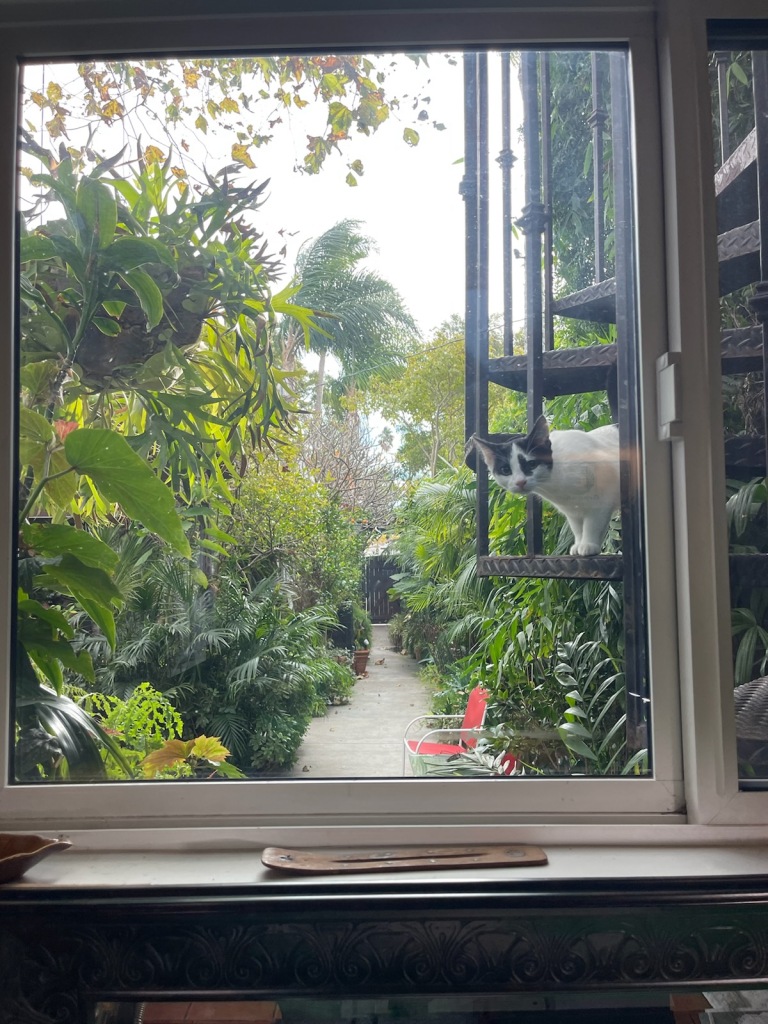
I did not want to extend an extension cord too extensively from a window to the nursery benches on the deck to the lower right in the illustration above. I thought that this shelf would be less obtrusive. Perhaps I should have thought a bit more about it. I successfully extended and obscured an extension cord for the fountain on the mountain, but again, that is another topic for later.

Now that it is installed directly outside the window, without the need for an extension cord, the shelf fits the heating pad reasonably well, and suspends eight #1 cans with three 4″ pots nestled in between.

By the time this explanation posts at midnight next Sunday morning, the largest of the four ‘Double Mahoi’ banana pups, which incidentally is already in the process of generating another rudimentary pup, might be exhibiting a slight bit of accelerated growth. The two smallest of these four pups were cut back to their corms, and the third will likely get cut back also, so will take a bit longer to exhibit growth. All four are arranged in the front row at the bottom of the illustration below.

The three 4″ pots that are nestled in between the #1 cans contain tissue cultured plugs of ‘Gran(d) Nain’, ‘Cavendish’ and ‘Orinoco’ banana. With all seven pups and plugs of banana neatly arranged on the heating mat, remaining space accommodated a few cuttings that should also benefit from the warmth of the heating mat.

The four #1 cans in the rear row at the top of the illustration below contain cuttings of passion flower vine and cup of gold vine. The passion flower vine to the right of center is unidentified, but ‘Constance Elliot’ is to the left of center, with a single cutting of ‘Frederick’. Almost predictably again, that is another topic for later. Nine cuttings of unvariegated cup of gold vine to the far right are shabby because they were superficially damaged by minor frost earlier. Six cuttings of variegated cup of gold vine are to the far left.

Although shabby, they do not look so silly from inside.

Dormancy Facilitates Survival Through WInter

Deciduous vegetation defoliates for winter dormancy.

Dormancy is not exclusive to vegetation. Many animals are dormant while they hibernate through cold winter weather. Some animals are dormant while they aestivate through hot and dry weather. Fungi and bacteria can maintain dormancy for many years or centuries. Dormancy is a technique for avoiding unpleasant situations, such as cold or hot weather.

Like some animals, fungi and bacteria, some vegetation is dormant through dry weather. This is evident within local chaparral climates and nearby desert climates. Even within a few coastal forests, buckeye defoliates during summer. Such vegetation resumes activity in response to late autumn rain. However, most vegetation here prefers winter dormancy.

Such winter dormancy is especially evident among deciduous species. Many evergreen species merely halt or decelerate their growth, but without defoliation. Several evergreen species defoliate only partially. A few only shed their old foliage as new foliage replaces it during the following spring. Few species prefer to grow most vigorously through winter.

There are a few advantages to defoliation for winter. Wintry wind blows much more freely through defoliated canopies. Evergreen canopies are therefore more vulnerable to wind. In other harsher climates, defoliated canopies do not accumulate much snow. Evergreen canopies might accumulate more snow than they can support. Some get heavy with rain.

Foliage is not as useful through winter as it is through summer anyway. The sun is lower to the south. Consequently, less sunlight gets through more of the atmosphere. Days are shorter while nights are longer. Furthermore, cooling autumn and winter weather inhibits photosynthesis. For deciduous species, foliage becomes less of an asset than a liability.

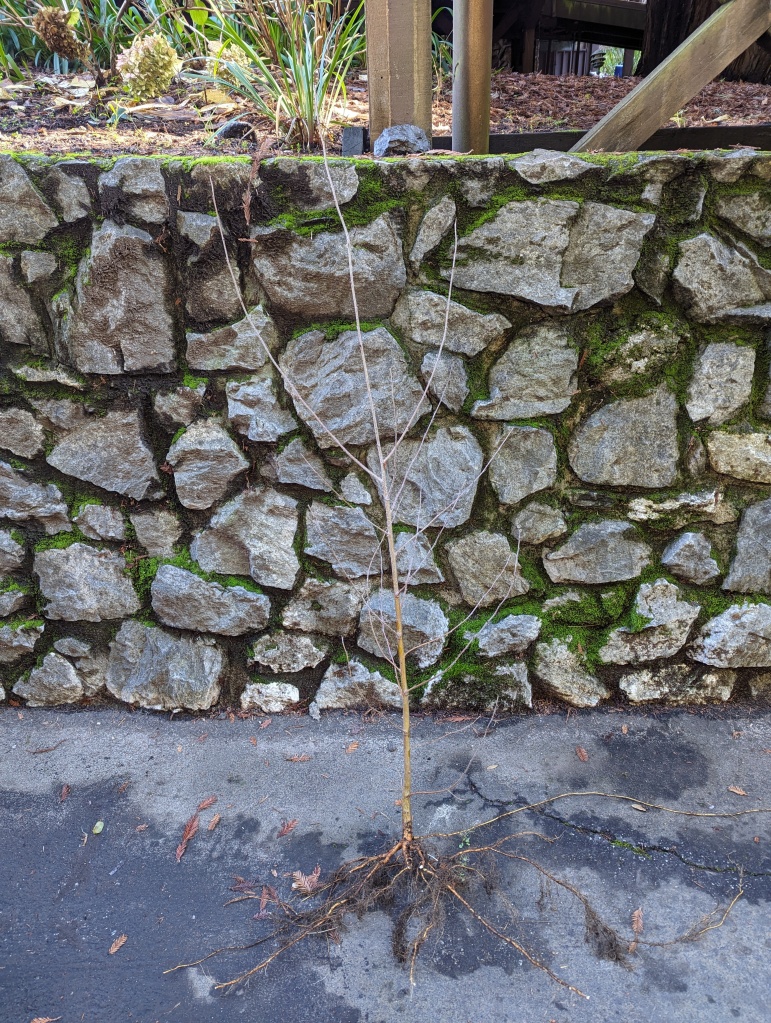
Dormancy, whether it involves defoliation or not, facilitates a few horticultural techniques. Bare root stock becomes available at the beginning of winter. Transition from its farms to home gardens is much less stressful during dormancy. So is the aggressive pruning that roses and deciduous fruit trees require. Most pollarding is safest during winter dormancy.

Abutilon

Bloom may become more scarce with cooling weather.

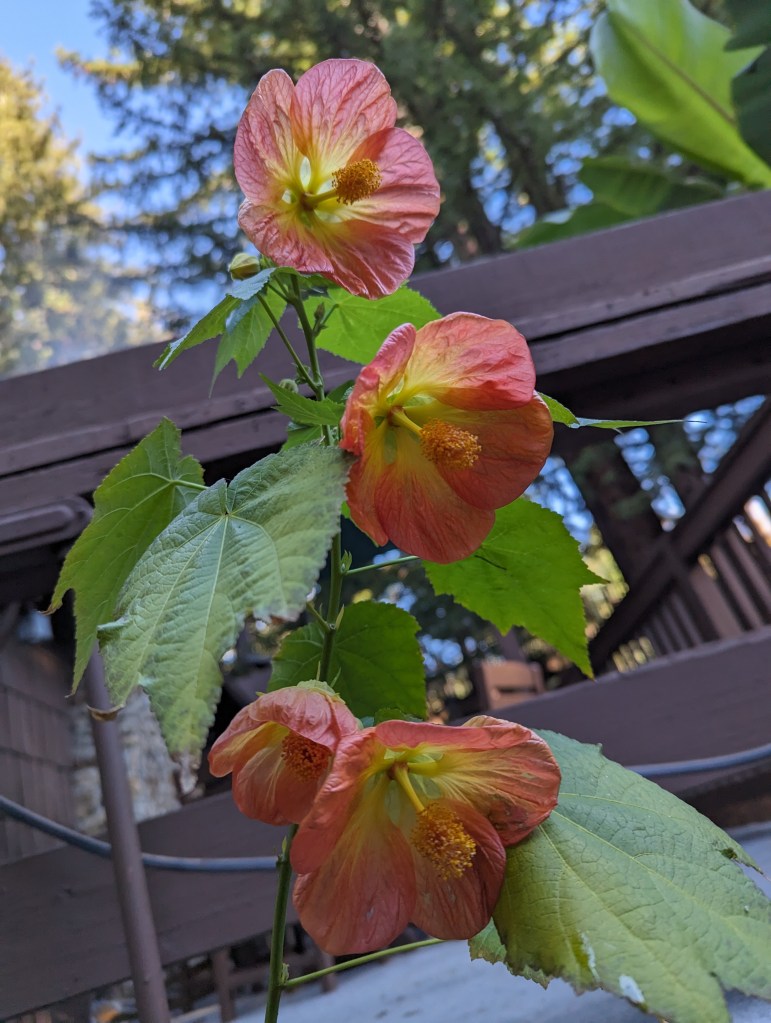
Abutilon X hybridum grows wild from seed within some of our landscapes. Although not prolific enough to be naturalized, dispersion of any viable seed seems odd for hybrids, since most hybrids are sterile. Of course, I do not know for certain if their ancestors were actually Abutilon X hybridum. They could have been other simple species of some sort. Besides, the name seems to apply to any cultivar of unknown parentage, including a few that are not actually hybrids.

Furthermore, even those that are generally sterile hybrids only needed to produce a single viable seed to start the process. Such a seed would likely grow into something that is more genetically stable, and therefore less sterile than its parents. Regardless of their supposed genetic stability, or because of their lack of it, their individual floral color is delightfully variable.

I am no more certain about the common name of this genus, species or group of hybris, which I know simply as flowering maple. Some know it as Chinese lantern. A few may know it as Indian mallow or parlor maple.

I am not so keen on the flowering maple, or whatever it is, for refined landscapes. However, the landscapes here are not so refined, and some are quite rustic. They benefit from the relaxed style, sporadic bloom, and open form of whatever this is.

Bloom is always sporadic, but is a bit more abundant during warm weather. Conversely, it can get scant while the weather is cool through winter. I am impressed by the few flowers that continue to bloom on this particular specimen. So are the hummingbirds. Bloom will likely become more scarce now that the first mild frost occurred last night. Also, foliage may get sparse until warmer weather next spring initiates regeneration to continue the seasonal cycle.

Frost

Before

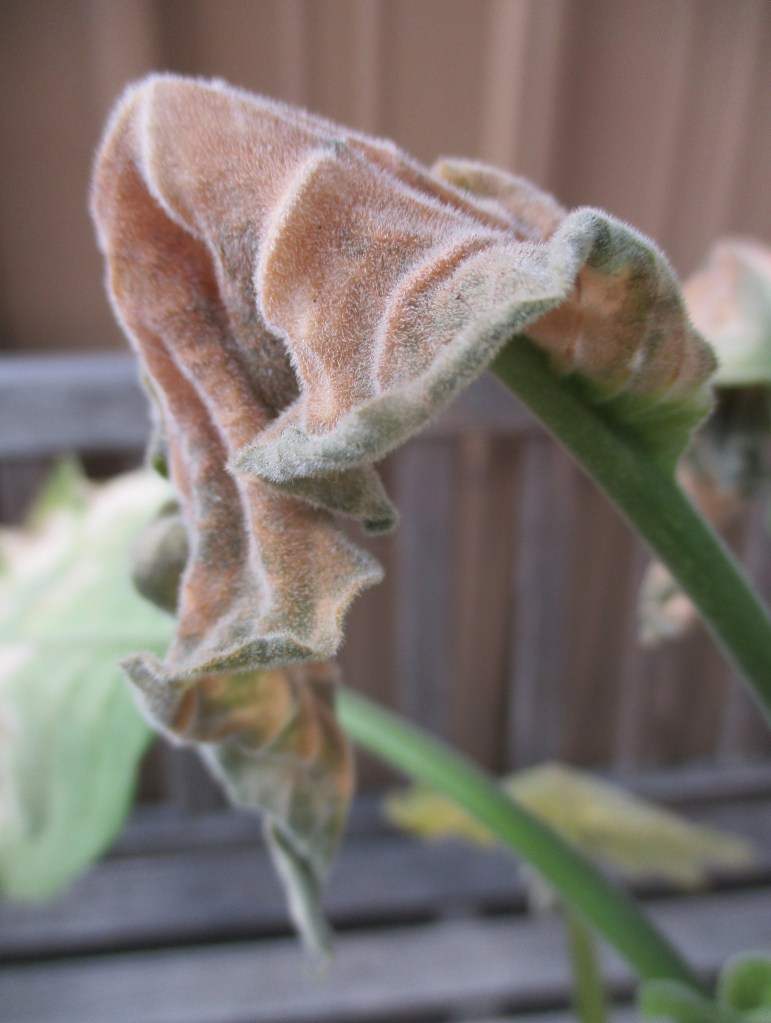
This elephant ear was happy and healthy as the sun set last night. As the sun rose this morning, it was sagging from frost damage. The picture that was taken prior to damage posted here (at my previous ‘Six on Saturday’ post) at midnight. Frost likely occurred shortly afterward. The picture that was taken after damage was taken only a few hours later.

Frost does not happen frequently enough to get much consideration here. When it does happen, it is not severe. This particular frost was only thirty- two degrees. Nonetheless, I should have sheltered the elephant ear. It would not have taken much effort to do so. I could have simply moved it over a few feet, so that it would have been under an eave. A few other species were likewise worthy of shelter. A few, though, should not even be grown here. The most practical means with which to avoid frost damage is to refrain from growing species that are vulnerable to it.

Fortunately, the elephant ear and all other species that were slightly damaged by frost early this morning should recover efficiently. Elephant ear typically loses its foliage through winter, and regenerates foliage for spring anyway. No more frost is predicted for the next week.

I am glad that I do not need to contend with the sort of frost that kills vulnerable species completely. The possibility of such weather would be much more limiting.

A pair of bougainvillea that I planted last autumn actually succumbed to frost last winter. Although bougainvillea commonly loses foliage and perhaps a few small stems to frost, basal stems should not have succumbed. I wanted to get them into their landscape during autumn, so that they could benefit from cool rain through winter, and be ready to grow in spring. Their replacements will get planted in spring.

After

Rainy Weather Begins With Autumn

Weather changes with the changing seasons.

Rain is at least as relevant as temperature is to the seasons here. Temperature does not change as much. The warmest of summer weather does not seem to be terribly hot. Low humidity helps. The coolest of winter weather is not too terribly cold. Some local climates lack frost. The difference between dry weather and rainy weather is much more obvious.

After all, rainy weather ends during spring, and does not resume until about now. Almost no rain occurs during the extensively arid summer season. This includes late spring and early autumn. Summer thundershowers are uncommon. Therefore, almost all rain occurs during winter. Some also occurs somewhat variably during late autumn and early spring.

This is quite normal for local chaparral climates. Comparatively to other climates, it might be both an advantage and a disadvantage. It is why most landscapes, particularly lawns, rely on irrigation. It is also why the growing season is so long here. This climate provides more pleasant weather to facilitate more gardening. It also necessitates more gardening.

Recent rainy weather is likely the beginning of the rainy season. If so, it is obviously also the end of the dry season. Transition from one season to the next is not on a very precise schedule, though. Dry weather could potentially resume for a while. Conversely, El Nino has potential to promote rainy weather. This winter could be even rainier than last winter!

Even if rainy weather does not resume for a while, irrigation requires seasonal reduction. This includes frequency and duration of automatic irrigation. Vegetation consumes much less moisture while dormant through winter. Less moisture evaporates from soil while the weather is cool. Rain may provide most of the garden with more moisture than it can use.

Unfortunately though, rain is also potentially messy. It makes soil muddy, and can cause erosion. It dislodges deteriorating deciduous foliage, especially in conjunction with wind. Colorful deciduous foliage is much less appealing on pavement or lawn than in its trees. Raking fallen leaves, and all other gardening, is less pleasurable during rainy weather of autumn.

a Tale of Two Jacarandas

Jacaranda seedlings from this year will be ready to grow next year.

Los Angeles is about three hundred and fifty miles to the southeast of Los Gatos. Relative to the number of different climates between here and there, the climates of the two specific locations are surprisingly similar. Nonetheless, they are not completely similar. Winter weather is somewhat milder within the Los Angeles region, with only minimal frost. Some coastal climates there lack frost. Also, spring weather there is a bit warmer than here.

Jacaranda mimosifolia perform spectacularly with such mild winter weather and warm spring weather. Without frost, or even with minimal frost, they can grow taller than thirty feet, and eventually grow broader than tall. After defoliating for the end of winter or beginning of spring, they bloom for late spring, immediately prior to refoliation. Their awesomely vivid blue bloom is almost as profuse as their subsequent foliage. No other tree of comparable size compares to their floral color or floral profusion. That is why jacaranda are so much more popular within the region of Los Angeles.

Here, occasional moderate frost inhibits comparable performance. Trees are generally smaller and more compact, with more globular form. Vigorous growth that develops after frost damage can be structurally deficient, but heavy with lush foliage. Bloom is more sporadic amongst such vigorously vegetative growth. Although very pretty by local standards, jacaranda is not quite as exquisite as it is within the region of Los Angeles.

Nonetheless, I am growing some. A colleague brought me a seed pod from which I extracted seed. Fortunately, only a few more than two dozens seedlings survived a late frost last winter. Otherwise, many more would eventually be in need of homes. A few will likely inhabit our landscapes. A neighbor wants a few. Any extra jacaranda trees can be shared with other neighbors, like so much other surplus.

Autumn Bloom Is Remarkably Natural

Some bloom adapts to regional climate.

Most flowers bloom during spring. That seems to be most practical. It maximizes the time for their seed to develop prior to the following winter. It conforms to the schedules of their naturally preferred pollinators. Bloom is less likely to succumb to weather through spring. Deviancy is natural though. Many functional flowers quite naturally prefer autumn bloom.

Deviancy, of course, is as complicated as it is natural. Autumn bloom occurs for a variety of reasons among a variety of species. Many can be delightful assets for home gardens. They provide more options for floral color than the most popular of cool season annuals. Some autumn bloom continues as autumn foliar color develops, and perhaps into winter.

Many flowers bloom randomly as warm weather allows them to do so. They may seem to bloom almost continually here. Cool weather may disrupt their bloom only during winter. As weather fluctuates, bloom might resume before a previously disrupted bloom finishes. African daisies provide autumn bloom because autumn is too mild to disrupt their bloom.

Technically, such flowers do not necessarily prefer to bloom during autumn. They merely bloom whenever they can. Most actually bloom most profusely during spring or summer. Canna produces summer and autumn bloom, as it regenerates from its winter dormancy. Otherwise, within frostless tropical climates, it blooms continuously. It is quite adaptable.

Some flowers that are actually more responsive to seasons simply prefer autumn bloom. Joe Pye weed and goldenrod grow only vegetatively through spring and earlier summer. They only begin to bloom about now. Perhaps their seed prefer to grow through cool and damp winter weather. Their seedlings may be vulnerable to desiccating summer warmth.

Naked lady is more extreme. It maintains dormancy through most of summer to bloom as summer ends. Then it grows through winter until spring warmth initiates dormancy again. It seems to believe that it still inhabits its native range within South Africa. Summer there is winter here. Actually, summer weather there is more severe than winter weather there.

Early Rain

This could be a sequel to ‘Late Summer’ from yesterday. It happened shortly afterward. It certainly adds another interesting component to this already odd year of weather. Although not impossible, rain at this time of year is rare. Almost all of the rain here occurs between late autumn and early spring.

Weirdly, if rain does occur during summer, it typically does so around the fifteenth of August. Seriously, it is very prompt about that schedule. It typically either begins or ends on that same date.

The first flash of lightning of the storm that started the CZU Fire occurred at 11:59 p.m. on the night of the fifteenth of August of 2020, less than a minute prior to midnight. So, although the storm occurred during the early morning of the sixteenth, it technically began on the night of the fifteenth.

This brief rain shower was minimal, but by local standards, it was surprising. I sort of wanted it to continue long enough to dampen and contain the dust of summer. It might have done so briefly, but could not prevent the dust from becoming dusty again shortly afterward. The aroma of damp asphalt dissipated even before that happened. It was fun while it lasted.

Perhaps this rain shower will be the last of this unusually autumnish weather. Warm and dry summery weather typically resumes immediately after brief rain showers that happen during the middle of August. Technically, for a summer rain shower, it is only half a month late. So far, the forecast does not suggest that pattern, but it has been wrong before, even here. I doubt that there will be any more rain prior to autumn, even if cool autumnish weather resumes until then. But of course, I have been wrong more often than weather forecasts.