Shasta Lake

Shasta Lake is a large reservoir on the Sacramento River. It contains water for flood control and to generate electricity. Some of the water within is used for agricultural irrigation and, to a relatively minor degree, to supply regional municipal water.

It is a very common misconception that the volume of water within Shasta Lake is necessarily relative to ‘drought’ conditions. Low water level is supposedly indicative of a ‘drought’. High water level is supposedly indicative of ‘normal’ weather conditions, including adequate precipitation. This same misconception seems to apply to all reservoirs in California.

Well, after the rainiest winter since 1982 and 1983, Shasta Lake is still not full. The level fluctuates, so might have been full earlier, or might be full later, but regardless, is not presently full. Water must be released prior to expected rainy weather, which can still occur during spring, in order to accommodate more water to control flooding. Less water may be released as drier weather is expected. Shasta Lake could therefore be fuller or completely full for summer, when almost no rain is expected. The presently observed water level does not indicate deficiency of water any more than a potentially higher water level during summer indicates surplus.

Most of California has a chaparral climate. Some of California has a desert climate. Such climates are naturally dry through summer. It is quite normal. It does not constitute a drought. A drought is an unusually dry weather pattern. It is not so normal.

Contrary to popular belief, California is NOT in perpetual drought. Although droughts occasionally happen, they are not annual events. Dry weather that occurs annually every summer is normal climate. If there is a deficiency of water here, it is because there are nearly forty million people relying on a limited supply of water.

Winter Weather Lingers Into Spring

Late wintry weather delays early bloom.

Winter was epic! Snow was more abundant than since 1976. Rain was more continuous than since 1982. Frost was colder than since 1990. All of this happened within this same winter! Californians generally appreciate rain and snow, and tolerate typically minor chill. Chaparral and desert climates here rarely get much. However, this weather is excessive!

Furthermore, such excessively cold or wet weather was unconducive to gardening. Most of us wanted to stay inside. Home gardens consequently endured neglect in conjunction with extreme weather. Regardless of the current weather conditions, winter is technically done. Now that it is spring, gardens should begin their systematic processes of recovery.

This may entail more effort for those who enjoy gardening than for the associated plants. Most plants are resilient to harsher winter weather than they endured here recently. That is how they survive other less temperate climates. Some may respond favorably to more thorough than typical grooming. Some might prefer later grooming while they regenerate.

Chill can actually enhance performance of some plants that prefer cooler winter weather. For example, some cultivars of apple are barely satisfied with the more typical local chill. They may perform better this year, after a cooler chill. Flowering cherry, purple leaf plum, lilac, wisteria, and many others may do the same. Stone fruits might be more productive.

Several plants do succumb to frost though. Some that typically die back but then recover may not recover this year. For some, the unusually cold frost was lethal. Others rotted as a result of lingering cool dampness. Kaffir lily that is blooming well now may succumb to rot later. Canna that grew early only to succumb to later frost should recover well though.

Some plants that endured frost and saturation last winter might delay their spring bloom. Roses could bloom better but also later, both as a result of cooler than typical chill. Some early spring bulbs that bloomed when they should suffered for it. Rain and wind knocked them into the mud. Later bulbs might avoid a similar fate by delaying their bloom slightly. Fewer conform to a comparably strict schedule.

Six on Saturday: No EMail

Modern technology annoys me. Firstly, the electronics industries are what destroyed the idyllic culture of the Santa Clara Valley. Secondly, it complicates things. If I try to rely on it as the rest of society does, it does not function. It is a long story, so to be brief, I could not download pictures that I sent from the telephone. These six are random, but became available

1. Monstera deliciosa, Swiss cheese plant is in Brent’s garden, four hundred miles away. He wanted to get it into the Canyon News, but sent me this uselessly shabby image of it.

2. Billbergia nutans, queen’s tears was blooming well enough for ‘Six on Saturday’ three weeks ago and is blooming a bit more now. Perhaps I should have taken a better picture.

3. Olea europaea ‘Arbequina’, olive trees were gifts for participants at a conference here. This is one of several surplus that we acquired. It is a little but exemplary rooted cutting.

4. Viola tricolor, Johnny jump up demonstrates that some plants that enjoy more wintry weather than they typically experience here perform well after the atypically wild winter.

5. Tulipa X gesneriana, tulip is not reliably perennial here. I therefore would not bother to grow it. This one came with my iris from the old garden, and got planted only because I could not bear to discard it while it was still alive. It somehow survived and bloomed! As if that were not impressive enough, It bloomed again this year! I will take better care of it now, and I hope that it establishes. I have no idea what it is, or where it came from.

6. Crazy weather finally relinquished spring to more appropriate weather this last week. This was the last hail. I can not remember so much incessant rain within a single season.

This is the link for Six on Saturday, for anyone else who would like to participate: https://thepropagatorblog.wordpress.com/2017/09/18/six-on-saturday-a-participant-guide/

Six on Saturday: Snow, Rain, Wind, Frost, Etcetera

Etcetera is the important part here We must adhere to a schedule. As mentioned earlier, this winter generated the only snow for most regions here since 1976, and more flooding since 1982. By local standards, this winter was severe. It seemed to continue longer than it should have, as if to delay spring and the chores that come with it. I managed to prune a disfigured lemon tree, perhaps more than I wanted to, but effectively so. It was a good reminder of what time of year this really is. The weather is presently pleasant. More rain is expected for tomorrow, Tuesday and Wednesday. However, it is not expected to be as torrential as it had been. No more frost is expected.

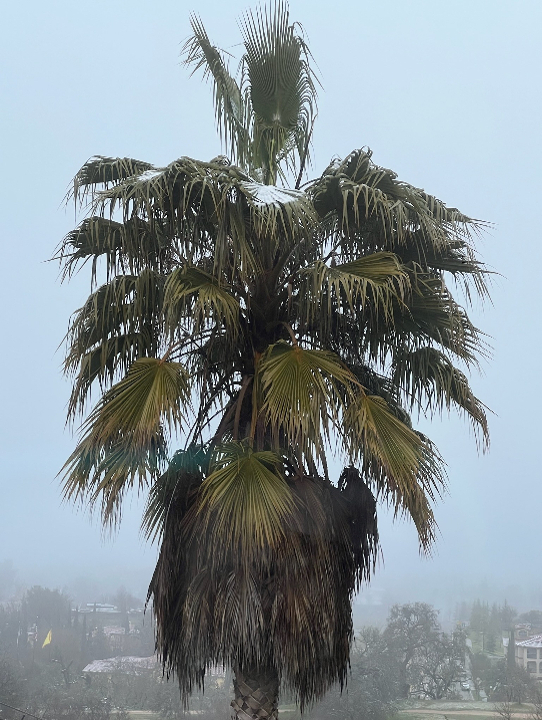
1. Snow looks silly on top of a Mexican fan palm, Washingtonia robusta. This was weeks ago and hundreds of miles to the south, but is amusing nonetheless. Brent sent it to me.

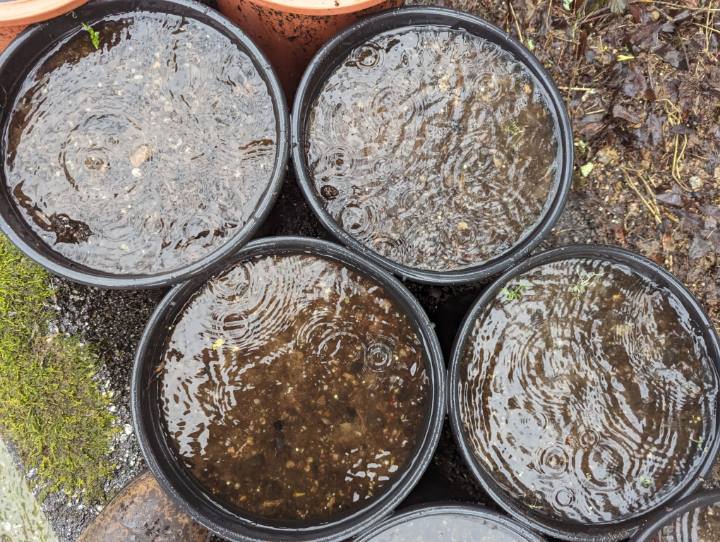
2. Rain fell faster than it could drain through the recently canned Canna. Their drainage holes are likely in the middle of the bottoms of these cans, rather than around the edges.

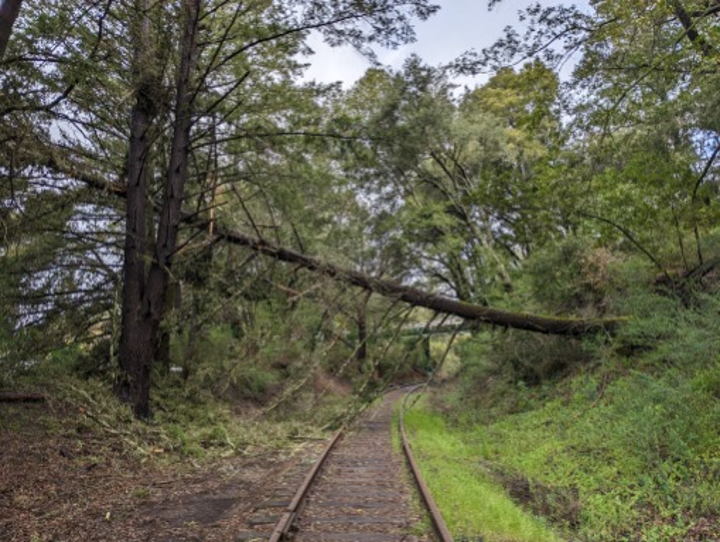
3. Wind blew limbs and trees down all over. Then, after it stopped blowing, this Douglas fir, Pseudotsuga menziesii, fell across the Roaring Camp Railroad behind the barn here.

4. Frost should be done for the year. So, I pruned the structurally compromised Eureka lemon, Citrus limon ‘Eureka’, and processed a few of the scraps into ungrafted cuttings.

5. Lemons were another byproduct of pruning. Most are not yet completely ripe though. Several ripe lemons are always available, but the primary phase should ripen about now.

6. Rhody has been a good sport through all the unusually wintry weather this winter. He is pleased to get outside more now. We got a similar but cuter picture for next Saturday.

This is the link for Six on Saturday, for anyone else who would like to participate: https://thepropagatorblog.wordpress.com/2017/09/18/six-on-saturday-a-participant-guide/

Rain Can Ruin Bloom And Developing Fruit

Bloom is not really early. Frost and unusually torrential rain just happen to be late.

Again this year, the excellent weather that makes gardening so much fun even through winter has the potential to become a problem. Winters are innately mild here, and like this year, are sometimes mild and warm enough to prompt many plants to bloom much too early. Many of the fruit trees and their ‘flowering’ (non-fruiting) counterparts are already finishing bloom as if it is the middle of spring, even though the equinox is about two weeks away. This should not be a problem for the flowering cherries, plums, pears and apples (flowering crabapples), but is risky for the many trees that should produce fruit.

The problem is that, despite the weather, it really is winter and early spring, so could potentially rain while fruit trees are blooming. The rain can batter the blooms, or cause them to rot before they set fruit, compromising or even eliminating the fruit production for the following summer. Trees that are not blooming, or just barely showing ‘color’ of the first few blossoms, should be safe. Also, the trees that bloomed earliest and have already set fruit should likewise be safe, as long as the weather does not stay rainy too long, which it almost never does here. Trees that are in full bloom when it rains are the most sensitive to damage.

It is impractical to cover mature trees with plastic sheeting to protect them from rain. Even if it is possible to get the sheeting over the trees, it knocks much of the bloom or developing fruit off anyway. Also, if the sheeting is not removed when the rain stops, it can trap humidity, which can rot the blooms that were so carefully protected from the rain. (Although, high trees hold the plastic high enough from the ground to allow for good air circulation.)

Small trees are easier to cover, but do not produce enough fruit to worry about. In other words, it would be easier to buy fruit at a market, or to get it from friends and neighbors with different varieties (that bloom at different times) than to put too much effort into protecting trees from the rain. In most situations, it is best to just accept that fruit trees will sometimes have ‘off’ years when they either do not produce, or produce only minimal quantities of fruit. The good news is that trees that lose some but not all of their fruit often produce best.

Plum bloom is not resilient to late frost or rain.

Six on Saturday: SNOW?!

Snow is extremely rare here. It falls every few years in my neighborhood, which is about 1,500 feet above sea level, but this is nearly nine hundred feet lower. For the Santa Clara Valley, just over the Santa Cruz Mountains, it has not snowed since 1976. A forecast that included a possibility of snow was quite a surprise. Actual snow early Thursday morning was more of a surprise. It resumed overnight and into Friday morning with thunder and lightning. Of course, almost all of it melted, so that it was no more than two inches deep. I can understand why those who contend with it regularly during winter dislike it. Yuck! Rhody stayed inside all day.

1. Clivia miniata, Kaffir lily is the most recent and shameless acquisition from Craigslist. Someone in Santa Clara wanted them thinned, so I got a trunkload, totally without guilt.

2. Clivia miniata, Kaffir lily really was justified! More than two dozen split and groomed shoots are a bit more than enough and very appropriate for this shaded and narrow bed.

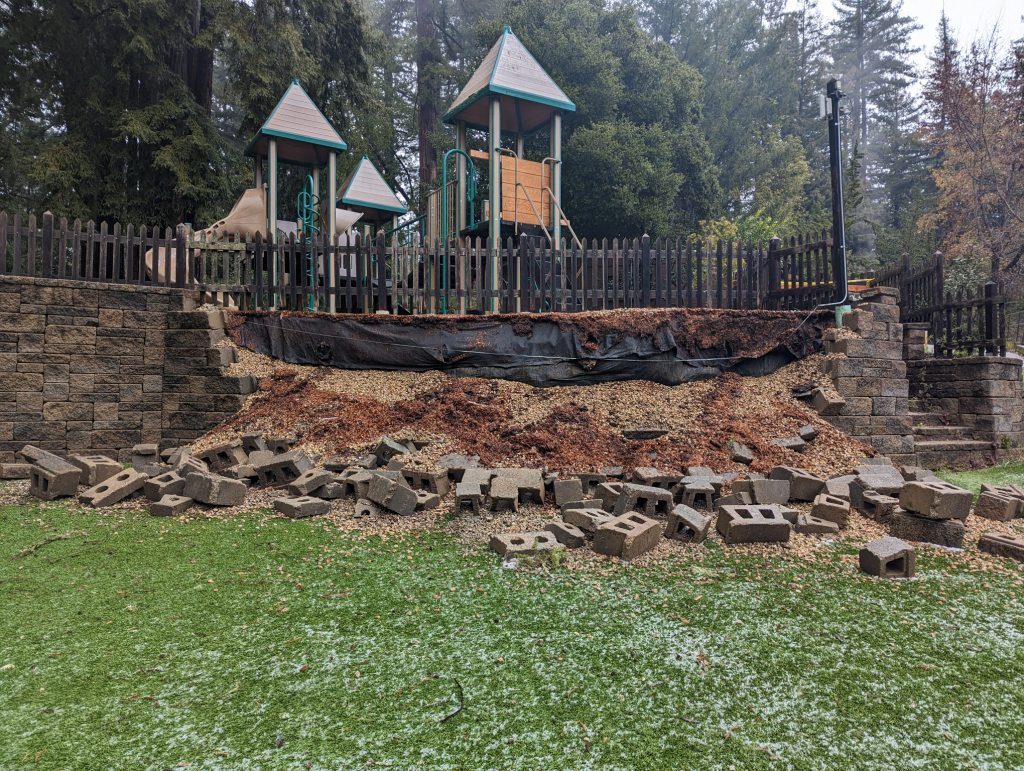
3. Jericho was not the inspiration for this landscape. It merely succumbed to all the rain. The upper few courses of stone got hastily but futilely removed as the wall began to lean.

4. Digitalis purpurea, foxglove does not do much now, and is merely incidentally to this strange picture anyway. Snow from Thursday and Friday is the major development here.

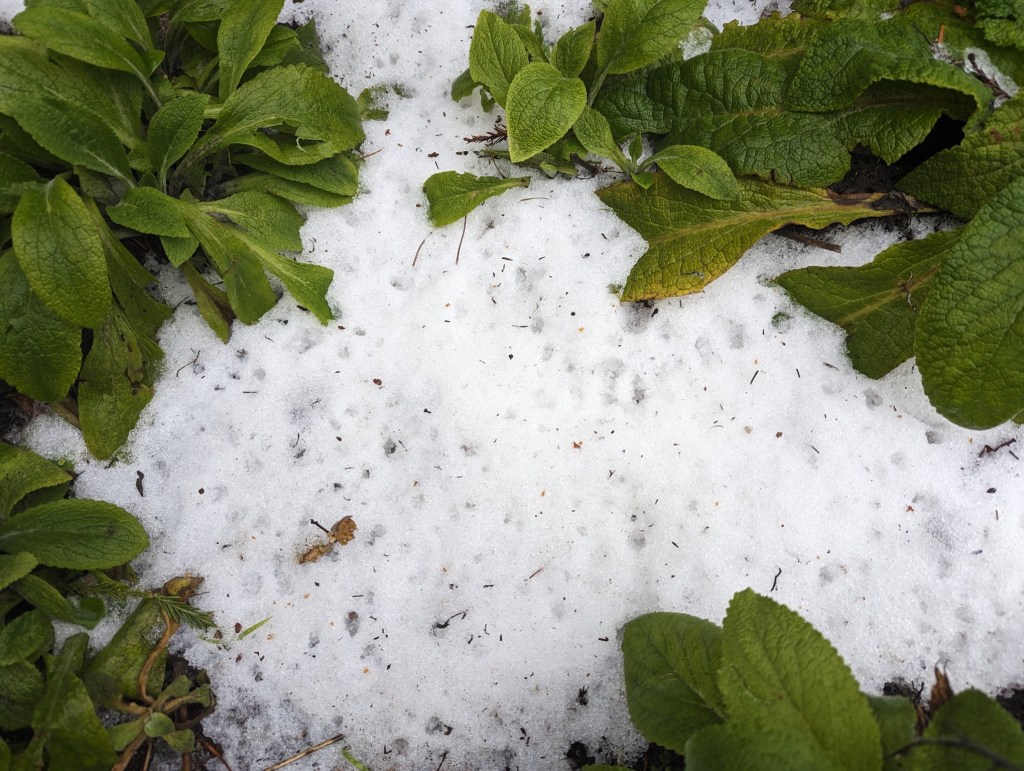
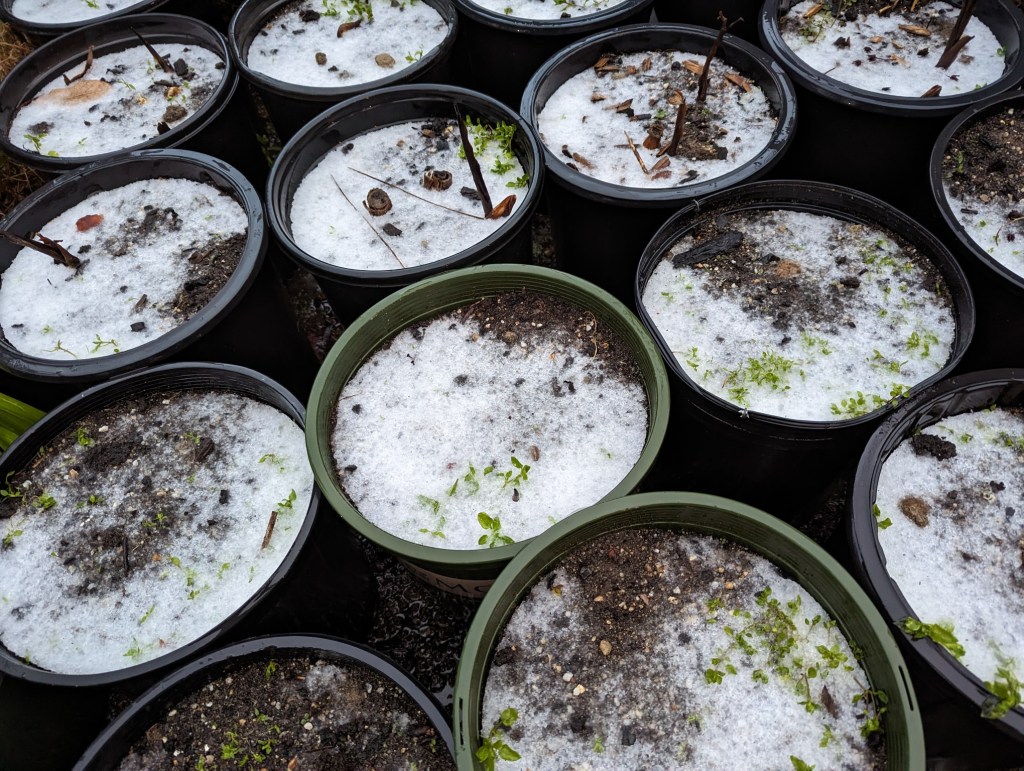
5. Canna is likewise incidental to this picture of what seems to be snow, but may merely be hail, which remained after the snow mostly melted. Canna are still dormant anyway.

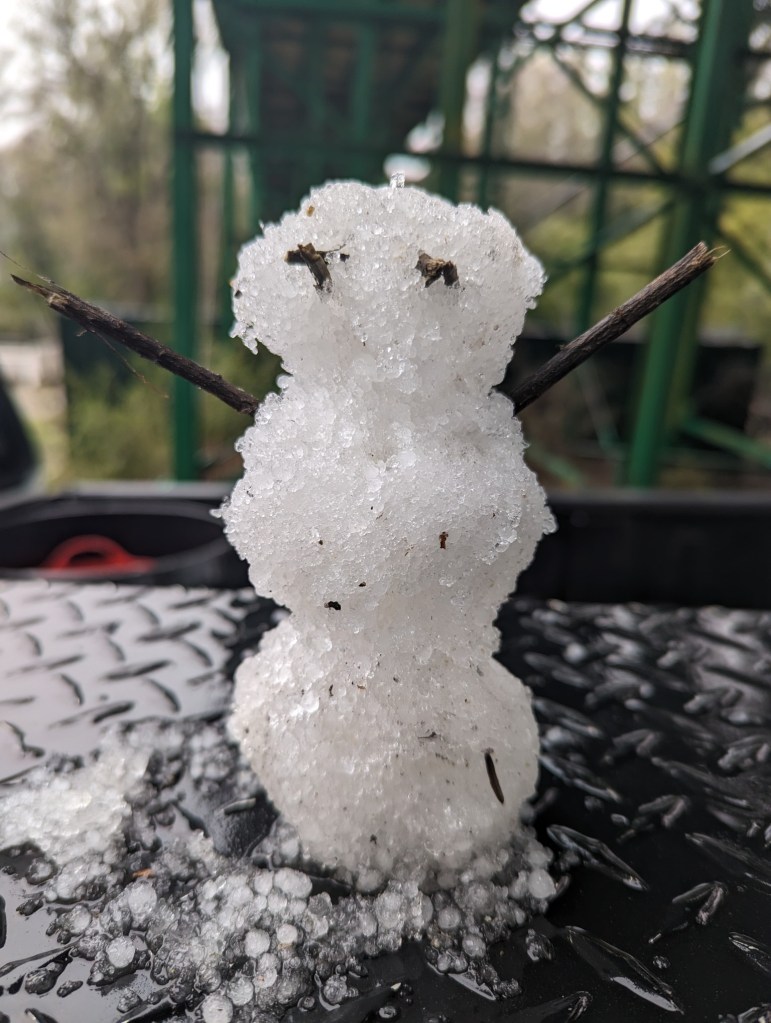
6. Snowman of three handfuls of slush and sticks is here just so that I can brag about the snow here. However, I find that snow is cold, wet and icky. I can see why it is unpopular.

This is the link for Six on Saturday, for anyone else who would like to participate: https://thepropagatorblog.wordpress.com/2017/09/18/six-on-saturday-a-participant-guide/

Houseplants Naturally Live Outside Somewhere.

Kalanchoe is a popular houseplant here, but grows wild in Madagascar.

The plants grown as houseplants may have serious disadvantages that prevent them from being happy in the garden, but have other advantages that help them survive indoors. They tolerate the lack of direct sunlight, the lack of humidity, the minimal fluctuations of temperature and the confinement to pots that they must endure for a domestic lifestyle. Their main difficulty in the garden is most are from tropical climates, so can not tolerate cold winter weather.

However, even happy houseplants like to get out once in a while. Even though most can not survive the coldest winter weather, the mildest winter weather is actually the best for them to get supervised outings. During clear and warm summer weather, sunlight can easily roast foliage.

Houseplants with glossy tropical foliage occasionally like to be rinsed of dust and whatever residue that they accumulate in the home. (African violets and plants with fuzzy leaves do not want water of their foliage!) Foliage can be rinsed in a shower or with a hose, but are more gently rinsed by very light drizzly rain.

Timing is important. Unusually cold or heavy rain should be avoided. Plants should be brought in before the sun comes out. It is probably best to not leave plants out overnight when it gets colder and they are not likely to be monitored. While the plants are outside, mineral deposits can be scrubbed from the bases of the pots.

The rain needs to fall this time of year anyway, so it may as well go to good use in as many practical ways as possible. It may be a while before it flows into the aquifer and gets pumped out to come back later for use around the home and garden.

So much of the water that gets used around the home has the potential to be used again. With modifications to plumbing and the sorts of soaps and detergents used around the home, used water, politely known as ‘greywater’, can be redirected, collected and distributed to the garden. Water may not be so important in the garden this time of year, but a Greywater Workshop happens to be coming up next week; and advance registration is required.

The Guadalupe River Park Conservancy’s Adult Greywater Workshop (for ages eighteen and up), ‘Greywater Basics: Reusing Household Water in your Landscape’, will be from 9:00 a.m. to noon on February 18th. The Workshop will be at the Guadalupe River Park and Gardens Visitor and Education Center at 438 Coleman Avenue in San Jose. Admission is $15, or $10 for members. More information is available, and reservations can be made, at www.grpg.org  or by telephoning 298 7657.

Six on Saturday: After The Storm

Rain is expected for today and Sunday. It rained a bit yesterday morning. This is normal for winter here. It will not prevent us from resuming seasonal work that was interrupted by the not so normal and epically torrential rain and associated flooding earlier. A bit of the mess associated with that earlier extreme weather remains, but is not so much of an encumbrance. Spring flowers such as daffodil have been blooming for a while. Flowering cherry buds are plumpening. One flowering cherry and the only flowering apricot are in full bloom. Meanwhile, other crews work to keep the power on.

1. Debris of all sorts remains on the banks of Zayante Creek downstairs. This might be a futon. I hope that it came from an exterior patio, and not from within a home upstream.

2. Zayante Creek is right where it should be now. It was slightly above the arch just prior to midnight of New Year’s Eve. The crew’s galley is inside the windows to the upper left.

3. After all that torrential rain, another crew came to prune trees for clearance from new utility cables. The work was not bad, but they could not remove this log from the cables.

4. After the crew finished pruning a particularly large coast live oak that survived all that torrential rain, the big oak fell. Yes, it fell AFTER the storms, and AFTER it was pruned.

5. As if that were not bad enough, it left this big limb hung precariously on the new cable that they installed immediately prior to the rain! It is heavy and hooked by a small stub.

6. Landon’s Tree blooms as if none of this drama ever happened. It is a flowering apricot that grew from the understock of a purple leaf plum that was cut down several years ago.

This is the link for Six on Saturday, for anyone else who would like to participate: https://thepropagatorblog.wordpress.com/2017/09/18/six-on-saturday-a-participant-guide/

RAIN!

Rain is naturally and innately . . . wet.

(February 12, 2012)

More than a week ago, many of us were astonished to witness countless drops of water miraculously falling out of the sky! What could this be? Where did this water come from? It is actually not such a mystery. These unfamiliar falling drops of water are merely a type of weather known as “rain”. “Rain” is actually nothing new, and happens every winter. Typically, there should have been an abundance of “rain” by this late in winter.

The problem with “rain” is that it is wet. Whatever it encounters also becomes wet, and often messy. Wet dirt becomes mud. Wet roads are hazardous to traffic. It is uncomfortable to go outside to do any gardening when everything is wet and muddy.

However, “rain” is very important to everyone’s survival. It is what moves water from the oceans back onto land, so that it can be collected and used for the many things that water is needed for. “Rain” also brings needed water to gardens, landscapes, and even the forests outside of urban areas. In one way or another, every living thing needs “rain”.

But wait! There’s more! “Rain” so efficiently waters gardens and landscapes that no other watering is needed! Most watering systems should therefore be turned off as long as there is enough “rain” to keep everything wet. Even when the “rain” stops, cooler temperatures and higher humidity keep things from drying as efficiently as they would during warm summer weather. Consequently, most watering systems can remain off until after winter, when the “rain” stops until next winter, and the weather gets warmer.

Actually, the only plants that may want water are those that are sheltered from the “rain”, and perhaps a few large potted evergreen plants that continue to lose enough moisture by evaporation from their foliage to get a bit dry between periods of “rain”. Even these sheltered and potted evergreen plants use less moisture this time of year because they are less active, and evaporation from their foliage is limited by the weather.

Remember; for plenty of moisture that is one hundred percent natural and absolutely free, try “RAIN”!

If A Tree Falls In A Forest . . .

If a tree falls in a forest of the tallest species of tree in the World, things might get messy. Understory trees often fall without much commotion, but the demise of this particular redwood was observed from all over the neighborhood. The forest that it inhabited is too crowded for good pictures of where it landed. I got what I could. Falling trees is one of the unpleasant and hazardous results of the recent epically abundant rain.

About twenty feet of trail dislodged with the massive root system that nearly inverted as it fell into the canyon below. The gap was less than fifteen feet long on the left and uphill side of the trail when this picture was taken, but widened as more soil collapsed into the muddy void below. Obviously, the trail is now closed. Repair is not a priority until after winter at the soonest.

The dislodged root system is about thirty feet wide. I did not estimate how far into the canyon it slid. Since I can not see the base of the trunk, I did not estimate how wide it is. The trunk extends diagonally to the right, where it is obscured by vegetation in the foreground. It broke many other trees as it fell, leaving the shattered trunks and limbs that are visible to the upper right and left. Some of the debris near the water was deposited by earlier flooding.

The trunk fell upstream into a curve in Bean Creek below, so almost crossed the creek twice. From this distance, it is difficult to estimate the width of the trunk. Because the top is not visible, it is impossible to estimate the height. If it did not burn up in the atmosphere, someone in Nevada might have received an unexpected delivery of lumber.