Six on Saturday: Occupational Hazards

Work is too much fun! It was supposed to be temporary work until I returned to work in a few months, but that was a few years ago. Well, that is another story. Work can be very frustrating at times also though. Unlike the farm, where only a few of us work on many acres, many very different people work on less acreage here. We all have very distinct priorities.

1. Training this grapevine like this was a lot of work. It extends from a rail fence on top of the retaining wall at the lower left, to the bottom of the upstairs banister at the upper right. This is my second attempt after someone who works in the building to the upper right cut it off the banister as if it was not obvious that someone meticulously trained it.

2. Now, decorations for the summer involve fake ivy stapled to half century old wooden pillars. This is near both the grapevine and walls that we needed to remove real ivy from.

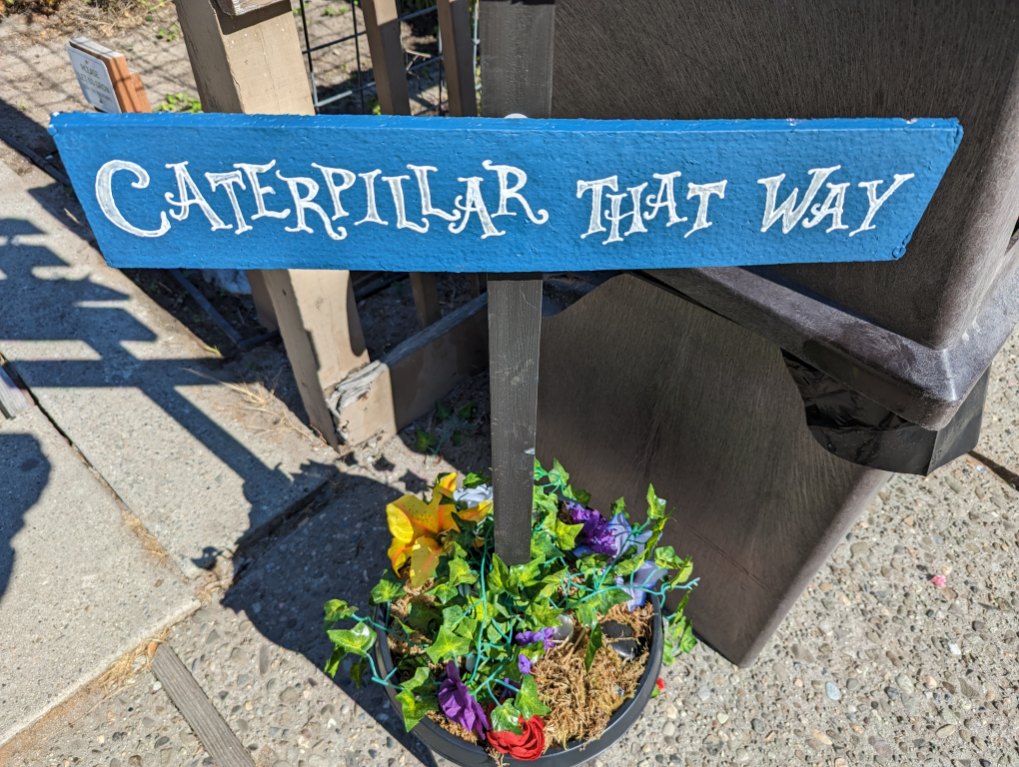
3. Is this some sort of insect repellent? Which way is ‘that’? Are fake flowers effective?
4. Ficus microcarpa ‘Nitida’ makes a great hedge. This is a picture of a picture of such a hedge, sideways, on a wall. Up is right. Down is left. It is effective but needs no shearing.

5. This is all sorts of wrong! The small sign to the lower right has never been so relevant. Someone who was hired for weed whacking whacked all the Canna here, as well as a few Clematis to the right. Weeds are now growing faster than the Canna. To compensate for the lack of bloom, fake roses were installed. It gets weirder. The fake roses glow at night.

6. Chorisia speciosa nearby seems like it really should be the worst occupational hazard.

This is the link for Six on Saturday, for anyone else who would like to participate: https://thepropagatorblog.wordpress.com/2017/09/18/six-on-saturday-a-participant-guide/
While You Were Out

P00516K
It’s a jungle out there!

Our work is the sort that could potentially continue as essential. Distancing is not a problem for us, since we generally work individually, and there are no guests here. However, work needed to be discontinued due to lack of revenue. A conference center can not generate revenue without big groups of guests. Even when groups can return, many potential guests can not afford to.

The chronology of this situation should have been documented more efficiently. We had been unable to work here for several weeks. I do not remember how long it had been. Work resumed two weeks ago, and can continue for six more weeks, for a total to two months. We will start no new projects during this time, but will primarily try to catch up on what was neglected earlier.

Salvage and preparation for resumption of neglect are presently the priorities. This entails vegetation management after weeds had been left to grow wild during their most active season. It is extreme. Most weeds either had dispersed their seed, or did so as they got removed. This is not much of a problem for areas that are not landscaped, but will be trouble within landscapes.

Weeds in areas that are not landscaped get cut down by weed whackers, and mostly left where they fall. Roots that remain within the soil, and debris dispersed over the surface, should limit dustiness later in the summer. Weeds in landscaped areas and where weed whackers can not get into must be pulled. We do not want young desirable plants to be ruined by weed whackers.

It is discouraging that no one is here to enjoy the landscapes that we put so much effort into while we can work. It is also discouraging to see how easily the landscapes can fall into disrepair.

Unplanned Green Roof

p90106The last green roof that I wrote about was planned, although not in a typical manner. https://tonytomeo.com/2017/11/25/green-roof/ It is still my favorite green roof. Otherwise, I am none too keen on the fad. Very few buildings benefit from green roofs, and green roofs really do take more work than conventional landscapes in the ground.

The sort of green roof pictured here was most certainly not planned. It could have been the result of a an uncleaned gutter. All sorts of weeds can grow in the damp debris that can wash off of roofs, particularly in damp and foggy coastal climates where moisture so often drips from the edges of roofs. This gutter is just a short distance from the beach in Santa Cruz. The willows in the San Lorenzo River are next door.

Knowing what I know about this particular type of willow, I would guess that the cleanliness of the gutter, or lack thereof, was not really the problem. These aggressive willows can germinate in the slightest bit of debris, even under a single leaf that did not get rinsed or blown away fast enough. Once germinated, their finely textured roots are experts at clinging to anything that might otherwise get rinsed away. If there is not enough debris and dirt for them to grow in, they simply collect their own. Now that it has started the process, it will continue to collect debris and expand its root system until it gets removed or ruins the gutter. It seems to have already collected enough debris to share with a few grassy weeds nearby. It is mostly dormant now, and might have defoliated in the rain since this pictures was taken a few days ago. However, if it stays, it will resume aggressive growth as winter ends.

Weeds Have Been Very Busy

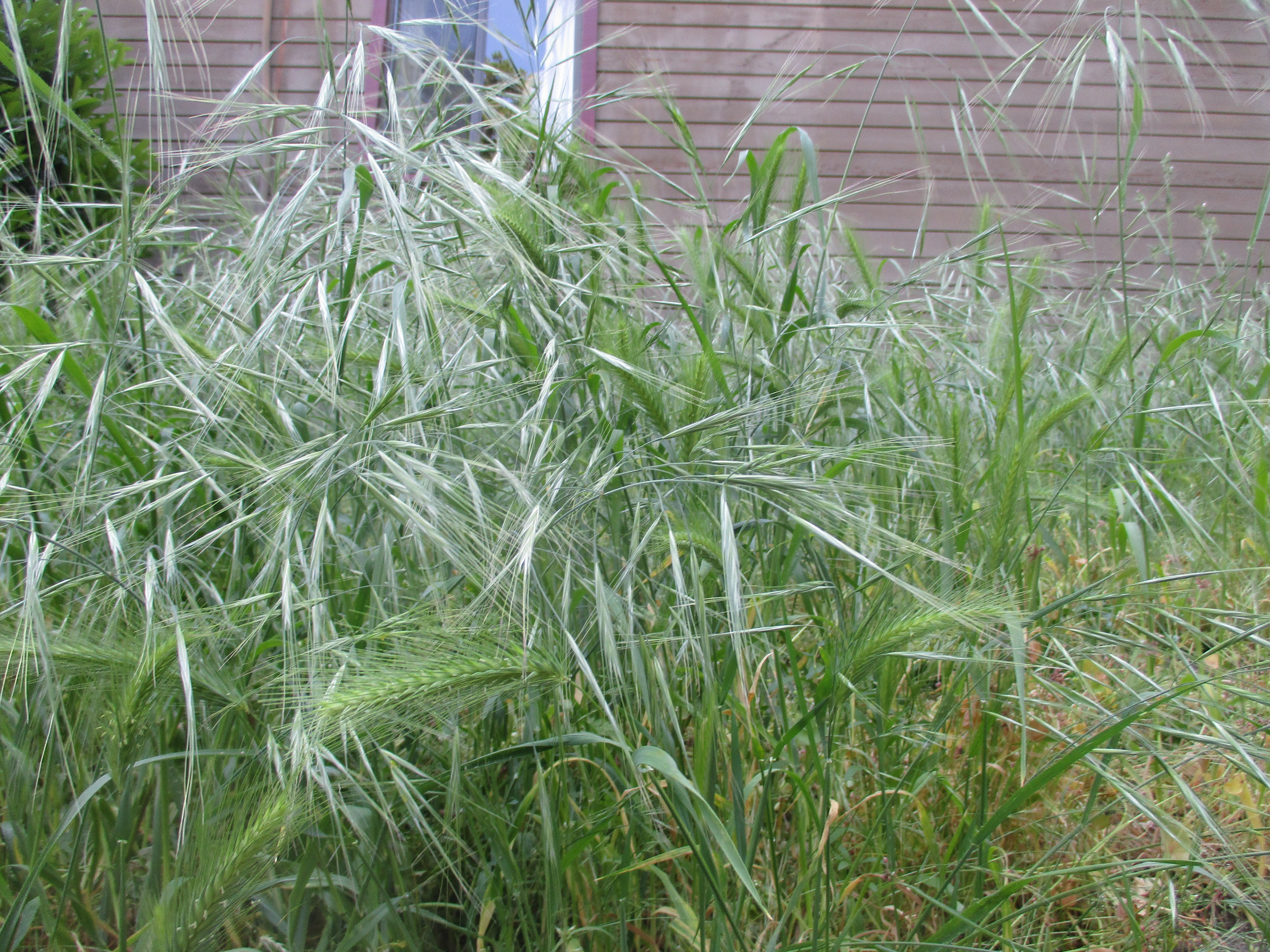
60323They are weeds for a reason. They grow like . . . well, weeds! By definition, they are unwanted. Yet, they typically proliferate and grow faster than desirable plants. They aggressively compete for space, sunlight and resources. Many weeds start to grow through winter, and get established while other seedlings are just beginning to germinate, or other plants are just waking from dormancy.

Besides staying ahead of other plants, weeds stay ahead of us by growing so much while the wintry weather keeps us inside. Many weeds are really just trying to stay ahead of insects or animals that eat them in the wild. Since almost all weeds are exotic (nonnative) and far from their natural homes, the insects or animals that should eat them are not here to do so. It is an unfair advantage.

Now that the weather is more conducive to gardening, weeds should be pulled as soon as they are big enough to get a grip on. This includes tree, shrub and big perennial weeds like blue gum eucalyptus, Acacia dealbata, coast live oak, glossy privet and giant reed. If simply cut down, they will regenerate even stronger, and will probably need to be dug out. The roots are difficult to kill.

Annual weeds are very different. They will die by next winter without any help. Some will die when they dry out over summer. However, they should be pulled anyway, before they bloom and sow their seed. If the weeds are too abundant to exterminate, they should at least be cut down before their seed develops. In some situations, the mown or cut weeds might be preferable to bare soil.

Burrclover, bindweed and purslane stay so low to the ground that mowing or cutting weeds does not slow them down much. They must unfortunately be pulled, which is a serious chore in large areas! Dandelion and foxtail can get mown once, but they have a sneaky way of coming back lower to avoid losing seed the next time. Dandelion can actually come back next year as a perennial.

Bermudagrass and crabgrass are low growing perennial grasses that spread vegetatively (with their stems), even if deprived of their seed. They are very tough! Spurge and oxalis seem like they should be wimpy, but they sow seed so profusely and so early that, by the time they get noticed, their next generations are already started. Oxalis survives winter with perennials stems and bulbs.60323thumb