 It is pretty but pervasive. Actually, I do not really find scarlet pimpernel to be all that appealing, but this is how someone who reads my gardening column in the Santa Ynes Valley News describes it. Embarrassingly, she requested that I discuss scarlet pimpernel while it was more of a problem back on June 7, but I only recently read the message. By now, it is already dying back for autumn, and is completely deteriorated in dry and hot exposed areas. It will be back next spring, and will bloom with tiny peachy orange flowers so that it can throw tiny but ridiculously abundant seed by summer before anyone notices. Flowers can be other colors in other regions. The sprawling stems can spread more than a foot wide, and can get up to about ten inches high if sprawling over other weeds. The tiny and soft leaves are arranged in opposing pairs. Scarlet pimpernel may not seem like much of a threat now that it is deteriorating, but new seedlings will be profuse early next spring, and can compete with seedlings of more desirable plants.
Control of scarlet pimpernel is not easy. If application of herbicide is an option, it does not stick to the foliage of scarlet pimpernel very well, even with a wetting agent. Hoeing eliminated larger plants, but does not kill the seed that the larger plants have already tossed. Scarlet pimpernel starts throwing seed so early that it must be pulled as soon as it appears in very early spring. Like I said, it is not easy. The small plants are not even easy to see. The process must be repeated at least weekly for a while, just because some seedlings will emerge after the first batch is gone.
Fortunately, scarlet pimpernel is not very vigorous. If it comes up through mulch, only a few plants will survive, and they will be easy to pull. They do not compete with other more vigorous plants well either. Many simple ground covers will simply shade it out, although it can mingle with and ruin some of the finely textured ground covers like baby tears and thyme.
I am sorry that I do not have any more information about scarlet pimpernel than is commonly known. I am speaking primarily from experience, and my experience has not been as bad as with other more aggressive weeds. Scarlet pimpernel always seems to be around, but is not so much of a problem that I am too worried about annihilating it completely.
Corndog Orchard
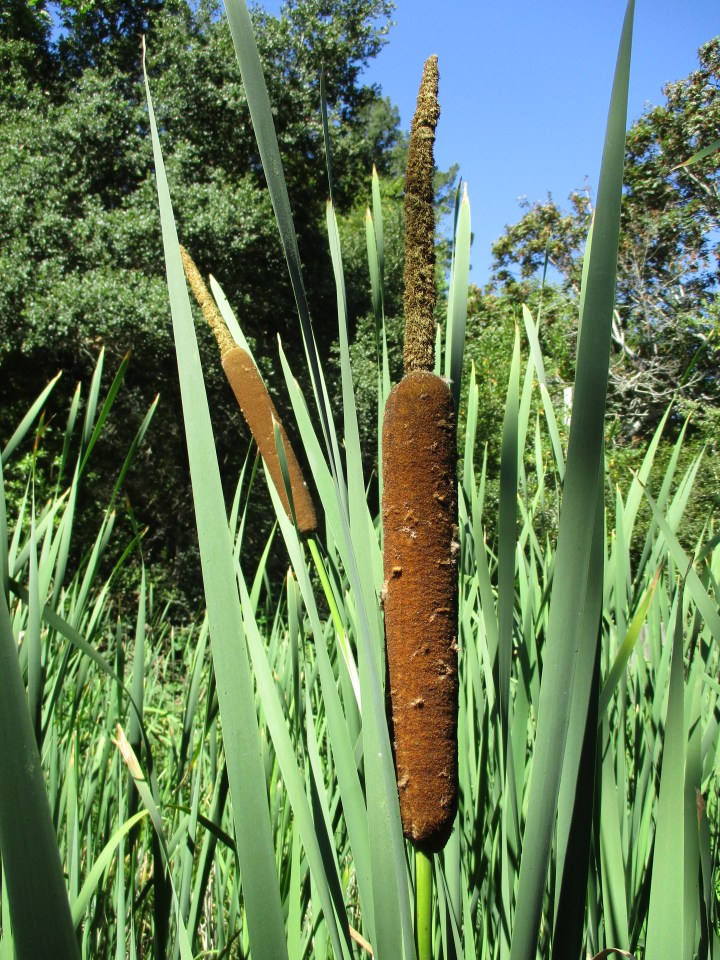 Urban sprawl replaced the formerly vast orchards of the Santa Clara Valley a long time ago. Nowadays, it is difficult to imagine that they were ever here. Apricots, prunes, cherries, almonds, walnuts and all that the region was once famous for are all now rare commodities.
Only a few minor corndog orchards remain. They survive only because they are not actual orchards that are grown on land that is useful for something else, but instead grow wild on otherwise useless marshland and along the few creeks that flow through the region. Some marshland that could not be converted into usable space was developed into parks, and within many such parks, the remaining marshlands are protected as native habitat.
Vasona Lake County Park and the small Vasona Lake within were once a large marshy area that sustained what was probably the biggest corndog orchard within the Santa Clara Valley. It is at the transition where the Los Gatos Creek flows swiftly from the slopes of the Santa Cruz Mountains, and then slows as it reaches its flat alluvial plain within the Santa Clara Valley. Although not nearly as abundant as they were prior to development, corndogs still inhabit the banks of Los Gatos Creek and Vasona Lake. We know them as cattails.
Because they are a native species that had historically been more common locally than anywhere else nearby, and because of their common name that is coincidentally associated with cats, cattails had been nominated to be the official Town Flower of Los Gatos (which is Spanish for The Cats). There are not many natives that would be as appropriate, and the only comparably culturally significant flowers would be those of the old fruit orchards, such as apricot blossoms. No other flower is both native and so culturally significant.
Weed Seeds Can Hurt Pets
 Plants are quite ingenious with their technology of exploitation of animals and people. Many get insects, birds, bats, spiders and anyone who is animated within their environment to disperse the plants’ pollen for them. Plants who prefer to not rely on wind, water or gravity to disperse their seed exploit a different range of animals to do so. They know how to compensate for their immobility.
This sort of exploitation is generally not as bad as it sounds. Many pollinators are rewarded for their service with nectar or surplus pollen. Dispersion of many types of seed is likewise rewarded with the fruit that surrounds the seed. Many types of nuts produce significant surpluses of seed to reward squirrels for burying them, and leaving just a few to germinate and grow into new plants.
However, there are many types of seed that are not so gracious, and several that are potentially dangerous because of the tactics they use to exploit those who disperse them. Mistletoe is an odd parasitic plant that makes very sticky berries. Those that do not get eaten by birds (for later ‘deposit’) can stick to the feet or feathers of unconsenting birds in order to catch a ride to other trees.
It is sneaky but effective. Most other plants that use this technique are small annual plants that rely on mammals instead of birds. Instead of sticking to feathers, their seed are designed to stick to fur. Such seed are not often a problem for wild animals who have short fur that the seed can stick to only for short distances before slipping out and onto the ground where seed really wants to be.
Domestic animals are not so fortunate. They have longer, shaggier and maybe curlier fur that weed seeds such as foxtail and burclover can get very entangled in. Because foxtail is designed to go into fur but not come out, it is seriously dangerous if it gets into the eyes, ears or noses of domestic animals. Because dogs and cats go wherever they want to, it is very important to eliminate such weeds from gardens where dogs and cats live, and to hopefully do so before they go to seed.
Horridculture – The Wrong Plant In The Wrong Place
 This is the opposite of the ‘right plant in the right place’. It is something that horticultural professionals should neither promote nor tolerate when feral plants appear in landscapes that they are getting payed to maintain. This example looks like it is more relevant to the topic of ‘Fat Hedges’ from https://tonytomeo.wordpress.com/2018/06/06/horridculture-fat-hedges/ , but there is more to this feral pyracantha than that. Yes, it is shorn too frequently to bloom or produce colorful berries. Yes, it looks like an upside-down and halfway buried Christmas tree. Yes, it contributes nothing to the landscape. What is worst of all is that it does not even belong there. It was certainly not planted there on the edge of the curb. There are others nearby, but they happened to appear in spots where they could have actually been assets to the landscape if they had not also been shorn into this weird upside-down and halfway buried Christmas tree shape.
Pulling or at least cutting weeds is generally one of the responsibilities of maintenance ‘gardeners’. It might be acceptable or even preferred to leave a few feral plants if they happen to appear where they might be useful. Those that appear where they would be a problem must be removed. It really would not have been much work to pull this particular pyracantha if it had been done when it first appeared. Even if it had not been pulled right away, and gotten cut down by a weed whacker long enough to develop strongly attached roots, it could have been dug out while young with only a bit of effort.
Okay, so that is in the past now, just like all the other days, weeks, months and years that this feral pyracantha was not removed. Okay, so if for some reason known only the maintenance ‘gardener’ who likely charges significant fees for the maintenance of this landscape, this specimen is to be salvaged, should it not have been pruned back away from the curb? Of course! Although it is right on the curb, much of the growth could have been directed back away from the curb and over the bare embankment. That area is not used for anything anyway. The emptiness of the embankment is certainly no asset to the landscape. Empty pavement is an asset here.
A chain is only as strong as the weakest link. A driveway is only as wide as the narrowest part. All this asphalt pavement and concrete curb is expensive. It was probably worth it to get a nice wide driveway. However, the usable area is not as wide now as it was originally. The feral pyracantha that looks like an upside-down and halfway buried Christmas tree extends nearly four feet into it. That means that the usable space of the expensive driveway is nearly four feet narrower in that spot than it should be. Just think of all the expense that could have been saved if the driveway had been constructed four feet narrower than it had been!
The Good Weed
 Once in a while, a stray seed of a plant that would normally be considered to be an invasive exotic species happens to grow in a spot where it happens to fit. Those of us who regularly pull up unwanted feral seedlings, are typically skeptical. We probably pull up many such seedlings merely because we do not trust them, or because we do not want them broadcasting their seeds elsewhere in the neighborhood. In our region, Acacia dealbata, blue gum eucalyptus, black locust, pampas grass, broom, poke berry and Himalayan blackberry get no consideration; and their seedlings should be removed as promptly as they are discovered. English ivy does not get much more consideration, but every once in a while, it happens to wander into a situation where it is allowed to stay.
Catalpa is one that we are not quite sure about. It is an exotic species that happens to disperse unwanted seed at times, but is not invasive enough to warrant prompt removal of all seedlings. Many seedlings appeared in the area several years ago, and most were removed because of where they were. However, if any other seedlings have appeared since then, they have been discreet enough to remain unnoticed. It was as if there was a very specific mating season. Catalpa had not been invasive prior to that, and has not been invasive since.
Two of the feral catalpa seedlings appeared on the edge of the parking lot at the Felton Presbyterian Church. One became disfigured and distressed, and finally died before being removed. The other just happened to be in the middle of a parkstrip, and in a location where a good sized shade tree had room to grow. Because no one could find a good reason for removal, it stayed. After only a few years, it is now a good sized and very well structured shade tree that blooms nicely this time of year. It may not last long, since catalpas are short lived, but for now, it is a nice component to the landscape. This weed gets a happy ending.
English Daisy
 Once it gets into a lawn, English daisy, Bellis perennis, can be very difficult to get rid of without leaving bald spots. The thin but tough rhizomes creep along the ground, producing rounded leaves that get no longer than two inches. Mowers barely scratch the surface. English daisy seems to prefer partly shaded areas to drier sunny spots. Although invasive, it can be pretty in informal lawns.
The inch wide white flowers with yellow centers bloom in phases throughout the year. They are least abundant during cool winter weather, and most abundant about now, as weather gets warmer in spring. Garden varieties have more clumping growth, and slightly larger white, pink or rosy red flowers, all with yellow centers. Some have plumply double flowers. They are grown as flowering annuals, but can perform for a few years as light duty perennials.
Onion Weed
 What an unappealing name! That is probably why so many of us know it simply as ‘wild onion’ or ‘allium’. Few of us bother to get sufficiently acquainted with it to know it by the species name of Allium triquetrum, which is actually not much more appealing than ‘onion weed’. It is not really wild, but has naturalized as an invasive exotic, or in other words, ‘weed’. At least it is a pretty weed.
The foliage might not be much to look at as it emerges from formerly dormant bulbs late in winter. Each bulb produces only two or three leaves that get only about half a foot tall, and are only a bit wider and glossier than grassier weeds. Then the three sided flower stalks grow up as much as a foot above the foliage, and bloom with as many as a dozen small and pendulous white flowers.
The half inch long flowers are individually no more interesting than their foliage; but collectively, they briefly brighten unrefined or neglected areas of the garden with wispy soft white drifts of bloom. They can bloom through shallow weeds or groundcover, and tolerate considerable shade. Yet, as resilient as they are, they are not too drought tolerant. Onion weed is edible, but not very flavorful.
Weeds Want To Get Ahead
 Weeds always seem to have unfair advantages. While we pamper so many of our desirable plants to get them to grow and perform, weeds proliferate without help. They survive harsh conditions, inferior soil and some of the techniques we try to kill them with. They do not need much, if any water. They broadcast inordinate volumes of seed. They grow fast enough to overwhelm other plants.
This is the time of year when most weeds really get going. Like most other plants, they like the warming weather and moist soil of early spring. Many bloom and sow seed before summer weather gets too warm and dry in areas that do not get watered. Some that happen to be where they get watered may perpetuate second or third generations through summer! Weeds really are efficient!
However, the same pleasant weather that allows weeds to grow so efficiently also allows us to come out to work in the garden. The same soft rain moistened soil that the weeds enjoy so much also facilitates weeding. It will be more difficult to pull weeds later when the soil is drier, and roots are more dispersed. It is best to pull them before they sow seed for the next generation anyway.
Most of the annoying weeds are annuals or biennials. Some are perennials. A few weeds might be seedlings of substantial vines, shrubs or trees, like privet, acacia, eucalyptus or cane berries, especially the common and very nasty Himalayan blackberry. Cane berries have thorny stems that are unpleasant to handle, and perennial roots that must be dug. They can be very difficult to kill.
Tree and shrub seedlings should be pulled or dug out completely. Except for palms, most regenerate if merely cut above ground, and are very difficult to remove or kill the second time around. It is no coincidence that they tend to appear in the worst situations under utility cables and next to fences and other landscape features. Birds tend to perch in such spots as they eat the fruit from around large seeds that then get discarded, or as they deposit small seeds that were within small fruit and berries that they ate earlier.
Algerian Ivy
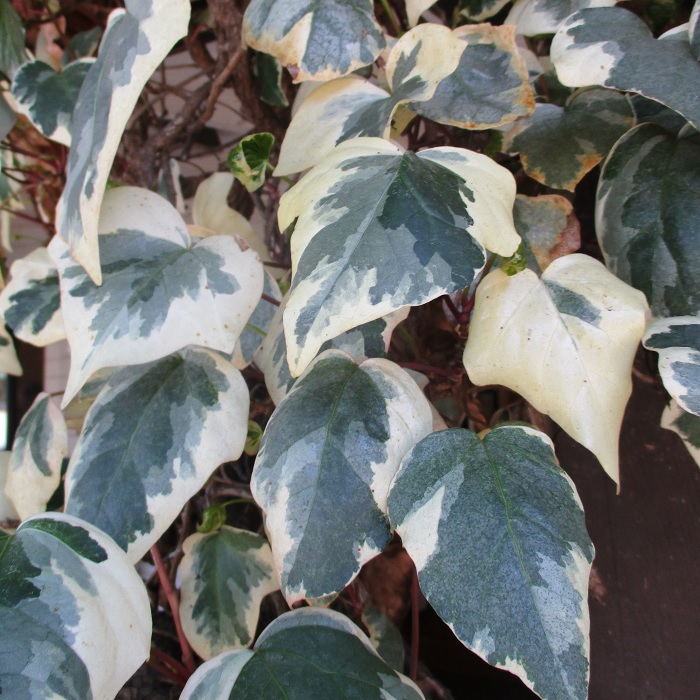 This is one of those plants that many of us have strong feelings about. Many of us who remember it from when it was more popular in the 1970s might consider Algerian ivy, Hedera canariensis, to be an aggressively invasive weed. Those of us who are less familiar with it might appreciate it as a vigorous and resilient groundcover that gets dense enough to exclude most other weeds.
Without regular pruning for confinement, Algerian ivy grown as groundcover becomes a vine to climb trees, fences, walls and anything else it can get into. As the vines mature and get closer to the top of their support, they develop shrubby adult growth. Algerian ivy can easily ruin the surfaces that it climbs, or overwhelm shrubbery and trees, but might not be so bad on bare concrete walls.
Well contained Algerian ivy might get about two feet deep. The glossy dark green leaves are about six inches wide, with three or five rounded corners. Leaves of vining or adult growth are smaller and more rounded. New plants are very easy to propagate from cuttings or by layering. ‘Ghost ivy’ is delightfully variegated with white, but usually loses variegation as new growth replaces the old.
Weeds Have Been Very Busy
 They are weeds for a reason. They grow like . . . well, weeds! By definition, they are unwanted. Yet, they typically proliferate and grow faster than desirable plants. They aggressively compete for space, sunlight and resources. Many weeds start to grow through winter, and get established while other seedlings are just beginning to germinate, or other plants are just waking from dormancy.
Besides staying ahead of other plants, weeds stay ahead of us by growing so much while the wintry weather keeps us inside. Many weeds are really just trying to stay ahead of insects or animals that eat them in the wild. Since almost all weeds are exotic (nonnative) and far from their natural homes, the insects or animals that should eat them are not here to do so. It is an unfair advantage.
Now that the weather is more conducive to gardening, weeds should be pulled as soon as they are big enough to get a grip on. This includes tree, shrub and big perennial weeds like blue gum eucalyptus, Acacia dealbata, coast live oak, glossy privet and giant reed. If simply cut down, they will regenerate even stronger, and will probably need to be dug out. The roots are difficult to kill.
Annual weeds are very different. They will die by next winter without any help. Some will die when they dry out over summer. However, they should be pulled anyway, before they bloom and sow their seed. If the weeds are too abundant to exterminate, they should at least be cut down before their seed develops. In some situations, the mown or cut weeds might be preferable to bare soil.
Burrclover, bindweed and purslane stay so low to the ground that mowing or cutting weeds does not slow them down much. They must unfortunately be pulled, which is a serious chore in large areas! Dandelion and foxtail can get mown once, but they have a sneaky way of coming back lower to avoid losing seed the next time. Dandelion can actually come back next year as a perennial.
Bermudagrass and crabgrass are low growing perennial grasses that spread vegetatively (with their stems), even if deprived of their seed. They are very tough! Spurge and oxalis seem like they should be wimpy, but they sow seed so profusely and so early that, by the time they get noticed, their next generations are already started. Oxalis survives winter with perennials stems and bulbs.

