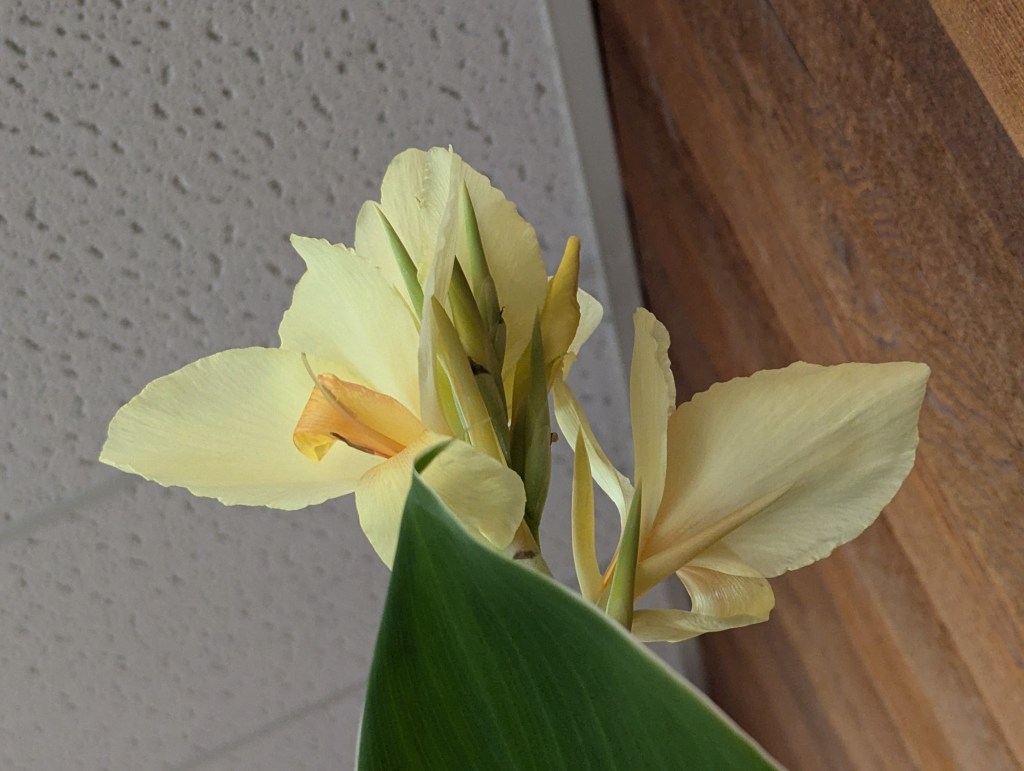
Just about everything in my garden has history in someone else’s garden. Almost nothing came from a nursery. I like to say that purchases are against the rules. However, I did purchase ‘Alaska’ Canna from Horn Canna Farm because I want to grow a white canna. I am over the shame already, and am very fond of this first white canna that I have seen since I was very young. As you can see, it is not very white, and is more of a creamy white or vanilla white. Actually, it is very pale yellow. It is presently growing as a houseplant in one of the buildings at work, which might have enhanced the pale yellow color of its bloom. I believe that it would have been whiter out in the weather. It is already growing quite nicely, so will need to move out into a landscape with all the other Canna for next year. I doubt that it will be as popular as the other brightly colored Canna, but a few who see it in bloom might recognize how rare creamy white Canna are now. I think that ‘Alaska’ would contrast splendidly with the dark bronze foliage of ‘Australia’.
Floral color attracts pollinators. Hummingbirds mostly prefer bright red, pink and orange. Butterflies mostly prefer bright orange and yellow. Bees prefer bright blue and purple, but are less discriminating than other pollinators. Of course, these are mere generalizations. Otherwise, the majority of pollinators might ignore species that bloom with white flowers.
Realistically, most flowers do not rely on pollinators for pollination. They rely exclusively on wind, so are just green or brown, and not visually prominent. These include flowers of grasses and conifers. Otherwise, small but prominently prolific white flowers are the next best option. They rely on either or both wind and pollinators for very effective pollination.
For example, firethorn bloom is very appealing to bees and other pollinators. It is also so prolific that some of its pollen disperses into the wind. Its tiny but abundant white flowers can not avoid pollination by one means or the other. Most orchard trees, such as apricot, plum, apple and pear, use the same technique. So do viburnum, photinia and elderberry.
This should not imply that white is a substandard color, though. After all, white flowers do attract pollinators. Several pollinators, such as nocturnal moths, prefer luminescent white flowers. More importantly, many pollinators see more than white. Several types of Insects see ultraviolet. What seems to be white to us can actually be elaborately colorful to them.
Furthermore, white needs no justification. It happens to be the best color option for some garden applications. It brightens visually dark situations, and mingles well with almost all other colors. A few types of flowers, particularly those with distinctive form, excel at white. Calla, camellia, lily of the valley and various lilies are only a few of numerous examples.
Cool season annuals for autumn and winter will soon replace old warm season annuals. White busy Lizzie, petunia, cosmos, alyssum, snapdragon and zinnia are finishing soon. White pansy, viola, dianthus and wax begonia may replace them. Later in autumn, white cyclamen will become seasonal. There are always enough white flowers to choose from.
Giant bird of Paradise may not look so good in its picture, but started the trend for these Six for this Saturday. White is my favorite color.
1. Strelitzia nicolai, giant bird of Paradise did not pose for a good picture, but impresses with its fancy bloom nonetheless. It bloomed nicely last year too, just three months after getting relocated from another garden. It is still canned, so is not even in the ground yet.
2. Nerium oleander, oleander reminds me that, contrary to the mild weather, it really is the middle of summer. This particular oleander was so overgrown and shabby from bad pruning for many years that it was coppiced. It worked so well that we could do it again.
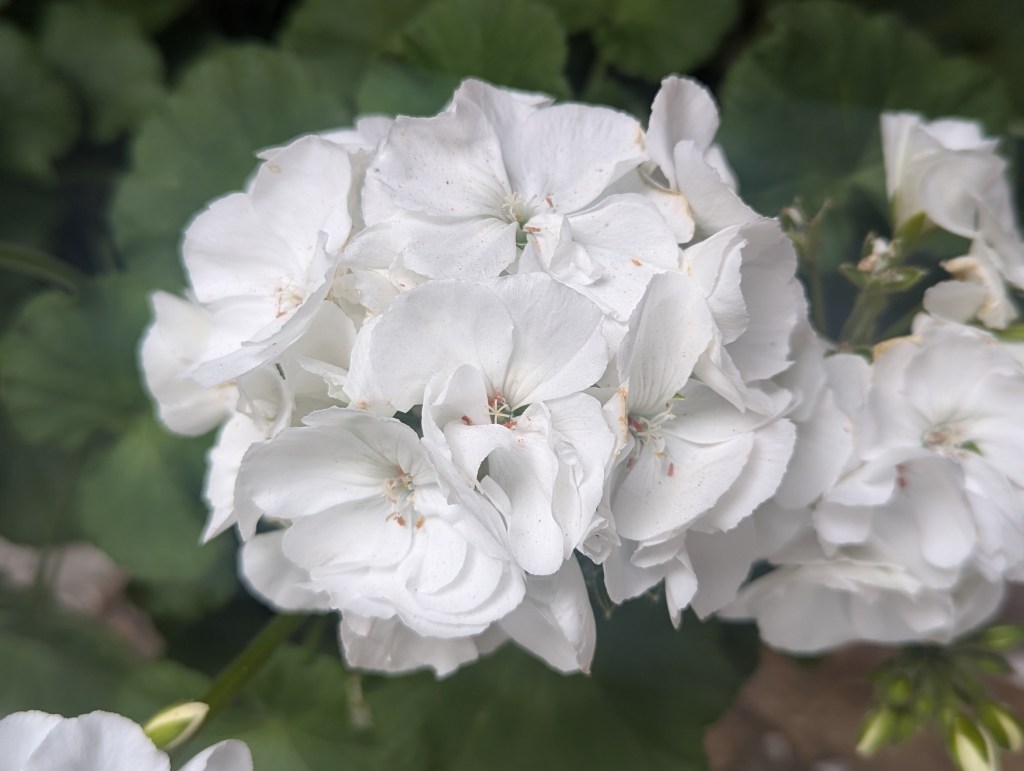
3. Pelargonium X hortorum, zonal geranium is a short term perennial, but provides too many replacement cuttings for extinction. I do not know how long it has been here, but I do enjoy propagating it now, not just because it blooms white, but also because it is easy.
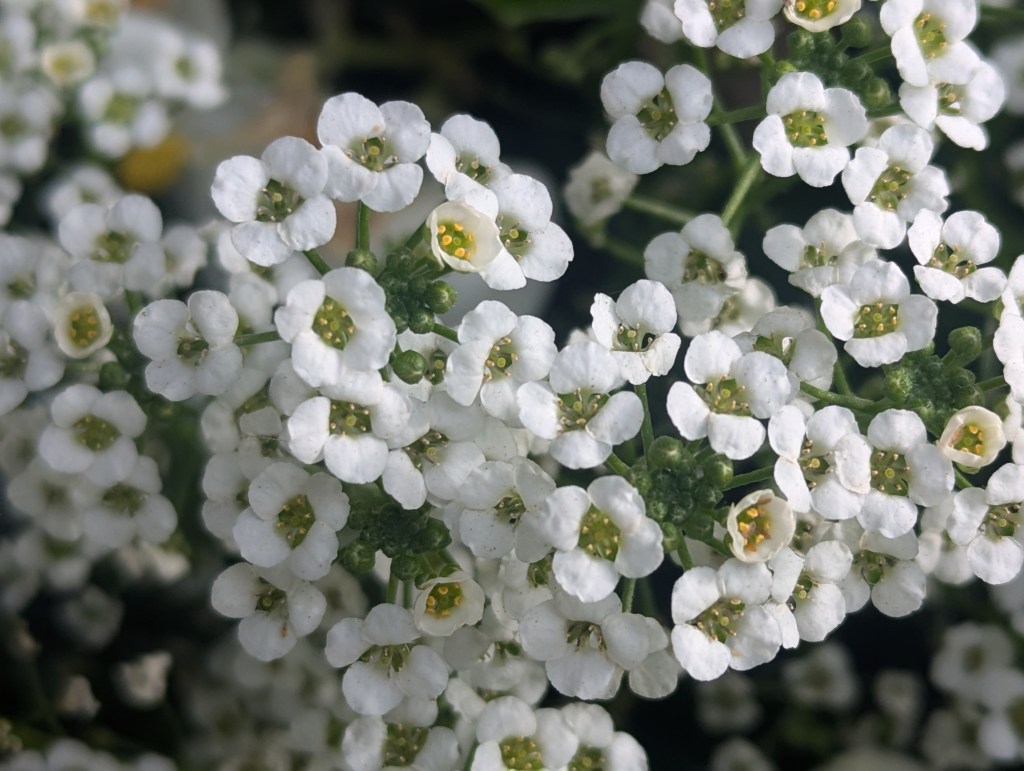
4. Lobularia maritima, sweet alyssum has been here a bit longer than expected also, but is not as perennial as zonal geranium. It was planted as a warm season annual early last summer. Because wax begonia is growing around it, it will not be replaced, but removed.
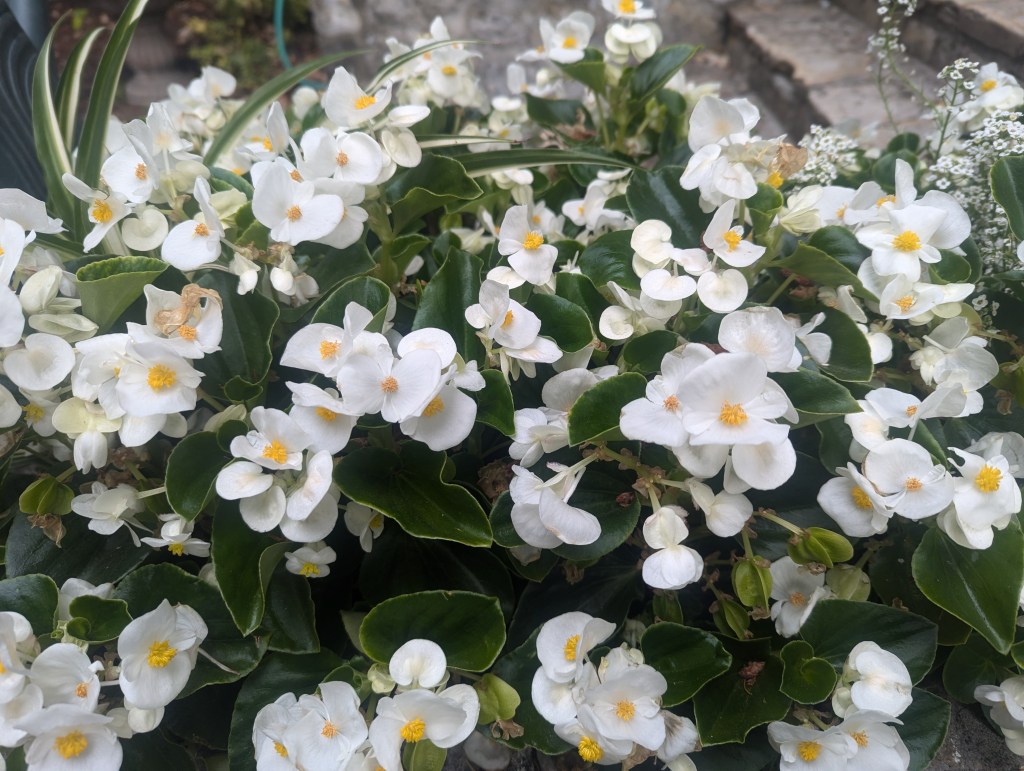
5. Begonia X semperflorens cultorum, wax begonia has been doing remarkably well now that it has its planter boxes within planter boxes to exclude aggressive redwood roots. It has been growing slowly but surely since last summer, so it now needs no replacements.
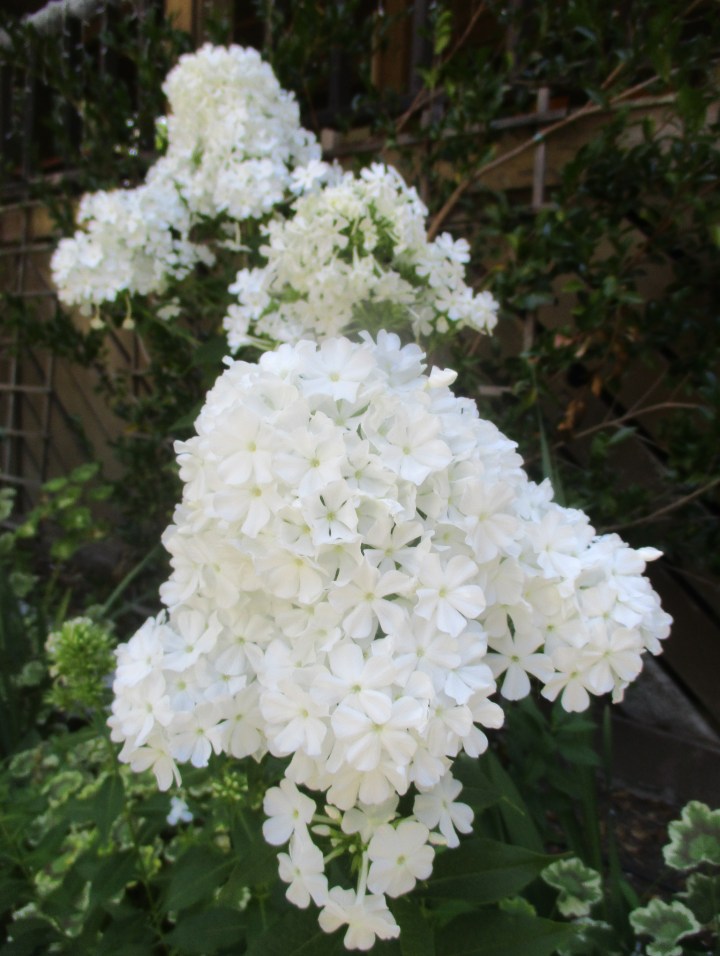
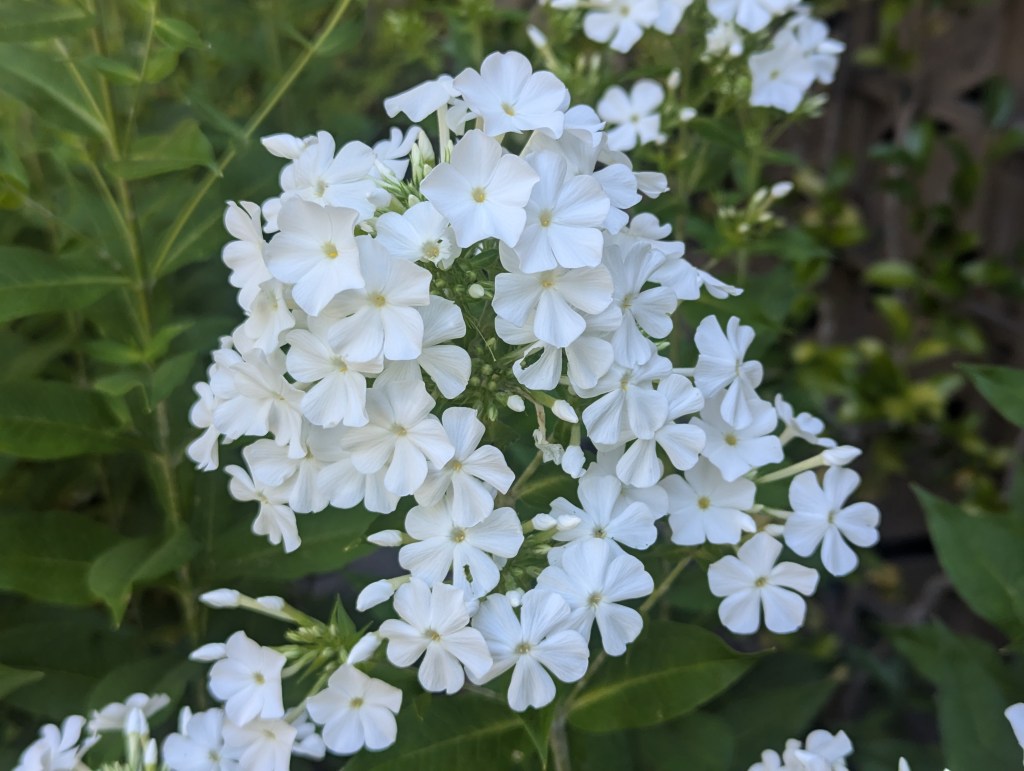
6. Phlox paniculata, garden phlox self sowed from an unknown source several years ago. It continued to self sow with such vigor that we thought it could become invasive. Then, it unexpectedly became docile, and now grows only where it is an asset to the landscape.
White is my favorite color. It is not the best color for all flowers, but it is the only color that I allow within the White Garden, which is really just the meager landscape of the Mount Hermon Memorial Chapel. Creamy white, such as white nasturtium and white canna, are not white enough. I am adamant about this. After replacing a few blue lily of the Nile with a white hydrangea, I needed to remove the hydrangea as it began to bloom with a slight pinkish blush. About that time, two winters ago, we added a white climbing rose. It was a perfect fit, and produced a straight cane that extended from the top of an original cane to the eave during its first summer. Because it was still young and small, it bloomed mildly but sufficiently. More importantly, it bloomed white. It got pruned over winter. Now that it is a bit larger, it is blooming a bit more fuller. However, it no longer seems to be blooming pure white! Young flowers unfurl with a creamy pale yellow blush before fading to white. It is too pretty to remove, especially without a replacement. This could become a major dilemma!
What makes this particular white bearded iris so special? Well, all three of the bearded iris that bloom white in my gardens are special. Each arrived with history, from other important gardens. I am impressed with this one now because it is so white. I did not know what color it was when I acquired it from its garden in Monterey so many years ago. I just wanted a souvenir from that particular garden after the owner passed away, so grabbed a bit of it during the estate liquidation. It bloomed for its first season, but was a dingy grayish white. I thought it might get whiter for its second season, but continued to bloom annually with the same unimpressive color. I could not eliminate it from my collection because of its historical significance. Because it is so uninteresting, I had not shared it or, until recently, tried growing it anywhere else. Then, because bearded iris grow and proliferate as they do, I brought a small bit of it to the Iris Bed at work, where I got this picture of it. I can not explain why it is so much whiter than it had been, but I am impressed.
Syringa vulgaris ‘Madame LeMoine’ French hybrid lilac bloomed bright white and right on time as March became April, and is not finished yet. It was somewhat of a surprise, since it remains canned until development of the landscape that it should eventually inhabit. It does not grow much while canned, so was not expected to be so spectacular in bloom. It is so spectacular that it was temporarily placed into a prominent position within another landscape, with its can mostly obscured by other vegetation, until it finishes bloom.
However, regardless of how spectacular it is, it reminds me that white is not necessarily the best color for all flowers. White happens to be my favorite color, and lilac happens to be among my favorite early spring flowers, but to me, lilac bloom should be lilac colored. I mean, it really should be that lavender or pastel purple color of traditional and formerly common old fashioned lilacs. The only advantage to this white floral color is that it would be appropriate to situations in which white is the most desirable color, or where lavender is undesirable.
Just as many flowers are at their best in white, some are best with other colors. Southern magnolia, lily of the valley, moonflower, gardenia, Easter lily and old fashioned calla are exclusively white, and would look weird in any other color. Gladiolus, tulip, hyacinth and rose can be all sorts of colors, but happen to excel at white. A few other flowers that can be all sorts of colors happen to not excel at white, such as bougainvillea, crape myrtle, English primrose, tropical hibiscus, wisteria and, of course, lilac. Both white crape myrtle and white bougainvillea happen to have been selected specifically for landscapes here, so perhaps white lilac is not so out of place.
Borago officinalis, borage, as I mentioned last October, blooms almost exclusively with blue flowers. At the time though, a few maturing seedlings were blooming with a few pink flowers that eventually were replaced with blue flowers. Now that more are blooming, a few are doing so like this, with white flowers. Also last October, I mentioned that, although white is my favorite color, I expect borage to bloom blue. Not only does blue seem like a more natural color for it, but is also prettier. White borage seems rather mundane. Fortunately, most bloom blue, with enough that bloom white for my own garden, where I am less concerned with how pretty they are. I now wonder if they will be true to type. In other words, I wonder if those that bloom white will produce seed for more that bloom white, or if they will revert to bloom mostly blue. I will take what I get, I suppose. I have not yet found one that I do not like. I would be impressed, or perhaps concerned, by orange bloom, but I seriously doubt that will happen. I should be more concerned with what to do with all these borage seedlings than with their bloom color. I will plant only a few at work, which leaves more than a few for my home garden. Although supposedly not invasive, they are also supposedly proficient with self seeding. Once they get established within my garden, they will likely always be there. I suppose that I should learn to exploit their culinary applications, particularly for those that bloom blue where I do not want them, but perhaps less so for those that bloom white where I do want them. Now I am getting ahead of the situation. After all, they are still just seedlings.




 Tony Tomeo