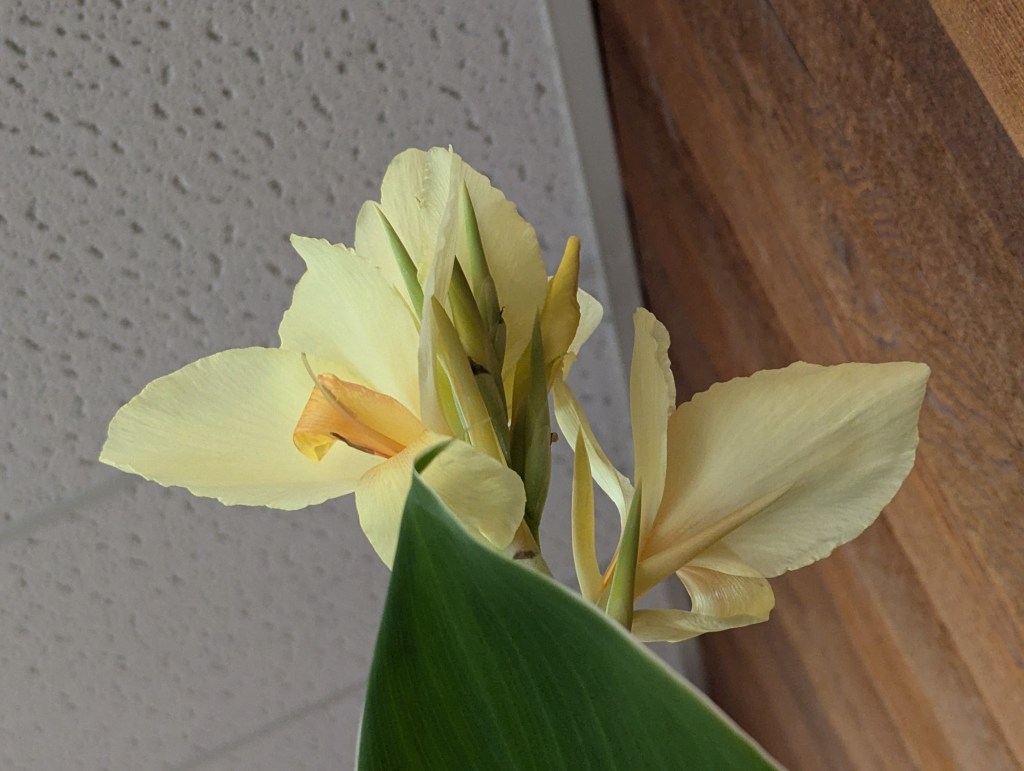
Just about everything in my garden has history in someone else’s garden. Almost nothing came from a nursery. I like to say that purchases are against the rules. However, I did purchase ‘Alaska’ Canna from Horn Canna Farm because I want to grow a white canna. I am over the shame already, and am very fond of this first white canna that I have seen since I was very young. As you can see, it is not very white, and is more of a creamy white or vanilla white. Actually, it is very pale yellow. It is presently growing as a houseplant in one of the buildings at work, which might have enhanced the pale yellow color of its bloom. I believe that it would have been whiter out in the weather. It is already growing quite nicely, so will need to move out into a landscape with all the other Canna for next year. I doubt that it will be as popular as the other brightly colored Canna, but a few who see it in bloom might recognize how rare creamy white Canna are now. I think that ‘Alaska’ would contrast splendidly with the dark bronze foliage of ‘Australia’.
Floral color attracts pollinators. Hummingbirds mostly prefer bright red, pink and orange. Butterflies mostly prefer bright orange and yellow. Bees prefer bright blue and purple, but are less discriminating than other pollinators. Of course, these are mere generalizations. Otherwise, the majority of pollinators might ignore species that bloom with white flowers.
Realistically, most flowers do not rely on pollinators for pollination. They rely exclusively on wind, so are just green or brown, and not visually prominent. These include flowers of grasses and conifers. Otherwise, small but prominently prolific white flowers are the next best option. They rely on either or both wind and pollinators for very effective pollination.
For example, firethorn bloom is very appealing to bees and other pollinators. It is also so prolific that some of its pollen disperses into the wind. Its tiny but abundant white flowers can not avoid pollination by one means or the other. Most orchard trees, such as apricot, plum, apple and pear, use the same technique. So do viburnum, photinia and elderberry.
This should not imply that white is a substandard color, though. After all, white flowers do attract pollinators. Several pollinators, such as nocturnal moths, prefer luminescent white flowers. More importantly, many pollinators see more than white. Several types of Insects see ultraviolet. What seems to be white to us can actually be elaborately colorful to them.
Furthermore, white needs no justification. It happens to be the best color option for some garden applications. It brightens visually dark situations, and mingles well with almost all other colors. A few types of flowers, particularly those with distinctive form, excel at white. Calla, camellia, lily of the valley and various lilies are only a few of numerous examples.
Cool season annuals for autumn and winter will soon replace old warm season annuals. White busy Lizzie, petunia, cosmos, alyssum, snapdragon and zinnia are finishing soon. White pansy, viola, dianthus and wax begonia may replace them. Later in autumn, white cyclamen will become seasonal. There are always enough white flowers to choose from.
Borago officinalis, borage, as I mentioned last October, blooms almost exclusively with blue flowers. At the time though, a few maturing seedlings were blooming with a few pink flowers that eventually were replaced with blue flowers. Now that more are blooming, a few are doing so like this, with white flowers. Also last October, I mentioned that, although white is my favorite color, I expect borage to bloom blue. Not only does blue seem like a more natural color for it, but is also prettier. White borage seems rather mundane. Fortunately, most bloom blue, with enough that bloom white for my own garden, where I am less concerned with how pretty they are. I now wonder if they will be true to type. In other words, I wonder if those that bloom white will produce seed for more that bloom white, or if they will revert to bloom mostly blue. I will take what I get, I suppose. I have not yet found one that I do not like. I would be impressed, or perhaps concerned, by orange bloom, but I seriously doubt that will happen. I should be more concerned with what to do with all these borage seedlings than with their bloom color. I will plant only a few at work, which leaves more than a few for my home garden. Although supposedly not invasive, they are also supposedly proficient with self seeding. Once they get established within my garden, they will likely always be there. I suppose that I should learn to exploit their culinary applications, particularly for those that bloom blue where I do not want them, but perhaps less so for those that bloom white where I do want them. Now I am getting ahead of the situation. After all, they are still just seedlings.
White is my favorite color. Do not argue with me about it. I do not need to hear that it is not truly a color or that it is the absence of color. Technically, it is either or both the complete absence of color or the complete saturation of all color. In that regard, it has either or both the same or opposite definition as black.
A prism demonstrates the colorfulness of white light by separating it into all other colors that it contains. Nothing is lacking.
Other colors can be mixed with a bit of white to become a tint, but retain their identity. They can be mixed with a bit of black to become a shade, but retain their identity. They can be mixed with other colors for various hues. Only white and black lose their identities with the addition of another color. No matter how pale, white becomes a tint of the additional color. No matter how dark, black becomes a shade of the additional color.
Pink is not really a color, but it is somehow more acceptable as such than white is. It is merely a tint of red. In other words, it is red with white.
Furthermore, brown is not really a color, but is somehow more acceptable as such than white is. It is merely a shade of orange. In other words, it is orange with black.
Gray is either or both a tint of black or a shade of white, but only if either or both black or white is considered to be the color that it is. Goodness, this is getting complicated.
Ultimately, such analysis is irrelevant to my predilection for white. Brent says that I am a white supremacist. That is rude. I just know that my favorite color is white.
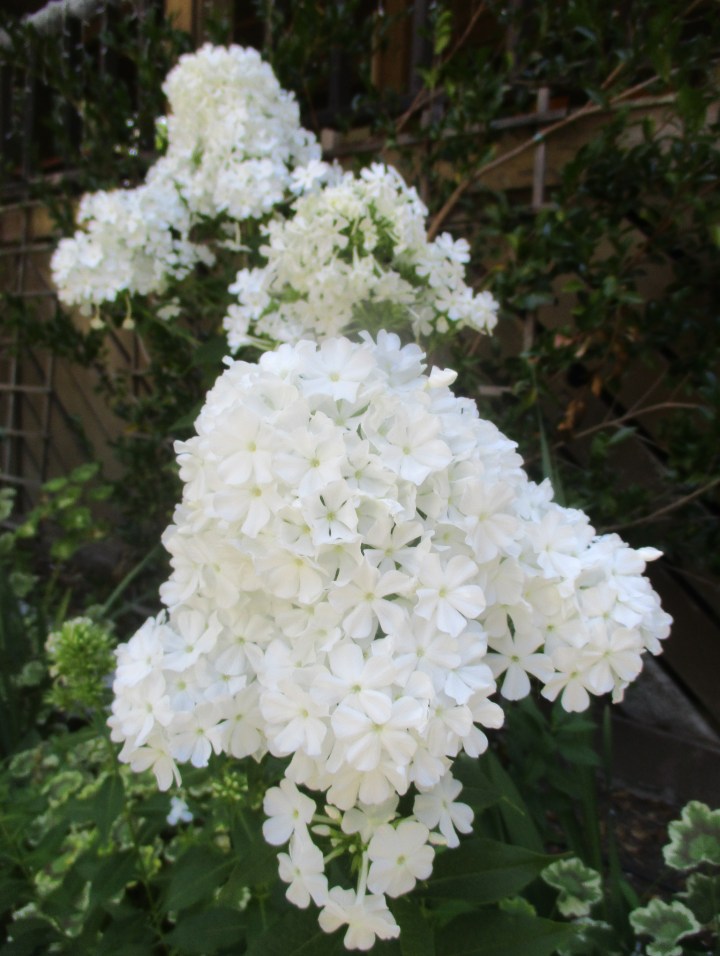
More than a dozen species of Phlox are native to various ecosystems of California. They are generally uncommon within refined home gardens though. The more popular garden phlox, Phlox paniculata, is native east of Kansas. It naturalizes in some regions, such as the Pacific Northwest. Locally, it might self-sow only where it gets water through summer.
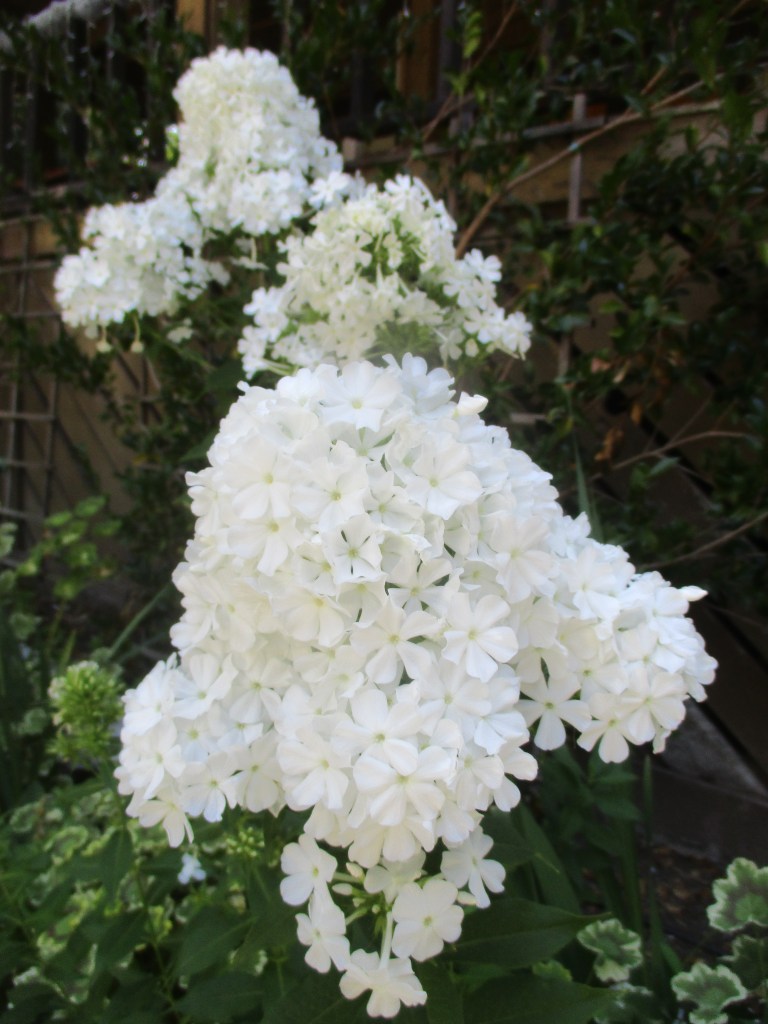
Garden phlox can get as high and wide as three feet. Some modern cultivars should stay a bit more compact. Individual flowers are only about an inch wide, but bloom with many others on dense panicles that are as wide as six inches. This richly fragrant bloom is red, pink, white, pastel orange or pastel purple, and continues for almost a month of summer.
As its potential for naturalization suggests, garden phlox is not particularly demanding. It appreciates good exposure, but can tolerate a bit of partial shade. It enjoys richly organic soil but can survive within soil of mediocre quality if it is not too dense. Regular watering sustains bloom, but established plants can survive with minimal watering after blooming. Propagation by division of large or overgrown plants while dormant through late winter is very easy.
If only it did not like such regular watering, the common white calla, Zantedeschia aethiopica, would be quite a sustainable perennial. Once established, it can be difficult to get rid of, particularly in well watered gardens. Even unwatered plants that die to the ground through dry summer weather are merely dormant and waiting for rain to regenerate and bloom.
The remarkably elegant blooms stand about two or three feet tall, each with a single spathe loosely wrapped as a flaring cone around a spadix that supports the indistinguishable diminutive flowers. The bright white spathe is often more than four inches wide, and can be twice as wide in shade. The spadix is only about three or four inches long, and as yellow as Big Bird. The spongy dark green leaves are about a foot or two tall.
‘Green Goddess’ blooms with a longer and recurved spathe with a green tip and margins. Colorful callas are actually different specie. All parts of all types of callas are incidentally toxic.
Even without the variety of color of hydrangea, these relatively delicate, crisp white flowers of snowball bush are quite elegant.
Like small, clear white hydrangea blooms, the round, three inch wide floral trusses of snowball bush,Viburnum opulus ‘Roseum’, are composed of many smaller flowers. Unlike hydrangeas that bloom after vegetative (stem and foliar) growth, snowball bush blooms early, so that as it finishes, deteriorating blooms will be obscured by soft green foliage before anyone notices. The distinctively lobed, three inch wide leaves get quite colorful in autumn. Snowball bush should not be shorn, but can instead be pruned aggressively while bare in winter. Older or obtrusively tall stems should be pruned to the ground where possible. Good sun exposure without too much reflected glare or heat promotes bloom and autumn foliar color. Mature plants can get ten feet tall and nearly as broad.
Alyssum is popular because of its lightly fragrant and lacy white bloom that lasts through most of the year. It seems to be more perennial than it actually is because it sows seed to replace aging plants. Candytuft, Iberis sempervirens, is a bit less prolific with bloom and fragrance, but otherwise resembles alyssum. Without seeding, it can be nicely perennial.
Candytuft does not get much larger than alyssum although it supposedly has potential to get almost a foot high and a foot and a half wide. Shearing after bloom phases enhances foliar density and subsequent bloom. Primary bloom occurs during late winter, spring, or perhaps early summer. Minor random bloom is possible at any time, particularly autumn.
Plants propagate readily by division of small tufts of rooted stems from within established plants. Alternatively, creeping outer stems develop roots if simply pressed into the soil or held down with stones. Pruning scraps are tiny and awkward to handle, but can grow as cuttings. When disturbed, candytuft exudes an aroma similar to that of related cabbages, which might be objectionable to some.
As a companion plant, candytuft hides the less appealing lower growth of roses; or it can cascade from mixed planters.
Most roses that are grown for cut flowers are not very appealing in the landscape. They look better behind shorter perennials or shrubbery, with their taller flowering stems standing higher above. Mounding herbs like lavender, lavender cotton or rosemary, or small hedges of boxwood, dwarf hebe or Indian hawthorn obscurer their thorny undergrowth nicely. Candytuft, Iberis sempervirens, is a small perennial that gets just high enough to give a neat edge to a row of roses.
It gets gets about a foot deep, and can very slowly but eventually spread over a few square feet. The tiny, narrow and dark green leaves are less than an inch long. Inch wide trusses of minute white flowers resemble those of sweet alyssum, although lack fragrance. Sloppy plants can be restored by getting pruned almost to the ground.




 Tony Tomeo