Six on Saturday: White Saturday

Black Friday was yesterday. White Saturday seems appropriate today. Actually though, I lacked six pictures after a two week commitment from which I returned less than a week ago. These six were cut flowers where I was at. It is a long story. Apologies for this lapse of any personally relevant horticultural topics.

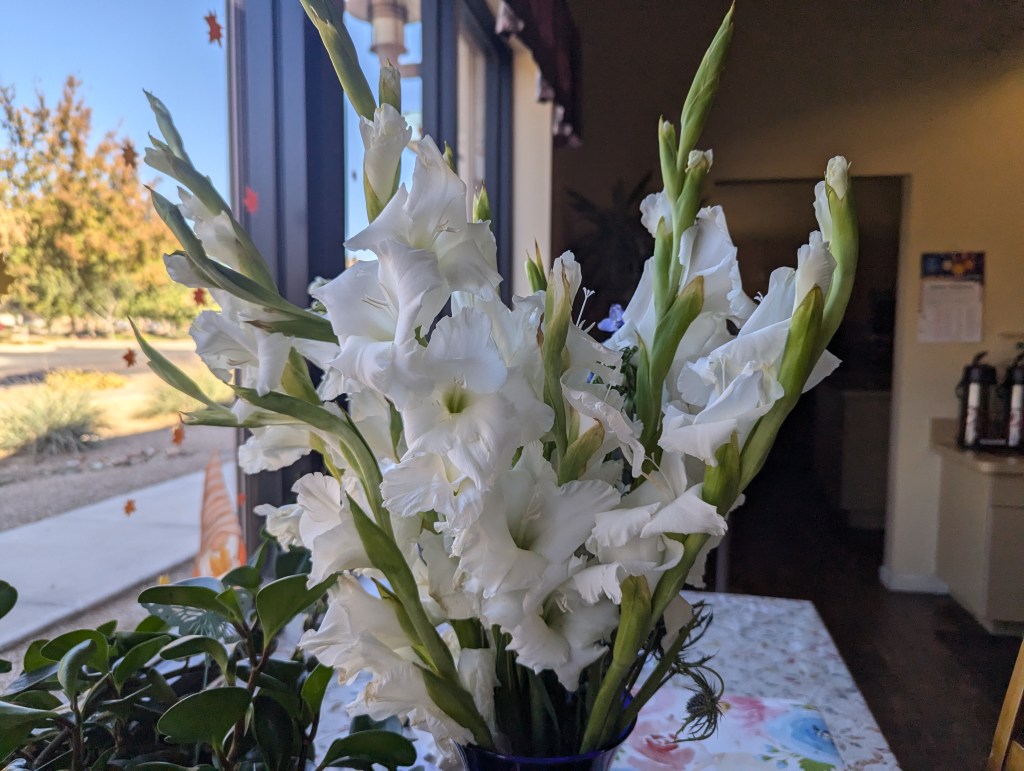
1. Gladiola is one flower that really excels at white! Except for the few at work, I have not grown them in many years. I grew some in yellow and orange in the old neighborhood in 2000 or so. They were fancy hybrids like this, so were not reliably perennial for too long.
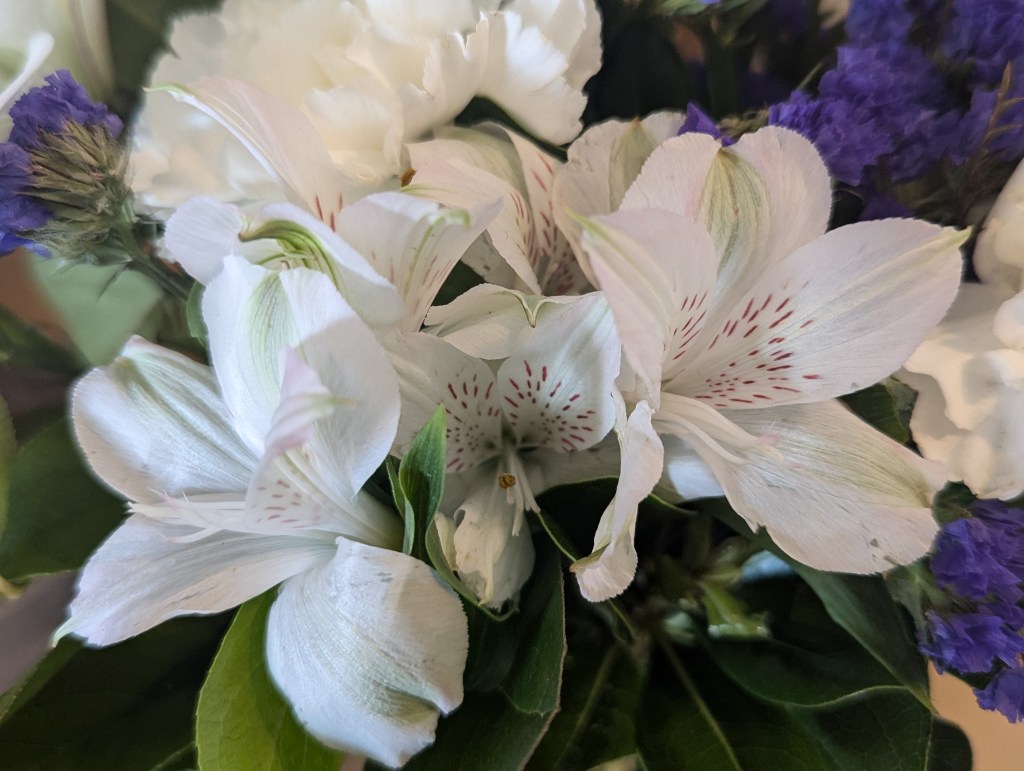
2. Peruvian lily was one of the first cut flower crops that I worked with after my first year of college, for the summer of 1986, when they were new and trendy. White had not been developed back then. I am impressed by how white this variety is, with only minor spots.
3. Carnation is one of the most ubiquitous of cut flowers, but is also the only one of these six that I have never grown. I have worked with only bedding types and sweet William in landscapes at work. I did not get close enough to notice how fragrant this carnation was.

4. Rose is the most popular of cut flowers, although it does not seem to be as ubiquitous as carnations do. I can not remember ever not growing them. I acquired some that are in my garden now while I was in high school in about 1984 or 1985 and brought them here.

5. Chrysanthemum that grow in the landscapes at work were formerly potted plants that were left with us to be recycled. We selected none intentionally. They might be more fun like that. Anyway, this particular cut white chrysanthemum is impressively humongous!

6. Lily was a secondary cut flower crop that I worked with for the summer of 1986, along with the primary crop of Peruvian lily, which is not actually a lily. We grew Asiatic lilies, and we grew white lilies, but not white Asiatic lilies such as this. I am happily impressed.

This is the link for Six on Saturday, for anyone else who would like to participate: https://thepropagatorblog.wordpress.com/2017/09/18/six-on-saturday-a-participant-guide/

Off Color – Very Variable Variegation

‘Stuttgart’ canna

Reversion among vegetation is the loss of an aberrative genetic characteristic, such as variegation or bronze foliar color. Because most genetic aberrations that are susceptible to reversion are disadvantages, reverted growth generally performs more efficiently, and displaces remaining genetic aberrative growth. For example, because its variegated portions lack chlorophyll, variegated foliage is less vigorous than foliage that is not variegated. Therefore, if not removed, unvariegated reverted foliage is likely to grow faster and replace variegated foliage. This ‘Stuttgart’ canna leaf seems to have done the opposite of reversion, by exhibiting such extreme variegation that all green color is lacking. Fortunately, it is not as bad as it looks. This is merely very variable variegation. Just as a few leaves may be completely green without actually reverting permanently, a few leaves are extremely variegated, and on rare occasion, a few, such as this leaf, may lack any obvious green color. Leaves that developed after and above this leaf exhibited more typical variegation with both green and white. Otherwise, this particular cane would not survive for long without chlorophyll for photosynthesis. The flowers are unaffected because they derive their floral color from pigment rather than chlorophyll. White redwood foliage can survive without chlorophyll only because it can rely on resources provided by the normal growth with green foliage that it is attached to, almost parasitically. Such growth is considered to be albino, but because it merely lacks chlorophyll rather than pigment, it is technically not albino. Furthermore, it is technically not variegated, since it is so completely white, without any green chlorophyll. Oh, this is more complicated than it should be. It is probably better to simply appreciate appealing genetic aberrations such as white, variegated or other colorful foliage. ‘Stuttgart’ canna will not refresh its variegated foliage until the end of winter.

See Anemone II

Anemone (or Eriocapitella) hupehensis

Sniveling works! Perhaps I should say that it can potentially be effective, and is sometimes more effective than expected. I certainly do not want to make the impression that I recommend it. Nonetheless, and contrary to the typical ‘Horridculture’ theme for Wednesdays, I can not deny recent favorable developments that, although not direct results of my snivelling about my lack of a white Japanese anemone, Anemone (or Eriocapitella) hupehensis, two weeks ago, somehow seem to be relevant to it. Firstly, someone at work brought me a pair of copies of an unidentified cultivar of Japanese anemone that is described as being very similar to that which is already here, with slightly pinkish pale gray bloom. Although not the right color, it is the right species. I intend to grow both the new and the old, and even if they are indistinguishable from each other, will continue to grow both because of their different but important origins. Secondly, a new landscape at a new home in the neighborhood includes several specimens of the most enviable and splendidly white ‘Honorine Jobert’ Japanese anemone! Those installing the landscape are completely unaware of the significance, and, as might be expected from such ‘landscapers’, actually told me that these Japanese anemones are the native bush anemone, Carpenteria californica. Why argue? I now know where I can get copies of ‘Honorine Jobert’ Japanese anemone after it has grown through next year. The other horticulturist here is acquainted with those who will live at the new home seasonally, so will have no problem procuring copies for me. As I intended to do with all of the now overly abundant canna and bearded iris, I plan to limit the number of cultivars of Japanese anemone to the original that was already here, the recent gift that might be the same as the original, and the ‘Honorine Jobert’ that I have yet to acquire.

See Anemone

Anemone hupehensis

Japanese anemone, Anemone hupehensis, which is now Eriocapitella hupehensis, is one of several species that I had been wanting to grow for a very long time. Like peony, goldenrod, Joe Pye weed, Indian paintbrush, beautyberry and fancy hybrids of clematis, they are prominent features of fancier gardens in other regions. Some of such species do not perform well here. Others are merely unpopular, but might perform well here if they get the chance. I see them all only in pictures, so can not distinguish what their respective situations are. The only anemones that I had ever encountered while young were sea anemones on nearby beaches. In college, I met poppy anemones, which we know merely as anemone, but found that they are not as reliably perennial as they are purported to be. Japanese anemone had been elusive, until I met a very established and perhaps invasive colony of it in an old landscape near Oakland less than fifteen years ago. I figured that if it can be as happy as it was in a relatively coastal climate, it could be happier here with a bit more chill during winter. Until then, I assumed that minimal chill was a limiting factor to their performance here. ‘Honorine Jobert’ seemed to be the epitome of single white Japanese anemone, but I had not seen any white cultivars, even those with double flowers, that were not alluring. Then, I discovered an unidentified cultivar of Japanese anemone on the edge of a rose garden here. It survives as a remnant of a preceding perennial garden, but does not perform well now that redwood roots have become so aggressive. Furthermore, its floral color is unimpressive. It is not white, but is not quite pink either. Heck, it is not even white blushed with pink. I do not know how to describe it. Initially, it seemed to be only slightly pinkish pale gray. Ick! This year, it seems to be slightly more pinkish than it had been, which makes it slightly less disappointing. However, now that I know it is here, I will not try any other Japanese anemone until I at least try to grow this one well. I am confident that if I relocate bits of it to a garden where it does not need to compete with other vegetation, it will bloom with a more appealing shade of pink. I will not mind that it is not white if it does that much. Then, if it can perform well, I will know that I can grow a white cultivar of anemone also. There is no rush though. Although white happens to be my favorite color, and Japanese anemone happens to excel at white, pink can be appealing also. This is my very first Japanese anemone, and regardless of how unimpressive it is now, I am pleased with it.

Khartoum

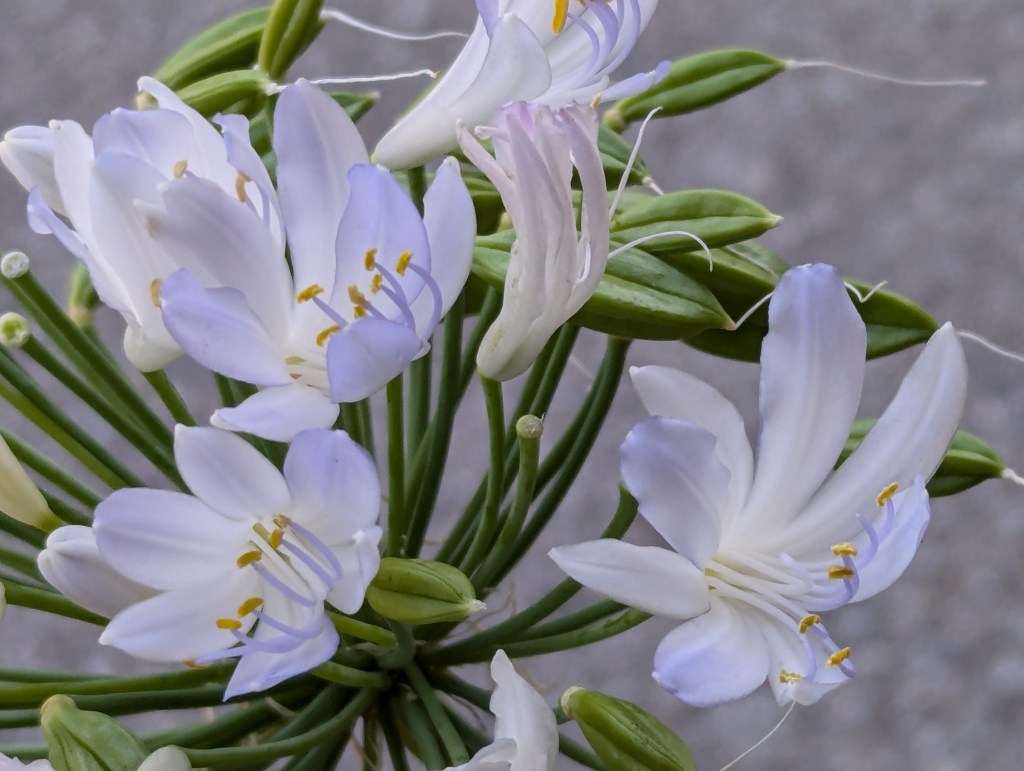
‘Khartoum’ (Agapanthus orientalis ‘Khartoum’) is a blend of Blue Nile and White Nile.

Khartoum is located where the Blue Nile River merges with the White Nile River to become the Nile River. Lily of the Nile, contrary to its name, is neither a lily nor native to any of the three Nile Rivers. It is in the Amaryllidaceae Family, and is native to Southern Africa. Coincidentally though, it naturally blooms either blue or white. It really seems like it should be native to at least two of the Nile Rivers, with those that bloom white inhabiting the floodplains of the White Nile River, and those that bloom blue inhabiting the floodplains of the Blue Nile River. Perhaps both should inhabit the floodplains of the primary Nile River. Like a few other species that bloom exclusively true blue or white, lily of the Nile sometimes exhibits sports, which are mutant growth, that bloom with the other of the two options. In other words, those that bloom blue sometimes produce a shoot that blooms white, and conversely, those that bloom white sometimes produce a shoot that blooms blue. As if genetically unstable, such sports may revert to their original floral color by the following season, and before they divide into several shoots that bloom prominently with aberrative floral color within their otherwise florally monochromatic colonies. When I noticed a single white bloom within an exclusively blue blooming colony, I did not want to wait for the following season to see what its intentions were. Then, as bloom faded and I separated it from the colony, I found that it was blushed with blue, as if already trying to revert. Because it is impossible to confirm its intentions, I canned it and set it aside to see what it does in the future. If blue, it can return to the landscapes with the random mix of blue lily of the Nile that has been accumulating as long as they have inhabited landscapes here. If white, it will be given to neighbors, because I want to maintain the genetic purity of the single white cultivar that is here. If it remains white with pale blue blush, it might get a separate but prominent position within a landscape.

Second White

How did this get in here?!

Lily of the Nile had previously been exclusively blue at work. Many from undoubtedly several different sources had been added to the landscapes for the past century or so, but, until recently, none were white. Even within a large and likely original colony, where genetic variability is evident among specimens that were added from different sources, or that grew from seed over the years, all bloomed monochromatically blue. I added the first white lily of the Nile only a few years ago. They are a significant herd of the same cultivar that I grew from only seven original pups that I acquired in the early 1990s. They are separate from the other lily of the Nile, in a neat row in front of the White Garden of el Catedral de Santa Clara de Los Gatos. They are not as fancy as they sound of course, and bloom with only a few flowers in the partial shade there, but they were supposedly the only white lily of the Nile. However, I recently found this other white lily of the Nile within the large and very established colony that provided many lily of the Nile for other landscapes. It could have grown from seed, and finally matured enough to bloom. I suspect that it merely reverted, as lily of the Nile sometimes does. I suppose that I should be pleased with it, but I am not so certain. It is almost intrusive, both to the exclusivity of the single white cultivar, and also to the exclusivity of the monochromatically blue colony. I have noticed within other old landscapes that, once one pup blooms white, others can follow its example. The same applies to a pup that blooms blue within a white colony. I may tag this particular pup for removal after bloom.

Six on Saturday: Homey

Almost nothing is purchased for my garden. Not much more is purchased for work. Just about everything is recycled from somewhere else, along with its history. Consequently, the landscapes are as homey as my home garden is. It is often difficult to not brag about it a bit too much. It is gratifying that others can enjoy so much of what I have enjoyed in my garden. For Six on Saturday, though, I will be brief with my descriptions of these few flowers that bloomed last week. Half are angel’s trumpets. Half are white. Of course, it is no coincidence that white is my favorite color. I requested pruning scraps of single white angel’s trumpet and white orchid cactus. Even if recycling, I may be somewhat selective. It all works out well.

1. Gladiolus papilio, butterfly gladiolus that was budded last week bloomed this week. It makes its landscape feel delightfully homey for me. I should have gotten a better picture.

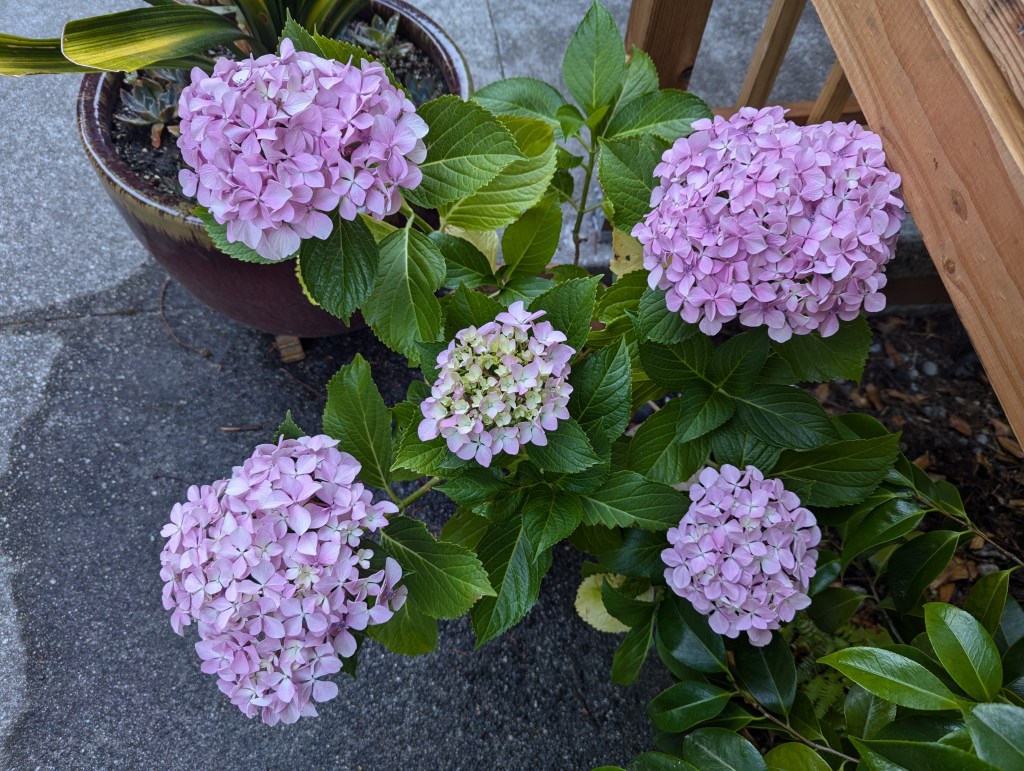
2. Hydrangea macrophylla, bigleaf hydrangea, like so much of what blooms here, came from another garden, then bloomed too well in recovery to not move out to a landscape.

3. Brugmansia, angel’s trumpet of an unidentified cultivar remains unidentified, but is a bit more obviously pink than any other color. Perhaps its cultivar name is not important.

4. Brugmansia candida, angel’s trumpet with fluffy double white flowers is what started all this fuss about angel’s trumpet. Yellow ‘Charles Grimaldi’ was the second acquisition.

5. Brugmansia, angel’s trumpet with single white flowers is an unidentified cultivar that I got merely because I like its single white flowers, but is not so great for the landscapes.

6. Epiphyllum, orchid cactus with clear white flowers remains as unidentified as most of these Six. Like all of these six, it also has important history that makes its garden homey.

This is the link for Six on Saturday, for anyone else who would like to participate: https://thepropagatorblog.wordpress.com/2017/09/18/six-on-saturday-a-participant-guide/

P

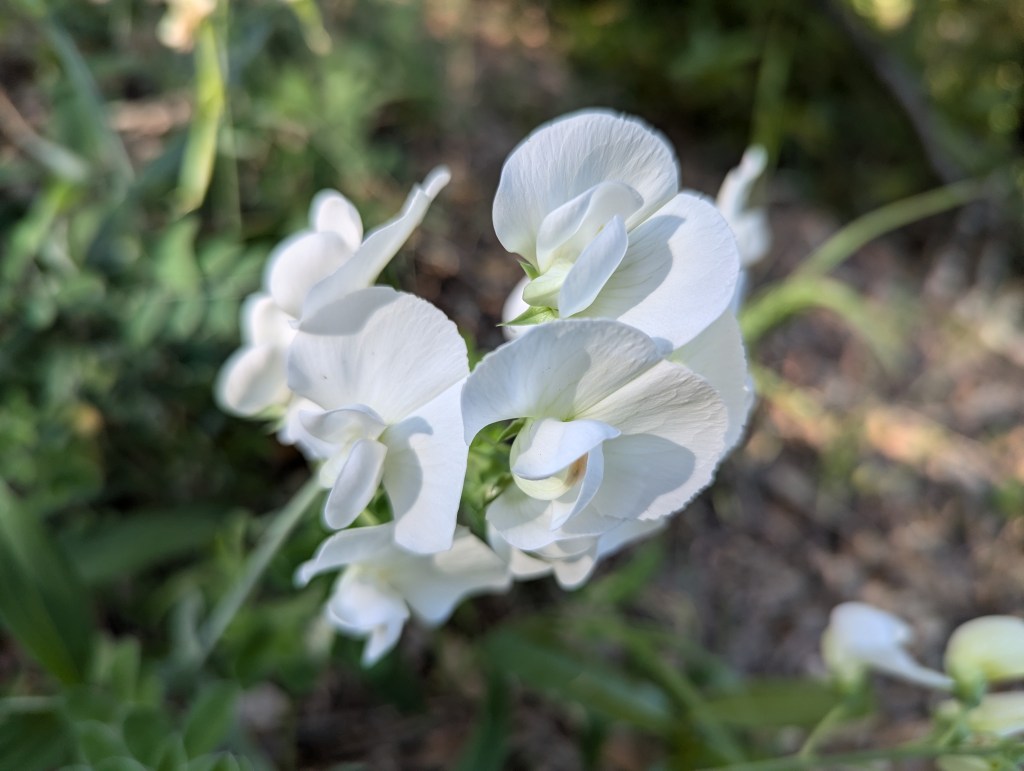
This dinky floral spike was all I needed to identify this as white Lathyrus latifolius.

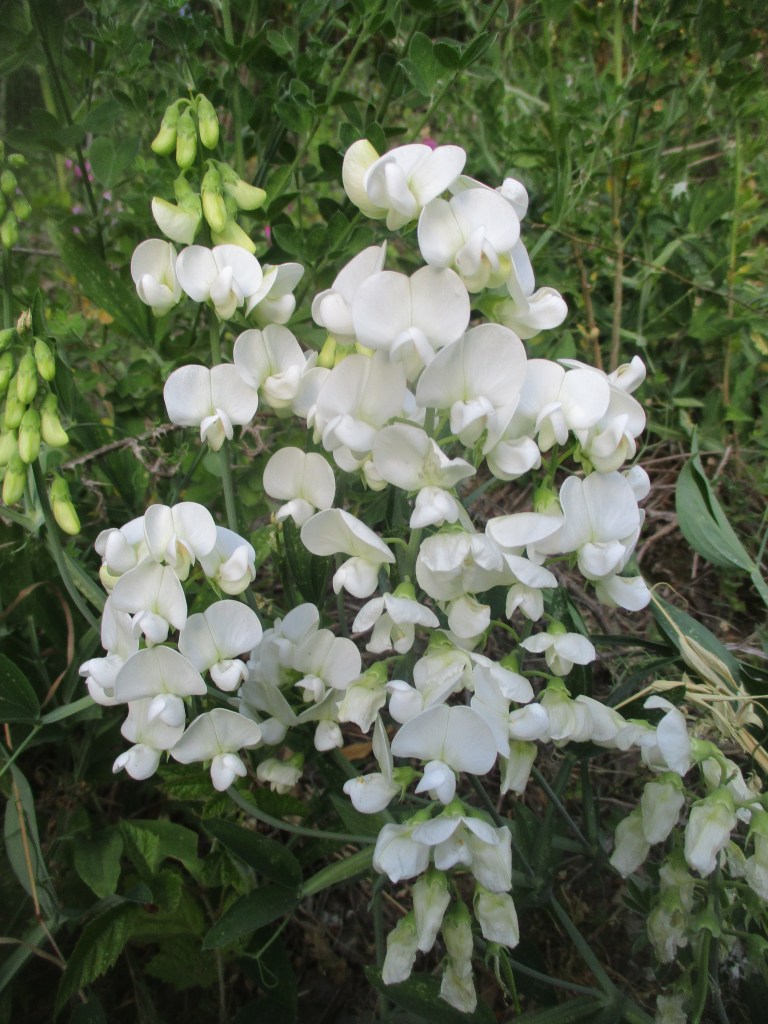
P is for pea, or more specifically, perennial pea, or Lathyrus latifolius, which does not begin with P, but that is not the point. Perennial pea is a naturalized exotic species here. Within our landscapes, it is difficult to kill. I suspect that it is just as difficult to kill outside of the landscapes, although I have not tried. After all, it is quite pretty, and does not seem to be too invasive beyond situations that it finds to be favorable. Trying to kill what grows beyond the landscapes here would be futile anyway, since there is so much more of it beyond the boundaries of what we have access to. However, I would not want to add any to areas where it is not already established and interfering with local ecosystems. That leaves me with a dilemma. I just acquired a perennial pea that I want to grow more of, but there is no place to grow it. Almost all of the perennial pea here blooms obnoxiously bright purplish pink. Very few bloom lighter pink with a swirly pattern. About as few bloom white. I am told that perennial pea can bloom red, but I am getting to suspect that such red is what I consider to be obnoxiously bright purplish pink. Anyway, I found a perennial pea that blooms white a several years ago, and grew several copies of it. I shared all the copies until none were left. I thought that I could always return to the original source for more. Unfortunately, the source was buried under debris that was removed from a mudslide two winters ago. What a bummer! I had been watching for white perennial pea since then. Then, last Wednesday, I saw it! It was not much, since only one floral stalk was beginning to bloom, but it was enough for identification. I got a good bit of its upper taproot and stems for many cuttings. The base of the taproot remains as a more permanent source if I need it, and if nothing happens to it. I am so pleased with this acquisition, even though I have no idea of what to do with it, like so much of what grows out there.

This is a better picture of the original stock from three years ago.

Green, White & Red

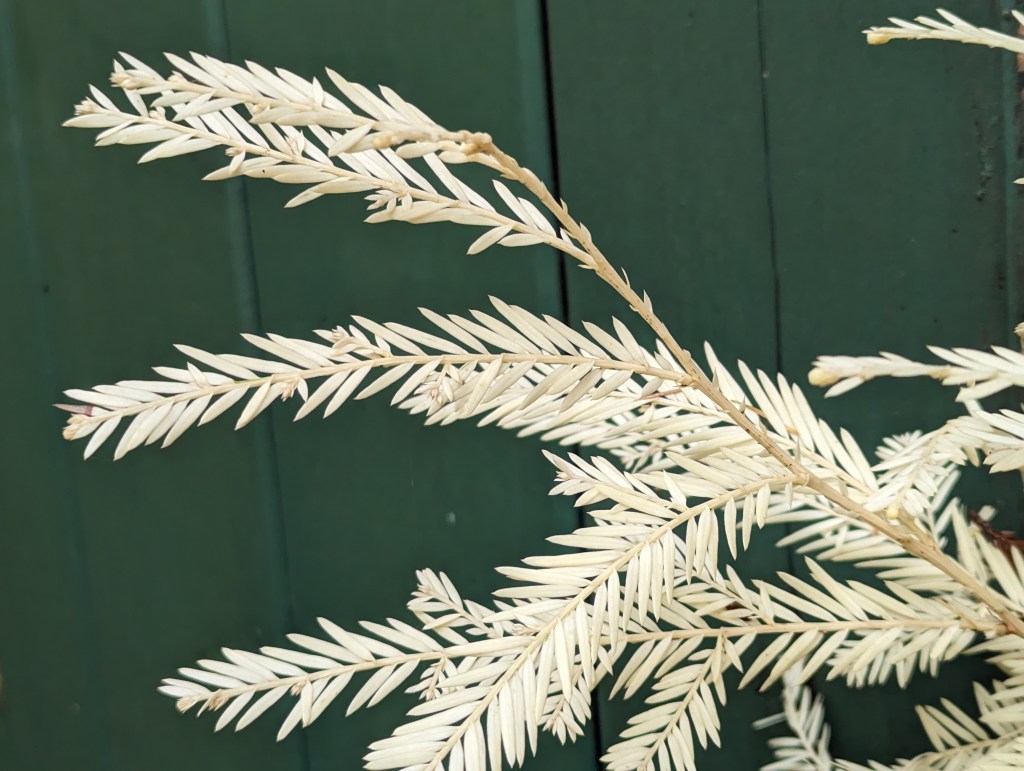
North Fourteenth Street is about as close as I have ever been to Italy; but amongst all the Green foliage here, I can find a bit of White albino Redwood foliage. It is a ‘sport’, which is a silly word for mutant growth. Because it lacks chlorophyll, and is consequently unable to photosynthesize, it is reliant on resources that it draws from the tree that generated it, which has a canopy of normal green foliage. Because of this reliance, copies of this mutant growth can not be grown as cuttings. Such cuttings simply could not sustain their own growth. I have made a few unsuccessful attempts to graft this mutant growth onto normal trees. The scions deteriorate before they can graft. I should try again. This foliage really is as strikingly white as it looks in pictures. I am certainly no expert on floral design, and I know that this foliage does not last for long once cut, but I suspect that it would look striking with black bearded iris or black hollyhock, or on a smaller scale, with black pansies or black petunias. Heck, it might likewise be striking with white flowers. In the early 1970s, albino redwoods, which are merely albino sports of normal redwoods, were considered to be very rare, with only a few documented specimens. Although they really are quite rare, many more have been documented since then, and many more, such as this specimen, remain undocumented. I wrote about this albino redwood foliage a few years ago, and was reminded of it by the wildlife photographer of Portraits of Wildflowers near Austin. Except for a few trees that are barely north of the border with Oregon, coastal redwood is exclusively native to the West Coast of California. It is the tallest tree in the World.

Horridculture – White

White bloom brightens a shady landscape.

White is my favorite color. Do not argue with me about it. I do not need to hear that it is not truly a color or that it is the absence of color. Technically, it is either or both the complete absence of color or the complete saturation of all color. In that regard, it has either or both the same or opposite definition as black.

A prism demonstrates the colorfulness of white light by separating it into all other colors that it contains. Nothing is lacking.

Other colors can be mixed with a bit of white to become a tint, but retain their identity. They can be mixed with a bit of black to become a shade, but retain their identity. They can be mixed with other colors for various hues. Only white and black lose their identities with the addition of another color. No matter how pale, white becomes a tint of the additional color. No matter how dark, black becomes a shade of the additional color.

Pink is not really a color, but it is somehow more acceptable as such than white is. It is merely a tint of red. In other words, it is red with white.

Furthermore, brown is not really a color, but is somehow more acceptable as such than white is. It is merely a shade of orange. In other words, it is orange with black.

Gray is either or both a tint of black or a shade of white, but only if either or both black or white is considered to be the color that it is. Goodness, this is getting complicated.

Ultimately, such analysis is irrelevant to my predilection for white. Brent says that I am a white supremacist. That is rude. I just know that my favorite color is white.