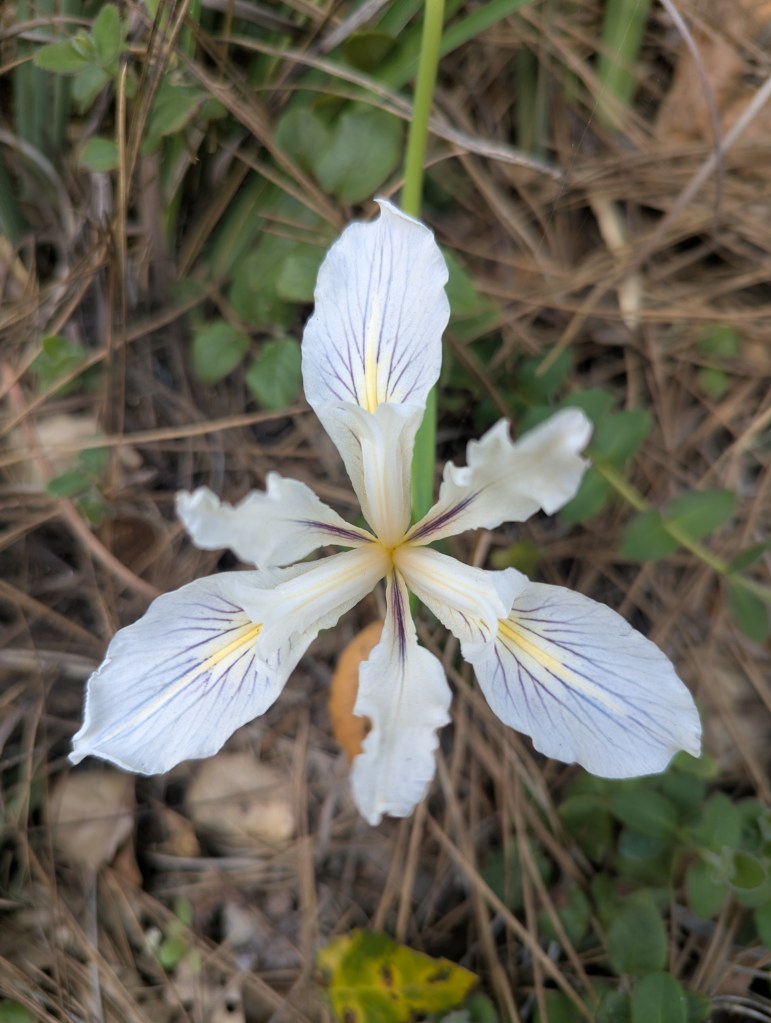
The natural range of Fernald’s iris, Iris fernaldii, is actually rather limited. It is endemic to only the Coast Ranges from Mendocino County to Santa Cruz County. Although it grows well beyond its natural range, it is quite rare in cultivation. Within chaparral climates that are warmer than its range, it prefers afternoon shade. Its foliage is greener with irrigation.
In the wild, Fernald’s iris develops sparse colonies, typically mixed with other vegetation. Colonies are more compact with cultivation and exclusion of other species. Propagation is very easy by division, or simple separation of wayward rhizomes. Fernald’s iris can be satisfied with shallow soil or soil of inferior quality. Too much fertilizer may inhibit bloom.
Fernald’s iris grows only about a foot tall, with slender, grassy and grayish green leaves. Floral stalks stand a bit more vertically and slightly above the foliage. The typically white flowers are paired on each floral stalk. Flowers might be pale or buttery yellow, or, rarely, pale lavender. Roots are thin but tough. Rhizomes, relative to those of other iris, are slim.
There are actually a few different flowers known as Queen Anne’s lace. The most common species, Daucus carota, that has naturalized and even become somewhat of a weed in some areas, has two and a half inch broad, flat-topped trusses of delicately minute but abundant flowers, with a single red flower at the center of each truss. Apparently, Queen Anne pricked a finger with a needle while making the lace, leaving a drop of blood. Modern varieties have broader and fluffier trusses, often lacking central red flowers. They are a popular ingredient or fill for mixed bouquets with more colorful flowers.
The biennial foliage of Queen Anne’s lace grows to about three feet tall in the first year, with weedy but intricately lacy leaves. It blooms in summer of the second year. It is very similar to poison hemlock, which is poisonous enough to kill Nero, so should not be allowed to grow in vegetable gardens or where toxicity might be a problem; just in case.
Feral flowers are technically not the same as wildflowers. As their designation suggests, wildflowers grow wild. They always have, without intervention. They are naturally native. Their native ranges can fluctuate, but do so naturally as associated ecosystems change. Their status as wildflowers does not change within home gardens or refined landscapes.
Feral flowers are progeny of cultivated flowers. Almost all are exotic, or nonnative. Some are true to type, which means that they are indistinguishable from the originals. However, because of extensive breeding, many revert to a more genetically stable state. Some can naturalize, or perpetuate without intervention. Then, they seem to behave as wildflowers.
For example, most home garden nasturtiums begin as garden varieties. They bloom with particular colors because of their breeding and selection. Their progeny, however, bloom with more natural floral color. After a few generations, they may bloom only basic orange and yellow. Such feral flowers can naturalize within riparian ecosystems like wildflowers.
Because they are not native, naturalized nasturtium are technically not wildflowers. They are merely naturalized feral flowers. Although they are rarely aggressively invasive, they can interfere with natural ecology. They might compete with native species for resources and space. They can sustain organisms that are pathogens to native vegetation species.
California poppy is a genuinely native wildflower. However, a few home garden varieties developed from selection and breeding. Initially, such varieties bloom with unusual floral colors like white, lavender, pink or red. After a few generations, though, their colors revert to their more natural orange. Although wildflowers, they are also technically feral flowers.
Many of the most noxious weeds here escaped from home gardens and naturalized. For example, common pink pampas grass became popular during the Victorian Period. Now, it is quite naturalized and compromising ecosystems throughout the West Coast. Its feral flowers are appealing, but perpetuate infestation. They are surely not native wildflowers. Water hyacinth and yellow flag are other examples.
Only four species of Iris are native here. The problem with identifying them is that three of them can be visually similar. Only Iris douglasiana is reliably and distinctively blue. Iris longipetala and Iris macrosiphon are generally pale blue, but can be as pale white with pale yellow veins as Iris fernaldii. Without keying it out, I can only guess that this particular iris is Iris fernaldii. The others seem to develop slightly larger and denser herds with slightly more upright foliage. Iris fernaldii develops relatively smaller herds and more relaxed foliage that does not stand as upright. Even what seems to be large herds are typically groups of smaller herds. Their flowers can lay almost on the ground. they shrivel too soon after cutting to work well as cut flowers. Nonetheless, they are a delightful native wildflower that is blooming as freely as it can where it grows wild. I really should relocate those that grow where they are not wanted, rather than discard them with other weeds. They might compete with weeds and other less visually appealing naturalized vegetation within areas that are not landscaped. Actually, they might be appropriate for a few areas that are casually landscaped.
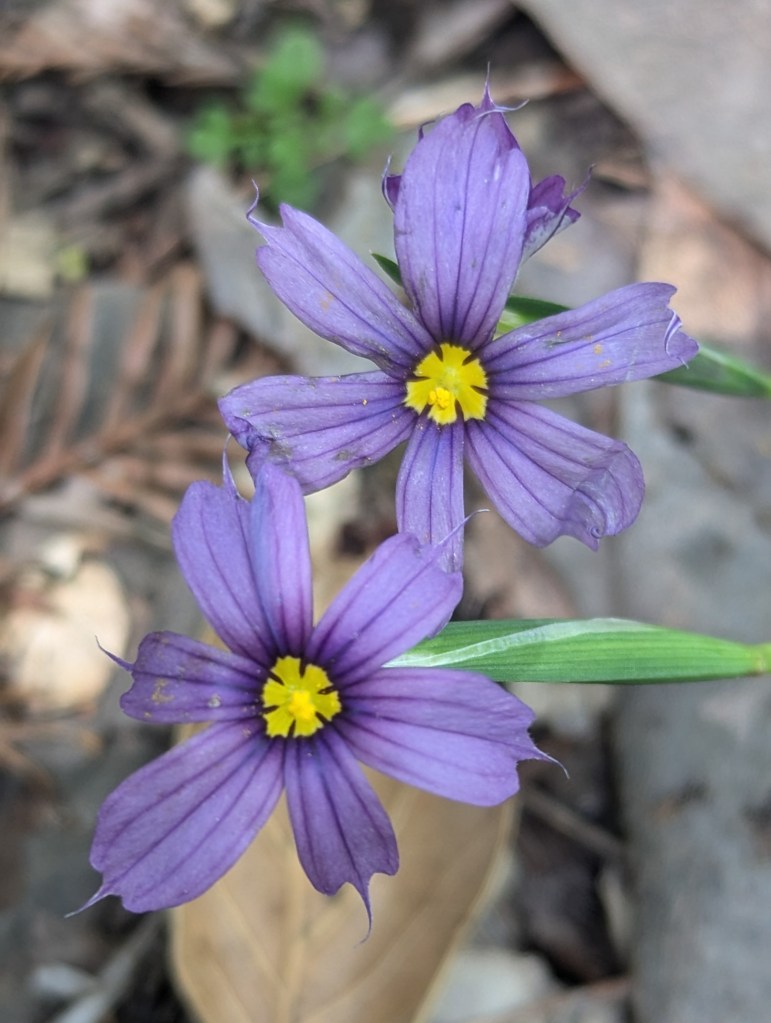
It is not a grass, and lacks eyes, but it is native to most of California and western Oregon. Blue-eyed grass, Sisyrinchium bellum, is related to iris, which actually sounds ocular. Its tiny flowers are typically rather purplish, but can be clear sky blue, or rarely white. Bloom continues through spring until summer dormancy. All foliage then dies back until autumn.
Blue-eyed grass develops small foliar tufts that expand quite slowly. It propagates easily from division of its thin rhizomes as it resumes growth in autumn. Plugging newly divided rhizomes adjacent to original foliar tufts accelerates expansion. Blue-eyed grass can self sow, but typically does so only sparsely. Its grassy foliage is typically less than a foot tall.
Although native and impressively resilient, blue-eyed grass appreciates a bit of moisture. However, it may never require irrigation, since it is dormant through the summer season. Irrigation might maintain foliage through much of summer, but if excessive, can cause rot. Blue-eyed grass prefers sunny and warm exposure, without contention from other plants.
California lilac grows wild throughout California.
Wildflowers are only part of the story. They are happy enough with the chaparral climate here to bloom for spring or summer. A few are naturalized exotic species, though. In other words, they are not native to California. They merely behave like they are, likely because they are from similar climates. Native species are happy here because they are at home.
More than the most abundant wildflowers are native. Many trees, vines, shrubs, annuals and perennials are also. They were here long before Spanish explorers imported the first exotic plants after 1542. They were as satisfied with local soils and climates then as they are now. This is why many are more suitable for home gardens than many exotic plants.
Native plants are less popular than exotic plants only because a few are a bit too natural. Since they are from chaparral climates, some may get a bit scraggly and dry by summer. They survive arid weather by being partially dormant through some of it. Most appreciate irrigation through summer. However, some are susceptible to rot with generous irrigation.
Conversely, there are several advantages to native plant species. They naturally require less irrigation than most exotic species. Once established, some expect none at all. Only species from other chaparral or desert climates might be less demanding. Landscapes of exclusively native species therefore conserve water. Some get all they want from rainfall.
Also, native species are more compatible with natural ecosystems. Any that self sow into nearby wildlands will be where they belong. They do not compete unfairly for pollinators that other native species rely on. Nor do they compete unfairly for possibly limited space and resources. Furthermore, they contribute habitat and sustenance to wild native fauna.
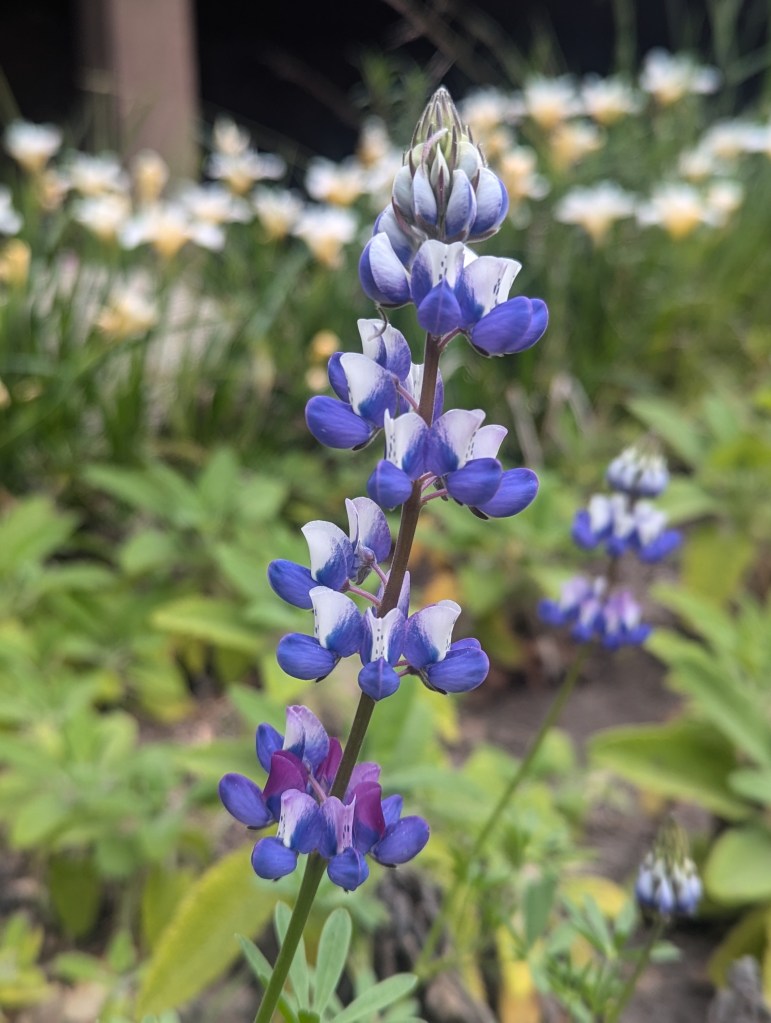
California poppy and sky lupine are probably the most familiar of native annuals. Various salvias and bush lupines may be the most familiar native perennials. California lilac and flannel bush are familiar native shrubs. California sycamore, coastal redwood and coast live oak are familiar native trees. Many native species are practicable for home gardens, and landscaping.
Cat’s tongue might be a more fitting name. Pacific hound’s tongue, Cynoglossum grande or Adelinia grandis grows where it wants. It can grow from cracks in pavement, and then be difficult to remove. It grows easily through decomposed granite, gravel or wood chips. Yet, it is not readily available from nurseries, or as seed. It is sporadic in its native range.
Pacific hound’s tongue may be uncommon because it takes a few years to bloom well. It does not bloom for its first year from seed and then blooms thinly for its first few years. By its third year though, its resilient perennial taproot should be very established. Its foliage dies back soon after late winter bloom. It stays significantly longer with garden irrigation.
Bloom resembles that of forget-me-not, but relatively sparse and on vertical stems. Floral stems are about a foot tall, or can be two feet tall. They are more numerous in cultivation. The small blue flowers are less than half an inch wide. Foliage develops basal rosettes, which may prefer a bit of partial shade. The biggest leaves are less than six inches long, like a hound’s tongue.
Warm season annuals are more varied than cool season annuals for one simple reason. Spring and early summer are the best time for bloom. Afterward, there is plenty of time for seed to develop, prior to cool winter weather. Obviously, most flowers want to exploit this schedule. This includes wildflowers, particularly in regional chaparral or desert climates.
Wildflowers are in more of a rush to bloom for early spring here because summer is arid. They could be more susceptible to premature desiccation later. They last longer and can bloom later in home gardens with irrigation. Actually though, not all wildflowers bloom for early spring. Some bloom for autumn or winter. A few bloom for summer, generally briefly.
There is no explicit definition for wildflowers. Western redbud and the various ceanothus are technically native wildflowers. Yet, they grow as large shrubbery or even small trees. Most popular wildflowers are annuals. A few are biennials or perennials. Some perennial sorts must mature for more than a year before they bloom well. Some are very persistent.
Technically, wildflowers should be locally native, and observable directly within the wild. Realistically, this expectation is unrealistic. Many of the most colorful, like perennial pea, are naturalized exotic species. Most wildflower seed mixes include random species from elsewhere. Some are regionally specific, but to other regions and very different climates.
California poppy and various lupine are the most popular and familiar native wildflowers. Douglas iris, yarrow and clarkia are about as practical for cultivated home gardens. Bush poppy and monkey flower more appropriate to rustic landscapes beyond home gardens. Many wildflowers need aggressive maintenance, such as cutting back after their season.
Seed of most annual and perennial wildflowers prefers to be in a garden by late autumn. It can then settle in through cool and rainy winter weather to grow and bloom about now. With watering after the winter rainy season, several might start now to bloom for summer. Some of the more sustainable species can disperse seed for another wildflower season.
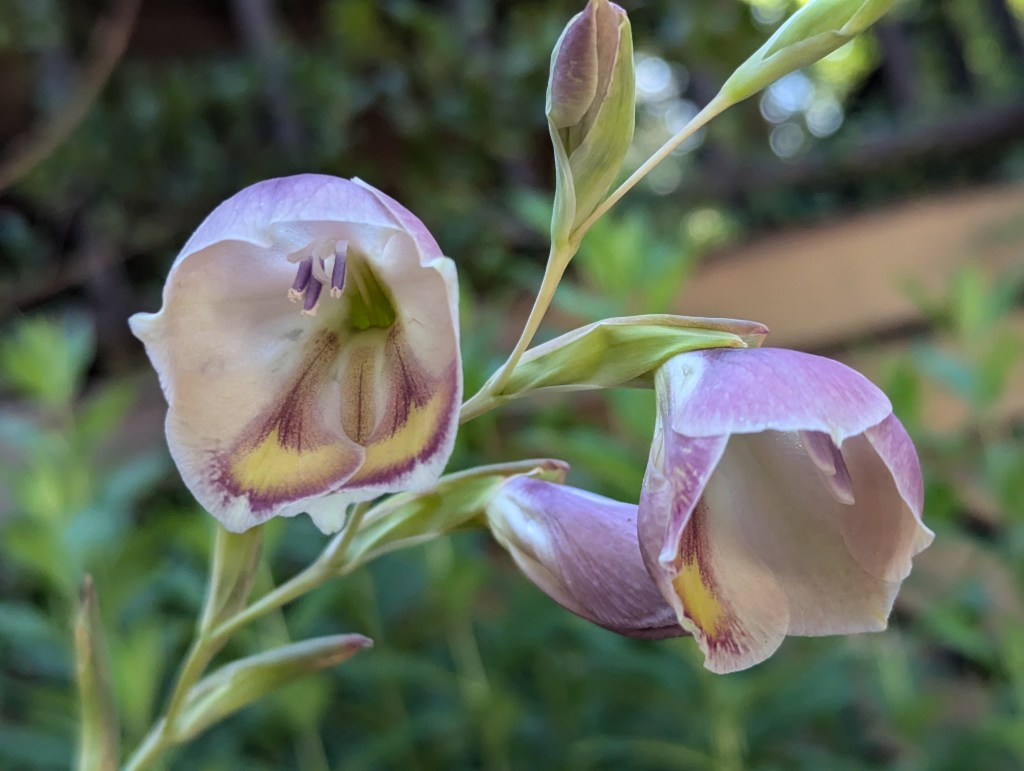
Gladiolus papilio, butterfly gladiolus has been performing very well, and, unlike the more common fancy hybrid gladiolus, it has been very reliably perennial. It multiplies and migrates like a wildflower. I know that I brag about it more than I should, and I just posted a picture of it for Six on Saturday last Saturday, but it happens to be one of my favorite perennials now. It was a gift from Tangly Cottage Gardening in the autumn of 2018, almost six years ago. Prior to that, I had been wanting to grow perennial gladiolus for quite a while, although I was not familiar with such species. I was only familiar with the common fancy hybrid sorts, which are generally not reliably perennial. Gladiolus murielae, Abyssinian gladiolus that arrived a few years ago as a gift from a neighbor may eventually inhabit a different portion of the same landscape that the butterfly gladiolus inhabits. It neither multiplies nor migrates as much as the butterfly gladiolus, and is a bit more garish in bloom, but is both reliably perennial and compatible with wildflowers, and technically, is probably more appropriate to that particular refined landscape. Various cultivars of Watsonia, bugle lily, most of which also came from Tangly Cottage Gardening, could also inhabit the same landscape. There is no rush to decide anytime soon, and the refined landscapes at work are constantly evolving. Within my home garden, I can be less concerned with how visually compatible some of such species and cultivars are, and be more concerned with growing what I enjoy. After all, that is how I acquire so many odd species and cultivars with so much history and from so many important gardens, and even from so many natural ecosystems. It is what makes my home garden so important to me.




 Tony Tomeo