All but one species of Clarkia are native somewhere in California.
Like California poppy, sky lupine and various other native wildflowers, godetia, Clarkia amoena, seems to prefer its own space. However, it is somewhat more adaptable than some other natives are to regular irrigation and coexisting with exotic (non-native) wildflowers that are not too overpowering. It is a common component in wildflower mixes, and is more likely than most to naturalize after the other wildflowers have died out.
It is best to sow godetia seed in autumn, directly where the flowers are wanted, so that the seed get watered in by rain and begin to grow through winter and early spring. Bloom begins later in spring or early summer. In areas that do not get watered regularly, occasional watering prolongs bloom. Fertilizer can actually interfere with bloom though. As bloom finishes, deteriorating plants should be left to disperse seed for the following year.
The two inch wide flowers are typically pink or purplish with red blotches or veining. Some are very pale pink or nearly white with deeper pink blotches at their centers. Most godetia are only about a foot or two tall. ‘Dwarf Gem’ stays less than a foot tall. Taller types get nearly three feet tall. The lanky stems are adorned with narrow light bluish green leaves that are about half an inch to one and a half inches long.
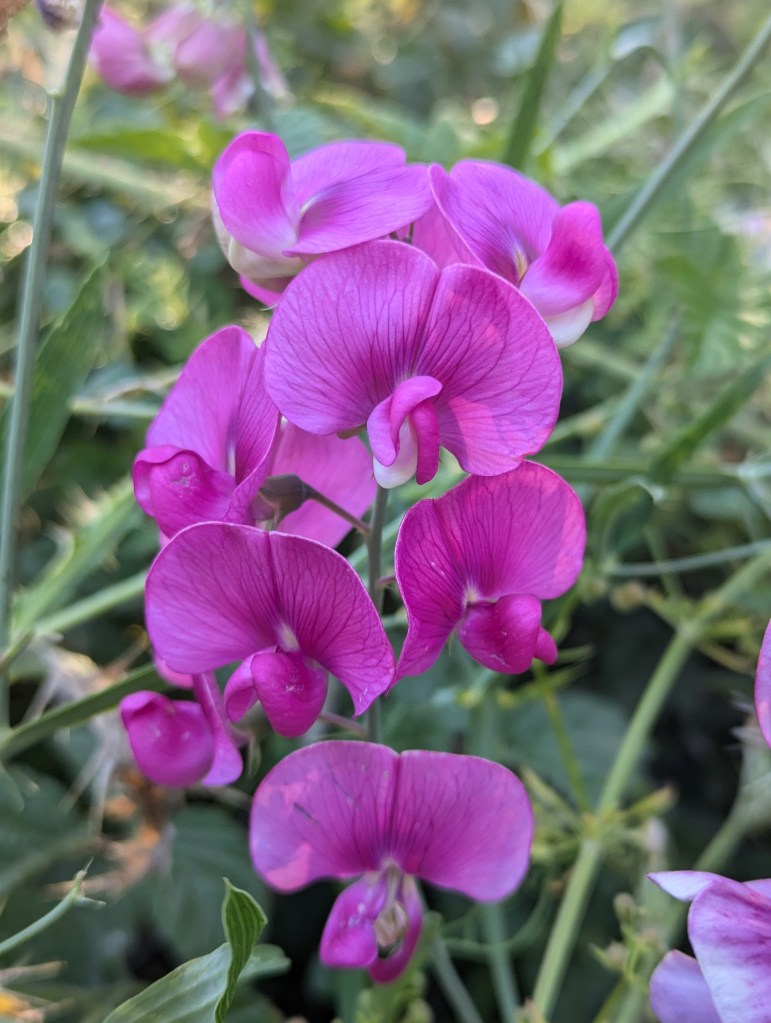
Now that the weather is getting hot, perennial pea, Lathyrus latifolius, is finishing bloom. It needs warmth to bloom, so can begin between the middle or end of spring. However, it shrivels in heat, so can finish between the beginning and middle of summer. Sometimes, it can bloom for almost three months. Sometimes, it finishes almost as soon as it starts.
Perennial pea is more popular as a naturalized wildflower than within home gardens. Its seed is rarely available from nurseries. Young seedlings might not grow very big initially. Mature specimens can vigorously climb and creep more than seven feet in any direction. Their fibrous perennial roots are very difficult to kill. Propagation by root division is easy.
Almost all perennial pea blooms with an abundance of bright pinkish magenta flowers. A rare few bloom with slightly striated light pink flowers. A bit fewer bloom with bright white flowers. Bloom resembles that of annual sweet pea, but is less frilly and lacks fragrance. Slightly bluish foliage and stems have a soft texture, and recover slowly from disruptions. Any parts can be toxic if ingested.
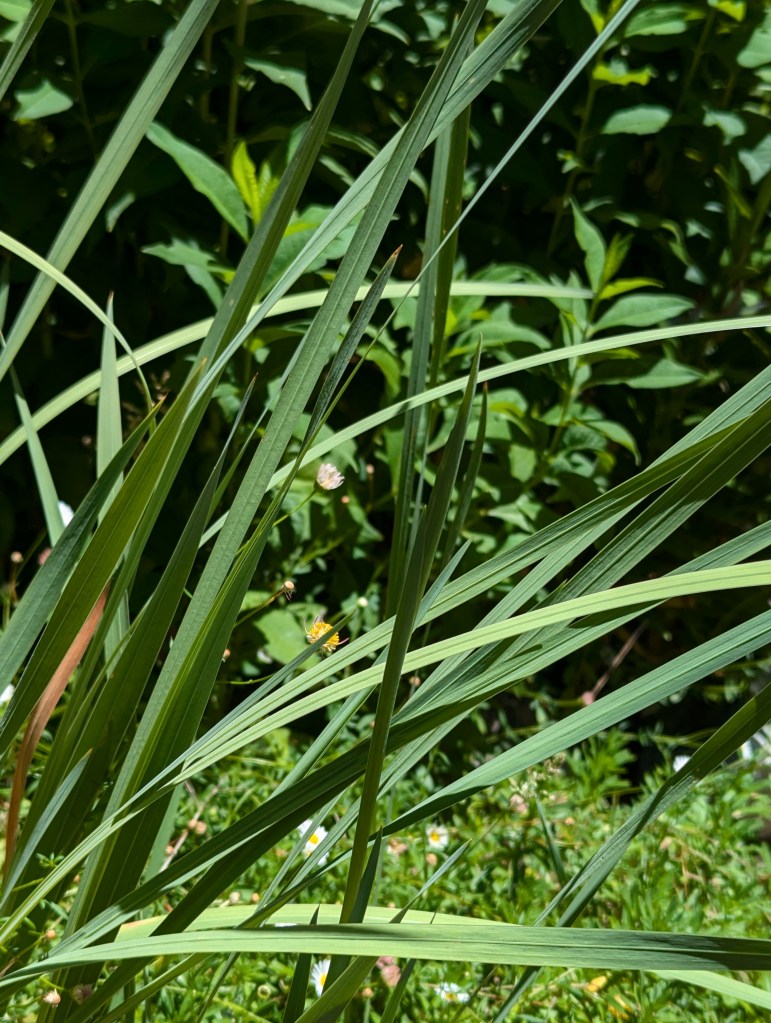
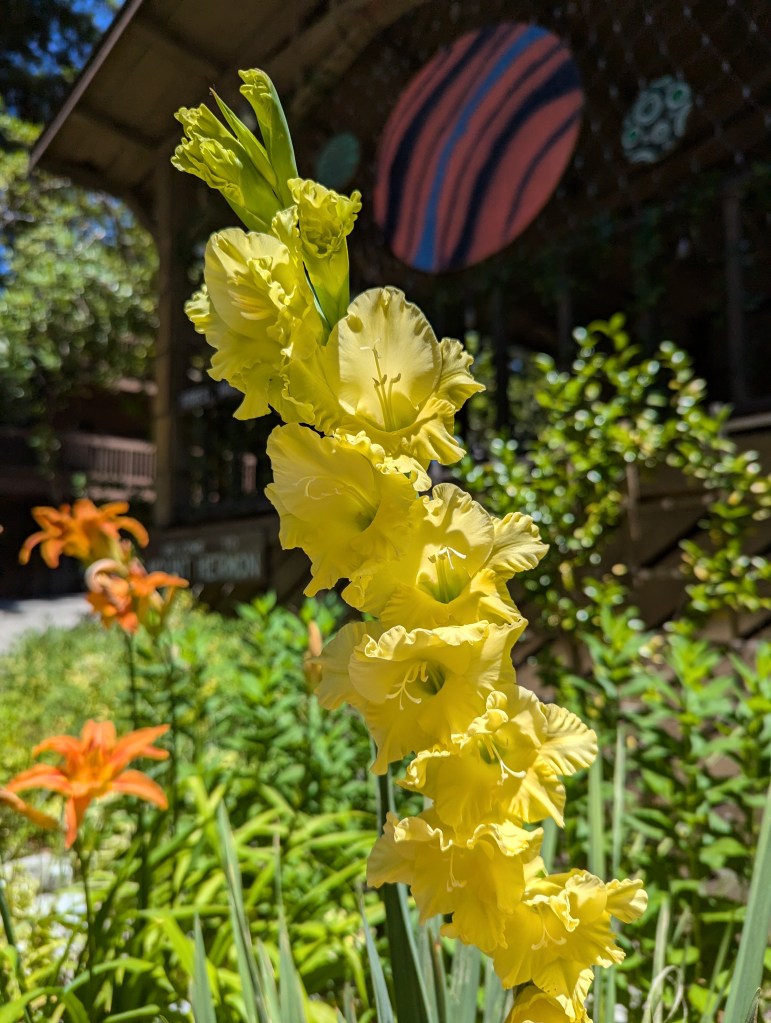
Butterfly gladiolus will not bloom for a while. Abyssinian gladiolus may not bloom at all. Hybrid gladiolus, though, are already finishing. I got these few pictures while I can, and will likely get pictures of butterfly gladiolus as they bloom later. I am glad to do so. They are my favorite gladiolus. They are more like wildflowers than overly bred hybrids. Also, they are very reliably perennial. I hope that the Abyssinian gladiolus perform also. They are also supposedly reliably perennial, but are not in a very good situation here. I should relocate them, perhaps closer to where the butterfly gladiolus are so happy. The hybrids are earning my appreciation too. I was not aware that they had potential to be perennial.
1. Gladiolus papilio, butterfly gladiolus is my favorite, because it is from Tangly Cottage Gardening, is approved by Skooter, is reliably perennial, and it blooms like a wildflower.
2. Its foliage is rather grassy, which is more compatible with other wildflowers than wide leaves of more garish hybrid gladiolus. The corms multiply and migrate quite efficiently.
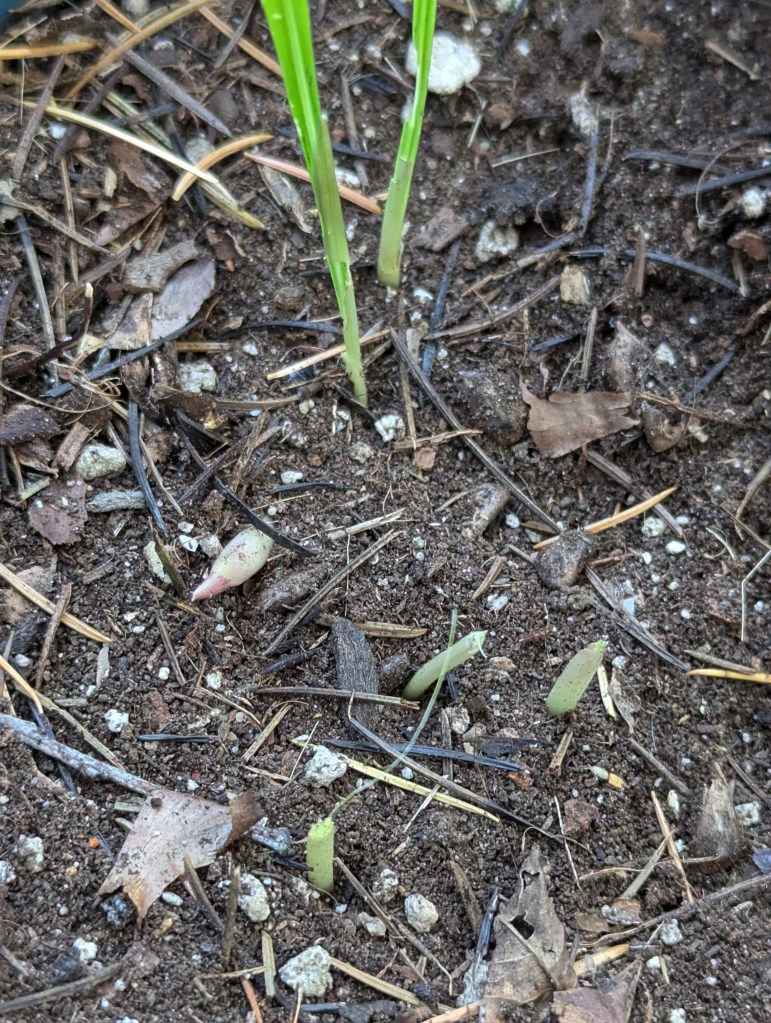
3. Gladiolus murielae, Abyssinian gladiolus is my second favorite, even while it is not so much to see. It is a gift from a neighbor. It should bloom for autumn, but I have doubts.
4. Hybrid gladiolus are the most colorful, but are not reliably perennial. However, these and two others have been blooming well here for several years, and actually multiplying.
5. This orange with yellow hybrid gladiolus was one of the first two to bloom again after a few years of producing only foliage. The yellow gladiolus joined them a few years later.
6. This purple hybrid gladiolus is the other of the first pair to resume bloom, although it does not multiply as much as the yellow gladiolus that resumed bloom a few years later.
It is impossible to say how long native wildflowers have adorned the natural landscape of California. Various lupines, California poppy and evening primrose had always been the most colorful wildflowers locally until they began to be displaced by exotic (non-native) plants only in the past two centuries or so. Although natives are remarkably resilient to dry summers and occasional wildfires, they are not very competitive with more aggressive and prolific invaders. What the natives and exotics have in common though is that they are so well adapted to local environmental conditions that they are able to perpetuate without much help.
Lupines, poppies and evening primrose, as well as native yarrow, godetia, and fleabane, may unfortunately need a bit of help if exotics want to move into their territory. In areas that are regularly or even only sometimes watered, weeding to remove more aggressive exotic plants helps the natives stay in control. They should otherwise do well on their own. Although without irrigation their growing season is much shorter, natives are slower to be displaced, since so many of the otherwise competitive exotics are not adapted to dry summers.
Many exotic flowering annuals are prolific enough to almost become naturalized, but are not quite aggressive or adaptable enough to get very far from cultivated landscapes. Cosmos, nasturtium, alyssum, catchfly (silene), four o’clock, gaura and foxglove self sow so readily that they are considered by some to be invasive. Some of us instead consider them to be ‘reliable’. They can be useful for unrefined parts of the garden that we do not mind watering, but otherwise do not want to put much effort into.
However, foxglove and even nasturtium can actually become noxious weeds in coastal areas not too far from here. I think that forget-me-not, feverfew, baby tears and English daisy can be problematic anywhere that they get enough water. Also, most annuals eventually revert to more genetically stable forms; which is why all varieties of dwarf nasturtium eventually bloom with the same yellow or orange single flowers. Yet, if we can distinguish between the plants that we can appreciate for their reliability and those that can be too invasive, native and exotic wildflowers and not so wild flowers can make gardening a bit easier.
(This article is from 2010, so contains irrelevantly outdated information.)
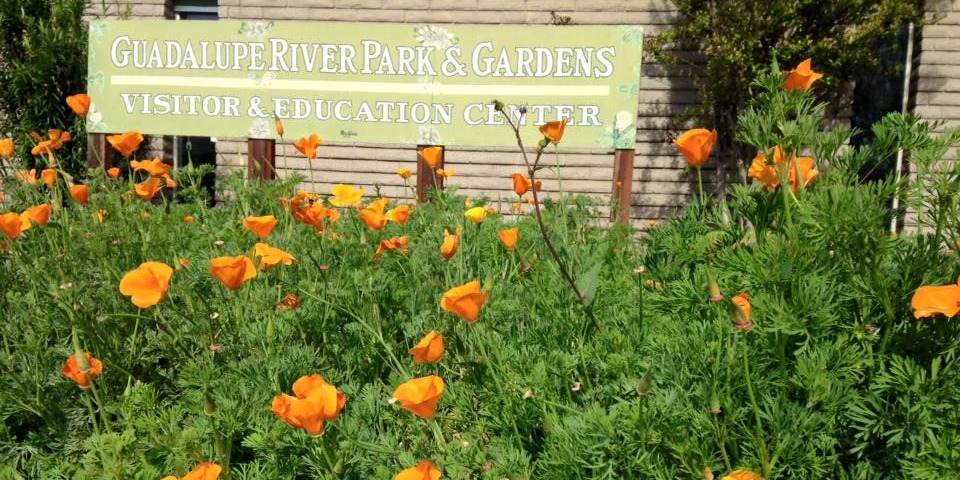
Now that the world renowned San Francisco Flower and Garden Show is over, it is time for an even more important horticultural event; Spring in Guadalupe Gardens, on April 24, between 10:00 a.m. and 3:00 p.m.. This celebration of Guadalupe Gardens, Earth Day and the Great Outdoors may not be as big and as fancy as some of those ‘other’ shows, but it is so much more important because it is local, centered around the Guadalupe Gardens Visitor and Education Center, which is located at 438 Coleman Avenue in San Jose.
My favorite part of Spring in Guadalupe Gardens is all the vendors of unusual plants. In past years, I found several fuchsias, aloes, cacti and weird tomato plants at Spring in Guadalupe Gardens. I never know what to expect until I get there. I hope to find unusual fig trees this year.
Spring in Guadalupe Gardens is also a great opportunity to meet with representatives of all sorts of gardening clubs. Gardening questions can be brought by the Master Gardeners of Santa Clara County’s Gardening Advice booth, where I will be working throughout the day. There will be workshops and lectures, music and entertainment, as well as fun activities for children.
Spring in Guadalupe Gardens happens to be at the same time as the peak of bloom in the Heritage Rose Garden, which is the largest public garden in the United States of America dedicated to the preservation of old roses. There will be tours in other gardens and trail walks too. If I did not need to work at the Gardening Advice booth, I would want to tour the Historic Orchard, which is literally a tree museum of the many fruit trees that once filled the vast orchards of the Santa Clara Valley.
Earth Care Recycling will host a free electronic waste drop off at the Visitor and Education Center to collect all sorts of computers, keyboards, monitors, televisions, stereos, radios, printers, fax machines, telephones, cell phones, DVD players and VCRs. (I thought mine was the last of the VCRs!) Proceeds benefit the Guadalupe River Park Conservancy.
Admission and parking are free. Just follow the signs from Coleman Avenue or West Taylor Street. More information about Spring in Guadalupe Gardens can be found at www.grpg.org or by telephoning 298 7657.
The unfortunate news about the Wildflower Show organized by the Santa Clara Valley Chapter of the California Native Plant Society and the Mission College Biological Sciences Department is that it will be at the same time (with another hour until 4:00 p.m.). The fortunate news is that it will continue the following day on April 25, so we all can attend both events! The Wildflower Show will be at Mission College in Santa Clara. Parking in lot C and admission are free.
More than four hundred specie of wildflowers and native plants will be displayed and accurately labeled. There will be free classes for native plant identification and wildflower gardening, and nature activities for children. Books, posters, seeds and note cards will be available for purchase. More information can be found at www.cnps-scv.org, or by telephoning 650 – 260 3450.
Sky lupine grows wild here. (This may actually be arroyo lupine.)
If California poppy were not the State Flower of California, sky lupine, Lupinus nanus, might be. Even though the perfect blue of sky lupine is the opposite of the perfect orange of California poppy, both of these brightly colorful flowers have several similarities, and are often sown together in autumn or winter for their early spring bloom. Both are native to western North America, but are very commonly displaced by exotic (non native) plants. As natives, they can easily self sow if competing specie are controlled. Both are satisfied with annual rainfall. As long as they are not watered too much in poorly draining soils, they are not too discriminating about soil. They do want full sun though.
Sky lupine is an annual that does not get very large, no more than two feet high and half as wide. It seems to be more colorful where it is kept less than a foot high by good sun exposure and wind. The finely textured, palmately compound foliage (divided into smaller leaflets that are arranged in a palmate pattern) gives it width, but only the lower half of its height. The upper half is its narrow spikes of small, neatly arranged ‘pea-shaped’ flowers.
Ceanothus of all sorts are collectively known as California lilac. A few uncommon species are also known by alternate names that might confuse those who are unfamiliar with them. Most species happen to be native to California, although most are not exclusive to California, and a few are not native to California. The species with the most extensive range is native to the eastern half of America, which does not include California. Incidentally, it is known more familiarly as New Jersey tea.
Ceanothus is not actually related to lilac. It merely blooms within the same season, with tiny flowers in floral trusses that are smaller but sort of shaped like those of lilac. The most traditional lilac bloom with lavender floral color, but a few cultivars bloom with pale blue floral color that sort of resembles that of some of the Ceanothus. Most Ceanothus bloom is richer blue, and some is pale white. The most fragrant of Ceanothus bloom is only mildly fragrant, and only in abundance. Most Ceanothus bloom lacks fragrance or smells rather dusty. Lilac, of course, is famously fragrant.
California lilac is therefore neither notably Californian nor a type of lilac. Nonetheless, during spring, we appreciate its bloom, both within refined landscapes and in the wild. It does not last for long, but it can be impressive, particularly among wild specimens that can grow larger than those within confined landscapes. The blue floral color of the majority of wild specimens and perhaps all cultivated specimens is comparable to that of native lupines, and contrasts splendidly with bright orange California poppies that bloom at about the same time. California lilac that grows wild need no maintenance, and although individual specimens do not last long enough to get old, they reliably replace themselves like so many native species do.
Although not native, gaura, Oenothera lindheimeri, can almost naturalize as if it were. All it needs is occasional watering through summer. It performs better with regular watering. Individual specimens live for only about four years. Some may last for only a single year. However, their abundant progeny are likely to replace and perhaps overwhelm them first.
Gaura prefers sunny and warm exposure. Shade causes sloppy form. Naturalized gaura has potential to become weedy or invade other vegetation. Seedlings relocate efficiently. Cutting back old growth as it deteriorates through winter promotes vibrant spring growth. Concurrent removal of the shabbiest old specimens favors vigorous younger specimens.
Collective growth is mostly less than five feet deep, with wispy and lightly foliated stems. Basal leaves are bigger than tiny upper leaves. Airy flowers are only about an inch wide. Floral color is mostly pale pink. Seedlings of cultivars with white or richer pink bloom are not necessarily true to type. Neither are seedlings of cultivars with richly bronzed foliage. Bloom continues from very early spring until cooler wintry weather.
It is endemic to every Californian County except for only Imperial County. It is endemic to every American State except for only Hawaii. Yarrow, Achillea millefolium, gets around! It is also endemic to many temperate climates of Europe and Asia. Apparently, it is not very discriminating in regard to climate or soil. It is as happy at the coast as it is farther inland.
Wild yarrow mostly bloom white or with pink blush. Modern cultivars bloom various hues of yellow, orange, red, pink or pinkish lavender. A few of the most florific modern cultivars are hybrids with other species. Phases of bloom might continue from spring until autumn. Tiny flowers form dense corymbs as broad as five inches, on stems as high as three feet.
Ferny grayish or light green yarrow foliage has a softly fine texture. However, it develops compact and mounded form. Individual leaves are tomentous and as long as six inches. Foliar aroma is variable among cultivars. Some cultivars may be objectionably pungent. Propagation by division of any overgrowth is easiest prior to the end of the rainy season.
These ‘Six on Saturday’ are even more outdated than my ‘Six’ that were outdated for last Saturday. They were taken at the same time, but are presently a week later. I really want to post them anyway though. I do not get to Southern California often, although some of these species also happen to be native here. All of this vegetation is native to, and grows wild within the Hollywood Hills, and specifically at the Bronson Caves, where I got these pictures. I brought back a few exotic species from the region, but did not take pictures of them. I can get pictures of them at any time, and they are not distinctive to Hollywood.
1. Clarkia bottae, punchbowl godetia was featured in my garden column. Now that I see it in bloom, I sort of wonder if it is what I thought, back in school, was evening primrose.
2. Eriophyllum confertiflorum, golder yarrow is merely my guess for the identity of this bright yellow wildflower. The floral trusses are smaller and rounder than they should be.
3. Eriophyllum confertiflorum, golden yarrow sort of looks like this. Well, I sort of think it does. I really can not remember. This is a bit farther back from the same bloom above.
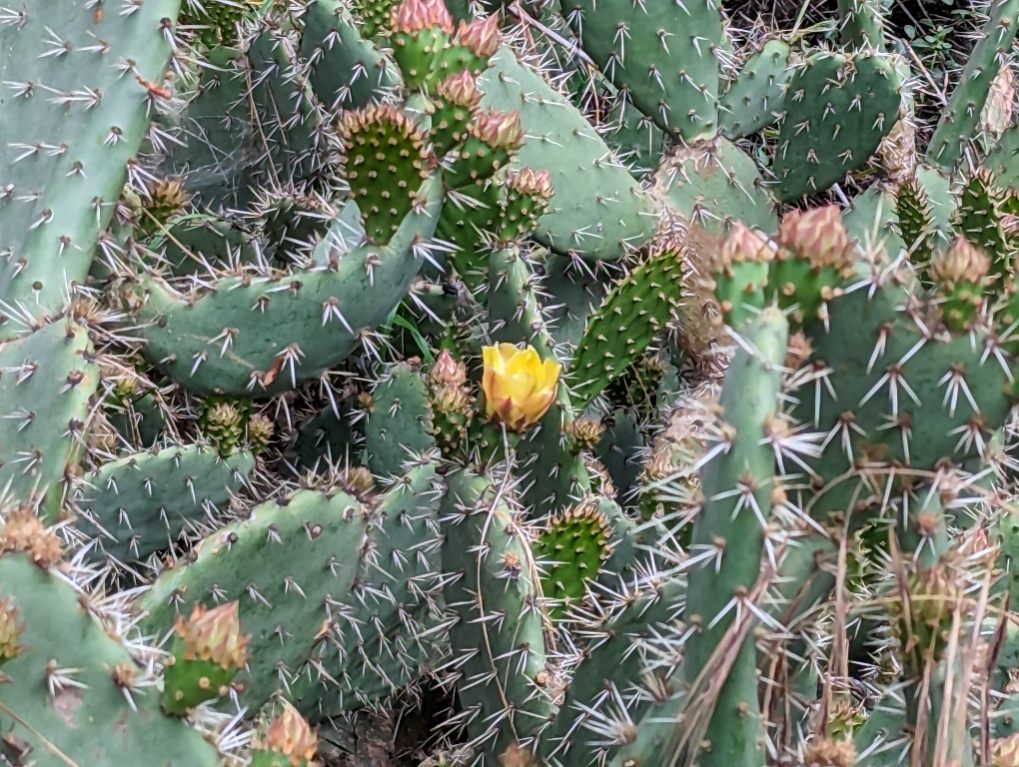
4. Opuntia phaeacantha or Opuntia littoralis, prickly pear is probably the same species as the big herd that I got a picture of for last week. This is a closeup, but of another herd.
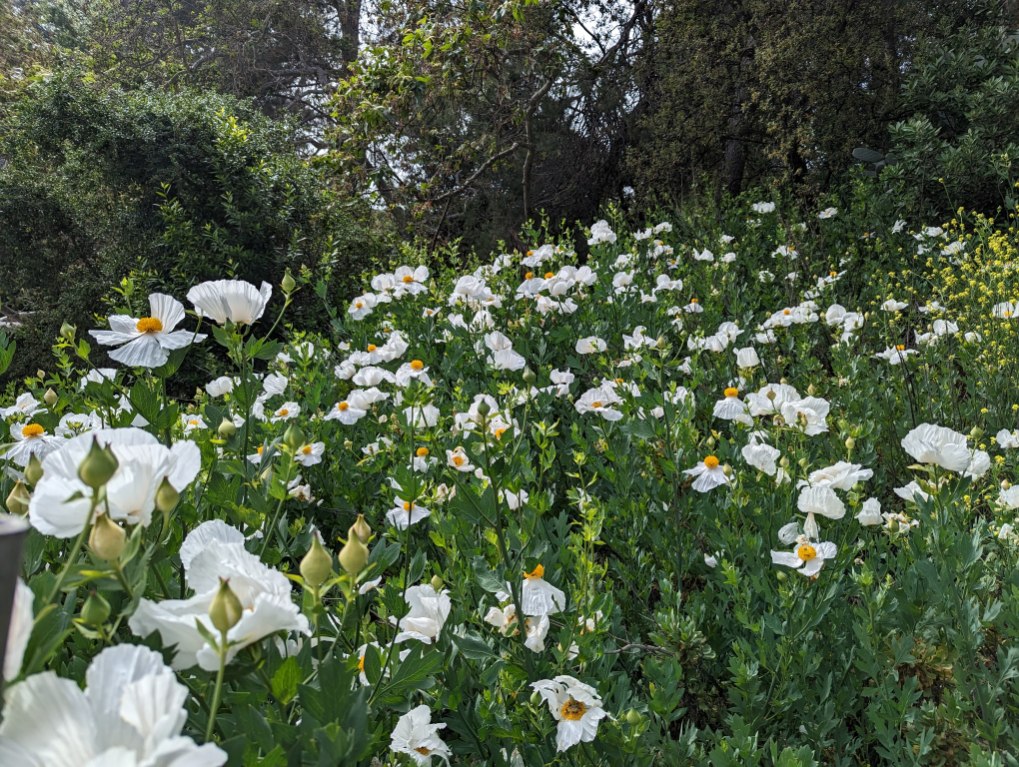
5. Romneya coulteri, matilija poppy is also known as fried egg poppy because the floppy white flowers with big yellow centers look like fried eggs. These were at least six feet tall.
6. Salvia mellifera, black sage is one of my favorite wildflowers here because I recognize it and its alluringly pungent foliar aroma from almost everywhere that I have ever lived.







 Tony Tomeo