Gophers

Do not underestimate the destructive potential of gophers!

Many of the yuccas that naturally live in deserts where forage may be scarce are equipped with an efficient defense system. Each leaf terminates with a nasty spine. Leaves are so abundant that the spines are impossible to avoid. It is amazing that these yuccas are as vulnerable as they are to gophers, who simple burrow below all the advanced defense technology to eat the starchy roots and any subterranean portions of stems.

Some of the techniques sometimes used to get rid of gophers are too dangerous to even discuss. Rodent poison (for rats and mice for example) is not only dangerous to other animals that may dig it up, but not often effective since gophers prefer to eat fleshy roots and stems. The only practical poisons can only be applied by licensed pesticide applicators.

New plants can be installed within ‘gopher cages’ that should exclude gophers from the root system at least long enough for the plants to get established. Gopher cages can be purchased ready-made, or can be constructed easily from chicken wire. They only need to be as deep as the planting hole, but can be wider for perennials that spread.

Gopher cages do not protect all roots, since some extend through the cage to disperse; but should protect enough roots to keep plants alive if outer roots get damaged. By the time the cages deteriorate, the plants within should be established enough to survive gopher infestation for a while; although even large plants can be killed by unrestrained gophers.

Properly used traps are the most practical means of controlling gophers. Traps should be installed in pairs, even though each pair typically catches only a single gopher. If possible, traps should be installed away from any gopher cages that may be present, since cages are difficult to work around, and nearly impossible to release from a sprung trap.

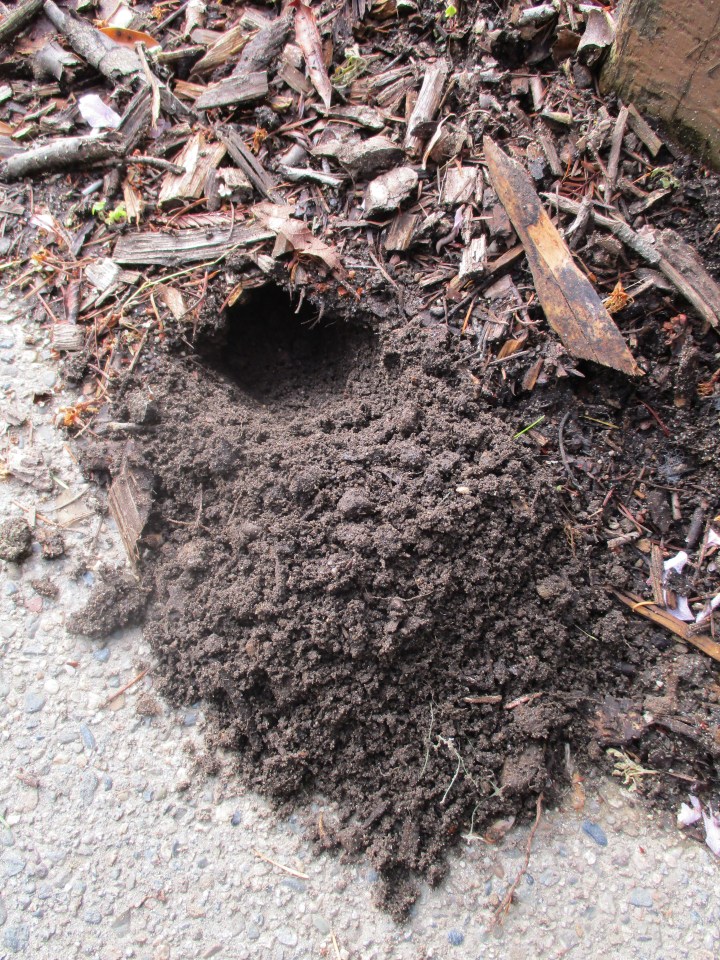
Once the entrance to a gopher run is found under a mound of freshly excavated soil, the entrance, which is typically filled with loose soil, should be excavated back as far as the main run, which extends perpendicularly to the right and left. The main run should be cleared of loose soil.

Each of the two traps can then be set and gently placed within the main run in each direction. A trap should be held by the spring end so that the claws and lever extend into the run. Wires attached to the spring end of the traps are easier and safer to pull the traps out with later, instead of digging the traps out. These wires can be attached to a stake to make them easy to find later.

The entrance hole should then be buried. Air circulation from outside will prompt the gopher to collect loose soil to plug the hole, and push the loose soil ahead, springing the trap prematurely.

The gopher within may not be interested in using the same entrance to expel soil, but will likely use the same run. Two traps are used because there is no way of knowing which direction the gopher will approach from. The unfortunate gopher can be removed in a day or so; so that the traps can be set into another run where fresh excavation has been observed.
Protecting Fruit From Hungry Wildlife

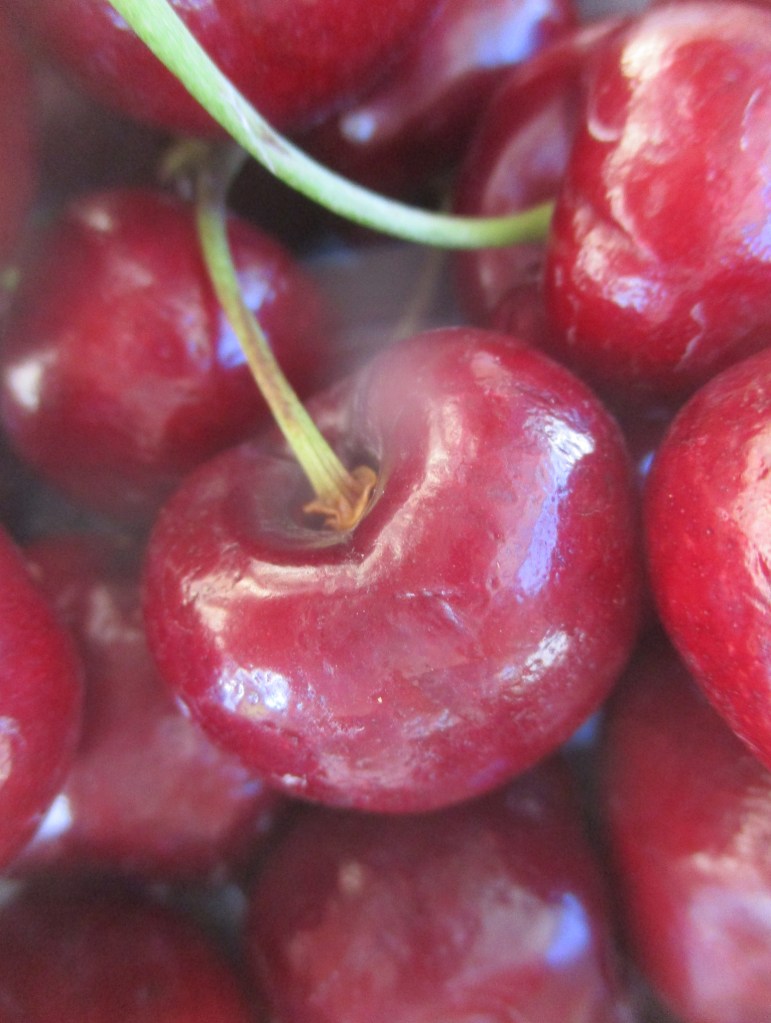
Cherries are too tempting for birds.

Dormant pruning of deciduous fruit trees last winter should finally be proving its benefits. Such pruning enhances tree vigor and resilience to disease. As importantly, it enhances fruit and nut quality. Birds, squirrels and perhaps other wildlife are unfortunately noticing. Protecting fruit as it ripens may seem to be impossible. Sharing might not be acceptable.

The problem with sharing is that most wildlife is greedy. Wildlife that is not greedy can be too generous by inviting their friends over to indulge. They may not consume everything, but might damage all that they can not consume. Protecting fruit does not deprive wildlife of sustenance that they require for survival. It merely diverts their exploitation elsewhere.

The problem with protecting fruit is that it can seem futile. Even if wildlife could read, they would not comply with signs telling them to keep out. Cats and dogs can not chase them all away, and can not be there to try all the time. Techniques that are somewhat effective for some wildlife are not effective for all wildlife. However, some techniques are effective.

Protecting fruit requires some degree of familiarity with whomever wants to exploit it. Not many deterrents are effective for all of them. Netting is only effective for marauding birds, but not rodents, who can chew through it. Because it is so difficult to install, and worse to remove, other options are better anyway. Flash tape repels some birds rather effectively.

Protecting fruit from squirrels is more challenging. Tree trunk baffles can only be effective if there is no other access to the subject trees. They are useless if squirrels can jump into low limbs from the ground or adjacent trees. Growing rosemary, lavender or mint around fruit trees is supposedly a mild deterrent. However, it obstructs maintenance of the trees.

Plastic snakes or owls might be effective for protecting fruit from both squirrels and birds. Plush toys might be as effective since squirrels and birds do not recognize them as safe. However, such effigies eventually become uselessly familiar without frequent relocation. Squirrels and birds may not seem to be very intelligent, but they are not too stupid either.

SQUIRREL!

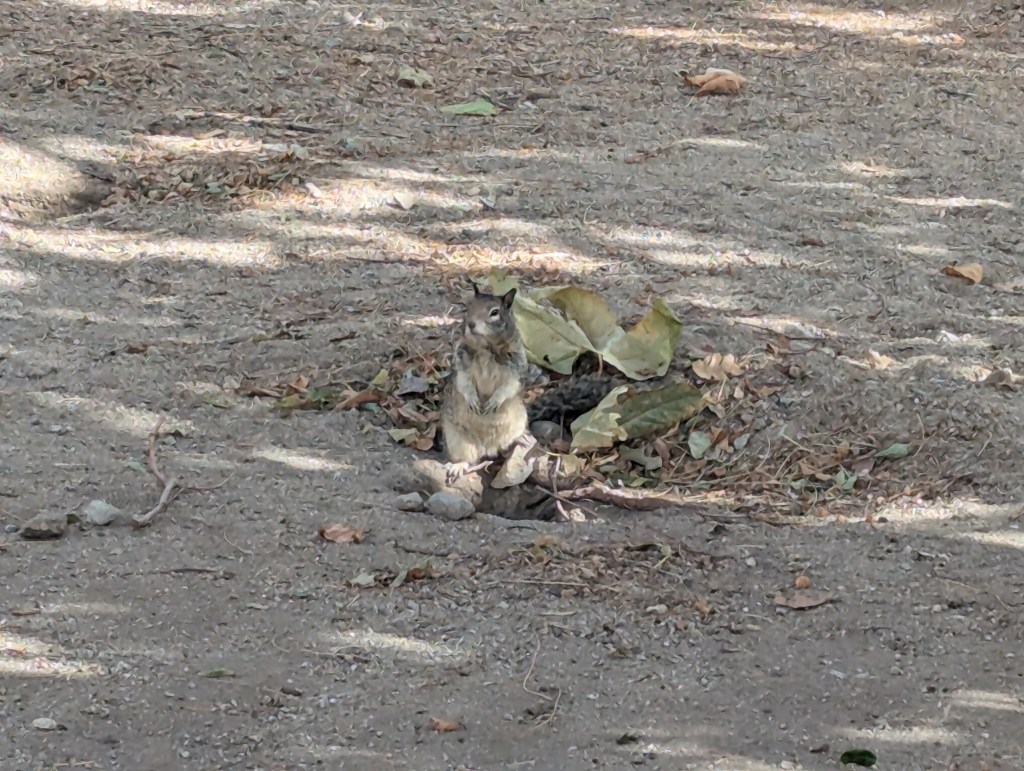
This is no ordinary squirrel. It is likely a ground squirrel, since, as such a designation and its presence on the ground suggest, it likely lives in the ground. That divot on the ground in front of it seems to be a burrow, presumably where it lives. It seems to be rather plump for a ground squirrel. Perhaps it could be a common squirrel who lives on or under the ground because it is too plump to live in trees. I have no idea. We did not get any more acquainted than necessary for me to get this picture from a significant and what I considered to be safe distance. Although a squirrel like this could inflict major injuries, I doubt that it can move very fast. It reminds me how fortunate that we do not contend with such large rodents at work. Gophers are small but very destructive to the vegetation within our landscapes. I do not want to know how much damage this squirrel or whatever it is is capable of. It must consume a considerable volume of roots, foliage or whatever it wants to eat. Supposedly, such squirrels, whether in trees or in the ground, are not as destructive as gophers, but I do not know what to believe. I suppose that some wildlife is more obviously worse. Fortunately for us, deer avoid our landscapes, though we could do nothing to exclude them. No one knows why. Much larger herbivorous wildlife that inhabit other regions, such as the Pacific Northwest are more voracious than deer. I can not imagine the extent of damage that just a single moose is capable of. Nor do I know how such wildlife can be excluded from landscapes. It seems to me that a moose can probably go wherever it wants to.

Birds Enjoy Colorful Fruits and Berries.

Brightly colored berries are an incentive for birds to disperse the seed within.

Colorful fruit and berries that ripen in autumn and winter bring more than their own color to the garden. They also attract all sorts of birds. Some birds want to fatten up on the earlier and typically more abundant and colorful fruit before migrating south for the winter. Other birds that stay through winter eat fruit and berries that develop over a longer season, after the migratory birds are gone.

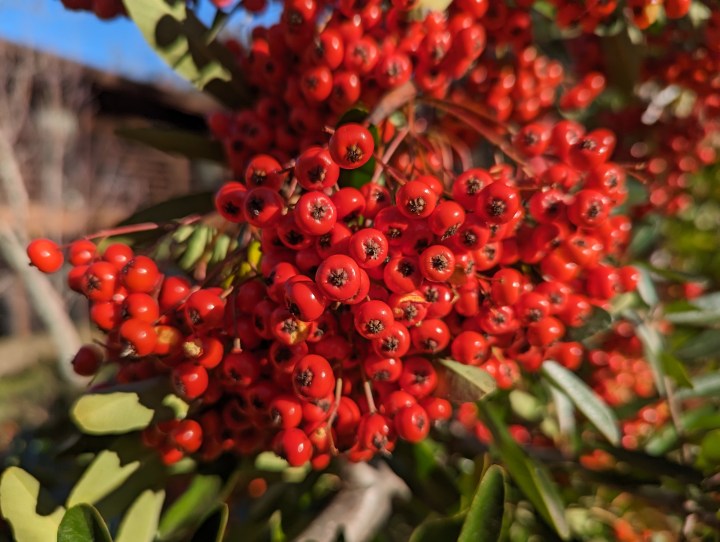
The most abundant and brightly colored red fruit of pyracantha (or firethorn) appeals to the early migratory birds that want to fatten up fast and get south. Cotoneaster, toyon and English hawthorn are not quite as flashy, but appeal to the same crowd of migratory birds. These sorts of plants get their colorful fruit early on in the season, but are then stripped of it rather efficiently.

The fruit of pyracantha, cotoneaster and toyon is not often very messy since almost all of it gets consumed; but the birds that eat it can be remarkably messy before they fly south. Coincidentally, these three plants are often grown as informal hedges and screens around the perimeters of large parking lots, so the mess is a traditional nuisance for many parked cars this time of year.

Chokeberry and elderberry ripen early enough for the migratory birds, but do not get devoured so efficiently because they are not so brightly colored. Migratory birds seem to prefer bright red or orange berries, so are likely to leave black chokeberries and blue elderberries for overwintering birds, which stay through winter. Strawberry tree, although not very productive, appeals to both crowds, and anyone else who might be interested in their fruit, by producing bright red berries throughout the year.

Persimmon, holly, loquat, some mahonia and some crabapple are even a bit more selective, by ripening their fruit later in autumn and winter after the migratory birds are gone. Pomegranate fruit splits open in the middle of winter, exposing a buffet of juicy red berries with meaty seeds for anyone who hasn’t gone south for the winter. Many pittosporums do the same, but without the colorful advertisement. Of course, most of us want to get our persimmons, loquats and pomegranates before the birds do!

Citrus such as lemons, oranges, grapefruits and mandarins that ripen later in winter do not attract birds, so we only need to share these fruits with our friends and neighbors. Citrus are colorful enough on their own anyway.

Horridculture – Rocky XXIV . . . or XXV . . . or XXVI . . . Oh, I can not count them all.

another sequel

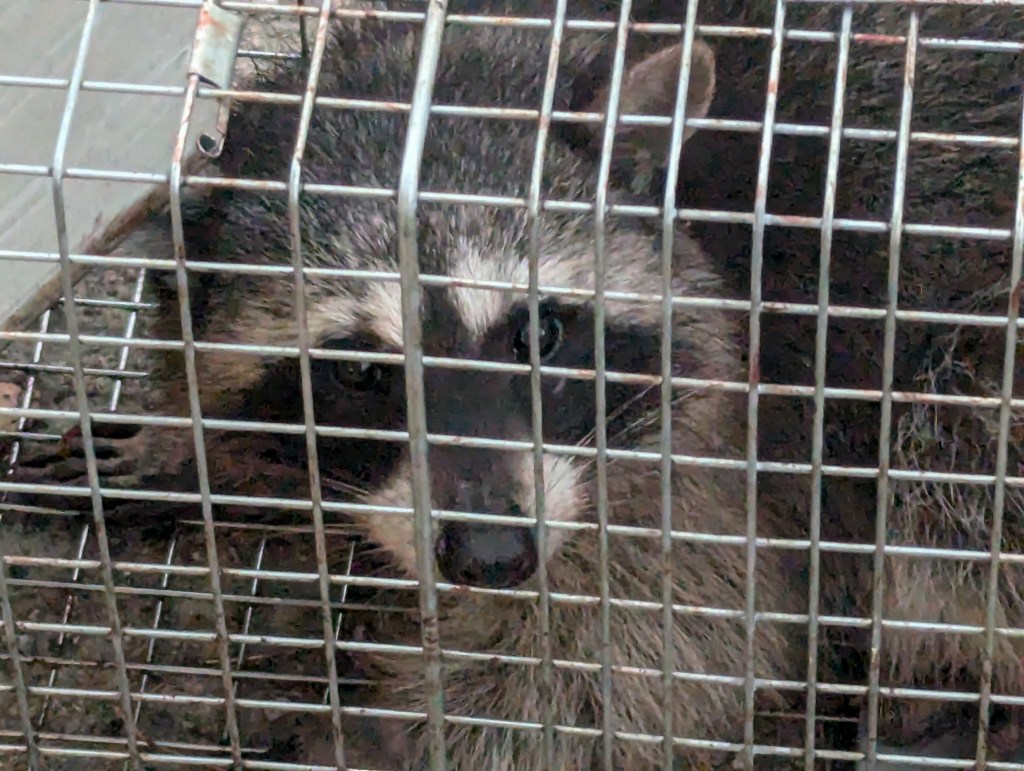
Winters are not very cold here. Otherwise, I might have assembled a fur coat. Instead, relocation of furs has been more practical than utilization. Besides, without exception, all were already in use when I encountered them. Actually, they were not relocated merely because I had no practical use for them, but, more importantly, because relocation was significantly less inconvenient to those who were wearing them at the time. Of course, it was not totally convenient either. That was sort of the objective. The inconvenience of relocation is a deterrent to those who wear the furs, who identify as racoons. They are unwelcome here. I realize that they eat mollusks and rodents; but neither mollusks nor rodents are problems here. I do not grow much vegetation that mollusks find to be appealing. Heather the kitty who identifies as a feline person is too proficient at deterrence of rodents to have use for any assistance. Actually, Heather is one of the two primary reasons that it is necessary to relocate raccoons. Rhody is the other. Unfortunately, raccoons have potential to become impolite or even dangerously hostile with my canine and feline housemates. Relocation does not permanently eliminate them, but it annoys them enough that, by the time they return, they are much more careful about avoiding us and our space. Also, their impressionable associates seem to learn from their examples. Because they can not be relocated off of the property, they go less than a mile away. So far, that seems to be sufficient. I do not know how long it takes for them to return, but I suspect that it takes quite a while. After this most recent relocation, I do not expect another relocation to become necessary until members of the most recent generation mature enough to become a problem.

WWF

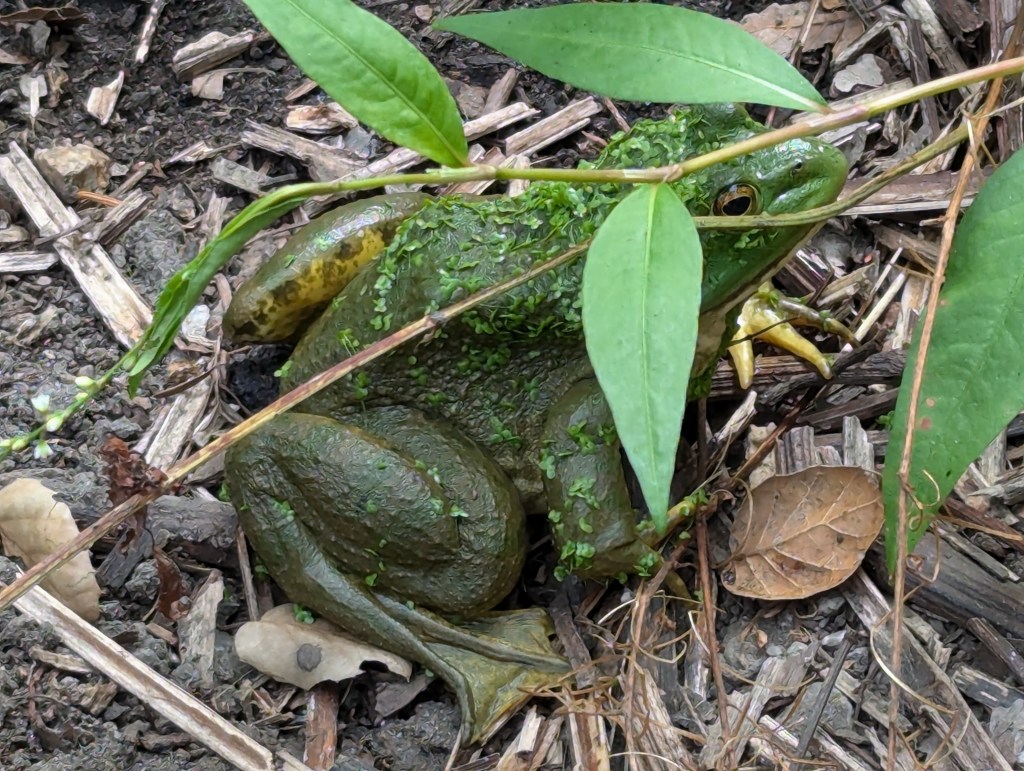
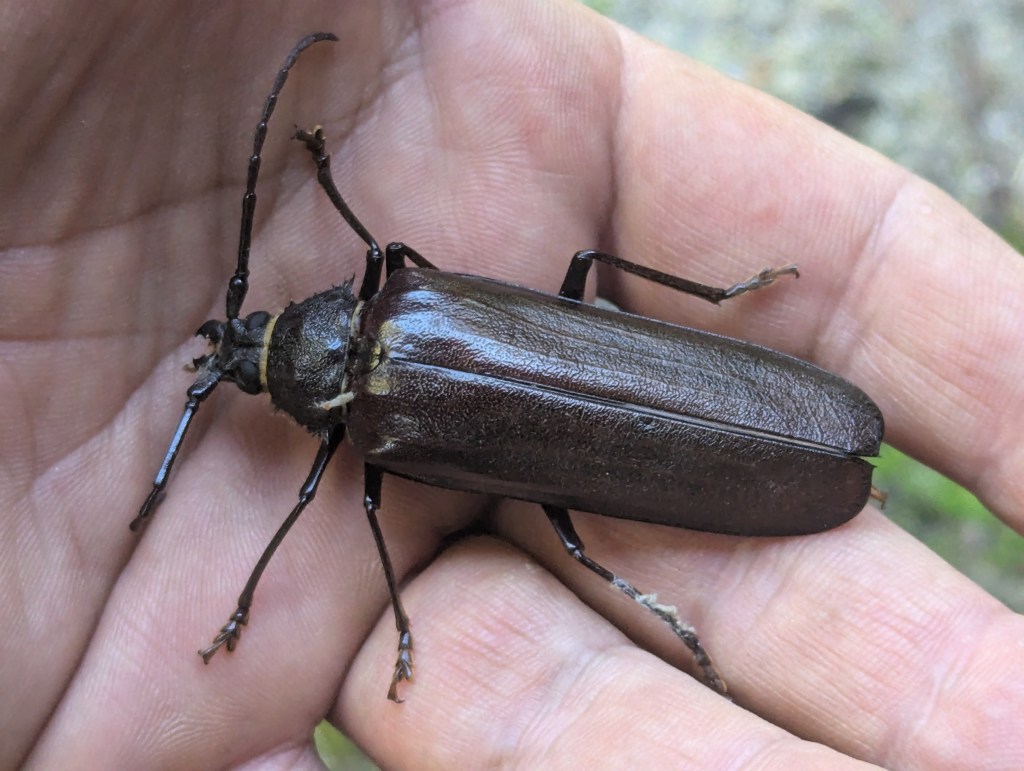
The World Wrestling Federation is now known as World Wrestling Entertainment because the World Wildlife Fund was already known as the WWF. The dude in the picture above could go either way. Apparently, he, or she, is some sort of aggressively invasive exotic bullfrog. Nonetheless, he or she still qualifies as wildlife, and now inhabits the drainage pond that is within a cultivated landscape that is adjacent to natural forest ecosystems. I mentioned his or her presence to a biologist who then informed me of how much damage this particular species can do to any natural ecosystem that it infests. I then realized that the tree frogs that had been so loud through spring had been silent all summer. Although they naturally get quiet by summer, they are not normally so completely silent. I am now concerned that the bullfrog might eat small fish who might inhabit the pond. Duckweed obscures activity below most of the surface of the pond. I would not mind if the bullfrog ate the duckweed. He or she probably does, but there is just too much of it. This species of bullfrog is omnivorous, so will eat anything that it can get its big mouth around, including mollusks and insects. That could be beneficial, but might also include beneficial insects. Actually though, I am more concerned about any baby fish than insects. Besides, when I met the insect in the picture below, I was actually somewhat concerned about the unwelcome bullfrog. I do not want his or her demise to be as violent as the appearance of this insect suggests it could be. I have no idea what this insect is, but it looks like it should have a Volkswagen hood ornament. Getting it together with the bullfrog could be an event for the WWF!

Colorful Autumn Fruit Is For The Birds

Firethorn is typically the most colorful of autumn berries.

It is hard to ignore the slight bronzing of flowering pear trees in the neighborhood. The recent warm weather after such a mild summer may detrimentally accelerate the development of autumn foliar color, as well as the ripening of some of the colorful fruit that adorns gardens through autumn and winter. Sadly, there have been reports of scorched persimmons as well.

Despite their deviation from a more typical schedule, many of the plants that provide the most colorful fruit start to do so about now, just as birds want to fatten up for winter. My favorites of these provide fruit that I like to get before the birds do. I have already harvested gooseberries, currants and grapes, and am in the process of getting to the elderberries and black chokeberries. Pomegranates will ripen later in autumn. Citrus and persimmon will be ready later in winter, followed by loquat. Natal plum produces randomly all year.

Even fruit that I do not want looks good and keeps the birds happy though. Firethorn is probably the showiest and most popular of these, since it produces such abundant bright red berries that linger into winter. Some have orange or even yellowish berries. Cotoneaster and toyon are similar, but not so flashy. English hawthorn makes similar berries, but grows into a larger tree. Fruiting crabapples were harvested in early summer; but the ornamental, albeit sparse fruit of the flowering crabapples will linger after the leaves fall. Plants that provide abundant fruit that is popular with birds may not be so desirable near where cars are parked outside though, since well fed birds can be rather messy.

I am particularly fond of persimmon, pomegranate, English hawthorn and crabapple trees for other reasons as well. Persimmon trees will provide some of the best orange and red autumn foliar color. By the time it falls, there is plenty of comparably bright orange fruit to replace it! Pomegranate blooms with few but bright reddish orange flowers in summer. English hawthorn and crabapple trees are among the most abundant of spring blooming trees. Some of the flowering crabapple trees bloom with unique shades of bright pink and nearly red. 

Heavenly bamboo, Oregon grape (Mahonia) and California pepper tree are not often grown for their colorful fruit, but sometimes like to show it off. Oregon grape is striking because the fruit is so dark purplish black. California pepper tree makes pendulous trusses of small pink berries. Snowberry is an uncommon native that makes few but striking white berries. 

History of Heather

Heather

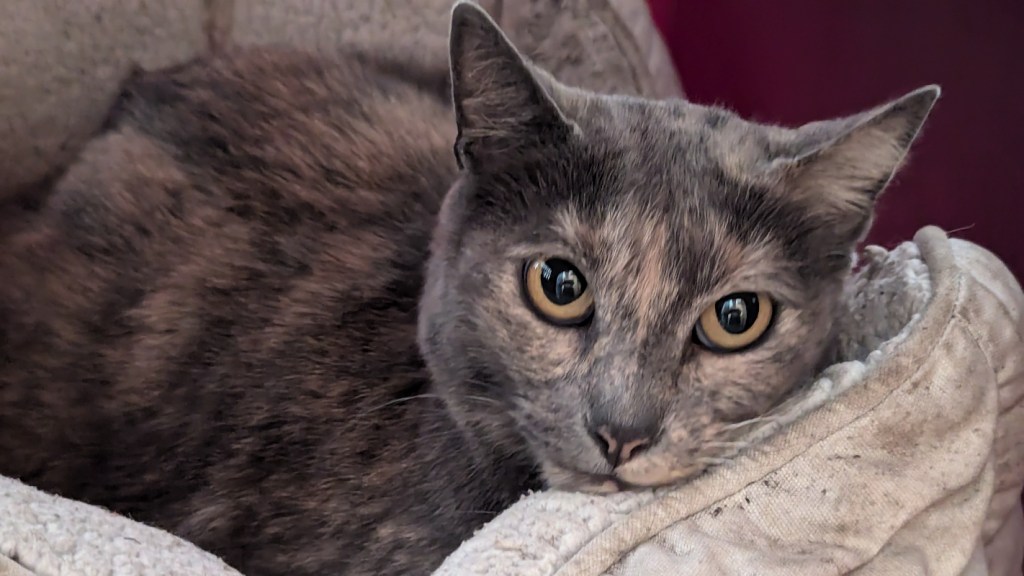
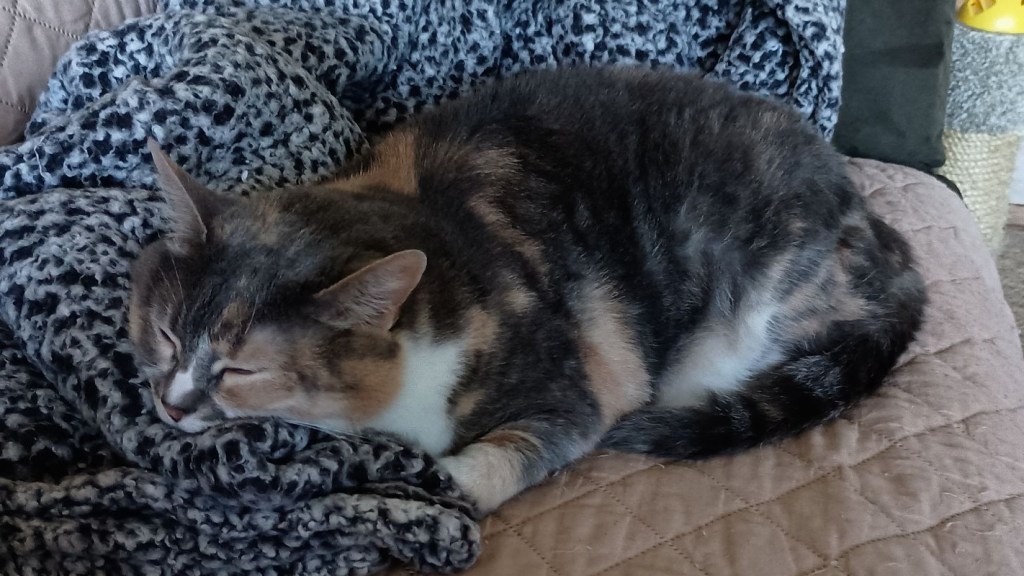
Heather just became a bit less mysterious. We now know why she came here to work as a mouser, and protect fruits and vegetables from rodents. A neighbor, prior to relocation to Hawaii, left her and a few other kitties with another neighbor who intended to find new homes for them. Another kitty who already lived at the second home was so inhospitable to her that she stayed outside most of the time, and eventually disappeared. She was assumed to have been a victim of coyotes. All but one of the relocated kitties, who happens to be Heather’s mother, were assigned to new homes. Heather’s mother and the original kitty of the household then relocated a few miles away. It is impossible to know where Heather was between leaving her previous temporary home and arriving here. She could have been here longer than anyone was aware of. Because we knew nothing about her when she arrived, she likely got more vaccines than she needed. She was already spayed, although not provided with a chip. Ultimately, she seems to be happy here, and has been very proficient with dissuading rodents. I am pleased that she is happy and decided to stay.

Heather’s Mother

Madonna & Black Lace

Sambucus nigra ‘Black Lace’ European black elderberry

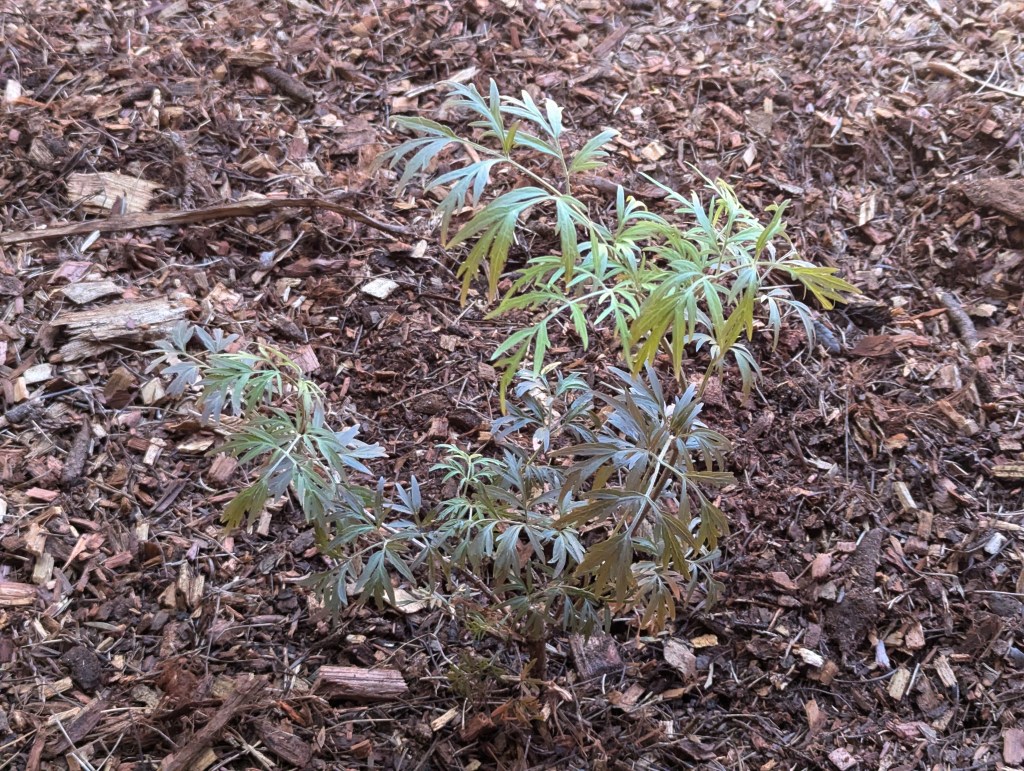
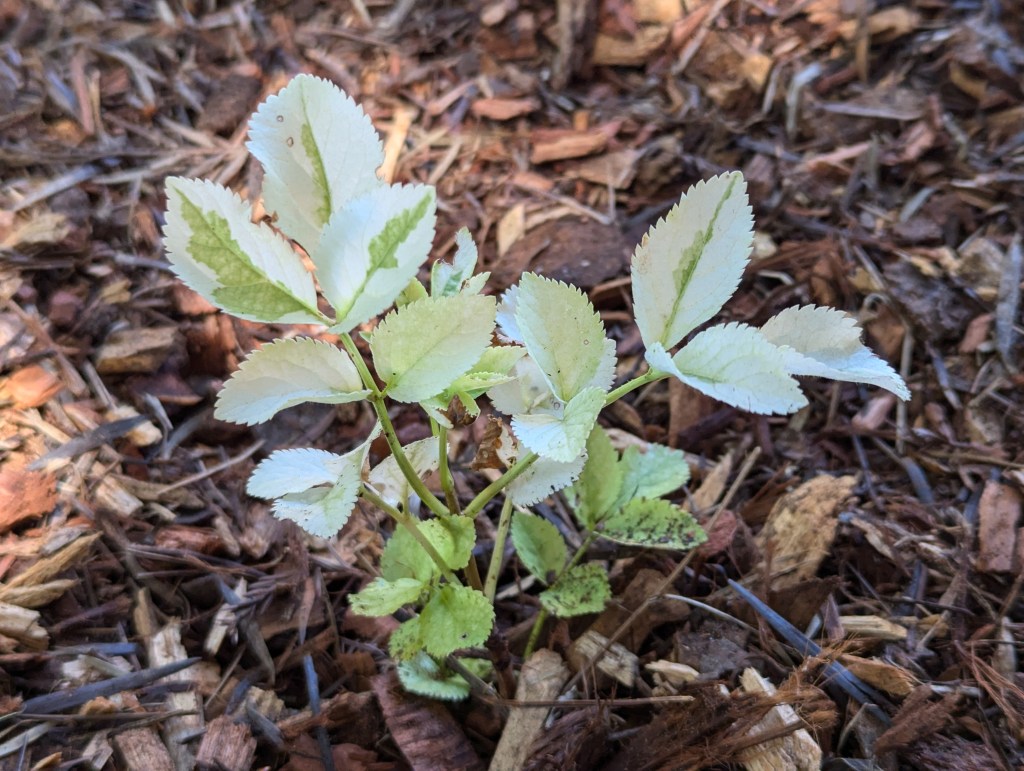
1984 was four decades ago. This is happening right now. Sambucus nigra ‘Black Lace’ European black elderberry, with intricately lacy and richly bronzed foliage, and flaring upright form, has inhabited one of the landscapes here for a few years. I was initially not so keen on it, but eventually learned to appreciate it as others who saw it expressed fondness for its distinctive texture and color. It was so popular that I grew a few too many copies from pruning scraps two winters ago, with the intention of adding a few more to other landscapes. I plugged a few more last winter, as if I did not know better. Several were shared with neighbors, but so far, only one was added to another landscape here, and only a few days ago. It may not look like much in the picture above, but should be a bit bigger and more richly bronzed next year. Sambucus nigra ‘Madonna’ European black elderberry, with simpler and yellowish variegated foliage, and somewhat more rounded form, was a more recent acquisition. Although I am not so keen on its yellowish color, it happened to become available while I was considering acquisition of a pollinator for ‘Black Lace’, which has not produced berries yet. Although each can self pollinate somewhat, different cultivars pollinate each other more effectively. Doves enjoy the resulting berries; and people enjoy seeing happy doves. The original specimen of ‘Madonna’ was thrashed when I acquired it, but provided more than sixteen rooted side shoot copies before going to live in a colleague’s garden. The first of these copies was installed adjacent to and in conjunction with the first copy of ‘Black Lace’. It may not look like much in the picture below, but it is just a dinky copy from a four inch pot.

Sambucus nigra ‘Madonna’ European black elderberry

Weed Eater

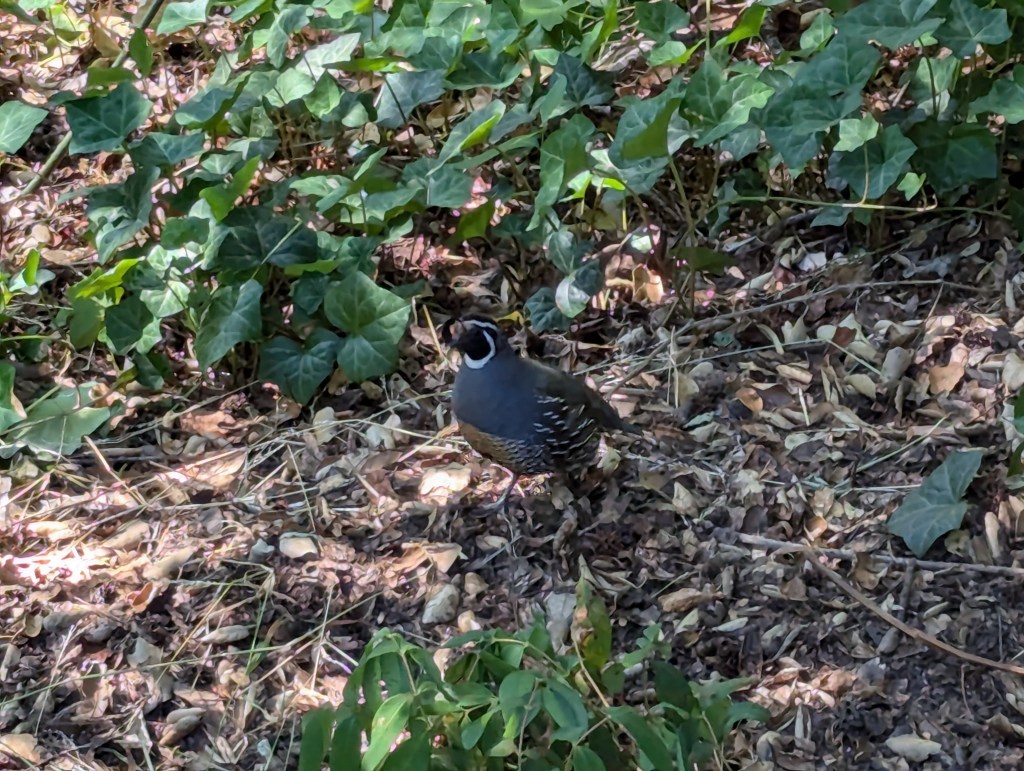
California quail are the Official State Bird of, as one might guess, California. They are delightfully plump but small game birds that are on the ground more than anywhere else. They fly only when necessary, and seem to avoid landing in trees or shrubbery. They effectively avoid predators by running into thickets of vegetation that their predators can not follow them into. Some believe that they sound like they say “Chicago” when they talk to each other. Actually though, they say “Hey Paco!”, in a politely mellow tone. They are a chaparral species that venture into adjacent forests such as the redwood forests here. Relatively colorful males, such as this, are typically followed by their visually subdued female mates after spring, and by now are likely to be followed by a herd of tiny and fuzzy chicks. Their motion on the ground is fluid, although most of a small herd can angularly and suddenly change direction, as if the Papa quail follows his silly apostrophe shaped topknot to the left or right, and the rest follow. They run about pecking at exposed soil, and often stop to scratch at forest debris where soil is not so exposed. Not only do they eat insects and mollusks, but most of their diet is seeds. Since only a negligible minority of seeds within our landscapes of desirable vegetation, such as naturalized wildflowers, almost all of the seeds that California quail eat here are those of weeds. They proactively eat weeds before they happen.