Cicada

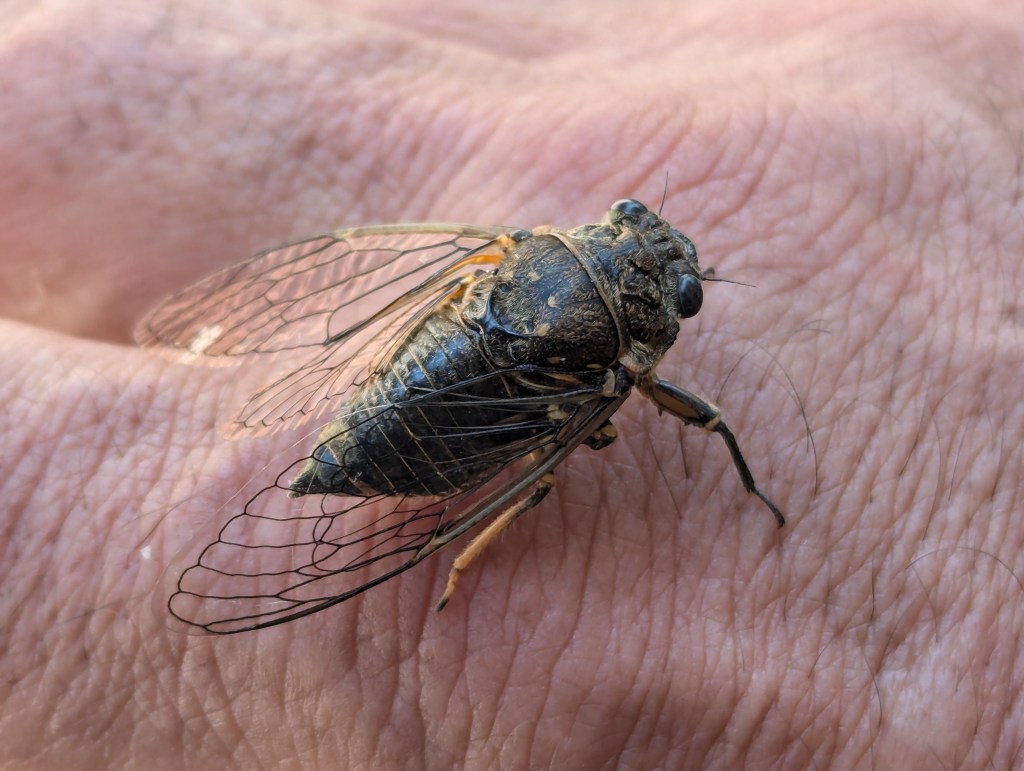
The left wing seems to be injured.

Contrary to common belief, cicadas are native to California. There are actually more native species here than in any other state. Of course, that is partly because California is so big, with so many distinctly diverse ecoregions. Cicadas are merely less prominent here because they are less numerous than they are within dense hardwood forests farther east. Within most regions here, they are somewhat rare. Even where they are most numerous, they do not congregate to form obnoxiously loud populations as they do elsewhere. Some native species are content to share their relatively mixed western forests with relatively few individuals of their own kind, and perhaps a few individuals of other cicada species. They are loud enough to find each other over significant distances. This cicada found its way to where I was enjoying the garden last Thursday. It was quite intimidating when it arrived with loud buzzing of its wings. It flew awkwardly before bashing into a steel building with a loud ‘PING’ that sounded more like a fat acorn falling onto the roof. I should have fled. It circled on the ground briefly before getting airborne again, and coming after me! It landed on my collar. I managed to maintain my composure as I removed it. I could see that one of its wings was impaired, as is evident in the picture above. That did not stop it from trying to fly again. It did not get far before landing on the asphalt driveway. It did not cooperate for the second picture below, which, although not of good quality, demonstrates that the impaired wing is not so impaired. It was likely merely out of whack from crashing into the wall. Before we could get acquainted, this no longer so intimidating cicada flew away as awkwardly as it arrived.
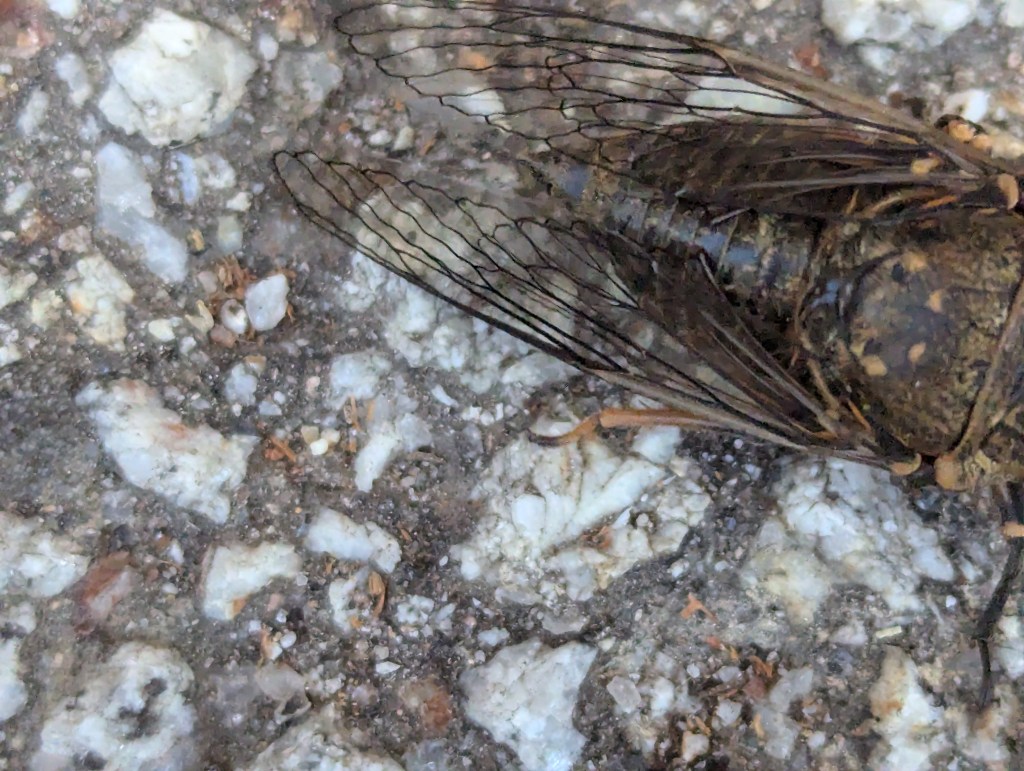
Both wings seem to be fine now. (This cicada did not want its picture taken.)

Locusts!

the SWARM!

Well, not exactly locusts; although, until they were reclassified within the Order Mantodea, they were of the same Order Orthoptera as locusts. Nor are they affiliated with either honey locust, Gleditsia triacanthos that I wrote about for last Tuesday, or carob, Ceratonia siliqua that I wrote about for the previous Tuesday, and which is the sort of locust that sustained John the Baptist in the desert. These abundant critters are young mantises, which likely hatched shortly before posing for this picture that my niece took on her front porch. My niece had seen a slow moving adult mantis there last autumn, and guessed that it might have deposited eggs, and then later died in privacy. Fortunately, she enjoys all sorts of flora and fauna, and was not too disturbed by this scene, or by the mother last autumn, as even some who work outside might have been. In fact, to the contrary, she was pleased that their mother felt that her porch was safe enough for them to start their lives on. She knows that there are plenty of insects for them to eat within the vegetation that inhabits the landscape there, as well as in nearby landscapes. This many mantises will eventually disperse into the neighborhood to satisfy their voracious appetites as they grow. That is why mantis eggs are available for sale from some nurseries. They are beneficially predatory insects because they consume detrimental insects. Since their arrival, my niece did a bit of research on their sort, and found that some people actually raise certain rare varieties of mantises as pets. As weird as it seems, it is no weirder than pet tarantulas. Anyway, this picture was taken more than a week ago. These baby mantises are likely already growing fast and dispersing elsewhere into Los Angeles.

Coy Koi

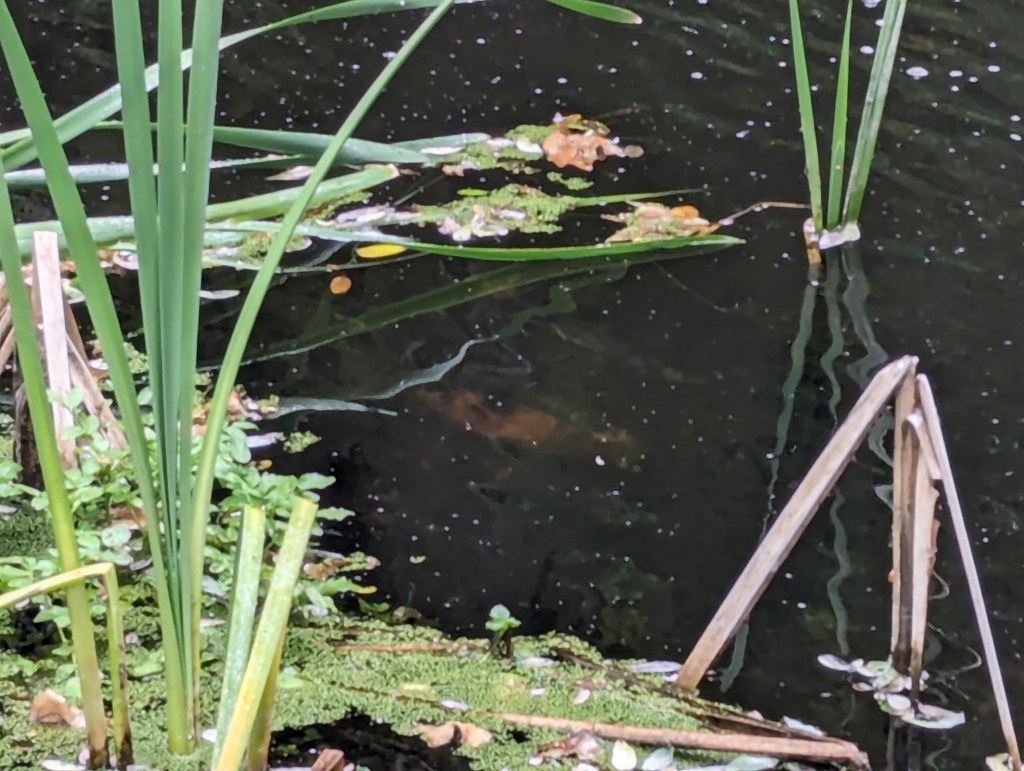
The larger of two koi is difficult to see at the center of this picture. The other is rarely seen.

Attempts to tame the recently discovered but still unidentified pair of koi within the drainage pond have been futile so far. Both remain elusive. Although the larger of the two is almost as big as Rhody, we still are not certain if they are actually a koi. We just do not know what else they could be. I try to get them to accept koi food, but the food floats on the surface of the water until a pair of ducks eats it. I should try to feed them some sort of food that sinks, at least until they respond to food, if they ever respond.

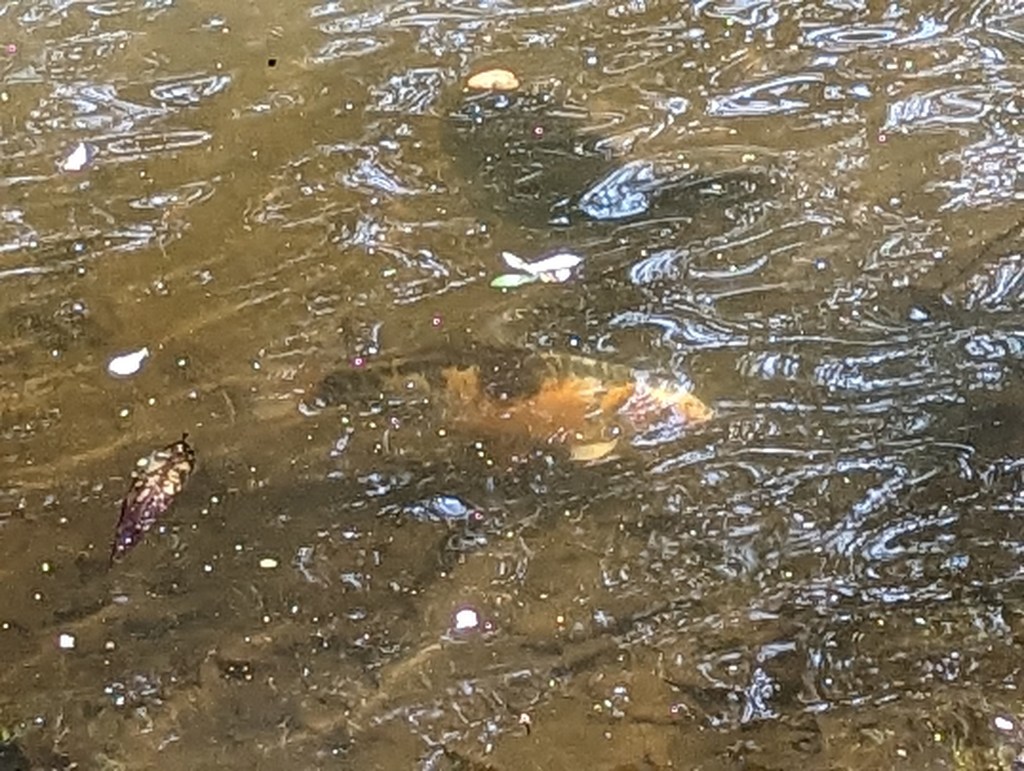
The larger and more visible of the pair is typically referred to as “Cheeto”, although not yet formally named. Cheeto happens to resemble, and could potentially be, one of the original koi who was also known as such. Its associate is known merely as its “Associate”. Even well trained koi do not respond to names. Nonetheless, we should probably assign them names, just in case they ever become tame. These are some of the options, besides Cheeto, for either of them.

Jaws

Nemo

Kraken

Moby

Sashimi

Gill

Charlie (Tuna)

Nessie (because of their elusiveness)

Roy (don’t need to be koi)

Blinky (of the Simpsons)

Wanda (a fish called Wanda)

I hope that whomever they are, they help to limit the proliferation of aquatic vegetation, particularly duckweed, within the pond, although I doubt that they can consume enough to make a noticeable difference. Also, I hope that they become friendly enough to amuse visitors. Neither are brightly colorful enough to be prominent if they remain elusive at a distance. We intend to add a bit more vegetation to somewhat mitigate erosion on the edge of the pond, as well as to displace other shabbier vegetation.

This is an older but better picture.

Six on Saturday: Are We There Yet?

As expected, the second half of my vacation was delayed. Then, very unexpectedly, all of our delays worked out. Rhody, Carson and I left exactly on time. Then, as unexpectedly, and just an hour from our first destination at Brent’s Jungalow, we were diverted to our final destination near Buckeye near Phoenix in Arizona. The explanation is as tedious as the additional six hour drive, at night and partially through Los Angeles style traffic. We are here now but got almost no pictures yet. We stopped only briefly in San Luis Obispo, where Brent and I were in school from 1985 to 1990, and where a few of our friends live.

1. From his shelf in back, through the dirty windshield, and through the dirty window of a cafe, Rhody stared impatiently at me as I tried to enjoy a bit of coffee the day before we left. ‘Hot Lips’ Salvia microphylla to the left is the only vegetation visible in this picture.

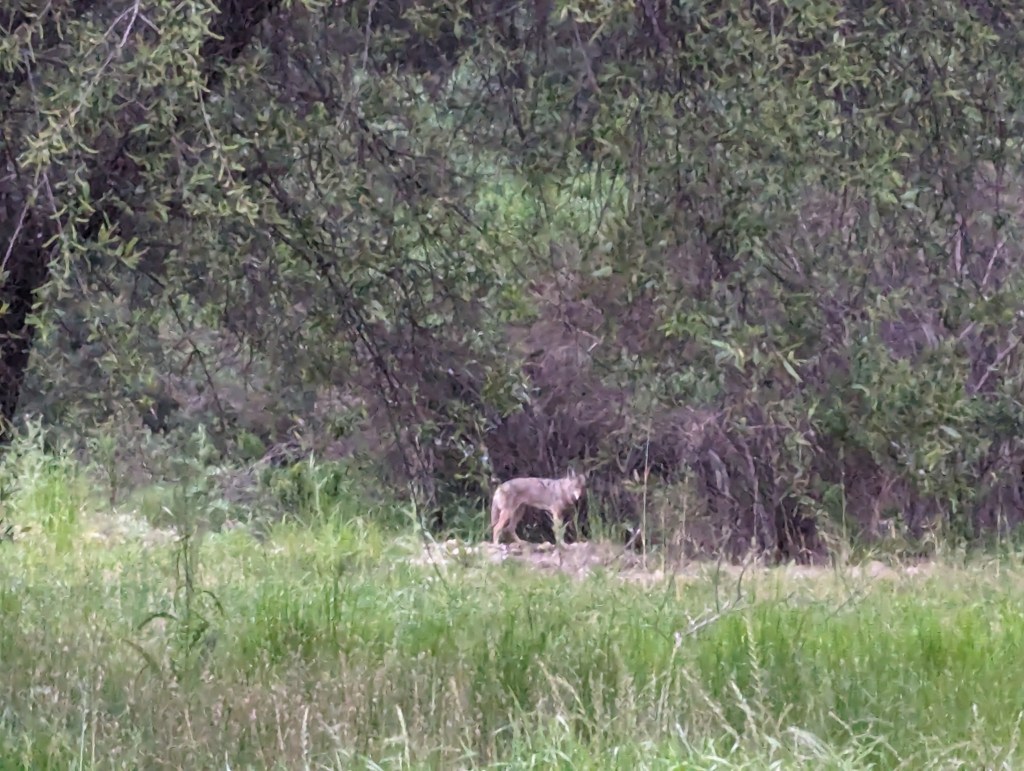
2. Wile E. Coyote also stared at me impatiently, at the end of the same day, as I finished a last task prior to leaving. I can not identify the vegetation that is visible in this picture. I suspect that the tree to the left and above is a common Pacific willow, Salix lasiandra.

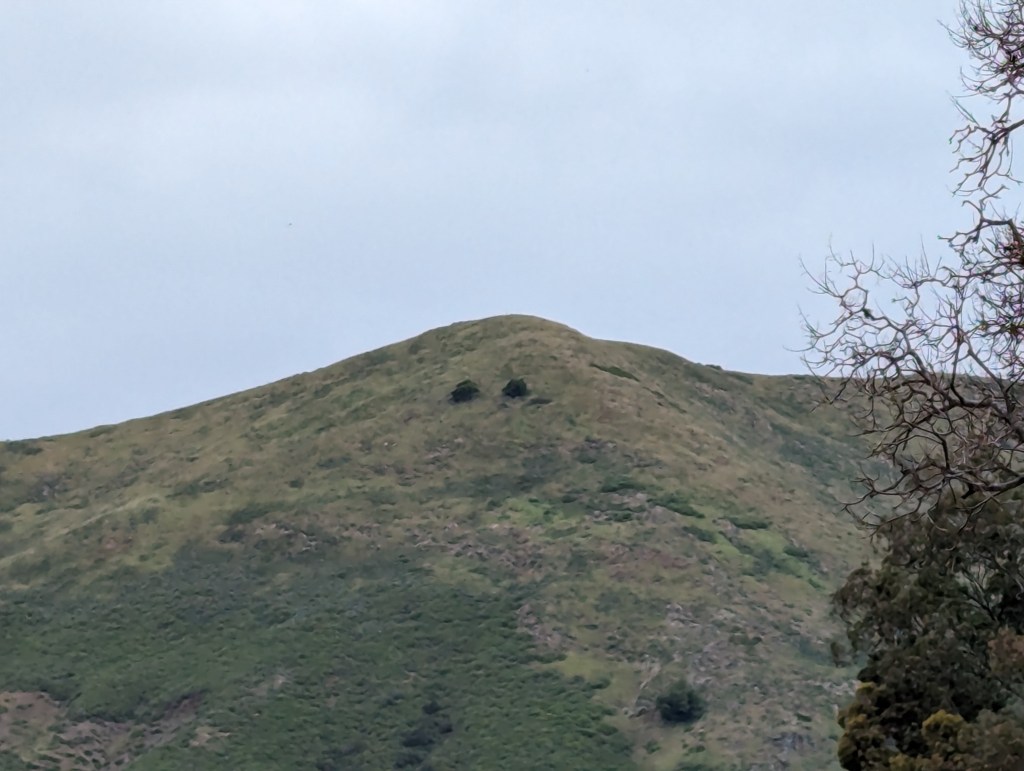
3. The hills have eyes. I have no idea what the pair of shrubs at the center of this picture are. I only know that they have not changed since I arrived at Cal Poly in 1985. I got this picture right outside of my classmate’s office in the Alan A. Erhart Agriculture Building.

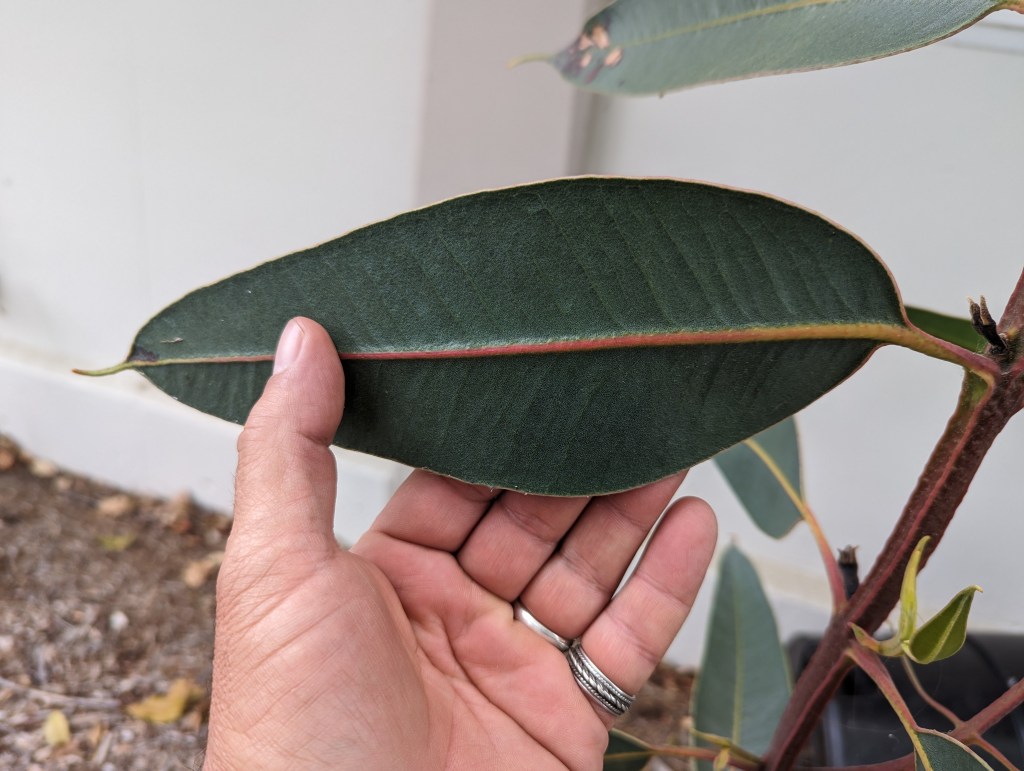
4. Also right outside of my classmate’s office, several specimens of unidentified eucalypti were recently installed. I recognize none of them. This specimen exhibits remarkably big leaves for the genus. These trees are very close to where I first met Eucalyptus torquata.

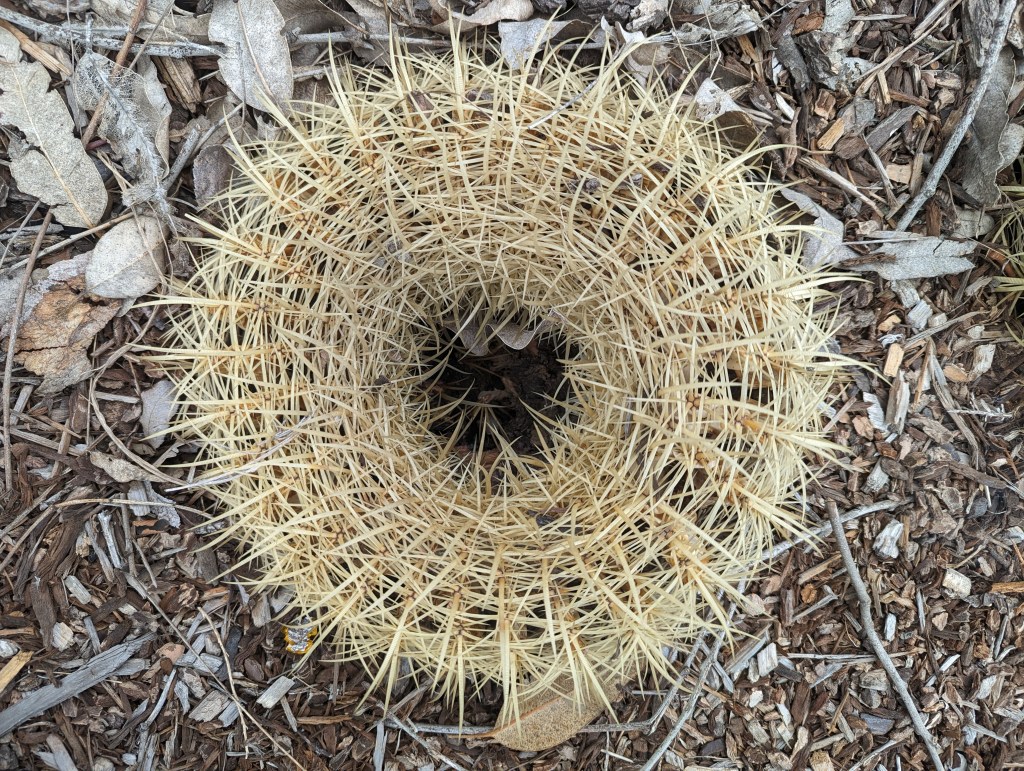
5. Barrel cactus, Echinocactus grusonii, dies ugly. It looks like something out of a horror movie, or like it consumed a horror movie. I suspect that this and several other similarly imploded carcasses decayed because of automated irrigation that is intolerably frequent.

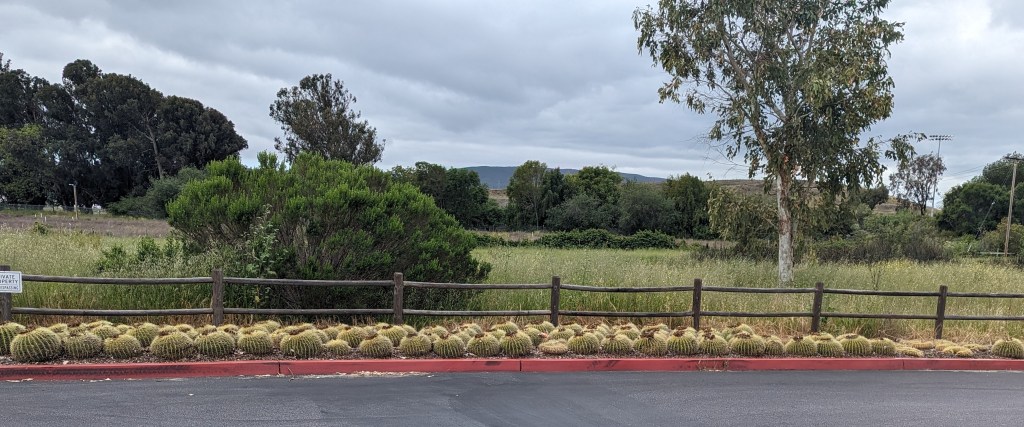
6. Is this good or bad landscape design? I typically prefer uniformity and symmetry, but this seems to be excessive. Several rotting specimens, mostly to the right, are disrupting the symmetry, but also leaving voids. I got this random picture as I left San Luis Obispo.

This is the link for Six on Saturday, for anyone else who would like to participate: https://thepropagatorblog.wordpress.com/2017/09/18/six-on-saturday-a-participant-guide/

Heather

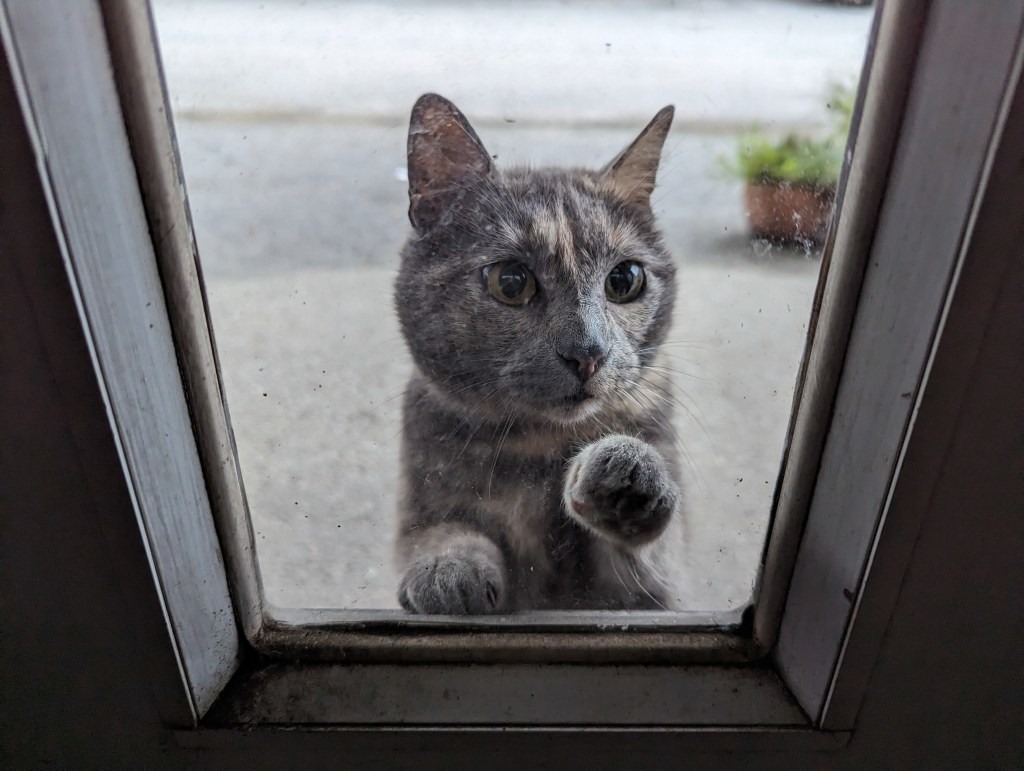
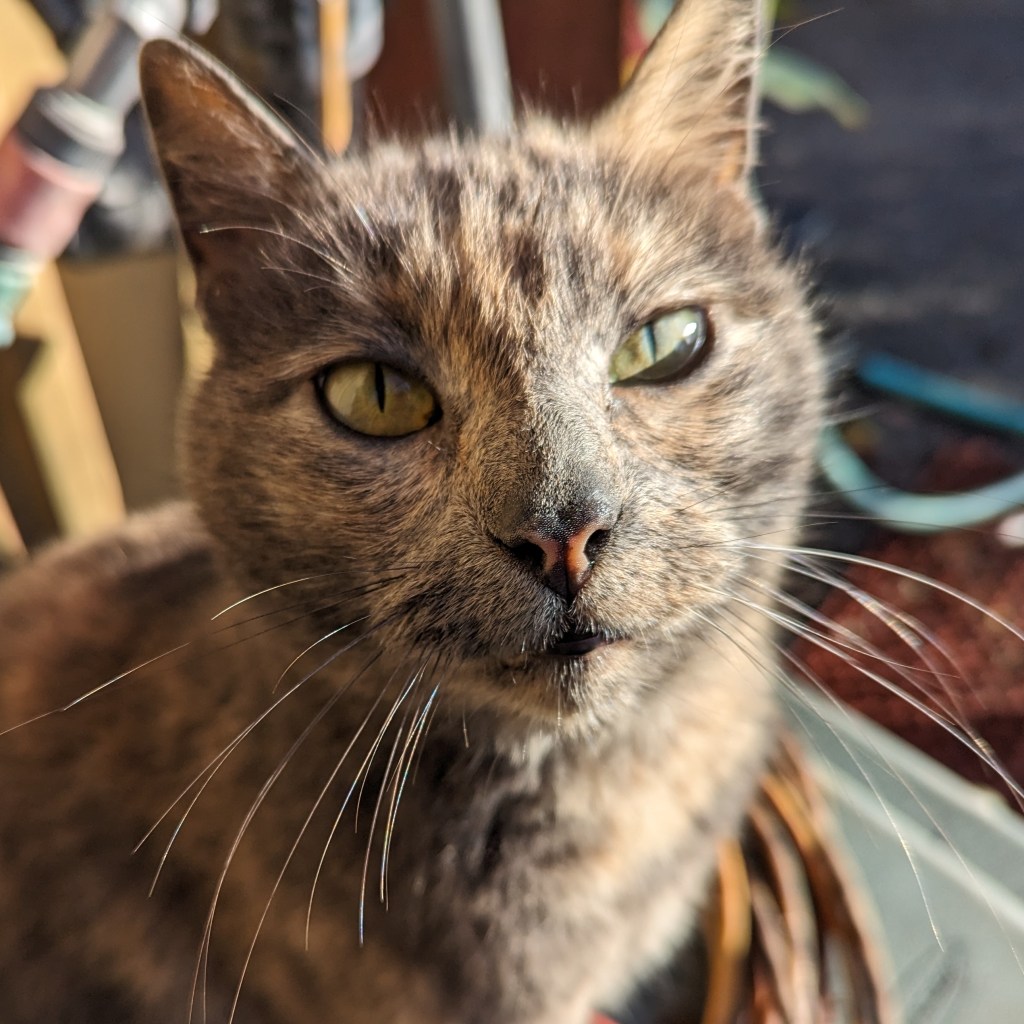
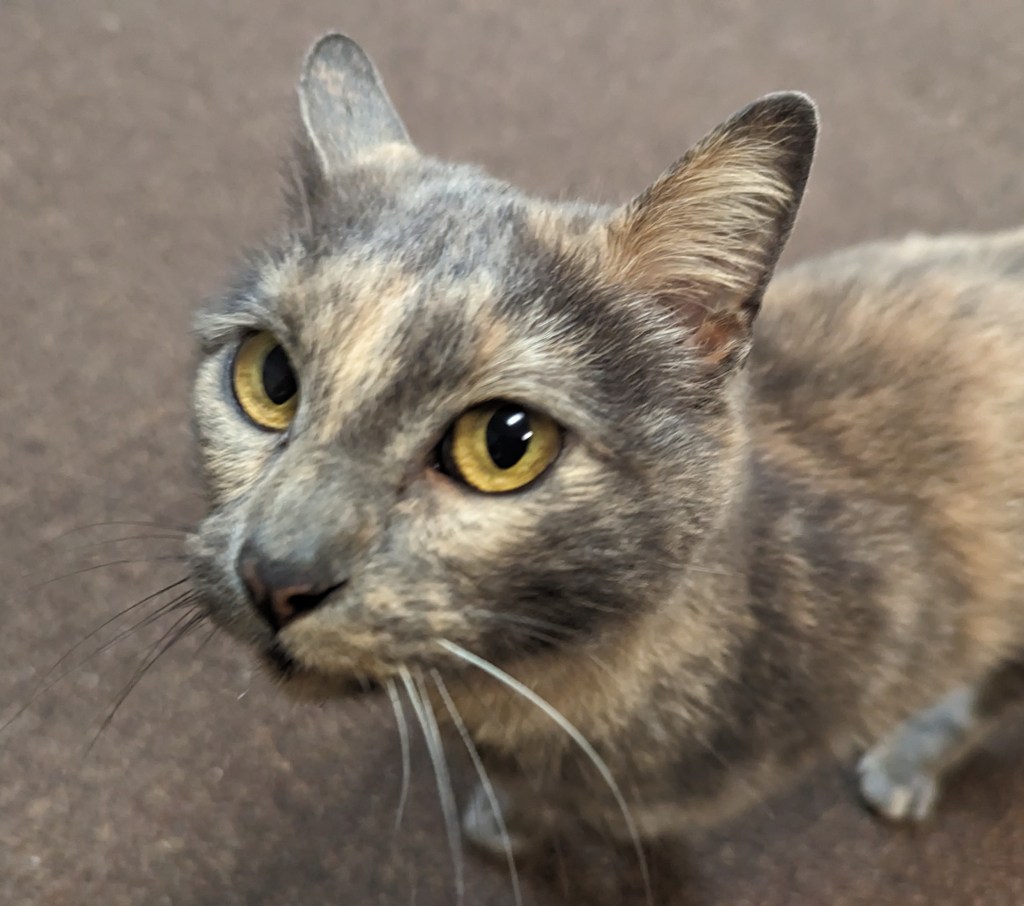
Heather is not related to Calluna vulgaris. She is feline, since she is a kitty, who is employed here as the only mouser within the maintenance shops. We did not hire her as such. She merely assumed the job. At the time, after Darla retired, we were in desperate need of a mouser. We do not know where Heather came from, and she can not tell us. She seems pleased to remain employed here. We are pleased to be without rodents.

Her technique is as mysterious as her origin. No one knows how she prevents rodent infestation. She does not seem to catch any. Instead, she seems to passively repel them, as if rodents vacated and will not return because of here presence. Skunks, opossums and raccoons are also notably absent since her arrival, and the raccoons were vicious.

Heather temporarily lived within the nursery when she first arrived and decided to stay. Shortly afterward, and after being named, she decided that she preferred the automotive shop across the road. If she had settled there originally, she might have gotten a lame name, such as Lexus, Tesla or Mercedes. Now, she is quite established here, and lives in a luxurious penthouse in the automotive shop mezzanine above the locksmith shop. She does not seem to venture away from the safety of the shop buildings or the surrounding fenced yard. She has several friends here, including Rhody.

Fortunately, Heather does not seem to need anything more than she can figure out on her own. I know nothing about providing for a kitty. She does not seem to mind at all. Actually, she seems quite happy here, and purrs when petted. She seems to enjoy looking cute for those whom she meets for the first time, and for pictures such as this.

Escargots

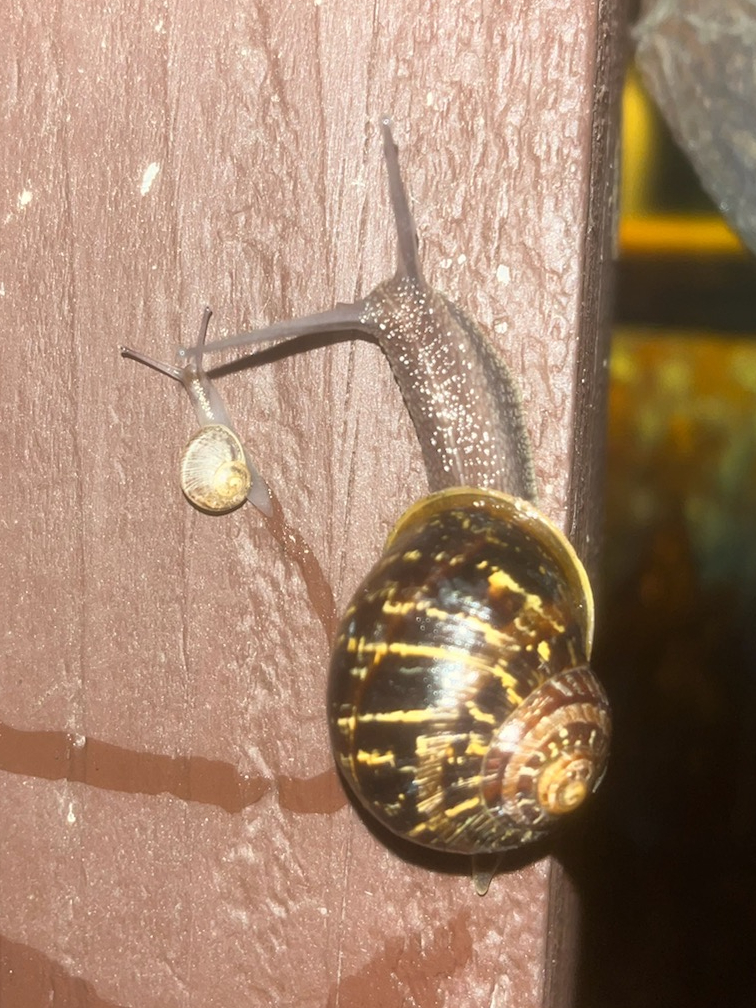
French hors d’oeuvres are somehow among the most bothersome of garden pests within California. They are voracious. They are very prolific. They are sneaky. They are more resilient to attempts to limit their damage than they had been in the past. Furthermore, attempts to limit their damage are less effective than they had been in the past.

Molluscicides, which are the pesticides that are formulated to be toxic to molluscs such as snails, are not nearly as toxic as they had formerly been. Years ago, they were so toxic that they had potential to be dangerous to cats, dogs, wildlife or children. They are safer for everyone now, including the molluscs that they should be toxic for. Some snails succumb after consuming such molluscicides, but some survive.

The progeny of snails who survive consumption of molluscicide are genetically more likely to also survive consumption of the same molluscicide than snails who did not survive to proliferate. Those who do not inherit such genetic resilience do not survive to proliferate. Consequently, each subsequent generation is more resistant to the particular molluscicide than its preceding generation. Although a different molluscicide would be more effective temporarily, a few snails survive it also, to proliferate and repeat the process. It is how they ‘develop resistance’.

Besides, many garden enthusiasts are hesitant to apply molluscicides because of how toxic such pesticides had been in the past, and how, regardless of how much safer they now are, they must still be toxic to some degree in order to be effective.

Lushly landscaped and generously irrigated home gardens are ideal habitats for snails. Vegetation within such landscapes is damp and sheltered, and provides an abundance of sustenance. Skunks, foxes, ducks and other wildlife that eat snails generally avoid or lack access to many urban home gardens. Opossums and raccoons are either uncommon, or more interested in eating fruits, vegetables, trash or dog and cat food.

Heather (not Calluna vulgaris)

Heather – rodent mitigation specialist

Heather is the new rodent mitigation specialist. She has been here for quite a while. We have been unable to determine where she originated from. Unless or until we do, she can stay here to dissuade rodent incursion. She has been remarkably effective with her expertise. None of the formerly bothersome rodents have been observed since her arrival. The seedlings and small perennials that the rodents had been eating previously have incurred no subsequent damage.

This will take some getting accustomed to. I am not particularly familiar with kitties. I give her a can of food in the evening, with dry food available at other times. She has a sheltered bunk out in the nursery, but might want to come into the foyer when the weather gets frosty or rainy. If so, I may put a warming pad for kitties under her bunk, since it will be close to an electrical outlet. She does not seem to be too demanding yet, but I have no idea how kitties operate. She could get demanding later, and because she is a kitty, I can not argue with her.

She does not have much to say though. She meows when hungry. When petted, she makes that weirdly distinctive purring sound that kitties make, but mysteriously, without actually speaking. She was quite fond of Rhody before people could get close to her, and seemed to enjoy how he chewed her head, but now that people regularly pet her, she avoids Rhody, and actually hisses at him if he wants to chew her head. She could not tell us what her name is, so, after some minor deliberation, we named her Heather.

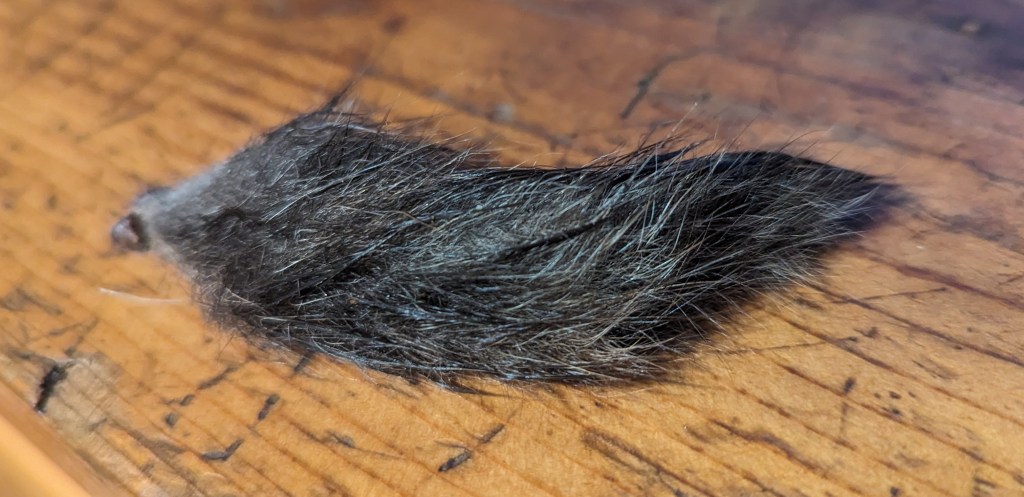
Notice her tail.

We do not know exactly how long Heather has been here, but after her arrival and prior to her socialization, we noticed that the tip of her tail was kinked. As she became socialized and pettable, we noticed that the tip of her tail beyond the kink seemed to be necrotic, and felt like an old fashioned rabbit’s foot keychain. A few days later, the kinked tip was no longer a concern.

tippy toupee

New Mouser

Rodents departed when she arrived.

Darla, the former mouser here, relocated to a more domestic lifestyle in Santa Clara during the unusually stormy weather and flooding last winter. She is getting rather elderly, and has earned a comfortable retirement. Unfortunately though, rodents of all sorts arrived immediately after her retirement.

Mice and rats infested the buildings while gophers and ground squirrels infested exposed ground outside, including the recovery nursery. Rodents of some sort ate the tops off a few of my banana plugs, and chewed the base of my cup of gold vine. Another chewed into a bag of seed for mixed erosion control vegetation, and made a mess of it.

Then, the rodents seemed to leave as suddenly as they arrived. Even tree squirrels became scarce. At about that time, we noticed, on rare occasion, what seemed to be a stray kitty. I thought that the kitty must live nearby, and would eventually return home. It avoided us, but never completely left the area for long.

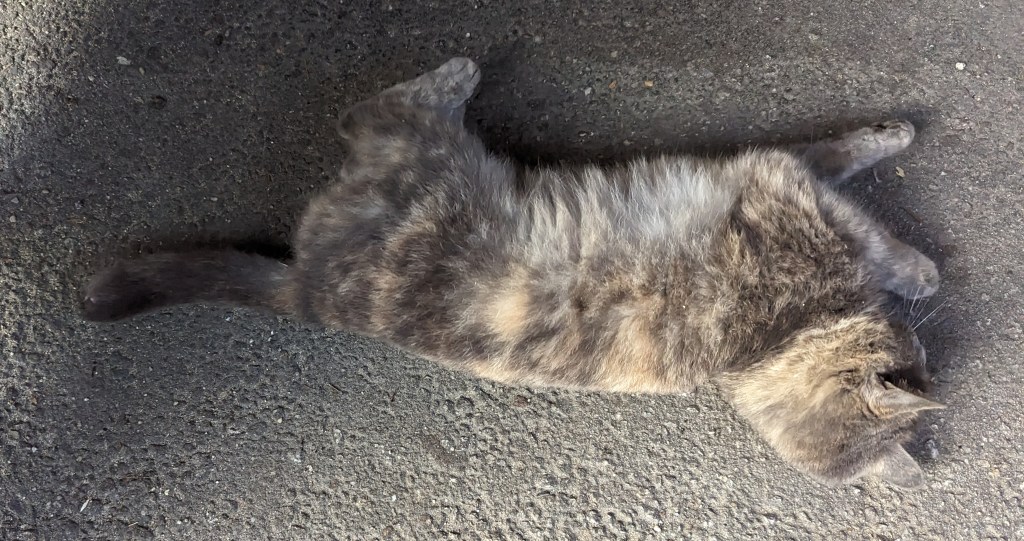
The kitty appears to be rather grungy because of its color pattern. I recently learned that this particular color pattern is known as tortoiseshell, and that almost all kitties with this tortoiseshell color pattern are female. I hope that she is not offended if my assumption of her gender as female is inaccurate. She is quite small and lean, with a thin tail that is kinked at the end. I intend to get a better picture of her to share with neighbors, just in case someone is missing her.

A bit more than a week ago, this kitty seemed to become a bit more interested in human activity here. For the first time, I offered her a bit of something that she might enjoy. Because there was no kitty food here, I gave her a small can of tuna from the galley. She enjoyed it so much that I got her some real kitty food. She now comes for it to the meeting room daily after the crew leaves. I have been able to get a bit closer to her daily, and petted her briefly for the first time a few days ago. She purrs quite loudly when petted, although she also seemed to be rather nervous. She prefers interaction with Rhody, who now chews her ears. I invited her into the hallway because it gets somewhat cool in the evening, but she does not want to come inside.

Because I believe that her presence here convinced the rodents to relocate, I would prefer her to stay if she has no other home to return to. If she only wants a bit of food from me, this could be a mutually beneficial situation. If so, we should determine what her name is.

Silverleaf Cotoneaster

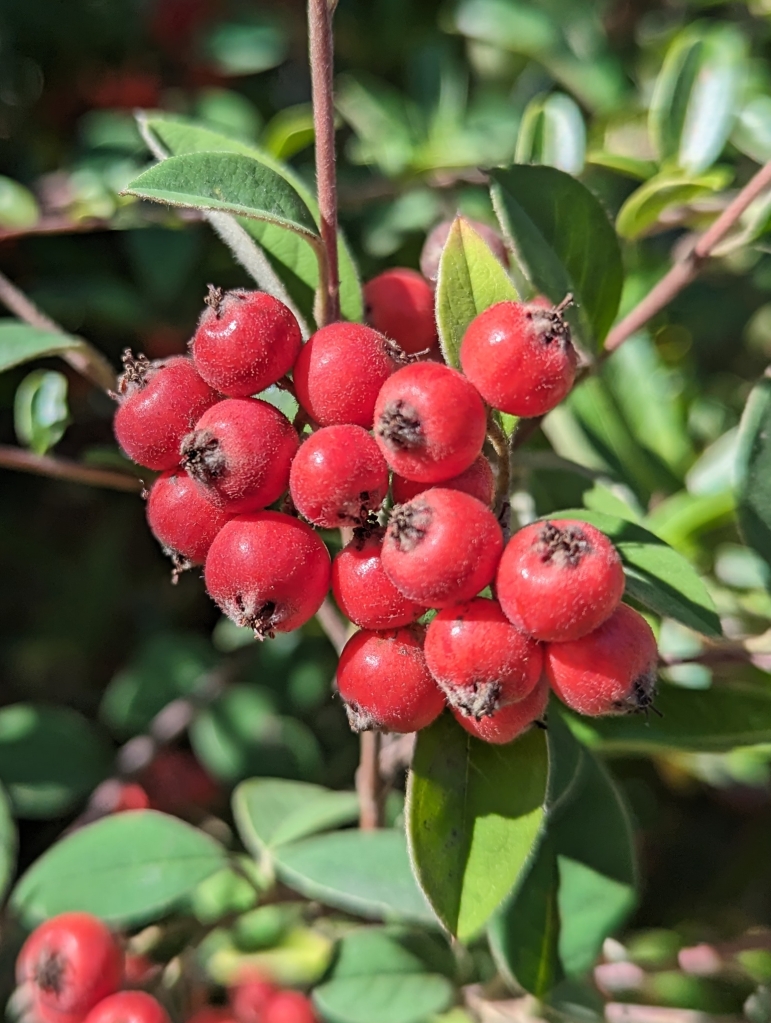
Silverleaf cotoneaster berries are subtly colorful.

Its prevalence within a few wild ecosystems suggests that it is native. In actuality, it likely naturalized here only after the Gold Rush. Silverleaf cotoneaster, Cotoneaster pannosus, is native to southern central China. It likely came here with the influx of Chinese laborers after 1848. It was a common component of the original landscapes of Golden Gate Park.

Nowadays though, silverleaf cotoneaster is rare within refined gardens. Modern cultivars and other species are more adaptable. Silverleaf cotoneaster naturally develops broadly outwardly flaring form. Pruning that damages its natural form causes awkwardly angular form. Ironically, undesirable feral specimens often develop the best form without pruning.

Silverleaf cotoneaster can get more than ten feet tall, and nearly twice as wide. Removal of old trunks to their bases promotes more vigorous new growth. Alternatively, removal of low growth promotes taller tree form on arching trunks. The small camo green leaves are unremarkable. The copious red berries that ripen for autumn are very appealing to birds.

Berries Get Colorful For Winter

Firethorn berries are very reliably abundant.

Some vegetation excels at exploitation of wildlife. All sorts of flowers use color and floral form to attract pollinators. Many flowers rely on fragrance or flavorful nectar for this same purpose. Many flowers employ a combination of such techniques. After pollination, many species produce fruit to draw wildlife to disperse their seed. This includes winter berries.

Just as flowers appeal to particular pollinators, fruits appeal to particular consumers. Big fruits appeal to animals who eat them, perhaps sloppily, but drop the seed within. Acorns and nuts appeal to squirrels who bury more than they can retrieve. Winter berries appeal to birds who do not digest the seed within. The birds deposit the seed wherever they go.

It is a mutually beneficial arrangement. Birds, whether migratory or overwintering, eat as many berries as they want. Vegetation that provides winter berries benefits from efficient dispersal of its seed. Naturally, such fruits ripen as birds are fattening up for winter. They are brightly colorful to attract hungry birds. They are small enough for birds to eat whole.

This is convenient for home gardening. It provides some color after defoliation of autumn foliar color, and prior to spring bloom. It is actually more appealing where cooler weather accelerates defoliation. Also, such color contrasts more prominently against snow within a stark landscape. Within any climate though, such berries last only until birds find them.

For some, birds and squirrels who come for winter berries are welcome. Some prefer the color of winter berries. Ultimately though, the wildlife determines how long winter berries linger. Anyone can cultivate vegetation that produces winter berries. Very few can protect such fruit from wildlife that craves it. Berries rarely last long enough to rot through winter.

Firethorn produces the most colorful winter berries. Various cotoneasters are similar, but with somewhat subdued rusty red color. Toyon develops larger but looser clusters of fruit. English hawthorn fruit resembles that of cotoneaster, but on bare stems. Hollies produce only a few berries. They are dioecious, so need male pollinators which are rarely nearby.