The Hedge on the Ledge – Update

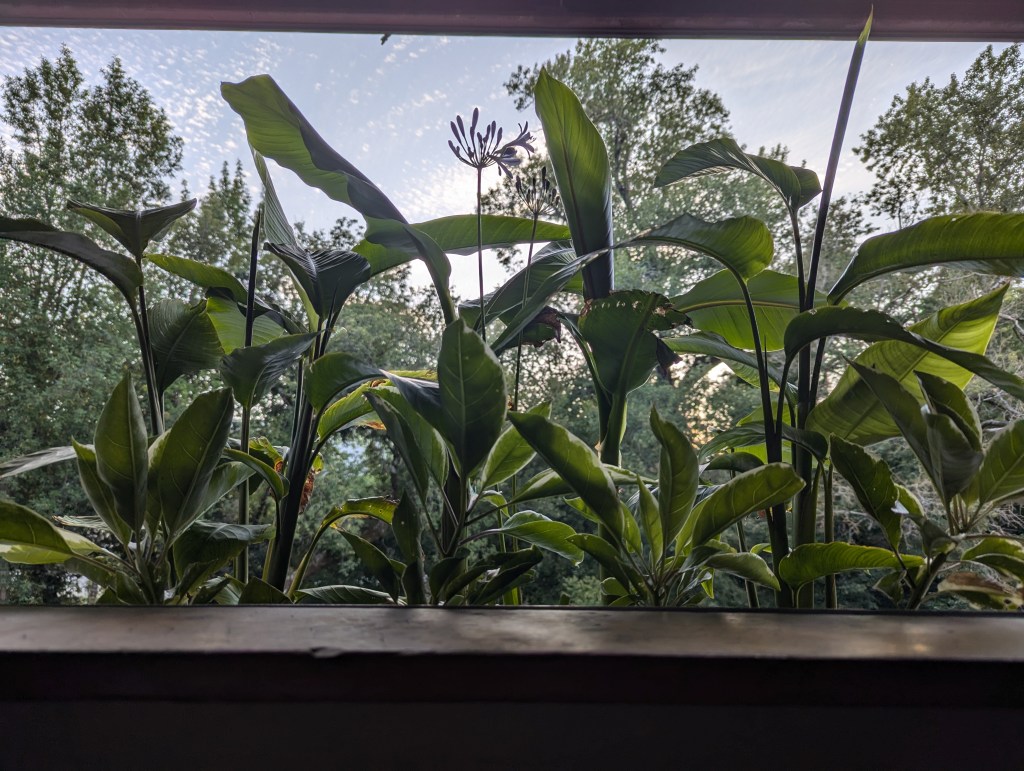
The Hedge on the Ledge continues to develop. Nothing has been added or subtracted from it since its previous update late last July. The vegetation has only grown and been moved about a bit. Perhaps that is an understatement. It has grown more substantially than it should have been allowed to within a situation that it should not actually be in. The only other change is that the pair of parakeet flower pups and the pair of banana pups switched places. It is so overgrown that it obstructs sunlight that would otherwise brighten the associated window. That was not so bad during warm weather of summer. It might not be so desirable as weather cools for autumn. Besides, all of this overgrown vegetation should relinquish its space to smaller vegetation that can benefit from the sheltered position and associated but presently unused heating mat through winter. After all, shelter from minor frost and access to electricity for a heating mat were the original justifications for the installation of this silly shelf below only the half of its window that opens. If I had known that it would still be here, I might have constructed it as a window box instead of an exposed shelf, so that the black vinyl cans and their faded old labels would not be so prominently visible. Eight #1 cans fit neatly onto the shelf, with three 4″ pots nestled into the spaces between them. An elastic strap holds them firmly in place so that they do not get blown off. The vegetation includes:

4 – #1 Solandra maxima ‘Variegata’ cup of gold vine – back row closest to window

2 – #1 Musa acuminata ‘Golden Rhino Horn’ banana – left and right corners of front row

2 – #1 Heliconia psittacorum (unidentified) parakeet flower – middle of front row

2 – 4″ Cucurma longa (unidentified) turmeric – left and right between rows

1 – 4″ Agapanthus africanus ‘Peter Pan’ lily of the Nile – middle between rows
Change of Scenery

I am certainly no landscape designer, but I think that I sort of dig this.

Window boxes annoy me. They were originally developed to contain aromatic herbs that dissuaded mosquitoes from entering small windows, likely before the invention of window screens. They remained popular while window screens were expensive, and to grow culinary herbs where garden space was limited in old European cities. None of that is useful to me. Mosquitoes are not much of a problem here, and if they were, window screens are not expensive. There is plenty of space for herbs in the garden. Furthermore, window boxes eventually rot as a result of the irrigated medium within, and share their rot with the wooden walls that support them.

The small shelf that I suspended below this window was intended for eleven small tissue culture plugs of various cultivars of banana. I wanted to shelter them from minor frost last winter. I intended to remove the shelf after winter. Obviously, I did not.

Without a plan, I moved eleven small specimens of various species from the nursery onto the shelf just to see how their composition could develop. I typically do not like to obscure scenery or obstruct sunlight from windows, but thought I could make an exception for this window. The scenery is not particularly appealing, with a busy roadway nearby. Through summer, a bit of shade from the warm late afternoon sun might be nice.

I did not want the grassy texture or bronzed foliar color of the sugarcane right outside the window. Nor did I want the disorganized texture of any of the gingers. I am rather pleased with how these few other species work though. They are nearly half as high as the window, but as I mentioned, for this window, I do not mind. They look rather jungley.

The eleven small specimens here are in eight #1 cans and three 4″ pots. The three 4″ pots are nestled into the gaps in between two rows of four #1 cans. A pair of young plugs of Cucurma longa, turmeric, in two of the three 4″ pots are not visible to the left and right. Only two blooms of a small specimen of Agapanthus africanus ‘Peter Pan’ lily of the Nile in the middle 4″ pot are visible. Four rooted cuttings of Solandra maxima ‘Variegata’ cup of gold vine are in the closer row of #1 cans. A pair of large specimens of an unidentified cultivar of Heliconia psittacorum, parakeet flower, are to the left and right in the rear row. A pair of pups of Musa acuminata ‘Golden Rhino Horn’ banana are in the middle of the rear row. This is so very inconsistent with my style, but I am getting to like it.

Utilitarian Garden Features Became Aesthetic

Nasturtium used to be more utilitarian.

Gardening is fun. Furthermore, gardens are pretty. Some gardens also produce fruits and vegetables. Not very long ago, production of fruits and vegetables was more of a priority for more gardens. Some big gardens generated firewood and a bit of forage for livestock. Contemporary abundances allowed gardening to become more aesthetic than utilitarian.

Such abundance may not seem so apparent while so many of society could benefit from a bit more. People work more than ever to earn resources to purchase produce that they can not grow in their gardens while working so much. It has become more feasible to do so. Landscape maintenance is just another expense that many would prefer to eliminate.

Nonetheless, some popular features within modern home gardens evolved from formerly utilitarian features. Many such utilitarian features were common within the infrastructures of home gardens prior to the development of any modern technology that replaced them. Some were popular only because such technology was either expensive or uncommon.

Shade trees are among the most traditional and perhaps more recognizably utilitarian of landscape features. Although, even they have evolved. With modern air conditioning and insulation, their shade is less important than their aesthetic appeal. Window screens and rain gutters are also modern technologies that made particular garden features obsolete.

Window boxes, which are now mere ornamental features, were originally popularized for aromatic vegetation, to repel insects from windows. Rosemary, nasturtium, ivy geranium and petunia had always been some of the more popular repellent plants for this purpose. They do not obscure much sunlight as they cascade delightfully outward and downward.

Foundation plantings, which now merely soften the perpendicularity of vertical walls and horizontal garden spaces, were also utilitarian features. Compact and resilient shrubbery or perennials inhibited erosion caused by rain falling from eaves above. They obstructed splattering mud from below also. Indian hawthorn and lily of the Nile were quite effective. They could survive through summer without much irrigation, but then survive excessive moisture through winter.