After several weeks of atypically warm and pleasant weather, more typical cool and rainy weather resumed to demonstrate that winter is not quite finished yet.
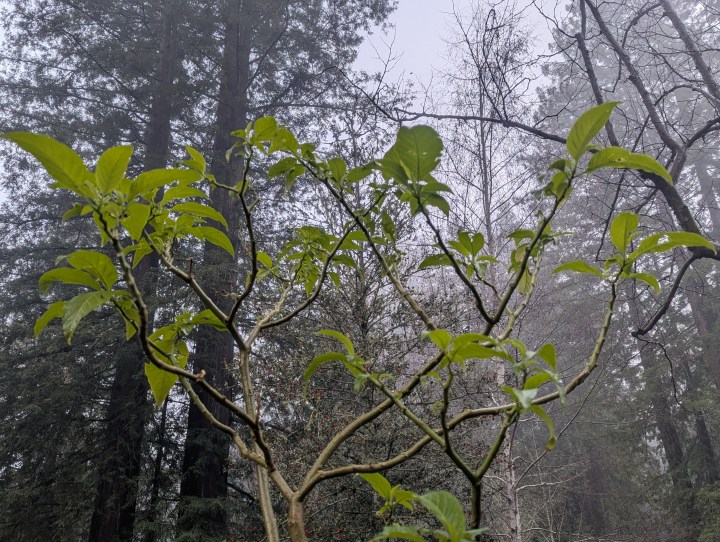
1. Brugmansia suaveolens, angel’s trumpet becomes rather scrawny through winter as it sheds its larger leaves that grew through summer, and generates smaller leaves instead.
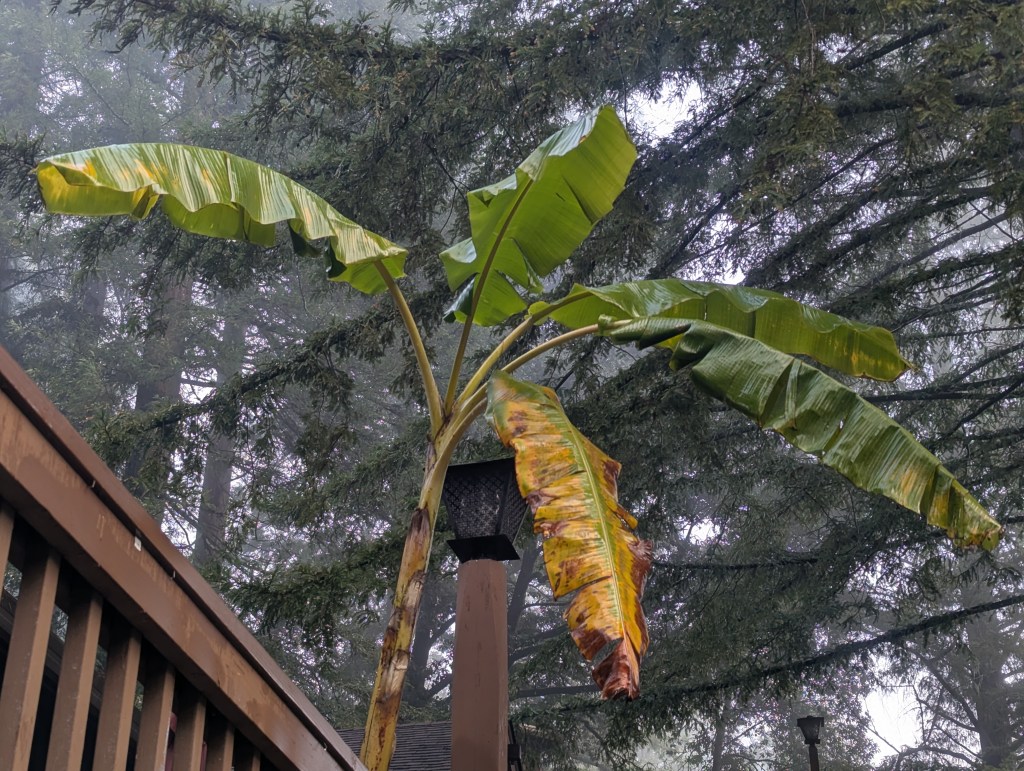
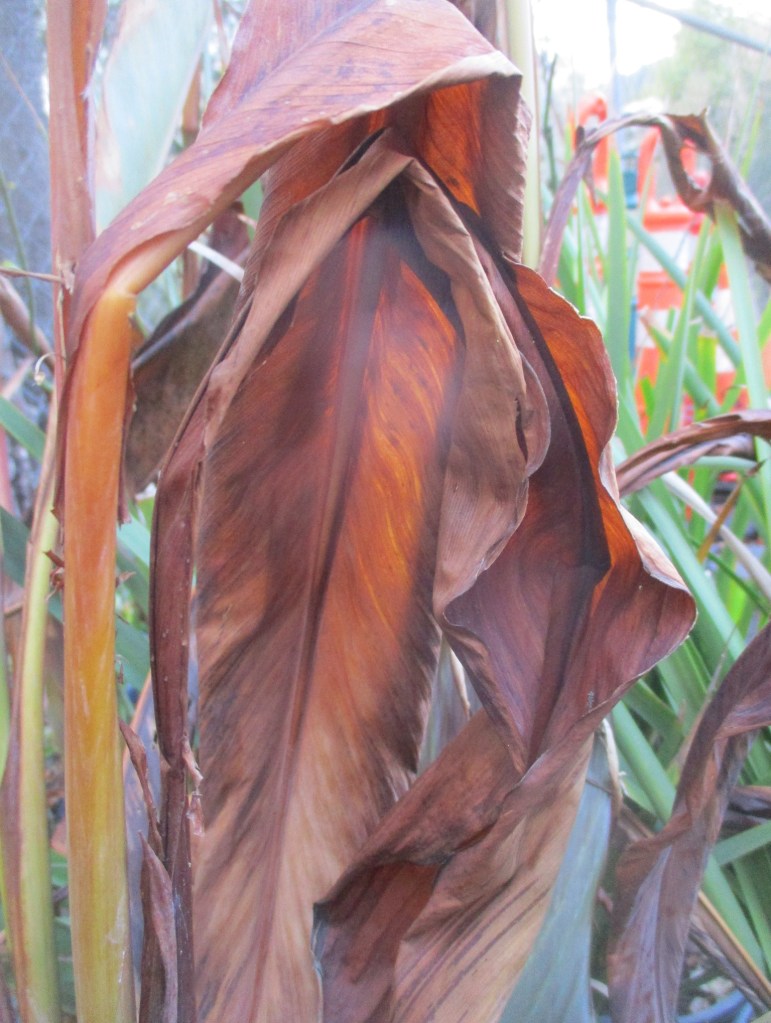
2. Musa acuminata X balbisiana ‘Blue Java’ banana would be notably scrawnier than it already is if more of its discolored and weather damaged foliage were to be pruned away.
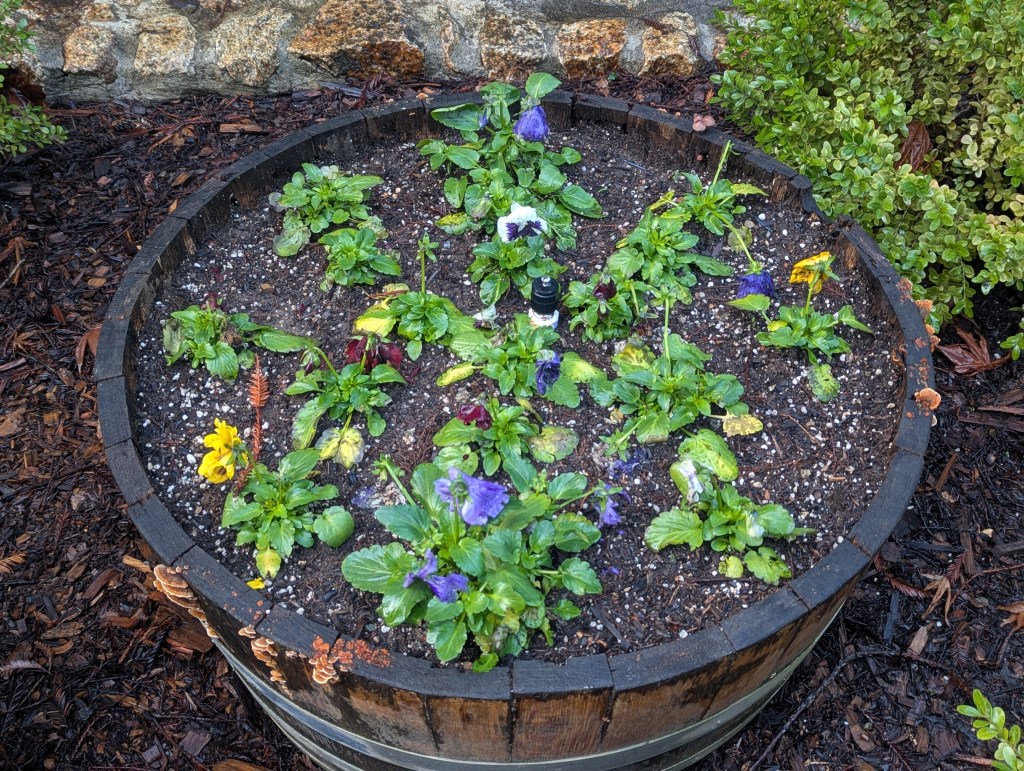
3. Viola X wittrockiana, pansy is a cool season or winter annual, but even it craves a bit more warmth than it has been experiencing since it was planted two or three weeks ago.
4. Canna X generalis, canna of various cultivars got cut back as their foliage succumbed to wintery chill and wind, but are already growing fast to replace what was pruned away.
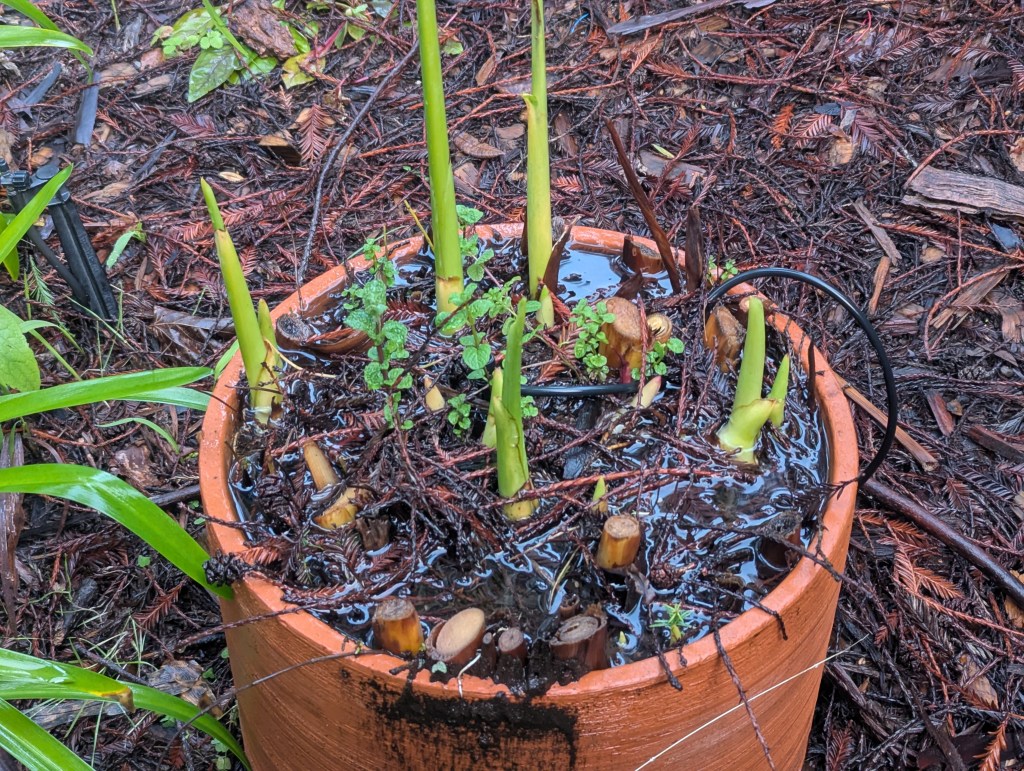
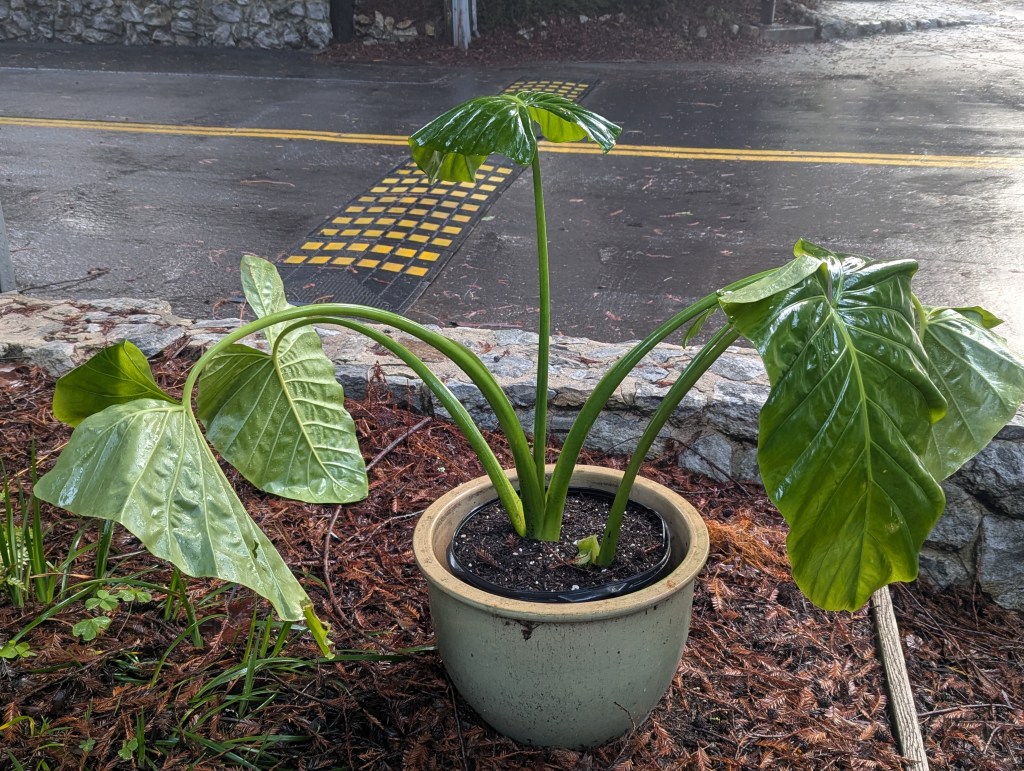
5. Alocasia macrorrhizos, taro was divided just before the weather got cool again, so it is difficult to know if it wilted because of the division, the lack of warmer weather, or both.
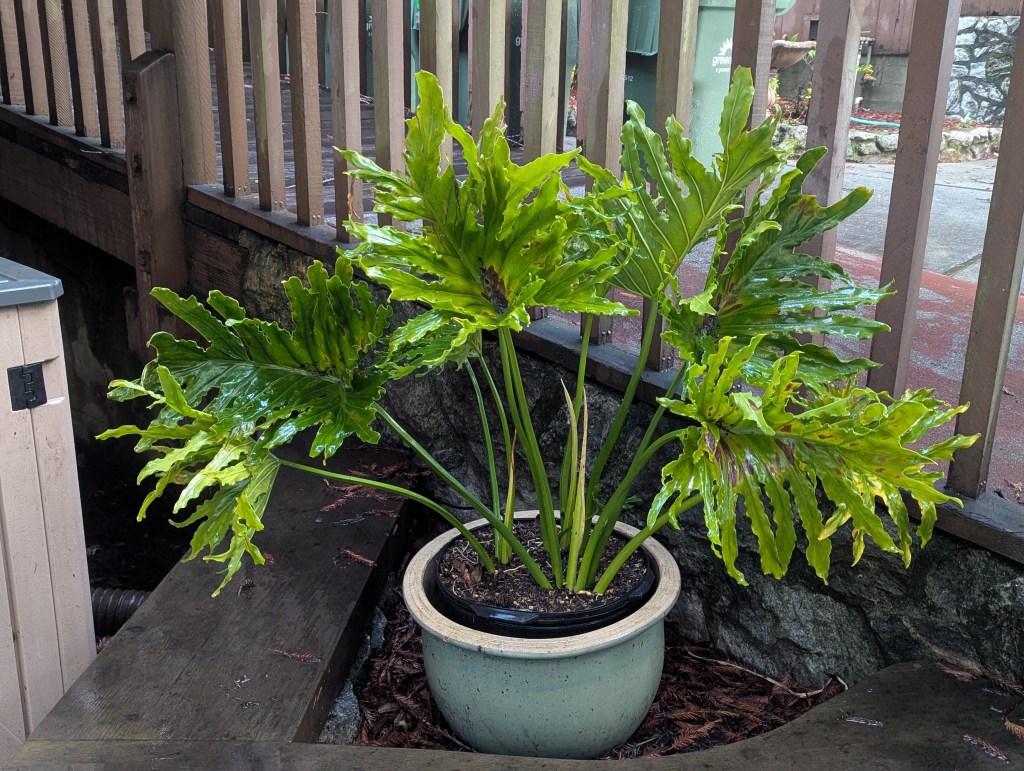
6. Philodendron selloum ‘Lickety Split’ split leaf philodendron was divided immediately after the taro, but has not wilted, and seems to be more resilient to the wintery weather.
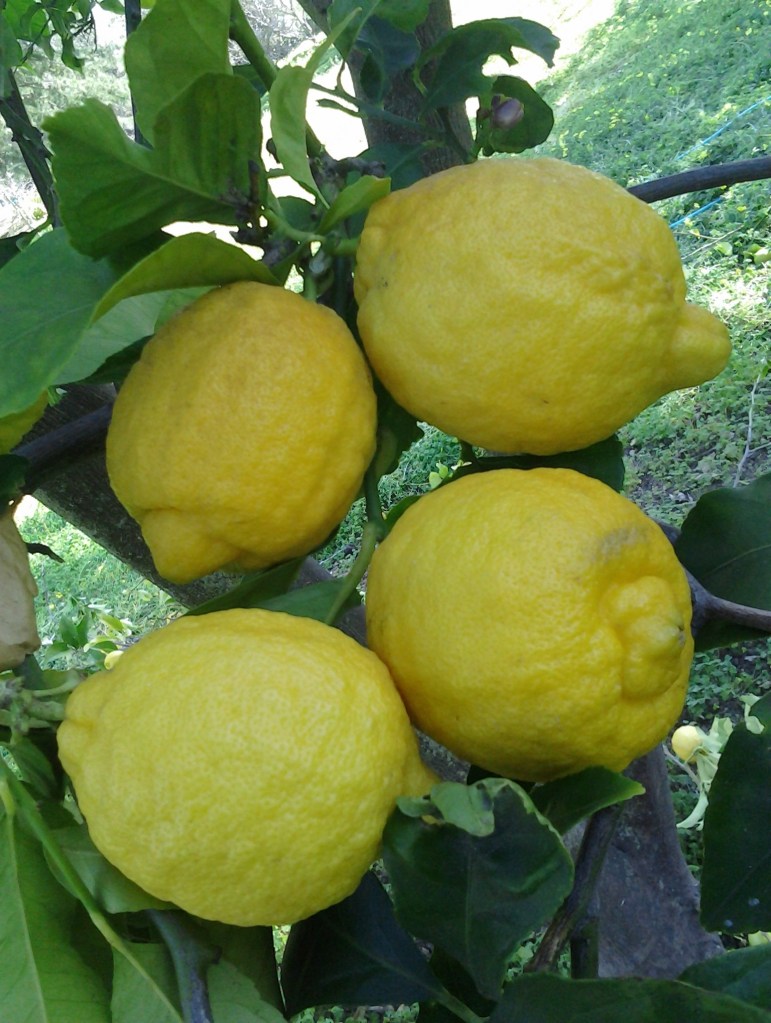
Planting and pruning of deciduous fruit trees are priorities for winter. Evergreen fruit trees are not as much of a concern. For them, planting and pruning should happen after winter. However, most citrus trees are most productive with their summerish fruit through winter. Oranges, lemons, limes, Mandarin oranges, grapefruit and more are ripening about now.
With the exception of Mandarin oranges, most citrus fruits are impressively durable. Most can last for months on their trees, which is likely why they seem so summerish. Mandarin oranges have loose skin, which causes them to oxidize faster than the others. ‘Valencia’ oranges, though, can linger for a year after ripening. They actually sweeten as they age.
Also, some cultivars of citrus extend their production with sporadic fruiting. While ‘Lisbon’ lemon fruits only for winter, ‘Eureka’ lemon fruits more sporadically. ‘Eureka’ is actually a cultivar or cultivated variety of ‘Lisbon’. Although a bit less productive in season, ‘Eureka’ produces several fruits out of season. It rarely disappoints by failing to provide a few fruit.
Oranges and lemons are the most familiar of citrus. They are surprisingly diverse though. ‘Meyer’ lemon is almost as acidic as other lemons, but with a richer flavor like an orange. Most oranges are dessert oranges for eating out of hand, but ‘Valencia’ is for juice. Blood oranges are for juicing, but ‘Moro’ is a dessert orange. Sour oranges are for marmalades.
Mandarin oranges that developed in the Americas formerly classified as tangerines. Now they seem to qualify as Mandarin oranges, like more traditional Mandarin oranges. They collectively might be the most diverse class of popular citrus. More cultivars of Mandarin orange are available than the others. ‘Rangpur’ lime is actually a sour Mandarin orange.
There is so much variety among citrus. Besides oranges, lemons and Mandarin oranges, there are too many to list. Grapefruit, limes kumquats, pomelos, calamondins and citrons are a few examples. Limequats are hybrids of limes and kumquats. Tangelos are hybrids of grapefruit and Mandarin oranges. Orangequats are hybrids of oranges and kumquats.
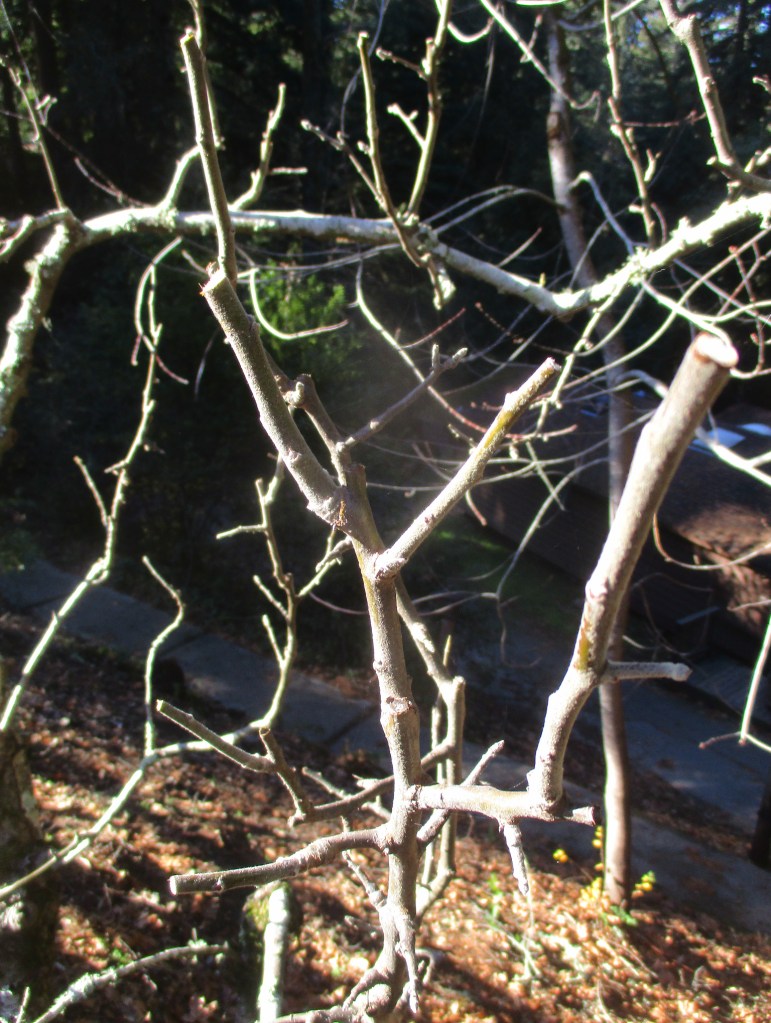
Bare root season begins now because bare root stock is so efficiently dormant for winter. Dormancy is the same reason that this is now also time for dormant pruning of fruit trees. It is comparable to anesthesia for surgery. Affected fruit trees waken from dormancy after winter with no idea of what happened. They then resume growth as if nothing happened.
Dormant pruning is important because of the unnatural breeding of most fruit trees. They have been bred to produce unnaturally large and unnaturally abundant fruit. Their fruit is so excessive that they can not support all that they could produce. Dormant pruning both limits production and concentrates resources. Resulting fruit is less abundant but bigger.
Bigger, better but less abundant fruits collectively weigh less than overly abundant fruits. Furthermore, dormant pruning improves structural integrity of affected trees. So, affected trees are able to support more weight but must support less. Ideally, they should need no propping for limbs that are too heavy with fruit. Limbs should not break from their weight.
Dormant pruning also directs and stimulates growth. It should prevent stems from getting so high that their fruit is beyond reach. Actually, most fruit should be within reach from the ground without a ladder. Vigorous growth is more resistant to pathogens than congested and less vigorous growth. There are actually quite a few advantages of dormant pruning.
Stone fruit trees and pome fruit trees are popular types that need dormant pruning. Stone fruit include apricot, cherry, nectarine, peach, plum and prune. They need similar pruning but to varying degrees. Peach needs more severe pruning because its fruit is so big and heavy. Cherry needs less aggressive pruning. Apple, pear and quince are all pome fruit.
Deciduous fruit trees are quite demanding, and reliant on timely dormant pruning. Those who would like to grow them should first be aware of their cultural requirements. Diligent research of pruning technique is helpful. Practical and annual experience is even better. Each year, it is an opportunity to observe how subject trees respond to dormant pruning.
Evergreen foliage and berries are now popular for home decor for a primary reason. Not many winter flowers are blooming and available for cutting and bringing in. Most flowers prefer to bloom while more pollinators are more active. Not many pollinators are out and about while weather is cool through winter. Consequently, winter flowers may be scarce.
However, they are not actually as scarce as they seem to be. Some winter flowers bloom without drawing attention to themselves. They do not need to if they rely on wind for their pollination. Colorful flowers are colorful only to attract pollinators. For example, redwood is blooming quite privately about now. It produces no prominently colorful flowers to see.
Some winter flowers do not actually intend to bloom in winter. They are merely confused by the local climates. For example, African daisy blooms whenever the weather is warm. It does not know to stop blooming for winter here because the weather is not overly cold. Cala are tropicals, so have no concept of winter. They should not bloom, but might try to.
Camellias are some of the most familiar and popular winter flowers. Sasanqua camellias bloom before common camellias. Different cultivars of each type bloom at different times. The latest sasanqua camellias might actually bloom after the earliest common camellias. Sasanqua camellias bloom more abundantly. Common camellias provide larger flowers.
Although most salvia bloom during warmer weather, a few bloom sporadically for winter. Autumn sage seems to never be completely without bloom. Meanwhile, cultivars of witch hazel bloom curiously on bare stems. So does winter jasmine, but only in yellow. Oregon grape can bloom impressively within cooler climates. It is evergreen and blooms yellow.
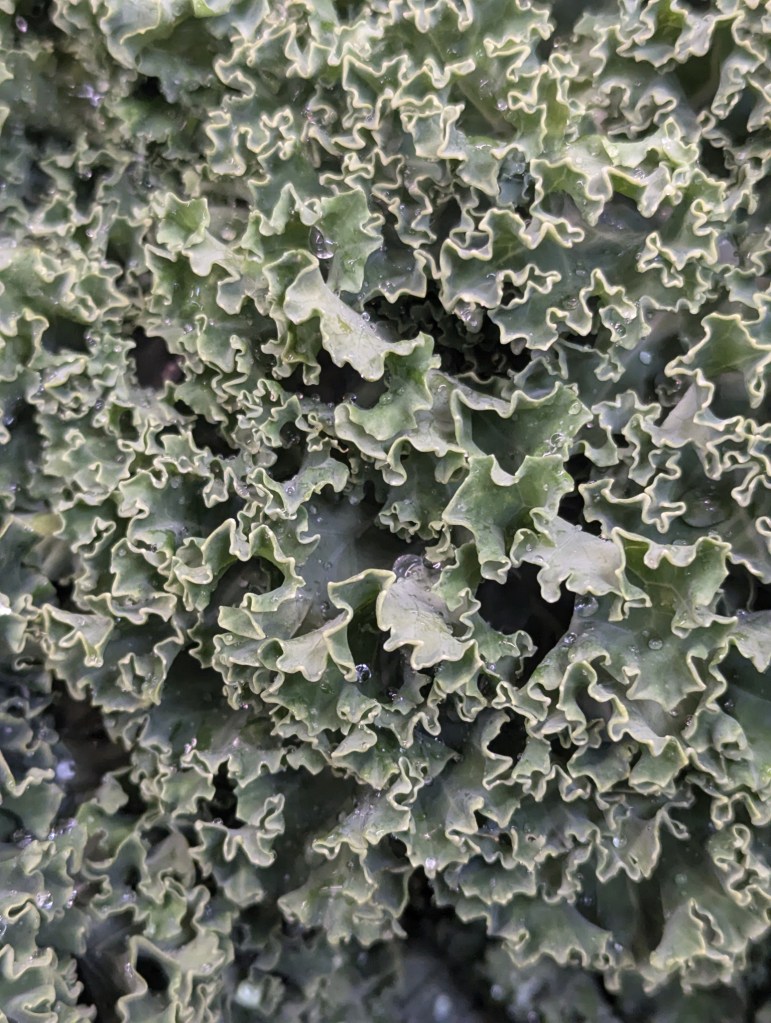
Many of the better winter flowers are cool season annuals, which are no good for cutting. These comprise pansy, viola, cyclamen, dianthus, snapdragon, nemesia and primroses. Stock is exceptional, because it can be cut and brought inside and is splendidly fragrant. Ornamental kale and ornamental cabbage are foliar plants that present like wide flowers.
Rain was one clue. Cooler weather is another. It is now so late into autumn that it will be winter soon. Every regional climate experiences some degree of chill. Some, particularly to the north, experience frost. This limits gardening in two ways. Several species prefer a bit less cool weather. Several prefer a bit more. Every species prefers a particular range.
Apple trees, for example, require vernalization, which is a specific duration of chill. Some cultivars require more than others. Without it, they can not distinguish seasons, so do not know when to bloom for spring. Consequently, few cultivars of apple perform adequately within Los Angeles. However, many perform very well in the cooler climates of San Jose.
Banana trees, conversely, need no chill, and are instead set back by frost. Some tolerate a bit more chill than others; but ultimately, they are all tropical species. They produce fruit only within the months between frosts. Consequently, not many banana trees are notably productive within San Jose. However, they perform better in the climates of Los Angeles.
Banana trees stop growing when the weather is cooler than fifty degrees or so. That is a bit too much chill for them. However, frost does not occur until the weather is cooler than thirty-two degrees. Banana foliage can therefore be safely dormant during chilly weather. That is a range of twenty-two degrees. Different tropical species survive different ranges.
The simplest form of frost protection is to not cultivate species that are vulnerable to frost. This is, of course, a bit too restrictive for many who enjoy gardening. Instead, some grow vulnerable species in pots to move to shelter prior to frost. Some simply grow vulnerable species below the shelter of eaves or big trees. Tenting may also be effective protection.
Alternatively, some species can endure frost damage to recover during warmer weather. If possible, outer foliage that succumbs to frost should remain through winter. It insulates inner growth from subsequent damage. Besides, premature grooming can stimulate new growth that is more vulnerable. Many perennials prefer cutting back after winter anyway.
Summer bulbs, such as canna, calla and dahlia, can wait until spring. They do not enjoy winter chill during their dormancy like spring bulbs do. Spring bulbs become available at nurseries now because this is the time to plant them. They wait patiently for winter to end before blooming. A bit of winter chill actually helps them to maintain their strict schedule.
That certainly does not mean that their strict schedule is not adjustable. Most early bulbs prefer interment into their shallow graves within weeks of Halloween. However, they can wait as late as New Year’s Day. This allows for successive planting, which prolongs their ultimate bloom. Early planting promotes early bloom. Late planting promotes late bloom.
Most spring bulbs from nurseries are prechilled because winters are relatively mild here. They are therefore less reliant on significant winter chill. However, some of such bulbs in several of the milder climates may bloom only once. They lack the winter chill they need to bloom for subsequent springs. Avid garden enthusiasts compensate with refrigeration.
That requires major diligence, though. Most who enjoy gardening do not want to dig and refrigerate dirty spring bulbs. Consequently, most who grow them enjoy them as annuals or disposable perennials. Unfortunately though, spring bulbs do not bloom for very long, and are not inexpensive. That is why they are not as prevalent here as in other climates.
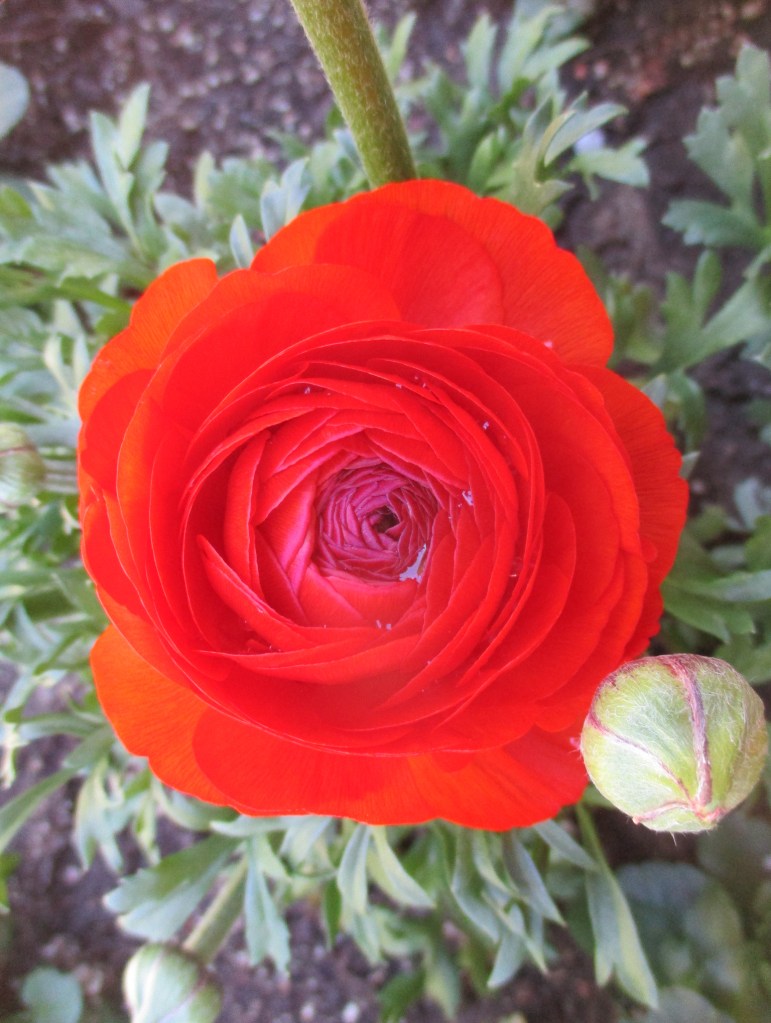
Freesia and narcissus, including daffodil, do not need much chill. They can settle in and bloom for many years after their initial planting. Ranunculus and anemone may not need much chill either, but are less likely to regenerate from year to year. Dutch iris and Dutch crocus are unpredictable. They might become reliably perennial, but may not cooperate.
Tulip and hyacinth may be more disappointing, since they require significant winter chill. If they can not experience such chill naturally from the weather, they require refrigeration. Otherwise, they bloom only once for their primary season, and only after prechilling. Yet, both are among the most popular of spring bulbs. Their blooms are simply too appealing.
Cool season vegetables do not include any winter squash. All squash are warm season vegetables. They all begin their growing season in early spring to grow through summer. Their foliage begins to fade by autumn, and then succumbs to winter chill. The difference between summer and winter squash is their harvest time. Winter squash ripen for winter.
Conversely, summer squash produce for summer. They produce several more individual fruit that are ready for harvest before they ripen. They produce even more in response to the harvest of their juvenile fruit. Any fruit that matures for too long can get big and tough. It also diverts resources that should otherwise sustain production of fresh young squash.
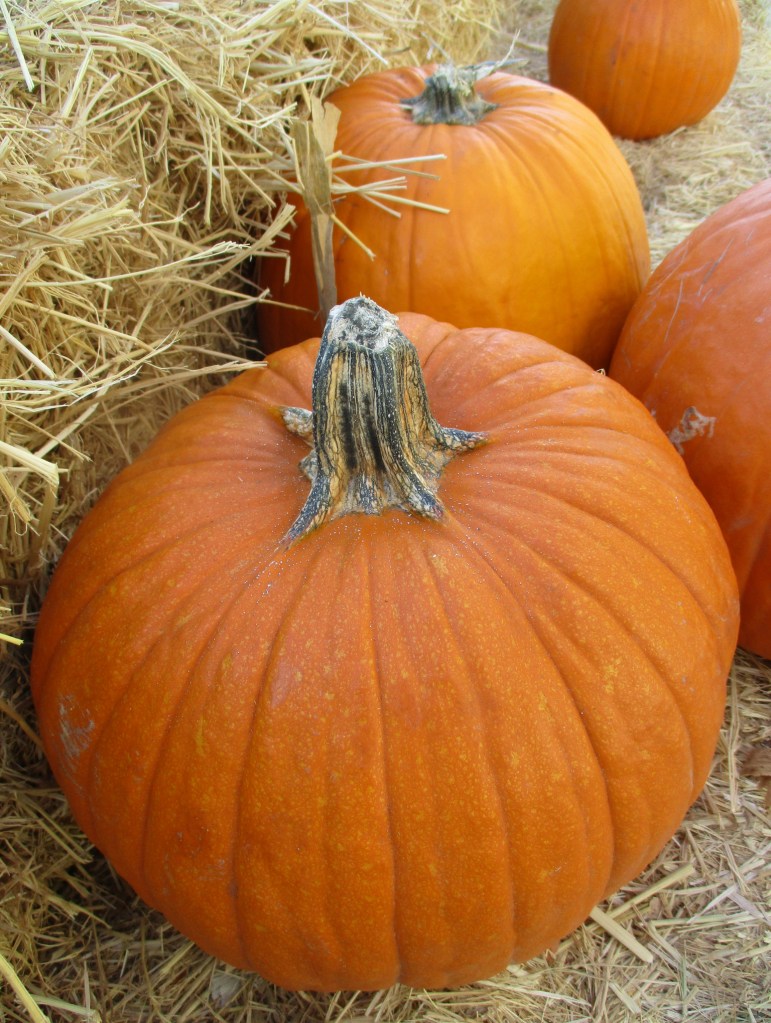
Winter squash produce fewer fruit that mature through summer to ripen by autumn. Some types produce only two or three individual fruit. Fewer fruit concentrate resources, so that individual fruit are relatively large. Pumpkin, which is a famously big winter squash, may grow singly on its vines. Once ripe, some winter squash might last for months into winter.
Ideally, some type of squash should always be available from the garden. Winter squash become available as summer squash finish. Then, summer squash become available as stored winter squash deplete. However, winter squash are supposedly better if they cure for two weeks after harvest. Summer squash might finish a while before that can happen.
Hubbard, butternut, acorn and kabocha squash are all types of winter squash. Countless others are available. Their vines are more rampant than those of typical summer squash. Those with relatively lightweight fruit can climb trellises or shrubbery to conserve space. Although they do not bloom as much as summer squash, their yellow flowers are edible.
Winter squash develop more uniformly with occasional turning as they grow. This entails turning fruit weekly so that all sides of it get exposure sometime. By now, the palest sides should face upward. Fruit should retain its short stem when cut from its vine. It is likely to mold without it. There is no rush to harvest though, since fruit can remain as vines wither. Exposure to mild frost supposedly enhances the flavor of winter squash.
Warm season vegetables that started late last winter will be finishing their seasons soon. Cool season vegetables, or winter vegetables, should begin to replace them. This might sound familiar as the same scenario for warm and cool season annuals. After all, almost all vegetable plants are either annuals or biennials. Few perform for more than a season.
Just like annual bedding plants, different vegetable plants perform to different schedules. Some warm season vegetables begin to deteriorate as warm weather ends. Others may continue to produce until frost. Some cool season vegetables need an early start. Others can start late and grow through cool winter weather. Gardens need not transition quickly.
Besides, different phases of some types of vegetables begin and finish at different times. Although late phases of corn continue to grow, early phases are already done and gone. Although late phases of beet might begin months from now, early phases can begin now. Warm season vegetables, ideally, relinquish space as cool season vegetables require it.
Cool season vegetables grow slower than warm season vegetables. Also, more of them are true vegetables rather than fruit that contain seed. Many are distended roots, such as beet and carrot. Many are distended foliage, such as cabbage and chard. A few, such as broccoli and cauliflower, are distended floral bloom. Peas are actually fruiting structures.
All root vegetables should grow directly from seed. They are vulnerable to disfigurement if transplanted. Besides, they typically grow in significant quantities that are not practical for transplant. These include beet, carrot, radish, turnip and parsnip. Cucumber and pea, although conducive to transplanting, also perform better from seed. So do lettuce greens.
Heading lettuce, though, is more like cabbage and larger cool season vegetables. Since only a few are necessary, transplanting them as seedlings is practical. Besides, they are conducive to transplanting. Cell pack seedlings for cool season vegetables are available from nurseries now. Seed is always available. It can go directly into a garden or into cells for transplanting later, as summer becomes autumn, then winter.
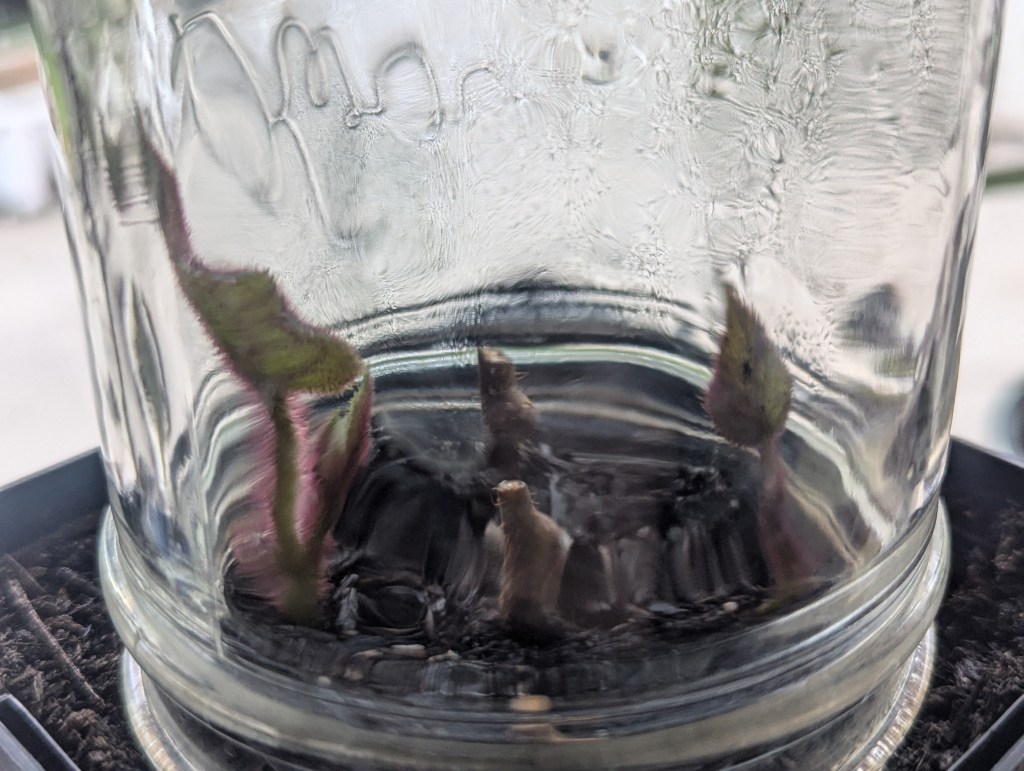
Flowers of all fruit need pollination for fruit to develop. Most are self pollinating. Some require pollination from another variety. Some are dioecious, so female flowers need pollination from male flowers. A few, such as figs and muscadines, are even more complicated, but they are topics for another article. For now, I am concerned with my female kiwi vine, which is growing like a weed, but would have been unable to produce any fruit without a male pollinator. It was not a planned acquisition. I grew it from cuttings from a bit of vine scrap that someone brought to dump in the debris piles here. Because it grew so well, I requested some male vine scrap from the same person who provided the female vine scrap. Obviously, since he grows the female vine in his home garden, he also grows a male vine to provide pollen. I wanted the scrap while it was dormant through winter, because that is when I prefer to start hardwood cuttings. By the end of winter, I figured that it was too late to start cuttings, and that I would need to wait to try next winter. Then, just a few days ago, the person who provided the female vine scrap brought me a small piece of the male vine, which was already foliated and growing! This presents a challenge, since I lack access to a greenhouse with bottom heat and mist. I cut the stem into five cuttings. Three have single axillary buds that are still dormant. Two are vascularly active terminal cuttings, which are merely short shoots that grew from two axillary buds that are still attached. All but the smallest leaves were removed from the terminal cuttings. So far, they seem happy under a jar. Now, I can only watch and wait.
If necessary, Oregon grape can be pruned to the ground now.
Spring has sprung; and winter has wenter . . . or whatever winter does to get out of the way of spring. Plants are more active now than at any other time of year. Deciduous plants that were dormant and bare through winter have already started to bloom and produce new foliage. Evergreen plants are now making new foliage to replace their tired old foliage that lingered through cold, wet and windy winter weather.
Frost is very unlikely this late. It is safe to sow seeds for all sorts of warm season vegetables and annual flowers, like beans, okra, zucchini, nasturtiums and sunflowers. It is likewise time to plant small plants for certain vegetables and flowers that are too slow to start from seed, like tomatoes, peppers, eggplants, petunias and impatiens.
Winter was the time to prune almost all deciduous plants (which defoliate) and many evergreen plants while they were dormant. However, pruning of plants that are susceptible to frost damage needed to be delayed until about now, even if they had been damaged earlier. Premature pruning would have stimulated new growth, which would have been even more sensitive to subsequent frost.
Any lavender starflower, bougainvillea, marguerite daisy or blue potato bush foliage that was damaged by earlier frost can now be pruned away. New foliage should already be appearing. Also, any mushy frost damaged leaves of giant-bird-of-Paradise and banana can be removed, and should be replaced by new foliage as the weather gets warmer.
The end of winter and beginning of spring is also the best time for any necessary severe restorative pruning of plants that can be damaged by frost, as well as many heartier evergreen plants. It is late enough to avoid frost, while early enough to take advantage of the first new growth phase of the season.
For example, lavender starflower that is both overgrown and damaged by frost can be pruned back to the main stems now, instead of merely shorn to remove damaged foliage. If pruned earlier, it would have not only been more sensitive to frost, but would have remained unsightly as long as weather remained too cool for it to regenerate new foliage.
It likewise can not be pruned much later without wasting most of the new spring growth that is presently developing, which would be very stressful and delay bloom. Pruning severely now will be unsightly for the least amount of time before new growth regenerates and blooms. It would also be less stressful, since it coincides with natural dormancy and regenerative cycles.
Privets, junipers, oleanders, photinias, bottlebrush and pittosporums that need restoration should also get it now, not because they are sensitive to frost, but so that they recover as efficiently as possible as weather gets warmer. Besides, bottlebrush, pittosporum and some other plants are susceptible to disease if pruned during winter, because pruning wounds are easily infected during rainy weather.

 Tony Tomeo