
Sunday Best – Flowering Quince (January 31)

Its common name is both simple and descriptive. Little leaf sage is a literal translation of its botanical name, Salvia microphylla. However, several of its most popular cultivars are actually hybrids with other species. Also, they are more popularly but inaccurately known as Salvia greggii. Most lack their species name between their genus and cultivar names.
Little leaf sage is a small and generally evergreen shrubby perennial. Mature specimens are about three or perhaps four feet tall. They are a bit wider, and some can slowly widen by dispersing little rhizomes. Their little leaves are less than an inch long and delightfully aromatic when disturbed. Where winters are cooler, frost might initiate partial defoliation.
Bloom is most abundant for late spring or early summer, and again for autumn. Sporadic bloom can continue throughout most of the year. A few flowers may even bloom through winter. Floral color ranges through red, white and pink, as well as peachy and rosy pink. Coppicing old growth at the end of winter promotes replacement with new basal growth.
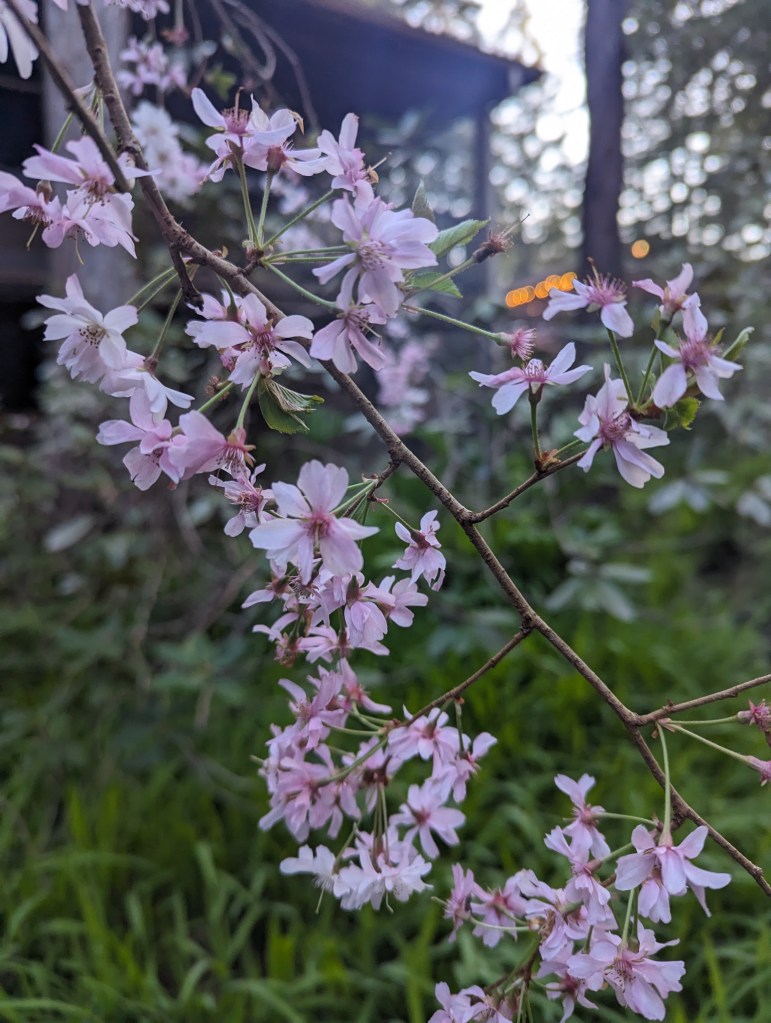
Its name describes it simply. Winter flowering cherry, Prunus X subhirtella, is a flowering cherry that blooms for winter. It is more popular where winters are cool enough to inhibit other bloom. It is less common here only because of other options for wintry floral color. Besides, slightly more floriferous flowering cherries bloom almost immediately afterward.
WIntertime bloom is actually a bit more reliable here than where it is more popular. Frost is too mild locally to damage it much, and mostly occurs earlier. Rain is mostly too light and too brief to dislodge much of the bloom. Bloom is a bit less profuse than that of other cherries because it is a bit more continuous. Therefore, it recovers from minor damage.
The relatively common sort of this uncommon flowering cherry blooms for late winter. Its bloom is slightly lavenderish pink. Some rare cultivars can bloom as early as autumn or as late as spring. A few are pendulous. Floral color ranges from white to pink. Floral form is mostly single but can be double. Deciduous foliage turns yellow or orange for autumn.

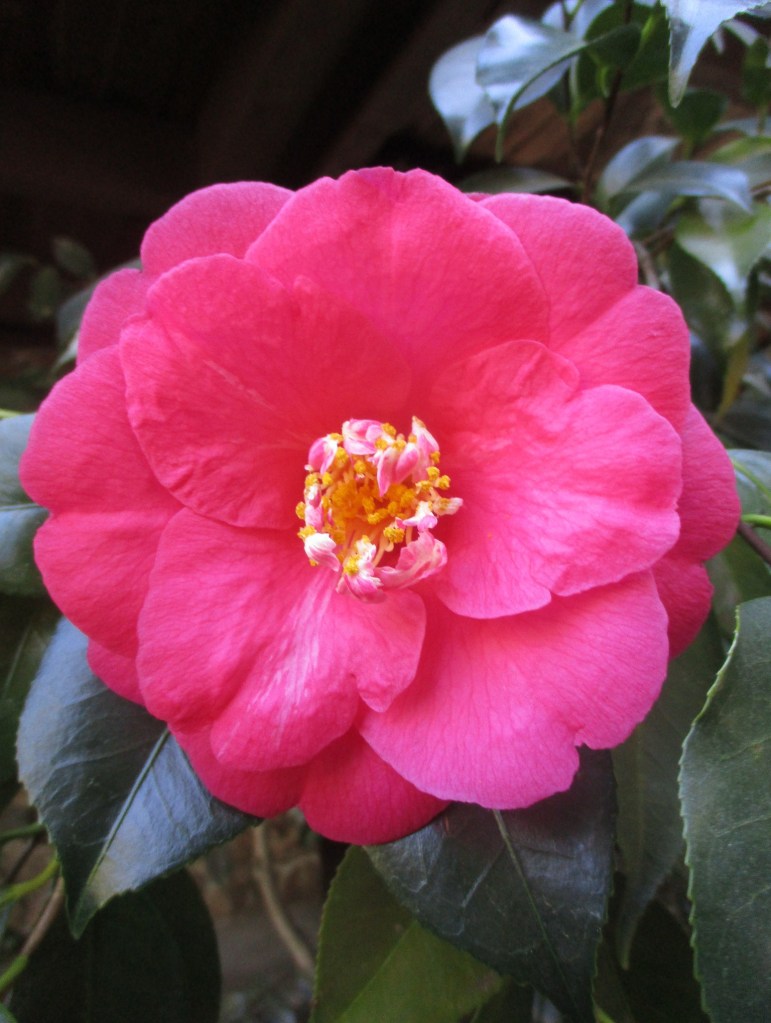
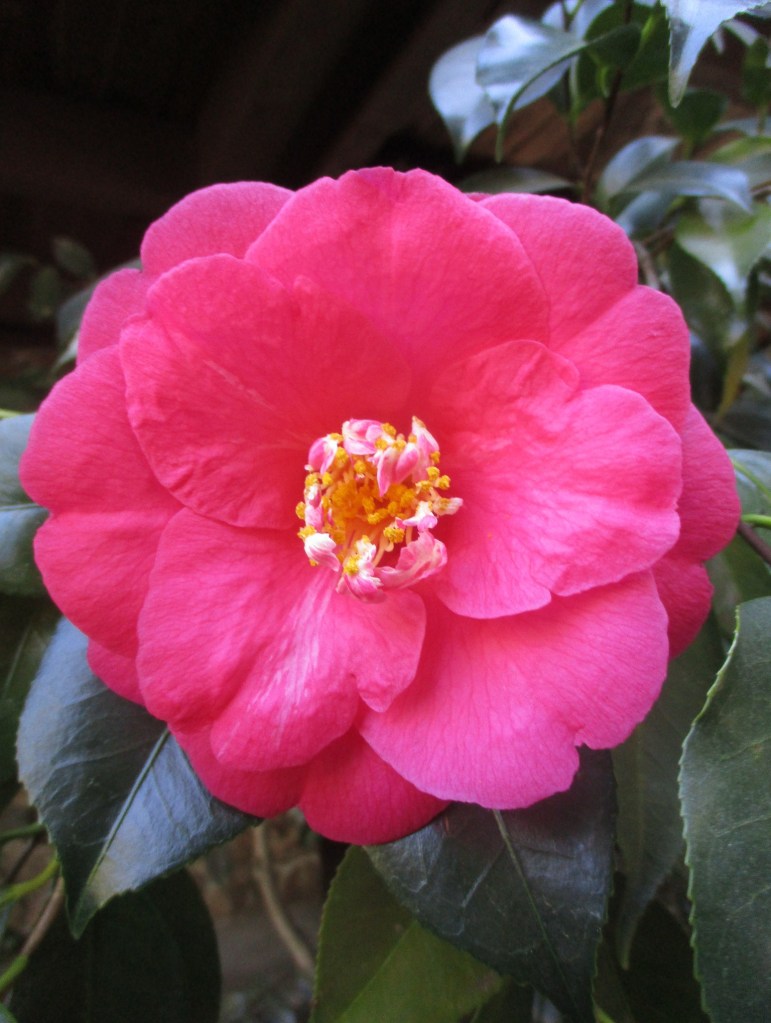
‘Yuletide’ Camellia sasanqua should bloom for Christmas, as the name implies. It typically does. However, it sometimes blooms early or late. It might be slightly late this year, but has been blooming for quite a while, and was beginning to bloom by Christmas.
It certainly is a delightful red. It seems to me that it can be slightly more reddish, with less of a pink influence, in some situations. Perhaps the bright yellow of the staminate centers cause it to appear as such within certain weather conditions or sunlight exposures. This particular flower may seem to be slightly pinkish as a result of distress. The hedge that it bloomed on had been infested with red spider mite earlier.
This particular cultivar of Camellia sasanqua develops distinctly upright and perhaps ovoid form, and can get quite tall. Most other cultivars develop more irregular or sprawling form, with long and limber stems, and relatively short stature.
I am impressed that this bloom is so resilient to wintry weather. Although much of the foliage is under a wide eave, most of the bloom is not under the eave, so has been exposed to both rain and frost. Apparently, Camellia sasanqua bloom is resilient to frost that is colder than it gets here. Camellia flower blight is common regionally, but mysteriously does not damage many flowers within the landscapes here. White and light pink Camellia japonica flowers are more vulnerable, but even they bloom quite nicely here, with only a few flowers succumbing before they finish bloom, and generally as their cumulative bloom cycle is finishing anyway.
Deer eat any cultivar of any species of Camellia, but avoid camellias here more mysteriously than camellia flower blight. I do not remember ever encountering damage that was caused by deer; and there are many camellias here.

Heaths, which are several species of Erica, derive their name from their natural habitats. They are endemic to shrublands of acidic and seasonally dry soil of inferior quality. Such ecosystems, or heaths, do not sustain many big trees or shrubbery. Species from heaths should be resilient to dry chaparral summers. However, they dislike locally alkaline soils.
This is unfortunately why heaths are quite rare within gardens here. They are popular as blooming potted plants for winter, but become scarce afterward. Within planters of potting media, they may grow and bloom for many years. In the ground though, they are likely to languish without acidifying amendment. They prefer the company of coniferous species.
Heath blooms for winter or very early spring. Heather is a similar relation, but blooms for summer or autumn. Floral color ranges from white to pink to rustic purplish pink. Flowers are dinky but abundant. Comparably dinky evergreen leaves are like soft juniper scales. Almost all available heaths grow less than five feet high. Most grow less than a foot high.
Except for flowers that bloom randomly throughout the year, most autumn bloom is done. Much of the formerly spectacular autumn foliar color succumbed to wintry rain and wind. Many colorful winter berries have already gone with migratory birds who consume them. Overwintering birds appreciate what lingers. Fortunately, some winter bloom continues.
Cool season annuals likely provide most winter flowers prior to spring. Ornamental kale generates a foliar display like a pastel version of summer coleus. Snowdrop bulbs bloom only white, but look sharp if other bloom is scarce. A few species contribute winter bloom merely because they lack regard for seasons. African daisy blooms whenever it wants to.
However, winter bloom is not comparable to spring bloom. That is an unfortunate reality. Most species that bloom randomly throughout the year bloom best for spring or summer. Most species that bloom specifically during winter are relatively subdued about doing so. Although pollinators are less active, competition for their pollination services is minimal.
Witch hazel is becoming more popular locally for its fragrant winter bloom on bare stems. Modern cultivars bloom with earthy tones of yellow, orange, red, and burgundy red. They prefer cool wintry weather though. Bloom may be inhibited somewhat within mild coastal climates. Winter jasmine bloom, although limited to only brilliant yellow, is more reliable.
Some species of Mahonia likewise bloom reliably but exclusively bright yellow. They are evergreen instead of deciduous. So is andromeda. Its pendulous ivory white or pale pink blooms are more striking in form than color. Daphne, which likely finished bloom already, is more striking in fragrance than color. Its light pink bloom is mostly obscured by foliage.
Camellias are among the most reliably colorful of winter bloom. Their floral color ranges through all hues between white and red. Floral form and abundance are notably diverse. Some bloom rather sparsely. Various cultivars bloom at various times throughout winter. Sasanqua camellias generally bloom earlier, with relatively smaller but profuse flowers. Camellias unfortunately lack fragrance.
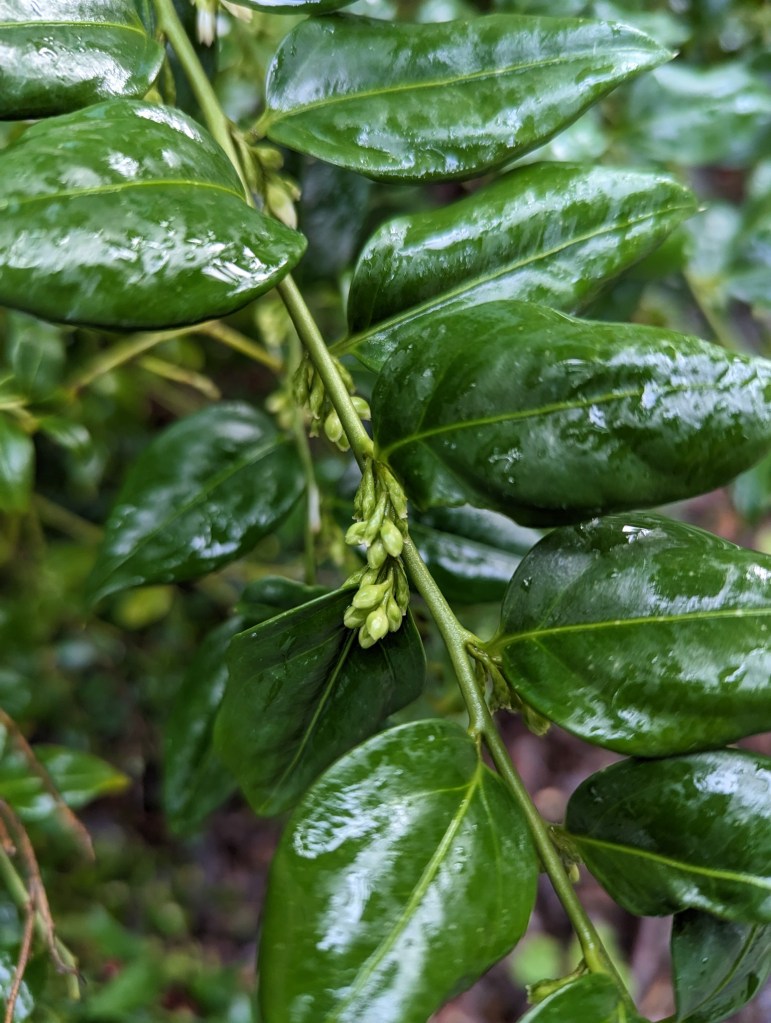
Floral fragrance is likely the primary asset of sweet box, Sarcococca ruscifolia. However, the splendidly glossy and evergreen foliage is as appealing as that of any of the various boxwoods. It is darker and richer green, with orderly arrangement on nimble and arching stems. Individual leaves are small but larger than boxwood leaves, and with pointier tips.
Sweet box blooms during winter, with deliciously fragrant but tiny pale white flowers that are not much to see. They are unlikely to get credit for their impressive fragrance without close investigation for its source. Vigorous plants may produce a few rich maroon berries that contrast delightfully with the rich green foliage. Cut stems work well with cut flowers.
Because it is naturally an understory species, sweet box not only tolerates partial shade, but actually prefers it. Harsh exposure fades its foliage. The dense foliage on wiry stems adapts to low hedging. It is better with alternating cane pruning to remove old stems and promote fresh basal growth. Overgrown specimens respond quite favorably to coppicing. They grow to three feet high.
Oregon gardens get to display superior peony bloom for spring and summer. That is one of several advantages of winter chill. Some plant species appreciate a bit more chill than they can get here. It enhances their performance. However, chill also limits winter bloom. Not many plants want to bloom while the weather is cool, and pollinators are less active.
That is one of several advantages of mild winter weather. It allows flowers that bloom for autumn to bloom a bit later. It allows a few of the flowers that bloom for spring to bloom a bit earlier. There is not much time between the last flowers of autumn and the first flowers of spring. Winter bloom is not as important here as where winters are longer and chillier.
Even if less important here, reliable winter bloom might be a bit more challenging. Some plants that bloom for winter in other climates might be hesitant to bloom for winter locally. After all, they prefer to bloom while the weather is cool. Mild chill might be unsatisfactory. Cool season annuals are unpredictable, but are likely the most reliable for winter bloom.
Of the popular cool season annuals, cyclamen is actually perennial. If not removed at the end of its season, it goes dormant for summer, and regenerates for subsequent winters. It does not bloom as profusely as it originally did, but adds color to mixed small perennials or ground covers that do not bloom for winter. Some types of primrose are also perennial.
A few perennials bloom sporadically and randomly throughout the year, including winter. African daisy and euryops daisy typically do not bloom as much as they do during warm weather, but can. Euryops daisy may actually bloom best during winter. Bird of Paradise flowers mature so slowly that those that begin during autumn might finish through winter.
Witch hazel, daphne, heather, mahonia and winter jasmine bloom for winter, but perhaps not as impressively as for other climates. Some camellia bloom abundantly while others bloom sporadically. Bergenia may bloom later here than for other climates. Forsythia and some spring bulbs, especially daffodil, bloom so early that they seem to bloom for winter.
 Tony Tomeo