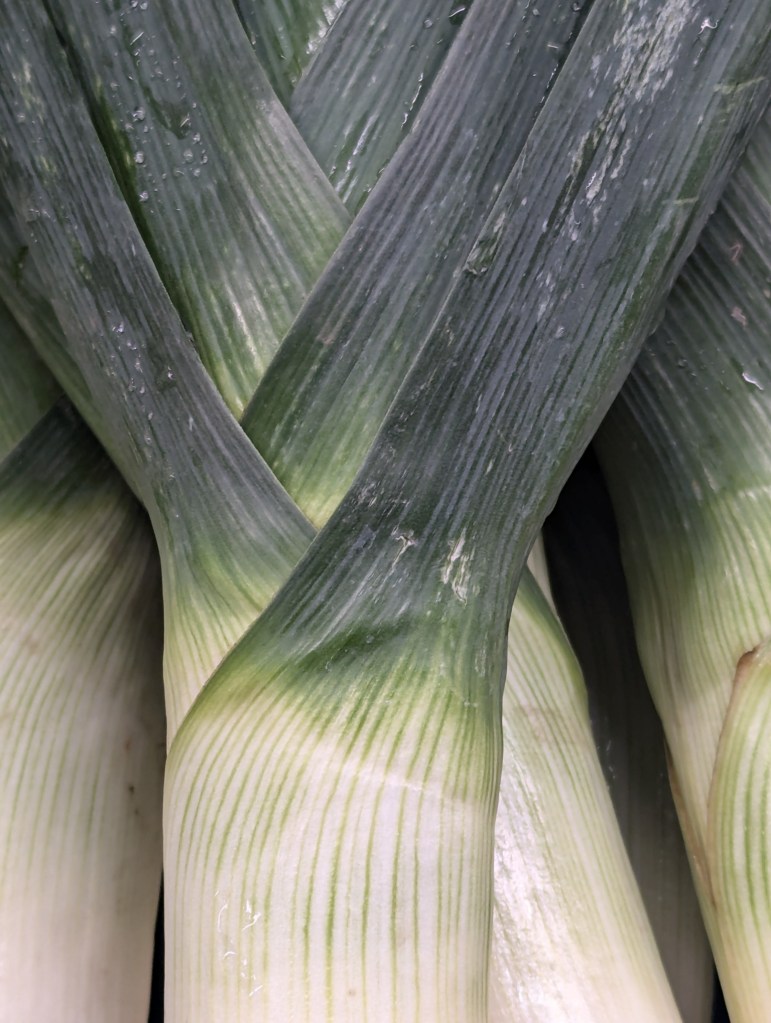
Leek, Allium ampeloprasum, is an old fashioned but traditional cool season vegetable. It is rare among home gardens, but has been in cultivation for thousands of years. It is one of the floral emblems of Wales, in conjunction with daffodil. In cooler climates, leeks may grow through summer for autumn harvest. They are only a cool season vegetable locally.
Leeks grow easily from directly sown seed, but are alternatively conducive to transplant. Therefore, they can start in flats while warm season vegetables are still producing. Then, they can transition to the garden early enough to mature before frost. Later phases which grow through winter are quite tolerant of mild frost. They might even be bigger and better.
Like several cool season vegetables, leeks are in no rush for harvest. Once mature, they can linger in their gardens for weeks without deteriorating or bolting. Like related onions, they prefer somewhat rich and loose soil. Until the winter rainy season begins, they need regular watering. Thrips can be more of a problem in other regions during warm weather.
Warm season vegetables that started late last winter will be finishing their seasons soon. Cool season vegetables, or winter vegetables, should begin to replace them. This might sound familiar as the same scenario for warm and cool season annuals. After all, almost all vegetable plants are either annuals or biennials. Few perform for more than a season.
Just like annual bedding plants, different vegetable plants perform to different schedules. Some warm season vegetables begin to deteriorate as warm weather ends. Others may continue to produce until frost. Some cool season vegetables need an early start. Others can start late and grow through cool winter weather. Gardens need not transition quickly.
Besides, different phases of some types of vegetables begin and finish at different times. Although late phases of corn continue to grow, early phases are already done and gone. Although late phases of beet might begin months from now, early phases can begin now. Warm season vegetables, ideally, relinquish space as cool season vegetables require it.
Cool season vegetables grow slower than warm season vegetables. Also, more of them are true vegetables rather than fruit that contain seed. Many are distended roots, such as beet and carrot. Many are distended foliage, such as cabbage and chard. A few, such as broccoli and cauliflower, are distended floral bloom. Peas are actually fruiting structures.
All root vegetables should grow directly from seed. They are vulnerable to disfigurement if transplanted. Besides, they typically grow in significant quantities that are not practical for transplant. These include beet, carrot, radish, turnip and parsnip. Cucumber and pea, although conducive to transplanting, also perform better from seed. So do lettuce greens.
Heading lettuce, though, is more like cabbage and larger cool season vegetables. Since only a few are necessary, transplanting them as seedlings is practical. Besides, they are conducive to transplanting. Cell pack seedlings for cool season vegetables are available from nurseries now. Seed is always available. It can go directly into a garden or into cells for transplanting later, as summer becomes autumn, then winter.
Leek, garlic, shallot and other species of the genus have more distinct growing seasons. Technically, onion, Allium cepa, is a cool season vegetable. It grows through winter to be ready for harvest before summer dormancy. Alternatively, it can grow through spring for a later summer harvest. In cool situations, it can grow through summer for autumn harvest.
Onions do not actually mature within a single season anyway. Most grow from onion sets which are simply small onions that grew from seed earlier. They simply finish growing for another season once plugged into a garden. Those that grow from seed in autumn might go dormant through the middle of winter. Spring is actually their second growing season.
The most popular onions are yellow or brown, red or purple, or white. Each type exhibits a distinct flavor. All develop a few hollow bluish green leaves that stand about a foot tall. Their foliage shrivels as they mature enough for harvest. They are useless if they bloom. Green onions are merely juvenile onions which have not yet developed distended bulbs.
Mustard is not easy to classify. It is a cool season vegetable here, although it grows until summer gets too hot. In cooler climates, it is a warm season vegetable. Whether warm or cool season, it provides more than greens. For agricultural applications, it is also a cover crop and livestock fodder. Its seed and seed oil have culinary and medicinal application.
Also, some consider mustard to be a wildflower, and some consider it to be a weed. Most but not all species that naturalized here are of the genus Brassica. None are native. Wild turnip and wild radish are similar and are also naturalized, but not as aggressively. Their bloom may be pink or creamy white. Most mustard varieties display bright yellow bloom.
Garden varieties of mustard have milder flavor and finer texture than wild sorts. They are sometimes available as cell pack seedlings, but grow like weeds from seed. Varieties for mustard seed might only be available online or from mail order catalogs. Mustard greens develop bitter flavor with age or bloom. Bigger lower leaves can develop coarser texture.
Winter bedding plants are a reminder. They become in season at about the same time as winter vegetables. Therefore, as pansies replace petunias, turnips may begin to replace okra. As for bedding plants, it is a slow process that can continue until frost. Some winter vegetables start earlier than others. Some summer vegetables produce later than others.
For example, young okra plants that started late can continue to be productive until frost. There is no need to replace them until then. Instead, older okra plants that started earlier also finish and vacate their space earlier. Early phases of turnip seed can use this space as it becomes vacant. Then, later phases of turnip seed can replace later phases of okra.
Winter vegetables, or cool season vegetables, do grow slower than summer vegetables. In that regard, spring and summer warmth is an advantage. Consequently, recovery from delays is not as easy for them. More winter vegetables than summer vegetables are true vegetables. In other words, they are not fruit that contain seed. Many are distended roots.
This is why most winter vegetables should grow directly from seed. Root vegetables are susceptible to disfigurement from transplanting. Also, most usually grow in quantities that are impractical for transplanting. Most winter vegetables that are practical for transplants grow big above ground. This includes small groups of broccoli, cauliflower and cabbage.
Because broccoli, cauliflower and cabbage are so big, only a few of each are necessary. One or two cell packs of seedlings may be sufficient. They may not cost much more than packets of seed. Also, they are immediately ready for transplant. Seed must start growing earlier, in cells, flats or in their gardens. However, more varieties are available from seed.
Beet, carrot, radish, turnip and parsnip are roots that must grow from seed. Baby lettuces grow from seed because they are so numerous. Hedding lettuces can grow from seed or seedlings. So can peas and cucumbers, but they are more likely to grow best from seed. Successive sowing or planting prolongs production time of almost all winter vegetables. Subsequent phases begin production as their preceding phases finish.
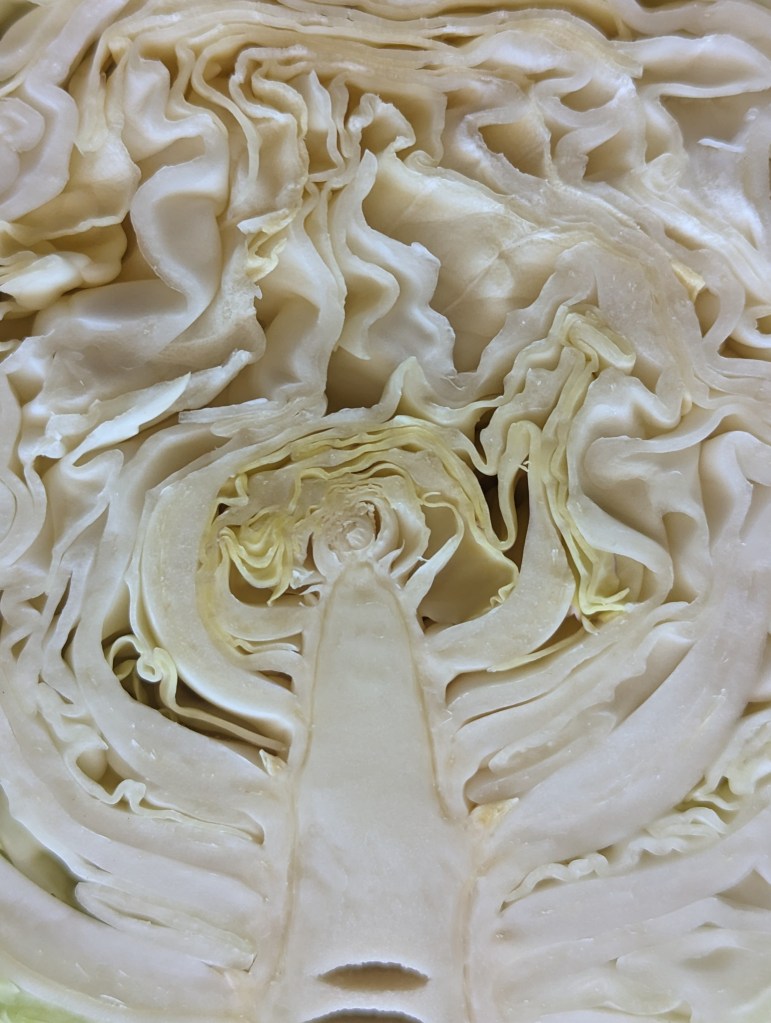
Resemblance to lettuce is merely coincidental. Cabbage, Brassica oleracea, is instead a close relative of very dissimilar vegetables. Brussels sprout, broccoli and cauliflower are different varieties of the same species. So are collard, kale and kohlrabi. All are winter cole crops. (Cabbage comprises the varieties of capitata, tuba, sabauda or acephala.)
Cabbage became seasonable last autumn. Its last phase is now maturing. It grows most easily from cell pack seedlings. Alternatively, it can grow from seed, which starts about a month and half earlier. Cabbage is biennial, so will go to seed if it stays in the garden too late. Warm weather initiates and accelerates the process, which ruins flavor and texture.
Green cabbage is the most popular type. Red cabbage is the second most popular type. Dutch white cabbage often classifies simply as a pale type of green cabbage. A mature cabbage weighs about a pound or two. Its loose outer foliage can be a foot to nearly two feet wide. Within more ideal climates, some varieties grow slower but significantly larger. With rain through winter, irrigation is probably unnecessary. Soil should be organically rich.
Warm season vegetables are replacing cool season vegetables about now. Technically, lettuce, Lactuca sativa, is a cool season vegetable. It grows through spring and autumn though. The last of it can continue almost until May. Within the mildest coastal climates, it can continue later. By the time it finishes there, it is almost time to plant more for autumn.
After thousands of years of cultivation and breeding, lettuce is now remarkably diverse. Most popular varieties are leaf, head or romaine types. Leaf lettuce is mostly green, but can be bronze, reddish or irregularly blotched. Most varieties develop loosely ruffly foliar texture. Romaine and head lettuce is denser but larger. Some grow a foot high and wide.
One commonality among lettuce varieties is that they tolerate neither frost nor arid heat. Some are a bit more tolerant of one or the other, which can prolong their season. Some of the larger romaine and head types need nearly four months to mature, though. Only a single phase matures within each season. Smaller types might mature in about a month.
Tomatoes were adequate, and perhaps quite good, but not as vigorous as they should have been.
Now that it is half way through September, it is impossible to ignore that tomatoes did not have a good season. Most of us who grow tomatoes were embarrassed by their performance until we realized that everyone else who grows them was also experiencing similar disappointing results. It was not because we did not water them properly. Nor was it because they lacked particular nutrients. They simply wanted warmer weather.
Plants that were put out early before the warm weather last spring did much better at first, but then decelerated as the weather became milder instead of warmer. Cool nights certainly did not help. Mildew, which typically slows a bit as weather becomes drier (less humid) though summer, instead continued to proliferate so that new foliage became infected almost as soon as it developed.
Earlier predictions that the weather would eventually get warm were not accurate enough for many of us who are only now getting enough tomatoes for fresh use, but not an abundance for canning, drying or freezing. There is still some time for most of the tomatoes that are on the vines now to ripen; but many will probably remain green by autumn. Some but not all of the last green tomatoes can ripen off the vine. Perhaps the only good news about all this is that there should be plenty of green tomatoes for pickling.
Sadly, tomatoes were not the only warm season vegetables to be dissatisfied with the weather. Green bean vines and bushes were generally healthy and made good beans, but did not produce very abundantly. Corn was likewise of adequate quality, but on smaller ears and less abundant. Even zucchini, which typically produces too much, was a bit subdued. Marginal vegetables that really prefer warmth, like eggplant and bell pepper, were downright disappointing.
Even if the weather gets warmer in the last days of summer, languishing tomato plants can not ketchup on production. They can be left to make a few more tomatoes, but will eventually need to get out of the way of cool season vegetables. Cabbage, kale, turnip greens, beets, radishes and all the slower growing vegetables that take their time through autumn, winter and early spring will want their space back soon. They will hopefully have a better season.
If possible, cabbage, broccoli, cauliflower and some of the larger cool season vegetable plants can be plugged in amongst the finishing warm season vegetable plants. Then, by the time the finishing warm season vegetable plants need to be removed, the next phase of cool season vegetable plants is already somewhat rooted and has a head start. This process works well in small spaces with good quality soil.
The main problem with this procedure is that it prevents potentially depleted soil from getting amended and well mixed between planting. It can also be a bit awkward to get the spacing of rows, furrows or mounds of the next phase of vegetable plants to match up with the previous phase. Smaller vegetable plants that get sown directly from seed into rows, like turnip greens, carrots, beets and radishes, really prefer customized bed preparation, after the warm season vegetables have been removed.
Many popular salad greens are somewhat discriminating about the seasons here. Some dislike even a minor chill during winter. Several more dislike arid warmth during summer. Frisee is a sub variety of curly endive, Cichorium endivia var. crispum, that dislikes both. It prefers weather from late summer through autumn, and from late winter through spring.
Frisee is related to chicory, which includes radicchio, puntarelle and Belgian endive. It is less closely related to dandelion. Because it is relatively unfamiliar locally, some know it as chicory or curly endive. It is typically a component of fresh green salads. Alternatively, it sautees nicely, or mixes with other cooked greens. Frisee is apparently quite versatile.
Frisee may be unavailable as seedlings in cell packs from nurseries. Because individual plants are small, it is most practical to grow them from seed anyway. Seed germinates in about a week. Seedlings mature in about a month and a half. Mature frisee is only a foot wide. It requires full sun exposure with frequent watering. Phasing prolongs productivity.
Just as warm season annual flowers that bloomed through spring and summer get removed to relinquish their space to cool season annuals, summer vegetable plants need to vacate the garden for cool season vegetables. Fortunately, removing vegetable plants is not as unpleasant as removing the pretty flowers might have been, because most have finished producing whatever it is that they were grown to produce.
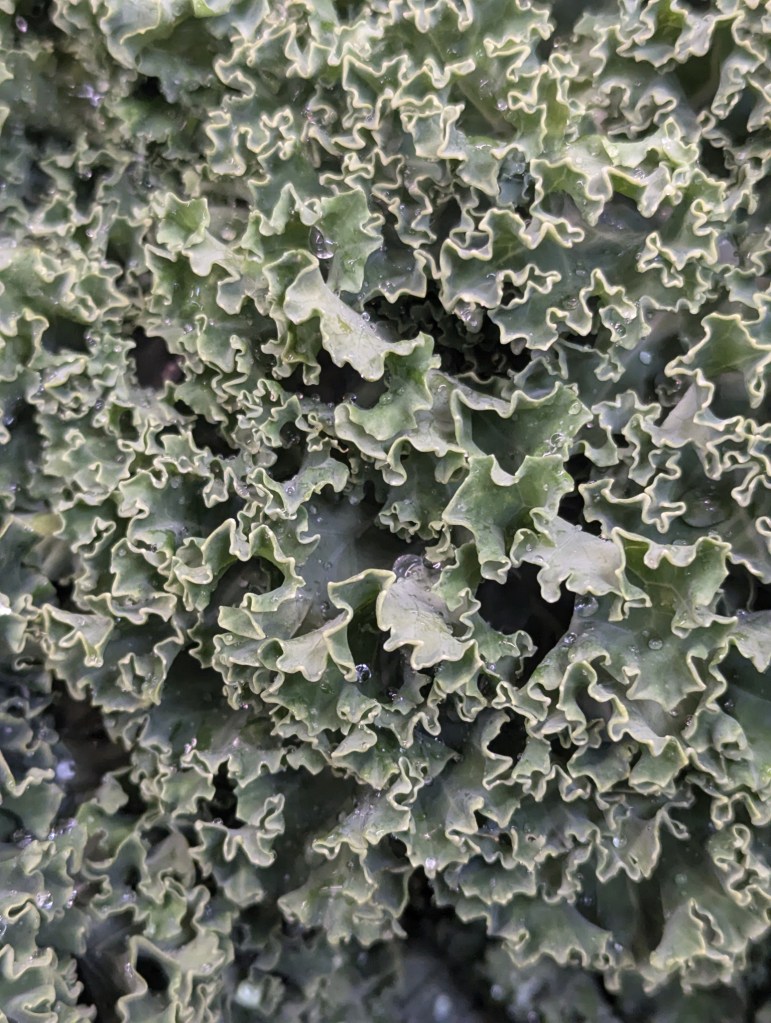
Besides, cool season vegetables are even cooler than warm season vegetables, since some have distinctive foliage that is appealing beyond the vegetable garden, in borders, pots and mixed plantings, out in the landscape. Swiss chard is a striking foliar plant, whether it gets eaten or not. The outer leaves can get eaten without compromising the appeal of the inner leaves that continue to grow and fluff outward to replace them. Arugula, kale, mache, loose lettuce (non heading) and collard, mustard and turnip greens do the same.
This ability to function in more places in the landscape is a definite advantage since cool season vegetables are not quite as productive as warm season vegetables are. They would certainly like to be as productive, but grow slower through cool weather.
Most cool season vegetables should be sown into the garden as seed. Root vegetables, like beet, carrot and radish, might be available as seedlings in cell packs, but do not recover very well from transplanting. Besides, seedlings of such plants in cell packs are either too abundant and crowded, or to sparse to produce much. Leek, loose leaf lettuce and most of the greens likewise grow best if sown as seed in rows instead of planted in tight clumps as they are grown in cell packs.
Only greens that are grown as individual big plants, like chard, kale and collard green, can be as productive from cell pack seedlings as from seed. However, each cell pack produces only six plants, maybe with some extras. A package of seed costs about the same, but contains more seed than most gardens can accommodate.
Actually, the only cool season vegetables that might be more practical to grow from cell pack seedlings than from seed are broccoli, cauliflower, cabbage and Brussels sprout. These vegetables grow as even larger plants, so minimal quantities, like one or two or perhaps three cell packs, are sufficient.
Like so many of the warm season vegetables, many cool season vegetables should be planted in phases every two to four weeks to prolong harvest. By the time the first phase finishes, the next phase will be ready. The frequency of phases depends on the growth rate and duration of production of the particular plants. For example, chard has a long duration of production, so does not need many phases.




 Tony Tomeo