Firewood

It is not too early to procure firewood.

Despite the pleasant warm weather, it will be autumn soon. This is the time to get ready for cooler weather through autumn and winter. The plants in the garden do that on their own without our help. They somehow seem to know what time it is. We only need to clean up the mess and empty the gutters when deciduous trees start to drop their leaves later. Most of our work involves features that are not plants.

Winters are so mild here that some of our work often gets delayed until it becomes necessary. If needed, we can paint, stain and seal decks, fences, patios and anything else outside anytime the weather allows right through winter. Many of us leave patio furniture outside all year both because the weather is not too harsh on it, and because patios are usable spaces even through winter.

Firewood is also commonly neglected or not even needed, but for different reasons. Many fireplaces were damaged or destroyed by the Loma Prieta Earthquake decades ago, and never repaired or replaced. Modern building codes outlawed the construction of new fireplaces even prior to that; so newer fireplaces are instead pellet stoves. Those of us who still use old fireplaces and stoves have more difficulty obtaining wood now that the orchards are gone and the outskirts of town are so much farther from home.

The advantage of pellet stoves is that fuel (which looks like stove food) is always available so does not need to be accumulated, stored and seasoned. The fuel also burns cleaner. Synthetic logs (made from compressed wood byproducts and fuel) are an expensive alternative for conventional fireplaces and stoves, but also burn cleaner than wood, and are always available. They are lightweight and clean, so can be picked up at the store and brought home in the trunk of a small car whenever a fire is wanted in the fireplace.

Good old fashioned firewood is both more work and stigmatized because of pollution. Those of us who do not have firewood available within our own gardens can purchase it from some tree service companies. It is most commonly obtained already split and seasoned directly from the wood yard where the tree service company stores it. It can be delivered for a price. Some people even like to pay a bit extra to get it  stacked.

Firewood obtained in this manner is typically a mix of random woods from trees found in local landscapes. There is often a preponderance of a particular type of wood. No one ever knows what to expect. The specific type of wood is designated only when a large tree or group of trees needs to be removed, and can be isolated from mixed wood.
Palms and yuccas, known as ‘herbaceous trees’, do not produce effective firewood! A few pieces in a load of firewood should not hurt anything, but palm or yucca ‘wood’ should not be purchased. Mixed wood often contains some resinous wood and eucalyptus, which burns just fine, but produces a bit more soot that needs to be cleaned from chimneys.

Firewood should be obtained annually in quantities that are likely to be used each winter. It is perishable, and can rot if stored several years outside. Even if it does not rot, it can become infested with rodents if it stays idle too long. Besides, excessive firewood simply takes up space that could be used for something else.

Fireplace Season

Firewood must be seasoned by now. Fresh wood will be seasoned for next year.

There are several reasons why fireplaces are not nearly as commonly used as they once were. Modern building regulations have prevented construction of newer fireplaces (except pellet stoves). Many fireplaces that were ruined by the Loma Prieta Earthquake were never replaced; partly because there are other more efficient sources of heat, and partly because of the concern of air quality. The fuel that was once relatively easy to obtain from orchards that were getting removed to relinquish their land for urban development has been exhausted.

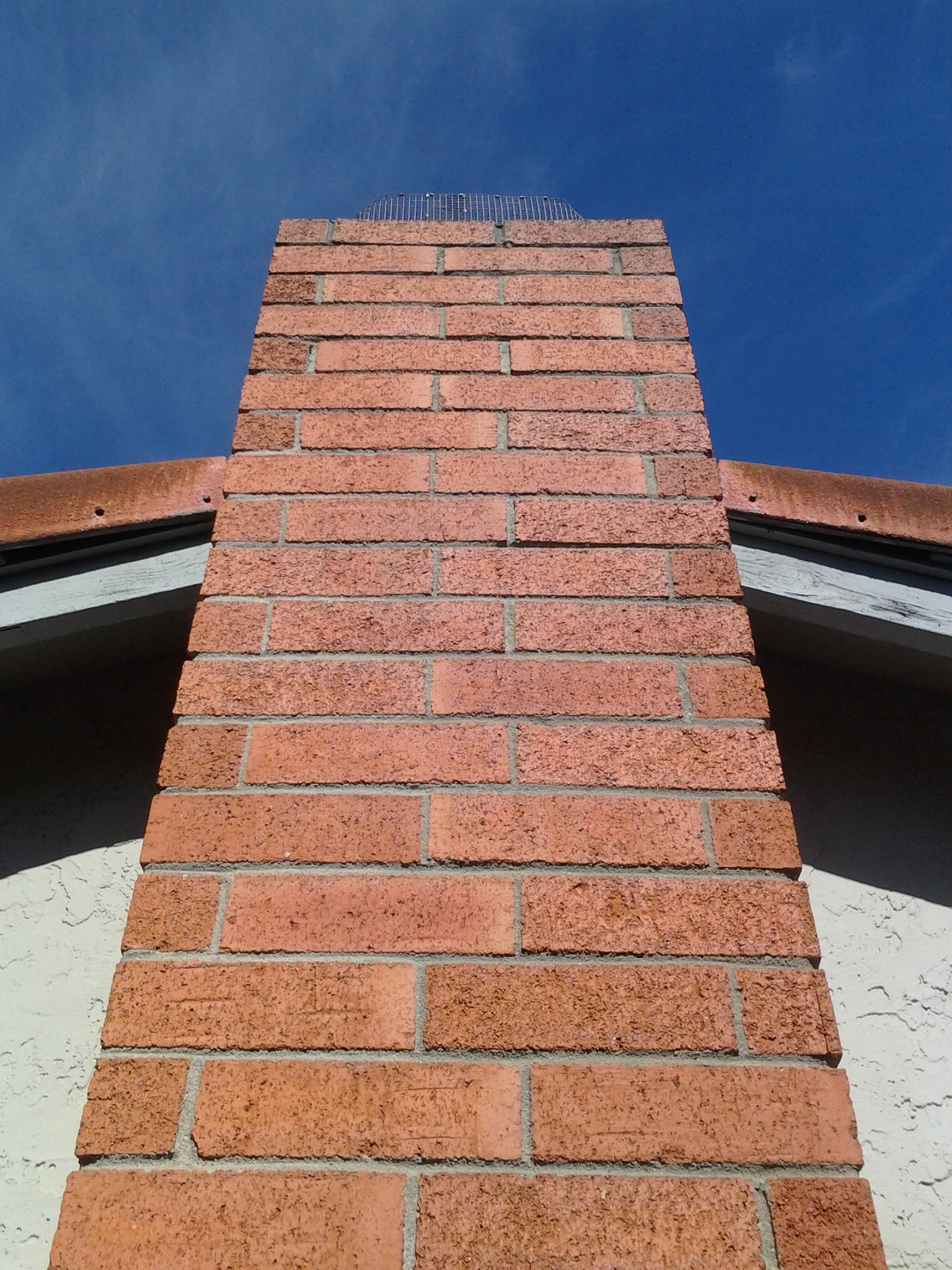
Regardless, those of us who use fireplaces need to be certain that they do not become overwhelmed by trees or climbing vines. Cypress, cedars, pines and some fan palms are remarkably combustible and hazardous when they get too close to chimneys, particularly if the roofs below are covered with old fashioned cedar shingles.

All trees and vines should be pruned away from chimneys so that they are out of reach of sparks and heat. The more combustible trees should get more clearance than deciduous trees (that are bare through winter) need. Nearby Monterey pines, Cypress and any trees that tend to accumulate debris should be groomed of debris, even if their limbs are already pruned back for sufficient clearance.

Trees should also be pruned for clearance from roofs and gutters; and any accumulated debris should be removed. Even before the weight becomes sufficient to cause damage, the motion of limbs in the wind is abrasive to roofs. Older roofs, particularly cedar shingles, will deteriorate under any accumulation of organic debris, particularly as it gets wet from rain.

Wood Still Warms Many Homes

Trees recycle quite naturally into fuel.

Fireplaces and wood stoves are not completely obsolete. They are merely less common than they were years ago. Modern building codes prohibit them within new construction. For some that incur damage from earthquakes, removal is more practical than repair. Not many people use fireplaces and wood stoves nowadays anyway. Nonetheless, a few do.

Sources of firewood have also changed. Displacement of orchards and forests by urban developments had been reliable sources. Such orchards are now gone. Forests are now farther away, and protected from harvest. Instead, most wood fuel is now obtainable from the tree service industry. Scrap from tree maintenance and removal converts to firewood.

Unlike uniform firewood from former orchards, scrap wood is variable. Orchards produce only one type of firewood from their unvaried trees. Firewood from forests involves only a few species that may remain separate for sale. Scrap wood can include any species that a particular tree service encounters. Except for larger volumes, separation is impractical.

The tree service industry provides less firewood than displaced orchards and forests did. However, nowadays, less firewood is necessary. There are many more homes here than years ago, but very few consume wood for heat. Residents who choose to burn firewood are now generally less selective. Yet, some might separate mixed firewoods accordingly.

Tree services prefer to leave firewood where it lands. They charge for removal of excess firewood. They typically cut logs to firewood lengths, but do not split them. Neighbors are therefore sometimes pleased to share wood from removed trees. Tree services sell wood that they must remove, after splitting and seasoning it. They typically charge for delivery.

Firewood for this winter must have seasoned by now. Most types should have sufficiently seasoned if cut and split before last spring. Fresh firewood can not season so late during increasingly cool and damp weather. Scrap from winter pruning can become firewood for next winter. Palms and other monocots do not produce actual wood that burns efficiently.

Firewood Is Old Fashioned Technology

Cut firewood needs to be split.

Chimney clearance pruning is easy to overlook nowadays because, for various reasons, chimneys are becoming obsolete. Modern homes lack them completely. Some chimneys of older homes succumbed to earthquakes. Because of simpler and cleaner alternatives for heat, remaining chimneys and their fireplaces, as well as firewood, are almost passe.

Ironically, chimineas and fire pits have become a fad. Most modern fire pits use propane for fuel, but a few use firewood. Although such fire pits and chimineas burn less firewood than fireplaces, they are ridiculously less efficient. Their warmth simply escapes into the atmosphere. Relative to the volume of wood they burn, they generate much more smoke.

Nevertheless, whether for fireplaces, wood stoves, fire pits, or chimineas, firewood is not yet completely obsolete. Some households only rarely use small quantities for ambience fires. Some households still use more significant quantities to supplement home heating. A few households rely on firewood as their primary or exclusive source of home heating.

For unrelated reasons, the availability of firewood has declined with its demand. Orchard trees that were still relinquishing their space decades ago are now gone. Also, wildlands are now farther from large urban regions where most people live. Wood from demolished buildings is more likely to become chipped mulch than to become available as firewood.

Fortunately, most tree services sell firewood that is a byproduct of their work. Such wood is generally a mix of various species, so may include some degree of softwoods, such as pine. Rural tree services are more likely to be able to provide specific types of hardwood, and are also more likely to be able to deliver it. Their softwoods might be less expensive.

Tree services prefer to leave wood where they do tree work, and actually charge a bit for removal. Cut rounds of logs should be firewood length, but need splitting and seasoning. Inadequately seasoned or damp wood generates more smoke than properly dried wood. It should stay sheltered from rain. Palms and yuccas are impractical for use as firewood.

Know How To Procure Firewood

Firewood from tree services might be an unknown mix.

Fireplaces and wood stoves simply are not as common as they were only a few decades ago. Because of modern building codes, most that get damaged by earthquakes get removed or replaced by pellet stoves. The orchards that once provided so much inexpensive firewood while they were being cleared for urban development are now gone. The wood yards in the relatively arboraceous outskirts of town are farther away. Many municipalities have established ordinances to limit smoke, although this is not a problem if well seasoned wood gets burned properly, and only means that fireplaces can not be used on ‘spare the air’ days.

Firewood can be purchased from tree services that need to dispose of wood anyway. Because it is only a byproduct of tree work, it will likely need to be stored and seasoned the year before it is needed, just like orchard wood. (Firewood from wood yards gets seasoned before it gets sold.) Some types of wood that are often mixed in leave a bit more residue in chimneys, necessitating more frequent chimney sweeping. Realistically though, chimneys should be cleaned regularly anyway.

Because firewood is perishable, it should be obtained annually, in quantities that will be used in a single winter. It can rot if stored outside too long. If stored in a shed or garage too long, it can get infested with rodents. Besides, too much firewood occupies quite a bit of space.

Synthetic logs (made from compressed wood byproducts and fuel) are an effective, clean and efficient alternative to real wood that do not need to be seasoned. Each log burns about as long as several real logs, and produces about as much heat, so only a few go a long way. They are always available from supermarkets, and can be brought home with the groceries. Pellet stoves that consume fuel pellets that look like stove food are even more efficient. However, there is no substitute for a fire with real wood in a real fireplace or wood stove.

Carpentry

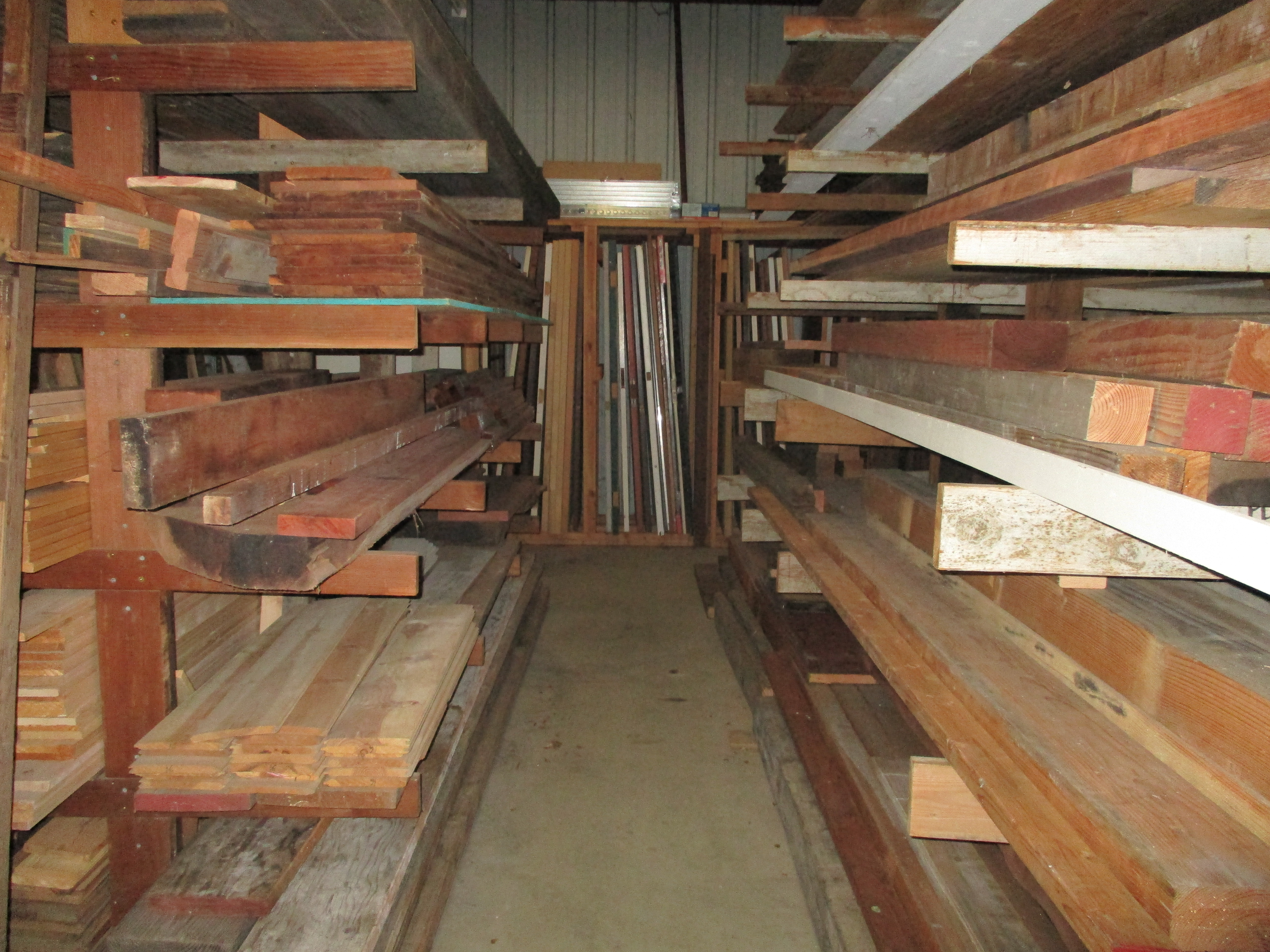
P90217Saint Joseph did not have it so good. He is still the most famous carpenter, and somehow got the most excellent city in the World named after him, but he did not work in a shop like this one. The most well outfitted carpentry shops back then lacked modern power tools, and the selection of woods that are now so easily imported from all over the World.

The best lumber in this shop at the Conference Center (where I work in the landscapes part time) is actually not the exotic sort. Three very important timber crops, (coastal) redwood, Douglas fir and ponderosa pine, happen to be native. A few of the larger of these trees that need to be removed get milled into lumber that gets used here.

Much of the lumber shown in this illustration is recycled from old buildings that were built from local lumber at a time when it was not so practical to import lumber to such a remote location. The rack on the back wall, at the center of the picture, contains old doors that are ready to be recycled. Flooring and moulding were made from native oaks, which are not the easiest to mill, but happened to be the most available. Nowadays, most of the lumber used here is procured from the lumber yard across the road, but it is neither of comparable quality, nor very interesting.

What is most interesting about the carpentry shop is not seen in the illustration above. There are a few on the Maintenance Crew who are proficient with structural carpentry, and one who is a finish carpenter. The finish carpenter is as proficient with carpentry as arborists are with trees that produce lumber. He is very familiar with all the various woods, and what they are useful for. It is his expertise that will ensure that the old recycled wood, as well as newly milled wood, will be utilized accordingly.

More of my bragging about the Maintenance Crew can be found at: https://tonytomeo.com/2018/10/10/horridculture-lessons-from-motivational-posters/ .

Fireplaces Are A Rare Luxury

51028thumbThere are fewer fireplaces after every significant earthquake. Removal of a damaged chimney is probably more practical than repair, particularly if the fireplace does not get much use anyway. Wood stoves sometimes get removed simply because they are in the way. Modern building codes forbid their return once they are gone, and also forbid them in new construction.

The few surviving fireplaces and wood stoves do not get used as regularly as they used to. It seems that no one is around the home long enough to tend to a fire. Orchards that provided so much affordable firewood as they were being removed for urban development are gone now. The outskirts of town, where trees and woodlots might be found, are now more than a short drive away.

Firewood can still be purchased from tree service businesses that must dispose of the wood that their work generates. Because such firewood is a byproduct of urban forestry, it is an unpredictable mix of all sorts of urban trees, and must be procured early in the year to be seasoned by autumn and winter. It is now much too late to purchase green firewood for this winter.

Almost all types of urban firewood are comparable to more traditional types. A few types deposit more residue in chimneys, so that chimneys need to be cleaned more frequently. Firewood from woodlots can be surprisingly more expensive; but it burns cleaner, and is already seasoned. Many woodlots would be pleased to deliver firewood that is ready to burn now.

Firewood is perishable, so only slightly more than enough for one year should be procured annually. Any leftovers can rot if left out in the weather too long. Firewood last longer in a shed or garage, but takes up too much space, and can be attractive to rodents.

Synthetic logs from the supermarket happen to be more efficient than real wood, and do not need to be seasoned. A single log burns longer and cleaner than a few real logs, and produces as much heat. However, they are individually very expensive, and are just not the same as real firewood.

The Great Pumpkin

P81007The Third Day of Creation was when it all started. Plant life was created just two days after Heaven and Earth, and Night and Day. It must have been a pretty big deal. Humans were not created until three whole days later!
After all this time since Creation, the flora of the World is still just as important as it has always been. Vegans can survive without the consumption of animal products, but no one can survive without the consumption of plants, or the consumption of animals who were sustained by plants. We breath oxygen generated by plants. We live in homes made of wood. We wear clothes made of cotton. Until relatively recent history, wood was the primary fuel for cooking and warmth through winter. Even modern fossil fuels that have replaced wood are derived partly from fossilized plants. There seems to be no end to the long list of what plants do for us.
As if all that were not enough, plants provide pleasure. Some are dazzling desert wildflowers. Some are majestic forest trees. Most are something in between. Many are invited to inhabit our gardens, landscapes and even our homes and offices. Some are bred to do what they do even better than they did originally.
David Paul, in the picture above, made a career of cabinetry, which involved all sorts of fancy and exotic woods. Most of these woods were derived from genetically unimproved trees that would have been found growing in the wild. Most were from eastern North America. Some were from other continents. Some of the favorite maple burls were specifically from New England and the Pacific Northwest. David Paul was no horticulturist, but he knew quite a bit about the flora that produced the fancy woods that he worked with.
The pumpkin is another story. David Paul grew giant pumpkins for several years in Colorado Springs merely because he enjoyed doing so. It required serious dedication throughout the entire long growing season. Yet, the pumpkins were grown only for the fun of competition. As huge as they were, they were not to be eaten. That is the epitome of growing something merely for the fun of it. This is such an excellent picture of that epic pumpkin that it was the illustration for the obituary of David Paul.

Firewood

P71027Heating homes has certainly changed. It has gotten much more efficient and less polluting. Homes are much better insulated than they were only a few decades ago. Heating systems use much less fuel, and produce much cleaner exhaust. That is partly how more than a million people who live in San Jose now make less smog than when there were half as many.

The unfortunate part of that efficiency is the decline in popularity of traditional fireplaces and stoves. Burning wood is now politically incorrect, and at times, even illegal. ‘Spare the air’ days are strictly enforced when air quality gets unpleasant.

In San Jose, building codes do not allow fireplaces to be build into new homes. Only homes that were build with fireplaces or stoves prior to the ordinance are outfitted with them. Fireplaces that are damaged by earthquakes are often removed instead of repaired.

Tending a fire does not fit into modern lifestyles very well anyway. If someone stays home long enough to do so, he or she is too busy with other work. Tending a fire simply is not considered a common household chore anymore. Fireplaces do not have thermostats, so do not maintain the sort of consistency in temperature that so many of us have become accustomed to.

Those of us who still use our fireplaces (when permitted) must procure firewood. There are no more deteriorating orchards to supply it. We can not grow our own because permits are needed to cut down trees that are big enough to make firewood. Permits are only granted for trees that must be cut down for other reasons. The need for fuel is not good enough.

Consequently, it becomes necessary to purchase expensive firewood. To some of us, it is still worth it. We can either purchase mixed firewood from a tree service, or get it from a firewood cutter in the Santa Cruz Mountains. There always seem to be more trees that need to be cut down than are needed for firewood.