Firewood Still Warms Some Homes

Firewood is a byproduct of arboriculture.

Firewood was much more popular only a few decades ago. It was readily available from displaced orchards and nearby forests. Fireplaces and even a few woodstoves were not yet so uncommon. People were more motivated to cut and split firewood. More than now purchased it already cut and split. For heating, gas and electricity were more expensive.

Firewood is not so readily available nowadays. Forests are not so nearby. Orchards that were subject to displacement in the past are now completely gone. Most firewood that is available for purchase is a byproduct of arboriculture. Yet, it may not be much less costly than gas or electricity for warmth. Gas or electricity are more convenient and less messy.

Fireplaces and woodstoves are not so common nowadays either. Modern building codes prohibit them from new construction. Repair is rarely justifiable for any that incur damage from earthquakes. Because most are very rarely if ever in use, their removal is generally more practical. The many more households that are here now utilize much less firewood.

However, firewood is not obsolete. It is a renewable resource that very literally grows on trees. Some households consume only very minor volumes from their home landscapes. Some households purchase more significant volumes of it from tree service businesses. In some communities, it is available from woodcutters who harvest it from private forests.

Regardless of its source, firewood for this autumn and winter must be seasoned by now. In other words, after cutting and splitting, it needed time to dry thoroughly. Otherwise, it is difficult to ignite, produces excessive smoke, and burns inefficiently. Palm, cordyline and yucca trunks are not suitable for firewood. They burn fast, but do not produce much heat.

Average home gardens do not produce much firewood. However, removal of a single big tree can instantly provide an abundance. Tree services prefer to leave such wood where it falls. They usually cut it to fit fireplaces but do not split it. Those with an abundance are often happy to share, especially if they use none. It occupies space, and eventually rots.
Chimney Clearance Must Be Maintained

Chimneys do not get enough consideration.

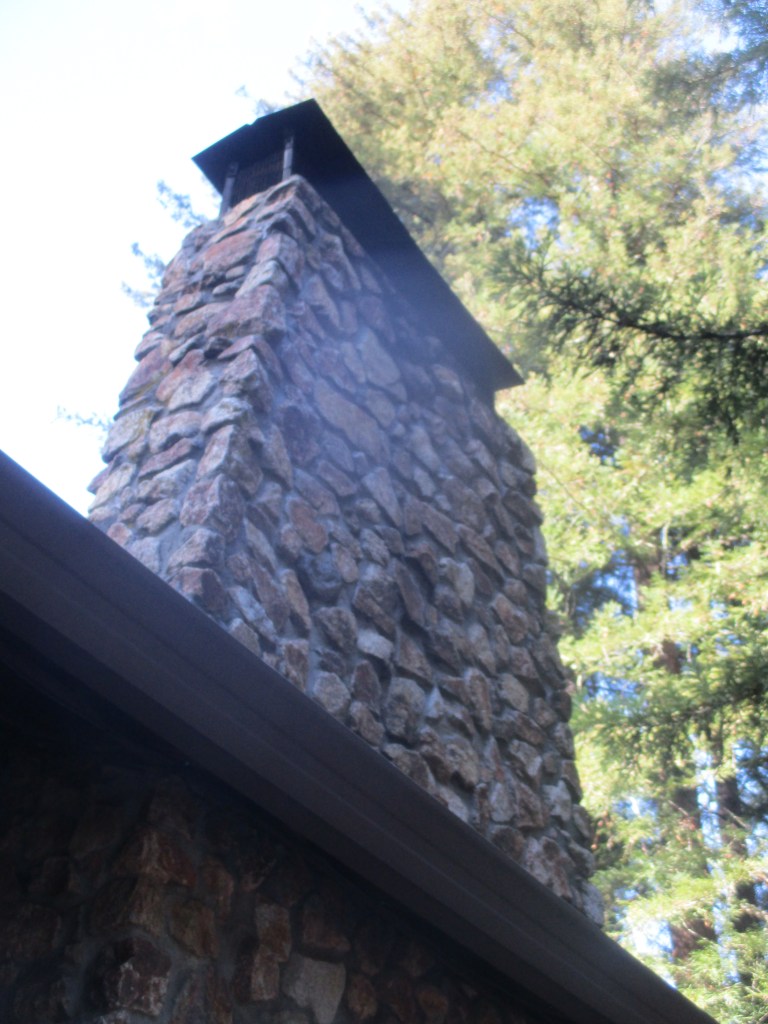
Chimneys are easy to neglect. Some are external to the homes they serve. They occupy visible but minor garden space. Others are internal. Only portions that extend above their respective roofs are visible. Besides the use of accompanying fireplaces or woodstoves, they do not change with the seasons. Nonetheless, chimney clearance is very important.

Trees and vines often extend growth over the tops of chimneys. They grow most actively while chimneys are least active through spring and summer. Such growth is hazardously combustible within the exhaust of chimneys below. Essential chimney clearance pruning eliminates hazardous vegetation prior to the use of associated fireplaces or woodstoves.

Various eucalyptus, cypress, pine, cedar, juniper, fir, spruce, oak and bearded fan palms are very combustible. Deciduous oaks become less combustible as they defoliate during cooling weather though. Other deciduous vegetation is likewise less combustible by the time chimneys are most in use. Vines can accumulate debris directly on top of chimneys.

Vegetation within ten feet of a chimney should generally be two feet below the top of the chimney or fifteen feet above it. More combustible vegetation justifies more clearance or more vigorous grooming. Accumulated dry detritus is more hazardous than fresh foliage. Burning vegetation drops burning debris onto other combustible vegetation and material.

Of course, fireplaces, woodstoves and their associated chimneys are not as common as they were in the past. Most municipalities banned them from new construction during the past many years. Removal of chimneys that incur damage from earthquakes is generally more practical than repair. Chimney clearance becomes unnecessary without chimneys.

Furthermore, few surviving chimneys experience as much use as they did decades ago. Modern heating systems are much more practical and efficient. They generate no smoke to offend neighbors. They are unregulated by ‘no-burn’ alerts. Now that urbanization has replaced orchards and woodlands, firewood might be expensive from local tree services.