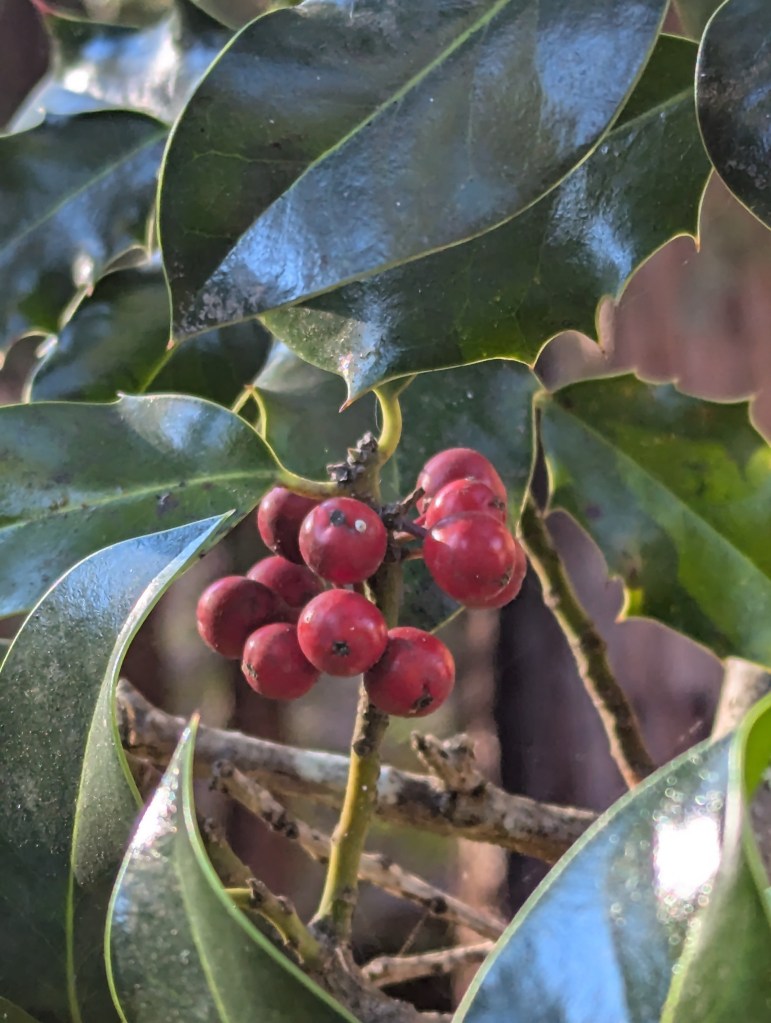
Hollies produced more bright red berries while they were more popular many years ago. Formal and perhaps lengthy hedges of exclusively female cultivars were common. A few or solitary male pollinators grew nearby, often as obscure small trees. Nowadays, males are oddly rare. Not many horticultural professionals are aware that hollies are dioecious.
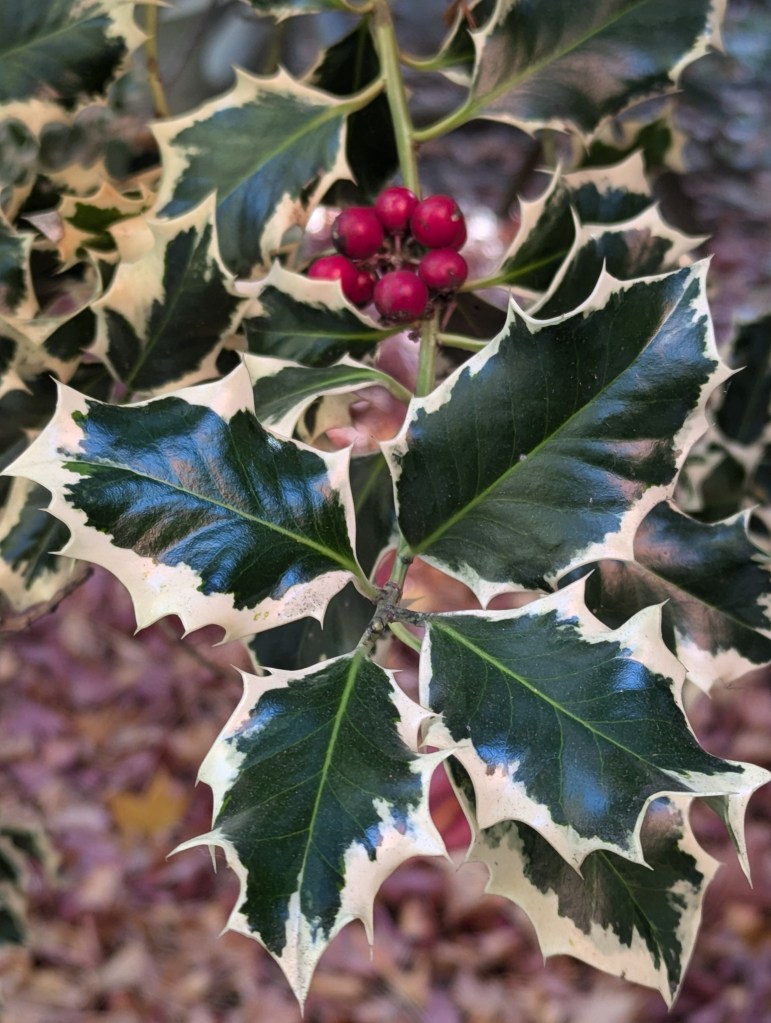
English holly, Ilex aquifolium, is both the most and least favorite holly. Some who grow it appreciate its distinctively intricate foliar texture. Others detest the unpleasant prickliness of the same foliar texture. No other holly is as spiny, although most are somewhat prickly. All hollies exhibit dark green foliar color, remarkably glossy foliar sheen and rigid foliage.
English holly can grow as a small tree with a dense canopy. With pruning, most stay less than ten feet tall. Cultivars with white or yellow variegation grow slower and stay smaller. Berries are common amongst naturalized colonies which naturally include both genders. Nurseries occasionally sell cultivars of both genders, potted together to mature together.
Winter bloom might be limited. Wintry berries, dried flowers and the remains of summery bloom can be more abundant. Evergreen foliage is as abundant as it always is. After all, it is evergreen. That is most likely why it is so popular for home decor through Christmas. It is the primary component of wreaths and garlands, and, technically, of Christmas trees.
Flowers are more scarce where winters are cooler. They are also more desirable indoors while the weather is too cool to be outdoors. Evergreen foliage effectively compensates. While flowers are less scarce here, the most traditional evergreen foliage is more scarce. It is simply less popular within home gardens locally. Also, less of it grows wild in forests.
Most cut evergreen foliage consequently grows on farms like certain popular cut flowers. Many of such farms are in the Pacific Northwest, where such foliage grows most readily. Many types of fir, spruce and pine that are popular for wreaths are naturally happy there. Western red cedar, which is the primary component of garland, is a native species there.
However, locally available cut evergreen foliage can be as delightful as traditional types. A few types are native species that grow wild beyond cultivated home gardens. More are exotic species within refined landscapes. Douglas fir is both traditional as well as native to many regions of California. A few native pines can substitute for more traditional types.
Redwood, cypress and juniper are likewise alternatives for traditional evergreen foliage. Some are natives or relatives of native species. Deodar and Atlas cedars resemble blue spruce. Arborvitae may substitute for Western red cedar, and is actually the same genus. English holly, although rare, and more rarely produces berries, is occasionally available.
Christmas trees are the ultimate form of cut foliage. Unlike other foliar decor, they almost exclusively grow on farms. Their cultivation is very impractical for refined home gardens. Collection of other cut foliage should not damage its source. Some may be from pruning scraps. Christmas trees, though, are much more than a few stems. They are entire trees, containing all their stems.
Evergreens are popular for home décor through winter because there is not much blooming so late in most other American climates. The tradition endures, even though cut flowers of all sorts can easily be purchased from common supermarkets nowadays. Here on the West Coast, where several varieties of flowers can bloom through winter, evergreen foliage is as popular as it ever was.
Christmas trees are the most substantial form of traditional seasonal evergreens. The biggest wreaths occupy less space, and are mostly confined to walls rather than floors. Garlands can be big too, but their less defined form fits more neatly into limited space. For many of us, neatness is not a priority. Displays of evergreens and all the associated ornamentation can get quite elaborate.
Not many of us grow our own Christmas trees. It is more practical to purchase them as if they are very large cut flowers. Most but not all of us who hang garland likewise procure it already made. Some purchase prefabricated wreathes too. However, it is possible that more of us create our own. Other bits and pieces of evergreens are unlikely purchased. Most are from our home gardens.
Most of the pine, spruce, fir, hemlock, yew, arborvitae, and various genera known collectively as cedar, that are traditional evergreens in other regions are scarce here. A few other exotic species of pine, as well as natives, are more common in some landscapes. There are also different cedar and arborvitae. Blue spruce can sometimes be found. Douglas fir is native to nearby mountains.
Other regions lack the abundance of various cypress and juniper that are common here, as well as coastal redwood. (Redwood foliage is perishable once cut.)
There are no rules about cut evergreens anyway. Within reason, we can cut and bring in whatever we happen to find to be appealing in our gardens. We should cut the foliage properly though, as if pruning. Also, we should not cut too much from any particular spot, but instead harvest evenly over a large area. It helps to take pieces that are out of view, or that need to be pruned out anyway.
 Evergreens are popular for home décor through winter because there is not much blooming so late in most other American climates. The tradition endures, even though cut flowers of all sorts can easily be purchased from common supermarkets nowadays. Here on the West Coast, where several varieties of flowers can bloom through winter, evergreen foliage is as popular as it ever was.
 Tony Tomeo