 Yuccas are almost as useful as aloes are for gardening in chaparral or desert climates. I say ‘almost’ because most are not quite as friendly. The leaves are outfitted with nastily sharp tips. It is how they protect themselves from grazing animals in the wild, but it is not such an advantage in home gardens. Some actually have the potential to be dangerous where someone could bump into them. The leaves of Joshua tree can puncture leather. Some types of yucca get so big that they make it difficult to avoid their nasty leaves, even if planted in the background.
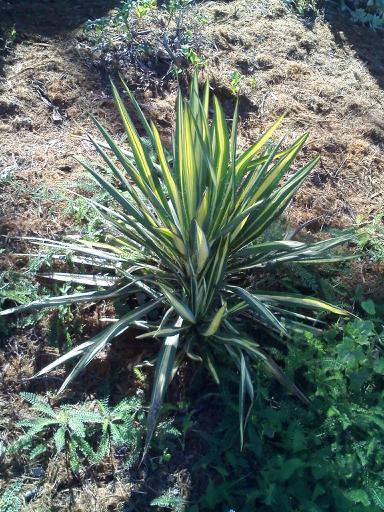
That being said, for those of us who do not need to worry about endangering children, dogs or anyone else out in our gardens, yuccas are very distinctive and handsome plants. Their striking foliage radiates outward from dense foliar rosettes. Large spikes of creamy white flowers that bloom in summer or autumn stand above the foliage quite boldly. Some yuccas produce remarkably tall floral spikes. Our Lord’s Candle, Yucca whipplei (Hesperoyucca whipplei), is a terrestrial yucca that sits low to the ground, but produces a huge flower stalk that stands ten feet tall! Modern garden varieties of Adam’s needle, Yucca filamentosa, are variegated.
Of the yuccas that develop sculptural trunks, only a few are available in nurseries. The giant yucca, Yucca elephantipes, is almost too common in mild climates, and unfortunately develops a massively distended trunk that is too big for some of the situations it gets into. Most other trunk forming yuccas that grow slower are uncommon because they are susceptible to rot in landscapes where they get watered through summer.
Except for a few tropical yuccas that are very rare, yuccas are very drought tolerant. Even in desert climates, some yuccas survive on annual rainfall. Others are happier if watered a few times through summer. Giant yucca happens to be a tropical yucca, but surprisingly does not need much water.
Giant yucca is very easy to propagate from cuttings of the big canes. Even big pieces can be cut and stuck as cuttings. However, most of the tree yuccas are difficult to propagate.
Terrestrial yuccas that do not develop trunks are generally easy to propagate by division of pups, although some are difficult to handle. Some terrestrial yuccas actually develop small trunks that creep along the ground, or maybe stand a few feet tall. They can be propagated as cuttings like giant yucca.
 We really should be growing more of what grows well here. This is as relevant in other regions as it is in the Santa Clara Valley. Some regions have a lot more to choose from. There are always limitations too. Tropical plants do not survive the winters of New England. Apples and pears want more winter chill than they can get in San Diego.
 Tony Tomeo