Yucca whipplei, which is now also known as Hesperoyucca whipplei, was the first species of Yucca that I met in the wild when I relocated to San Luis Obispo in 1985. Although it is too unpleasantly spiny for me to recommend it for home gardens, it is my favorite species of Yucca.
The only specimen of Yucca whipplei that inhabits our landscapes produced a few seed pods two years ago. I dried the seed and sowed them last year. I would have been pleased if a few germinated successfully. Instead, hundreds of them are now growing! Again, I grew too much of a good thing.
I can install several as a deer fence below a portion of my home garden. Although they grow only about three feet tall, deer will not try to jump over them uphill if they can not land beyond their painful foliage on the uphill side. However, if I put them three feet apart, only about twenty seedlings will be needed for approximately sixty linear feet of deer fence. That might be only about a twentieth of the hundreds that are now growing! They are still babies. I can worry about finding homes for them later.
Curve leaf yucca is one of a few species of the genus that is difficult to identify. It may be a distinct species, Yucca recurvifolia. It may be a naturally occurring variety of mound lily, Yucca gloriosa var. tristis or recurvifolia. Yet, it may be a natural hybrid of Yucca aloifolia and Yucca flaccida. To complicate all of this, its physical characteristics are inconsistent.
The evergreen leaves of curve leaf yucca are typically pliable, and curve downward. Yet, they can be quite rigid and upright. Foliar color is typically grayish green but can be olive drab. Stout but upright trunks can potentially develop, but may never do so. Only their tall floral stalks that bloom for summer are consistent. Individual flowers are small and white.
Curve leaf yucca enjoys warm and sunny exposures. Occasional watering through warm weather may improve vigor, but is unnecessary. Old colonies form large mounds that can slowly grow as high and wide as ten feet. With the exception of gophers, which eat roots, not much bothers curve leaf yucca. In fact, it can be very difficult to eradicate if unwanted. Pups may continue to develop from rhizomes for many years.
Yucca whipplei seed is likely more rare in cultivation than in the wild.
Yucca whipplei, which is now known as Hesperoyucca whipplei, should not be so difficult to procure. It is the most common species of the genus within the next few hundred miles south of here, and was quite common in the hills around San Luis Obispo, where Brent and I studied horticulture at California Polytechnic State University (Cal Poly). I should have taken pups from wild specimens within the region, but I know of no one with wild specimens within their gardens. I can only see them from a distance, and, although within view, they are far enough away to necessitate quite a hike to get to. I never bothered to procure pups from specimens that I encounter directly in the Santa Monica Mountains north of Beverly Hills because they might be a different variety, or related to such a variety. Contrary to dramatic bloom, seed of the species is supposedly rare because the larvae of its very specialized pollinating moth devour almost all of the seed that develops from successful pollination. (The moth pollinates a flower only to provide seed for its larvae to eat.) Seed should be even more rare here because the specialized pollinating moth has no business so far from the natural range of its sustaining species. Somehow, a specimen that bloomed at work produced these few seed capsules. Someone else besides the specialized pollinating moth apparently took interest in its bloom. Although I have no idea what variety of Yucca whipplei the particular specimen is, I am pleased with the seed, and will try to grow them if they are viable when their capsules dry. (I hope that removal from their deteriorating stalk does not compromise their development.) Furthermore, I will get at least one pup from the original parent now that it will generate a litter after its monocarpic bloom. It is likely the variety that I want and am most familiar with anyway, because that particular variety happens to be the most common. Of course, I will procure a pup from a wild specimen within the region of San Luis Obispo if I ever get the opportunity to do so, just in case it is any different from what is growing and now blooming here.
This does not happen often. Actually, it is quite rare, which is one of the consequences of enjoying my horticultural professions a bit too much. I almost never crave travel as I have been lately. Why should I? I live and work in such an excellent region which is excellent for horticulture and just about anything else. It is the sort of region that those who are not here travel to. Furthermore, there is nothing here that I want to get away from. In order to travel, I must first make obligations where I intend to travel to. Then, I can not change my plans for such travel. Even then, some of my obligations are horticultural pursuits, as if I must make work where I intend to go to compensate for my inability to take all of my work with me. I prune apple trees when I go to the Pacific Northwest. I procure regionally rare species where they are more available when I go to the Southwest. While vacationing in the region of Los Angeles last May, I spent a day greeting guests at one of Brent’s three landscapes that were featured on ‘Blooms With a View’, the Spring Garden Tour of View Park and Ladera Heights. I have no such plans anywhere yet. Now that it is late summer, it would be inconvenient to leave here for more than three days anyway. So, why should I so arbitrarily want to travel? I do not know. I suppose that I could go to the region of San Luis Obispo for Monday and Tuesday. I would like to find a pup of the regional variety of Hesperoyucca whipplei spp. whipplei that I first encountered while studying horticulture at Cal Poly there. But of course, I need no excuse to travel.
Yucca elephantipes at Taco Bell in San Luis Obispo in 1968.
Down on the corner, or at least next door to the western corner of Olive Street at Santa Rosa Street in San Luis Obispo, Creedence Clearwater Revival stopped at Taco Bell, supposedly about the second of August of 1968, on their way from Palo Alto to Santa Monica. They were famous for such horticultural songs as ‘Run Through The Jungle’, ‘Have You Ever Seen The Rain’, ‘Cotton Fields’ and ‘I Heard It Through The Grapevine’, which I incidentally remember playing on the radio as I drove over the Grapevine Highway on my second trip to Los Angeles sometime in about 1987. This particular Taco Bell is conveniently located for travellers, since its corner location is also the interchange of southbound Highway 101 and Highway 1. The two highways are concurrent to the south. The original Taco Bell building has been replaced with a larger modern building that also occupies the parcels to its left and right, so that it really is down on the corner now. A bit more than eighteen years after the picture above was taken, in autumn of 1986, Brent and I became very familiar with the original. It was the scene of one of his more notorious adventures, which is too naughty for me to describe here. Another tamer incident involved the relatively small giant yucca, Yucca elephantipes, to the lower right in the picture. It was larger by 1986, and prior to one of our visits to Taco Bell, it had suspiciously deposited a few small limbs onto the sidewalk. Upon closer inspection, we found bits of pulverized chrome plated plastic and an emblem from what was likely a relatively new Cavallier of the early 1980s. Of course, we could not just leave the yucca canes there on the sidewalk to eventually be disposed of. We loaded them into the trunk and took them back to our dormitory, where we shared them with neighbors. The smallest shoot grew in a can of soil in our dorm room until it matured enough to also be given away. Because I sort of enjoyed it while it was there, Brent gave me a larger and more impressive specimen with an even more scandalous history a few years later. I have grown hundreds of giant yucca specimens since then, but the original that Brent gave me before 1990 is still here. I wonder if any of the others survive.
Among the many garden chores that I neglected so far this summer is the ‘processing’ of many of the bits and pieces of unusual succulent plants that I acquired from earlier volunteer work days at the Arizona Garden at Stanford. Volunteers are always welcome to take any of the debris that we generate. After everyone present took what they could, I could not bear to waste what was left; so I took more than I should. Cacti, agaves and yuccas cannot be recycled as green waste, so would otherwise have been disposed of.
I really wanted large canes of a particular unusual yucca, so processed them as large cuttings first. I only needed to cut away all but the foliage on top, stick them in the ground and keep them watered until roots grow. This particular desert yucca does not grow roots as efficiently as tropical yuccas do, though.
Meanwhile, many pieces of cacti, ice plant, and succulents that I can not even tell you the names of remain out in a pile in the driveway. However, as I was looking them over today, I noticed that they are not only alive, but actually seem to doing quite well. Some are even blooming!
This is just too weird. There is no soil. There is no watering. Even if there were, there are no roots to exploit the resources that are necessary to keep plants alive. These bits and pieces of various succulents get only sunlight and warmth during the day. Apparently, this is all they need for now.
They know that it will eventually rain. When it does, they will develop new roots into the soil wherever they are. Since I do not intend to let them do this in my driveway, I will eventually get them into the garden, and water them in to hasten the rooting process. I will groom them and strip lower foliage from agaves and aloes, so that they look better than the debris that they are. They should actually grow slightly and look pretty good by autumn.
There are so many different kinds of ‘succulent plants’ or ‘succulents’, that the definition is not always so clear. All cacti are succulents that are equipped with spines. Many relatives of poinsettia (euphorbs) have fleshy green stems just like cacti, so are also succulents. Some of these even look like cacti, with comparable spines. Aloes and agaves are succulents as well, with large fleshy leaves, some with very sharp leaf tips and teeth on their leaf margins. The list goes on, including sedums, sempervivums, echiverias, aeoniums, crassulas, lithops, ice plants and more.
Simply speaking, succulents store water in distended ‘succulent’ leaves, stems or even roots, in order to survive long dry seasons. Most happen to be remarkably easy to propagate from cuttings. Some can even be grown from relatively large cuttings. In the desert where water is a very limited commodity, many succulents defend themselves with spines or teeth.
Yuccas, which are related to aloes and agaves, are considered (by ‘some’) to be succulents as well, even though they lack fleshy leaves or stems. Some yuccas that form trunks and branches, particularly those that are from tropical or forest environments, and especially the common Yucca elephantipes, are just as easy to propagate from cuttings as other succulents are.
Yucca is a genus of about fifty species. However, any two can hybridize. They are more like fifty or so varieties of one species. They maintain distinction by blooming at different times or inhabiting different ranges. Mound lily, Yucca gloriosa, is one of these species. However, it is technically a perpetuating hybrid of Yucca filamentosa and Yucca aloifolia.
Mound lily develops symmetrical foliar rosettes that are only a few feet tall. Stout trunks that develop below can very slowly elevate these rosettes about eight feet. Elegantly tall floral stalks can stand as high as five feet higher. The stiff and evergreen leaves are one to two feet long, and about two inches wide. Their terminal foliar spines are very sharp.
The most popular cultivar of mound lily is variegated with creamy white stripes. Tristis is a variety with more flexible and arching foliage. It formerly classified as a distinct species of Yucca recurvifolia. All yuccas bloom with small, pendulous and creamy white flowers. Such flowers may exhibit a pale purplish or faint pale greenish blush.
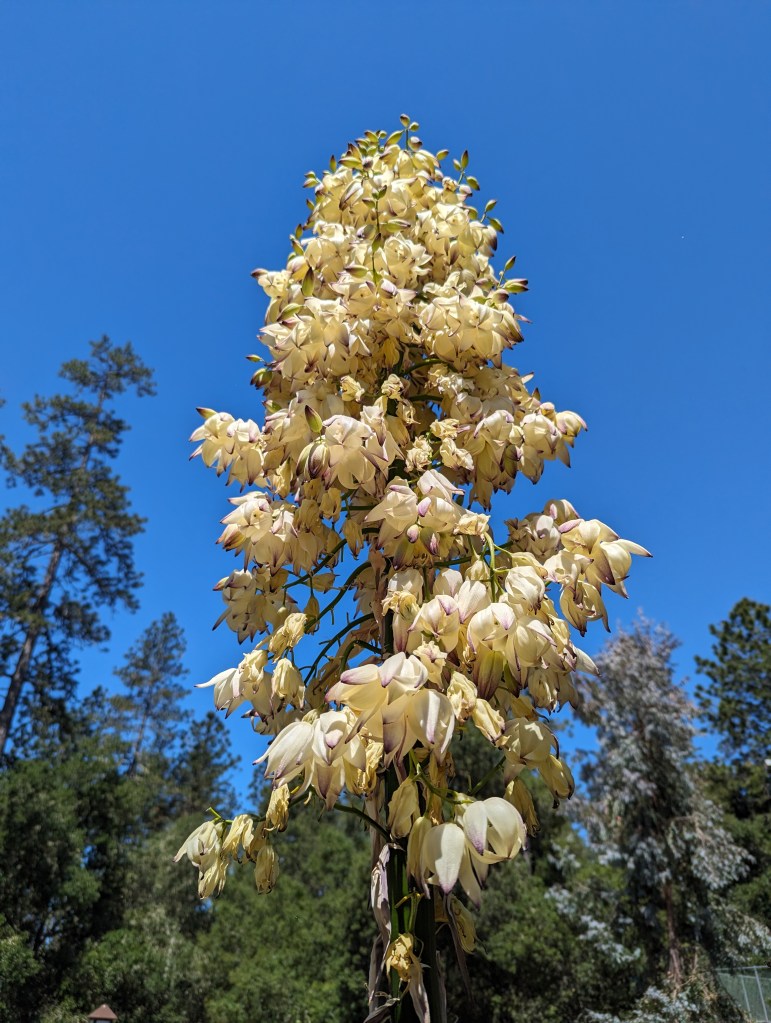
(Hespero)Yucca whipplei has an identity crisis. My contemporaries and I learned it as Yucca whipplei. Botanists now insist that it identifies as Hesperoyucca whipplei, although, like any and all other species of Yucca, it can hybridize with any and all other species of Yucca. (If it is a different species of the same genus, such hybrids would be interspecific hybrids. If it is a different genus, such hybrids would be intergeneric hybrids, which is even weirder.) Also, my contemporaries and I learned its common name as Spanish bayonet. Botanists prefer to designate it as chaparral yucca. It is alternately known as foothill yucca, Quixote yucca or our Lord’s candle. Because it was the only species of the genus that was locally native, we typically referred to it merely as yucca. Later, I learned that Spanish bayonet is a general designation for a few arboriform species of Yucca, which develop trunks and perhaps limbs, such as Yucca aloifolia, and that Spanish dagger is actually more commonly a generic designation for a few species that lack significant trunks or limbs, such as this particular species. Anyway, regardless of all this nonsense, I had been wanting to grow this species since encountering it while studying horticulture at California Polytechnic State University in San Luis Obispo, but could not find an appropriate situation in which to do so. It is too wickedly spiny for most landscapes. I was told that a specimen inhabited one of the landscapes at work, but because it did not look familiar, I was sceptical. It adapts so efficiently to whatever situation that it grows into, that its foliage here is somewhat different from how it develops in the wild around San Luis Obispo. Its impressively tall bloom is very familiar though, and is very distinctive of the species.
Green waste from the Arizona Garden is fair game for volunteers.
(This article is from 2010, so contains irrelevantly outdated information.)
Some gardens are native gardens. Some are wildflower gardens. Others are vegetable gardens, white gardens or rose gardens. There are really all sorts of gardens. Mine though is the only garden that I am aware that is described by some as a ‘felony garden’.
This less than appealing distinction originates from my habit of ‘recycling’ green waste from other gardens. From the bits and pieces of debris generated by normal maintenance, I like to propagate copies of plants that I like for my own garden. Sometimes, I get large volumes of material, such as clumps of New Zealand flax or African iris. Sometimes, I just get small bits of pelargonium or English ivy. Sometimes, the small bits are not exactly generated by maintenance.
On March 20, I really scored big! I procured a pick up full of large canes of a somewhat uncommon species of yucca, along with more than a wheelbarrow full of pieces of various cacti, agaves, aloes and succulents! I suppose that I should feel guilty; but I was helping to dispose of the green waste generated by the volunteers at the Arizona Garden at Stanford University.
The historic Arizona Garden could actually use the help of more volunteers during their Volunteer Days every third Saturday of each month. Most of us were pulling weeds last month, and will likely be pulling more this month. Although there is not always booty to be had, (and no one scores like I did!) volunteers are welcome to the debris they generate from any needed grooming and pruning.
The next Volunteer Days will be on April 17, May 15 and June 19. Volunteers can arrive at any time after 9:00 a.m., and should bring heavy gloves since almost everything in the Arizona Garden is equipped with nasty thorns or spines. Some who stay through noon like to bring bag lunches. New volunteers should contact Arizona Garden Coordinator, Christy Smith at 650 – 723 7459 or christy.smith@stanford.edu before attending a Volunteer Day to get any other necessary information and specific directions to access the Garden.
On April 18, the day after the next Volunteer Day at the Arizona Garden, the Going Native Garden Tour will be visiting more than 65 gardens throughout the Santa Clara Valley and the Peninsula from 10:00 a.m. to 4:00 p.m.. The gardens range from newly planted to established, from townhome lots to acre parcels, but all feature native plants. Some gardens feature talks about native plant gardening. A few gardens will have native plants available for purchase.
It is not possible to see all the gardens within this self guided tour, so guests can choose which gardens to visit. Admission is free, but limited; so early registration is recommended. Registration is required prior to noon on the day of the Tour. Registration can be arranged, and more information about the Going Native Garden Tour and about volunteering can be found at www.gngt.org.
The fifty or so specie of yucca that are native to North and Central America are horticultural nonconformists. Like most of the related agaves and aloes, they are classified as succulents; but none have succulents leaves. Their stems store moisture, but are about as succulent as trunks of palm trees. Actually, many are classified as trees because they develop heavy and sculpturally branched trunks, but they are really just big herbaceous perennials that get very old.
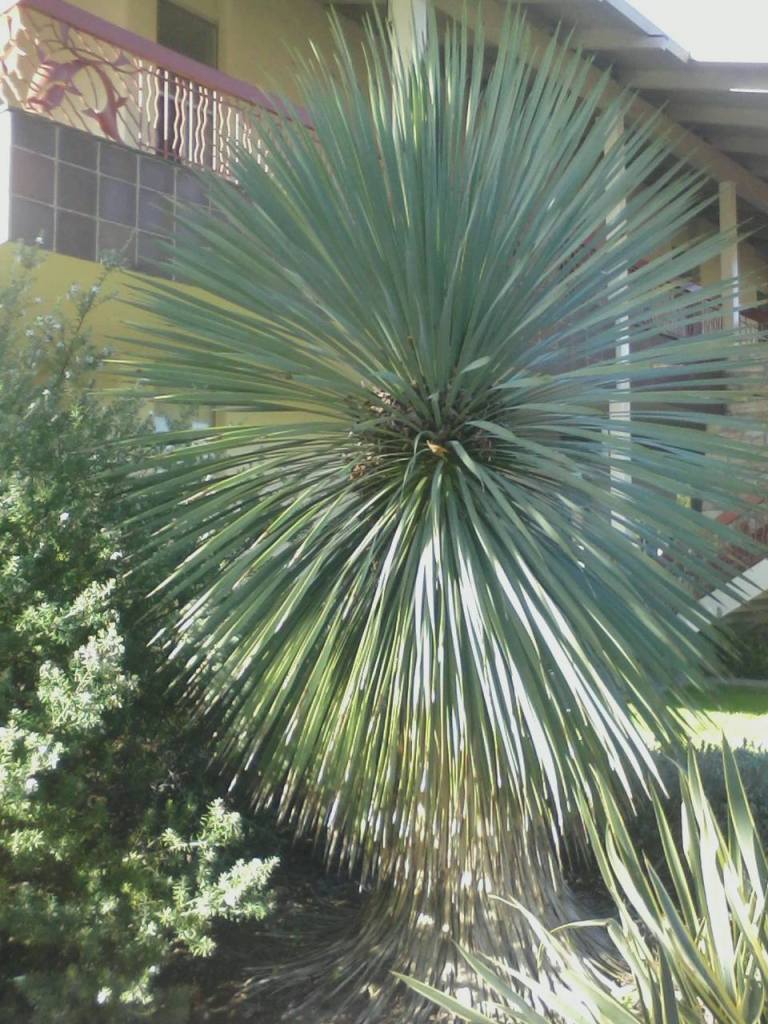
From the Big Bend region of Texas and adjoining Mexico, beaked yucca, Yucca rostrata, happens to be one of the yuccas that develops a trunk, but grows so slowly with such billowy foliage, that it respected more as a striking foliage plant. The largest and oldest plants get no larger than fifteen feet tall and rarely develop one or very few branches. Most are less than ten feet tall with single but bulky symmetrical foliar rosettes. The individual grayish leaves are limber and narrow, but very abundant. ‘Sapphire Skies’ has even more striking bluish foliage.
As if the excellent foliage were not enough, mature beaked yucca blooms with small white flowers on big spikes nearly two and a half feet tall. Spikes can appear through winter and are typically finished blooming by spring, before summer dormancy, but do not seem to be too devoted to any particular schedule.
Beaked yucca is less common than it should be; perhaps because it is difficult to grow in nurseries. Besides, they are not for every garden, and are very likely to rot where they get watered as frequently as most other plants get watered. They do not mind if watered perhaps a few times through summer, but are more than satisfied with what they get from rainfall.






 Tony Tomeo