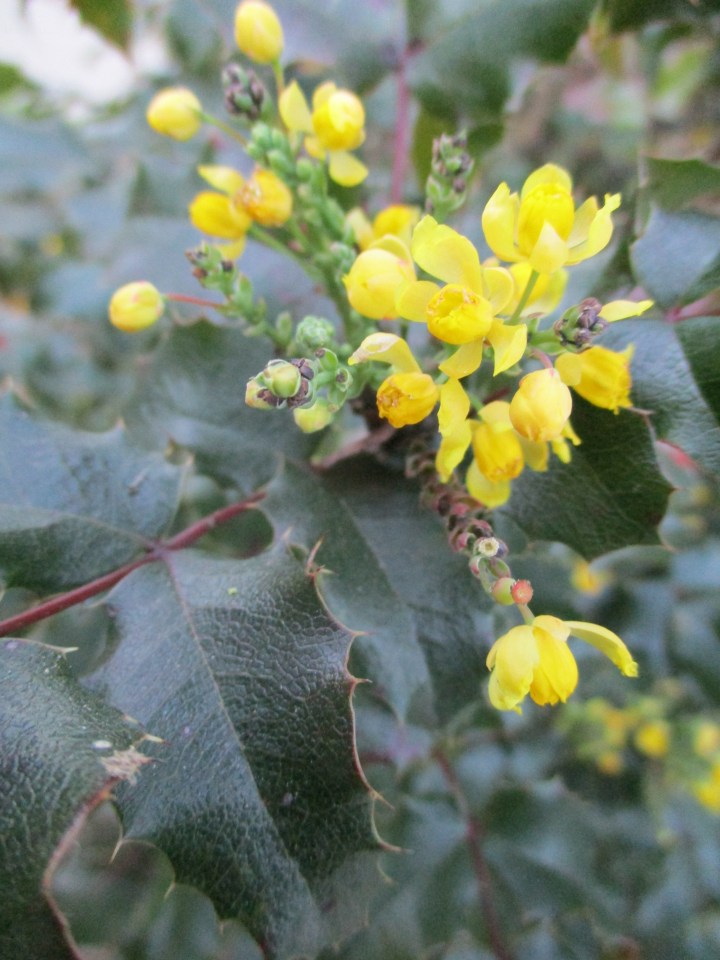
 Oregon has good taste. Douglas fir, one of the most useful of timber trees in America, was selected as the state tree. Oregon grape, Mahonia aquifolium, was designated as the state flower. Although the tight clusters of tiny bright yellow flowers that bloom about now may not be as flashy as other state flowers, they contrast handsomely against the glossy and deep dark green foliage.
The pinnately compound evergreen leaves are larger than they seem to be. The smaller individual leaflets that resemble holly get noticed first. They are are not quite as wavy, spiny or thick as leaves of English holly are, so can work well where spiny foliage would be objectionable. Dark grayish blue berries are not abundant, but happen to make good jelly for those who hunt for them.
Mature plants get about five feet tall and broad, and can spread wider like Heavenly bamboo does. Foliage might be a richer shade of deep green, with a slightly more relaxed texture, in partial shade. A few garden varieties are available, including some that are more compact, and some with more rounded leaflets. Old canes should be pruned out as they get replaced by newer canes.
 Tony Tomeo
It’s good to see someone singing the praises of mahonia! They are are in flower here just now – usually planted for their foliage and the yellow flowers that come at a time when there’s not much floral colour around, but they are a good source of food for the bees too.
LikeLiked by 1 person
They fit into unrefined landscapes so nicely. Unfortunately, ‘gardeners’ shear them like they shear nandina. Once in a while someone prunes them by alternating canes, and they are really splendid. I think they look like what English holly would look like if it were a perennial. They work well with redwoods and other evergreens. Besides, I really like Oregon.
LikeLiked by 1 person
I’ve heard of Oregon grape but have never seen one. Mahonia trifoliolata is common in Austin, where it is among the early flowers each year:
https://portraitsofwildflowers.wordpress.com/2015/03/28/an-agarita-bush-flowering/
LikeLiked by 1 person
That looks meaner!
LikeLike
Yes, the leaves are quite prickly. I’ve often gotten stuck.
LikeLiked by 1 person
Mahonia lomariifolium used to be popular decades ago, and still looks great in landscapes of that style. It is nasty, but worth it.
LikeLike
I see that Mahonia lomariifolia is from China. I also see the species name has gotten changed:
https://en.wikipedia.org/wiki/Mahonia_oiwakensis
LikeLiked by 1 person
What’s their heat tolerance like?
LikeLiked by 1 person
Oh, I actually do not know. I know that they can do well in exposed situations here, but I do not know if they could be as exposed in the heat of San Joaquin Valley. I know that they tolerate more frost then they get here.
LikeLiked by 1 person
I also grow a Mahonia, though not the native one that Steve mentions–I’ve never had luck with that one. Mine is the Mahonia bealei and they’re in bloom now, for which my honeybees are very grateful. There’s another native mahonia here in Central Texas, Mahonia swaseyi, but I don’t think I’ve ever seen it at a nursery, which it too bad. I know Oregon grape–a nice plant!
LikeLiked by 1 person
There are cultlivars of Mahonia that I had always thought were Oregon grape, but they may be other specie or hybrids. If they were not so commonly ruined by gardeners, they would be a plant that should be more popular than it is.
LikeLike
Those flowers look a little like a daffodil
LikeLiked by 1 person
They are tiny though. The picture is a close up. The daffodils nearby are the exact same color.
LikeLiked by 1 person
Mahonias are supposed to be good plants for birds, I’ve been told.
LikeLiked by 1 person
Birds really do seem to like them. I do not know why. They do not make a lot of berries. Birds may also like the thick growth that they can get around it, but larger birds can not get through.
LikeLiked by 1 person