Blackwood acacia, Acacia melanoxylon, happens to be one of my least favorite trees, but it does happen to be rather interesting. Mature trees have no leaves. Really. I don’t mean that they defoliate through winter and refoliate in spring. Only juvenile growth has bipinnately compound leaves. As growth matures, leaves are smaller, and are outfitted with distinctively winged petioles. As growth progresses, the winged petioles, known as ‘phyllodes’, become more prominent, and lack vestigial leaves. Therefore, once mature trees outgrow their juvenile growth, no leaves remain.
I dislike blackwood acacia because it is an invasive exotic species, like Acacia dealbata, but not as invasive. Mature trees sucker profusely from roots to form groves of several straight and vertical trunks. Where they are not a problem, groves of mature trees are rather handsome, but do not last long before they start to deteriorate. Foliar liter has an herbicidal effect that inhibits weed growth, but also inhibits the growth of desirable plants. It also produces an objectionable aroma.
1. Juvenile leaves are bipinnately compound, like those of Acacia dealbata.
2. Leaves become more diminutive with distinctively distended petioles as growth matures.
3. Adult foliage is comprised exclusively of phyllodes, without leaves. The phyllodes function and look just like simple leaves.
4. Blackwood acacia flowers are not much to look at. Even in full bloom, they are grungy yellowish white.
5. At least the bark is handsome.
6. The best blackwood acacia is a dead blackwood acacia.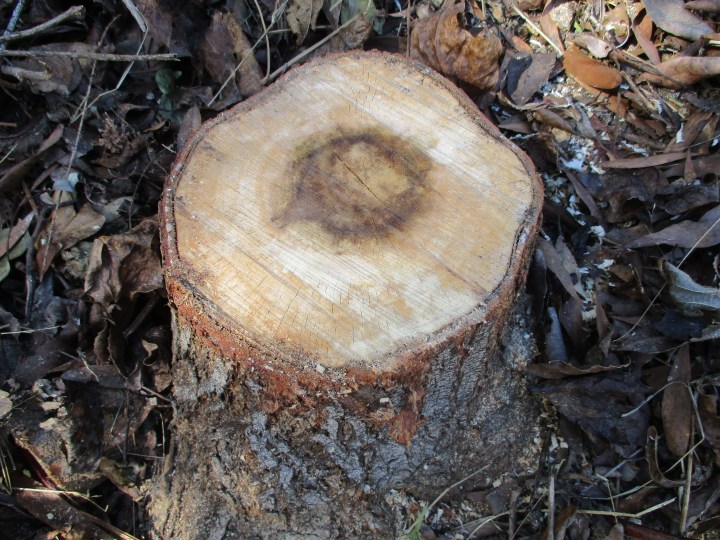
This is the link for Six on Saturday, for anyone else who would like to participate:
https://thepropagatorblog.wordpress.com/2017/09/18/six-on-saturday-a-participant-guide/
 Tony Tomeo
I like the flowers as well, it’s an odd tree though isn’t, not hardy here so only seen it in large glasshouses, not my favourite of the genus as well
LikeLiked by 1 person
Glasshouses?! What a waste of space! There are so many prettier and better behaved wattles.
LikeLiked by 1 person
A really interesting post. I was going to ask how they photosynthesize without leaves, but you went on to explain that. I’ll need to look this tree up – although I don’t think I’ll be planting one after reading this!
LikeLiked by 1 person
Sorry to blow your image. It is a handsome tree in someone else’ garden. It is just too much trouble to bother with. We cut them down at work to favor more desirable trees.
LikeLike
What a fascinating tree. Love the flowers, too, but you’re right that the bark is gorgeous. [I knew you’d get addicted to SoS 😉 ]
LikeLiked by 1 person
Oh cuss! I can stop anytime. I just happened to be working with this tree and took a few pictures. I just happen to have a few more pictures for next week; but I do not need to do it.
LikeLike
Ah, but you’d miss us.
LikeLiked by 1 person
maybe
LikeLiked by 1 person
Very interesting. I really liked an purple Acacia I met in Australia over Christmas. Lovely glaucous purple foliage, seemed so well behaved, not like your beasts.
LikeLiked by 1 person
Oh yes; the Acacia bailleyana ‘Purpurea’ – or something like that. It can be green as well. It is nice because it is complaisant and not invasive. It is also as colorful as other acacias. There are a few well behaved acacias, but like eucalyptus, the few bad ones give the entire genus a bad reputation. Even blackwood acacia is not necessarily bad in the right situations, and where the aroma, mess and short lived quality of the trees are not problems.
LikeLike
As pretty as it is in bloom, the acacia pollen is one of the most allergenic!
LikeLiked by 1 person
Yes! The Acacia dealbata is so pretty, but it is a serious problem here, and is so invasive.
LikeLike
Ha ha very interesting even if you don’t like the tree much!
LikeLiked by 1 person
I really dislike it. Really. However, it is sort of cool too. I knew of several trees growing up, and I sort of liked them.
LikeLiked by 1 person
I like the flowers, think you are being a little harsh on the poor misunderstood tree. 😉
LikeLiked by 1 person
I like to cut them into firewood and burn them! However, where they are in situations where they are not likely to throw too many seeds to become invasive, they are not always that bad. I know of a few in Santa Cruz that can not do much damage where they are located. Their seed will just fall into the beach sand or the ocean, where it will do nothing. The trees happen to be quite handsome. They will not live for much longer, but they are nice while they last. They also happen to b resilient to coastal conditions.
LikeLike
The flowers are kind of interesting. Reminds me of Buttonbush (Cephalanthus).
LikeLiked by 1 person
I suppose they do not look so bad in the picture. They do not get much notice in the trees. They look rather grungy, and are somewhat messy.
LikeLiked by 1 person
Mystery solved. I see these through out Kenneth Hahn Park but could never figure out what they were. Just another invasive…
LikeLiked by 1 person
I am so accustomed to ignoring them that I do not remember them ad Kenneth Hahn Park. I remember various eucalyptus trees and come cool pines, and a whole lot of flannel bush!
LikeLiked by 1 person