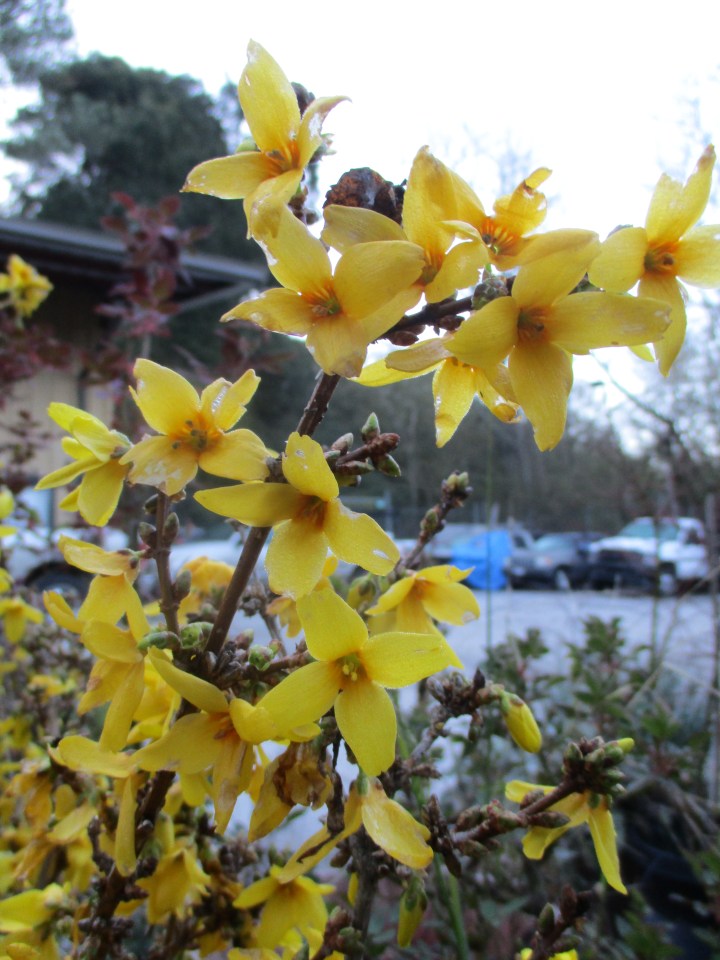
 It is a shame that forsythia is not more popular here. Years ago, there was a commonly perpetuated myth that winters were not cool enough for it, as well as lilac. We now know that both lilac and forsythia are happy to bloom here. Now, some might insist that there are so many evergreen shrubs that bloom nicely right through winter, that there is no need for deciduous blooming shrubbery.
They might not say so after seeing how spectacular forsythia is in bright yellow bloom as winter becomes spring. It uses the same tactic as the flowering cherries that bloom at about the same time, by dazzling spectators with profusion, before foliage develops to dilute the brilliance of the color! The flowers are tiny, but very abundant. Plump buds on bare stems can be forced indoors.
Forsythia X intermedia is the standard forsythia, although a few other specie and variations, including some compact cultivars, are sometimes seen in other regions. Mature specimens should not get much higher than first floor eaves, but can get twice as tall if crowded. The simple opposite leaves are about two or three inches long, and can turn color where autumn weather is cooler.


Forsythia and pussy willows were the signs of spring during my years growing up in Iowa. Everything you say about its virtues is true. We used to bring branches in for forcing, and it was one of my first experiences of paying attention to nature’s processes. Now, the only time I see it is when the stems arrive in the grocery stores — at $3 per stem, the last time I checked.
LikeLiked by 1 person
We had miles of apricot blossoms here for that purpose, but I still think that forsythia would have been nice in home gardens.
LikeLiked by 1 person
Anther plant I’ve not heard of. I see it belongs to the olive family – it looks very pretty and it should be available here.
LikeLiked by 1 person
There are a few plants in that family that do not seem like they fit, including pink jasmine and other jasmines.
LikeLike
I’ve always liked the colour yellow in all types of flowers and shrubs.
LikeLiked by 1 person
Even for those of us who do not like yellow so much, this bloom is exquisite. It is hard to dislike it!
LikeLike
It is the first shrub to blossom in Switzerland. At this time of the year you see it has a highlight in many gardens.
LikeLiked by 1 person
I am sure that is pretty spectacular after the sorts of winters you get there!
LikeLiked by 1 person
I grew winter sweet in a previous garden- a similar thing I think, but nowhere near as yellow.
LikeLiked by 1 person
We do not even have that here. It is available in catalogues, but not many even know what it is. I believe that it is more popular north of Portland.
LikeLiked by 1 person
It is ubiquitous here , there is hardly a garden without it. I find it difficult to love, its bright egg -yolk yellow is not very subtle. We’ve already got daffodils everywhere, we don’t need all this yellow. I prefer the primrose yellow of Forsythia suspensa ‘Nymans’. Or the very early flowering Forsythia giraldiana is always welcome in late February.
LikeLiked by 1 person
How funny. I am not fond of yellow, but I find this to be very appealing because it is a floriferous as flowering cherry, but as yellow as acacia and daffodil!
LikeLike
It’s ubiquitous here as well but I still love it because of the tall arching or trailing branches when they’re left unpruned. The problem is people plant varieties that want to get much larger than the availablwcspace and ugly pruning ensues, often in late summer, resulting in no or few flowers. Such a waste!
LikeLiked by 1 person
Pruning is a serious problem. ‘Gardeners’ shear it with hedge shears, ruining the arching form.
LikeLike
Forsythia is ubiquitous here, its yellow flowers heralding the onset of spring. Its Czech name unfortunately translates to “Golden Shower”….
LikeLiked by 1 person
That probably does not sound so bad in Czech.
LikeLike
No, in Czech it sounds actually quite beautiful. I snickered like a middle schooler when I first heard it…
LikeLiked by 1 person
I rooted pieces from my mom’s shrub. Hers was a really lanky kind that flopped everywhere . I think hers was about 10 years old when I did it. That was 40 years ago & it is still going strong. I read on lots of blogs how people hate them. I don’t know why because I absolutely love mine.
LikeLiked by 1 person
Yes, it seems that most people really like it, and a few do not. There is not much in between.
LikeLike
Forsythia grows abundantly in Ohio where the winters can be bitter . Here on the South Eastern coast I see that lovely plant only occasionally. It could be the sandy soil , the warmer winters , or the salty air or a combination. However Azaleas in many colors are so abundant here that we have a festival .
LikeLiked by 1 person
I am often reminded that the flowering deciduous plants are less popular here because there are many evergreen plants that bloom right through winter. I do not get it. Hibiscus are nice, but they do not compare!
LikeLike
I have mixed feelings about Forsythia. I do like the yellow flowers, especially as they come so early. But I wouldn’t want a whole hedge of the stuff. One shrub is enough.
LikeLiked by 1 person
I sort of think that individual shrubs show off the arching form better. I think a hedge would look nice in the neighbor’s garden, but it would be too much yellow for me.
LikeLiked by 1 person
I love forsythia. I used to have ahtickewt outside my window and they made the days brighter, literally, by all their yellowness! I like them going wild like the forsythia walk at Dumbarton Oaks.
LikeLiked by 1 person
I really wish they were more popular here. We have only two, but I would like to propagate many more.
LikeLike
Goodness, either I can’t type or auto correct is really gone…I had a thicket…
LikeLiked by 1 person
Oh, I get it.
LikeLike
If the snow ever stops, the forsythia may get going here…. I am always immensely cheered by the yellow blooms, especially after a winter as brutal as this.
LikeLiked by 1 person
There are nice even after a winter as dull as our winters are.
LikeLike