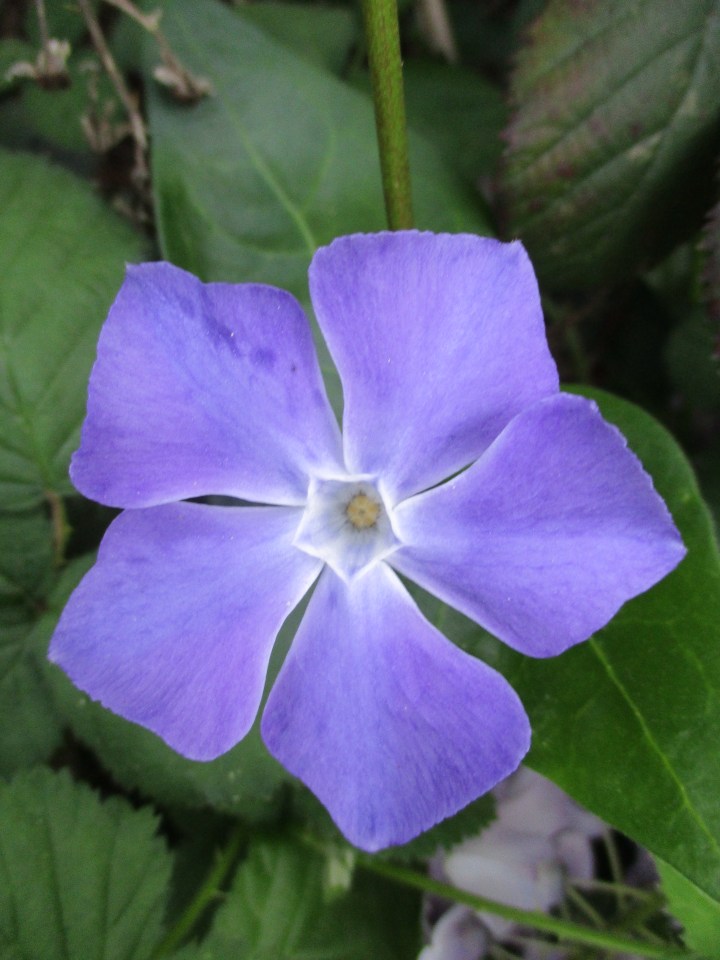
 Like so many of the easiest to grow plants, periwinkle, Vinca major, is too easy to grow. It has become an invasive exotic (nonnative) weed in many moist riparian environments. It can get rather weedy in home gardens as well. This can be an advantage if it happens to fill in for bald spots in areas of other ground cover. It is a disadvantage if it overwhelms or competes with other plants.
It is hard to believe that such a seemingly innocent plant with sporadic but delightful light blue flowers amongst rich green foliage has such unpleasant potential. The radial flowers are about an inch or maybe two wide, and bloom almost all year except for winter. The simple evergreen leaves are likewise an inch or two long. The wiry stems stand a foot or two high before flopping over.
Once stems lay down, they develop roots where they touch the ground, and form new plants that repeat the process of producing upright stems that flop over. Without confinement, there is no limit to the trouble they can get into. Fortunately, it is not a fast process. Cultivars with white or purple flowers, or variegated foliage are more complaisant. Periwinkle is neater if mown as winter ends.


Pretty but one of the forbidden aliens here – it also tried to take over parts of our current garden.
LikeLiked by 1 person
I can totally understand why it is is forbidden! It is very invasive.
LikeLike
Another pretty one I don’t see here.
LikeLiked by 1 person
It is probably just as well. It could have the potential to naturalize. However, it can be nice in urban landscapes.
LikeLiked by 1 person
That’s a lovely picture. I quite like a vinca. The small white flowered one is neater and I recently saw a lovely variation – vinca major oxyloba with the daintiest, star-shaped blue flowers. it was scrambling up a wall at the back of a rock garden. Here it is with wood anemones http://www.bethchatto.co.uk/s-z/vinca/vinca-major-var-oxyloba.htm
LikeLiked by 1 person
Vinca minor is a much neater ground cover, and is still used here because it is not invasive. It has been around a long time, but does not seem to have become an invasive exotic in the surrounding wildlands. Almost all of ours is blue. White is rare. This Vinca major oxyloba is a new one for me.
LikeLiked by 1 person
I am not sure I like that one as much. I would definitely prefer it if it were not invasive!
LikeLike
It’s a love/hate relationship for me. It’s very invasive here even in dry areas and is, in fact, marketed as a god drought tolerant ground cover. I planted it in a birch tree bed a number of years ago and now, because it roots are no tenacious, cannot get rid of it at all. I’ve decided to accept it and turn the whole thing over to it, with the birch growing through, of course. Means transplanting a number of perennials but in the end will be work it, I think.
LikeLiked by 1 person
I totally get it. I hate how invasive it is, but it is hard to dislike the pretty blooms, or how resilient it is. I planted it many years ago in an urban landscape where it could not escape into the wild, and would do it again in the right landscape.
LikeLike
I made the mistake of planting it at my old house and somehow it moved with us. It loves our hot, wet, humid climate.
LikeLiked by 1 person
I actually planted it once too, but in an urban landscape, and in a spot where it could not escape. I would do it again in the right spot.
LikeLiked by 1 person
It’s such a pretty plant. I planted some in a big pot a few years ago, and some reached the ground and rooted. The pot is no longer there but now I have vinca growing in a spot that I like.
LikeLiked by 1 person
It can be sneaky!
LikeLiked by 1 person
It’s pretty and I like it where it is. Pushes out the creeping charlie, which is impossible to get rid of.
LikeLiked by 1 person
Luckily I don’t have it here, as I know it to be a garden thug. I do plant something called vinca, but it’s a smallish plant that doesn’t creep, comes in a variety of colours and is finished off by the frost when it arrives. It’s very tough other than its susceptibility to frost.
LikeLiked by 1 person
Oh yes! That is a warm season annual. That is an odd one here. It typically looks chlorotic, but no one can figure out why! Even though it typically looks bad people still try to grow it.
LikeLike