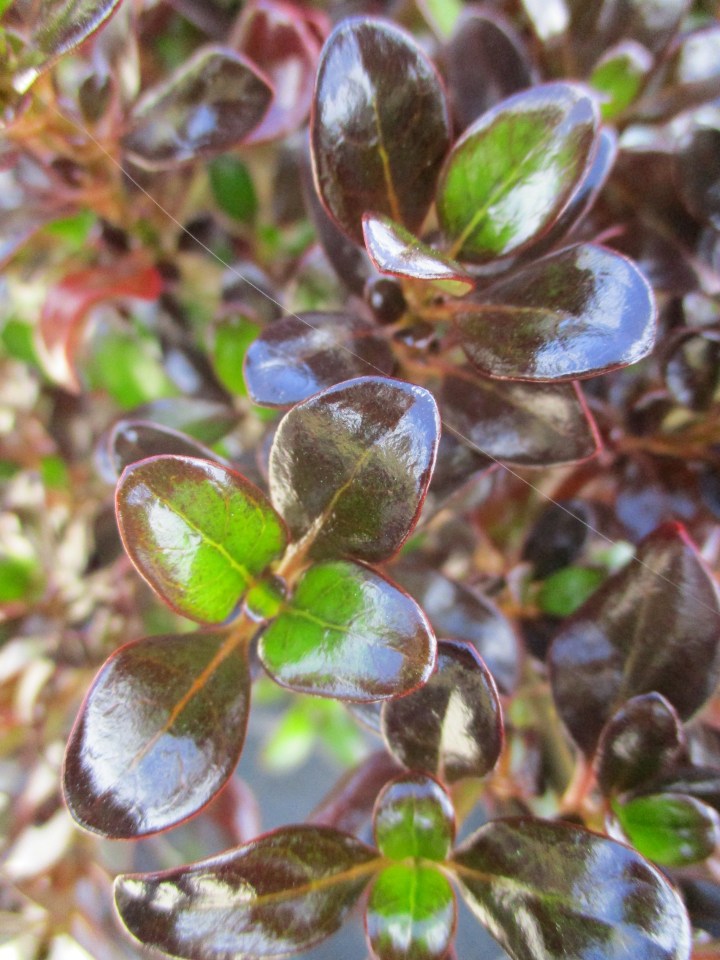
 As the old fashioned larger mirror plant, Coprosma repens, fell out of favor through the 1990s, several more colorful varieties of a more compact species of mirror plant, Coprosma X kirkii, became popular. (The ‘X’ in the name indicates that it is actually a hybrid of two specie.) Without getting much more than two feet deep, it spreads out laterally like dense evergreen groundcover.
The color is not from bloom, but from the very glossy foliage. It can be variegated with white, gold, red, pink or bronze, or completely brownish bronze. Some varieties stay very shallow. Others can be shorn into low hedges like Japanese boxwood, only shorter. Although mirror plant does not mind partial shade, foliar density and color is best with full sun exposure and occasional watering.
Most modern varieties are known by their cultivar names, without their specie names. For example, Coprosma ‘Tequila Sunrise’ lacks the species name of ‘X kirkii‘. Such omissions might be the result of confusing hybridization with Coprosma repens, for rounder leaves. In other words, some cultivars may be of ‘questionable parentage’. Some are just dwarf cultivars of coprosma repens.
 Tony Tomeo
Those tree are so tough. I do like the one with the pink leaves.
LikeLiked by 1 person
The old fashioned one that gets so big is notorious for growing in the canopies of Canary Island date palms, and getting shabby. I like in the garden, but some of those fancy hybrids look sort of weird. There is a very dark brown and green one that Brent says looks like ‘someone ate too many olives and espresso and threw up’.
LikeLiked by 1 person
I have Coprosma repens Pacific Night, so can add ‘does well in clay soil’ 🙂
LikeLiked by 1 person
Oh yes. I did not think of mentioning that because so many of us here have dense soil. It happens to do well in the mucky soils near the San Francisco Bay in San Mateo County, even where the soil is quite saline. There are not many plants that will tolerate that.
LikeLike
I have not heard them called mirror plant, but I do like them, they make nice fillers
LikeLiked by 1 person
Yes, and the low ones are nice ground covers where not many other plants will grow.
LikeLiked by 1 person
I think I will get a ground cover one
LikeLiked by 1 person
That’s fascinating.
LikeLiked by 1 person
Thank you. I think that the old fashioned straight specie was more interesting, but I do not see it around any more.
LikeLiked by 1 person
I’ve never seen a plant with a shine like that.
LikeLiked by 1 person
I have. It was plastic.
LikeLiked by 1 person
You’re always funny.
LikeLiked by 1 person
Thank you . . . I think.
LikeLiked by 1 person
That was a compliment, yea. I enjoy your sense of humor. 🙂
LikeLiked by 1 person