These are merely odds and ends that would not conform to any particular category. The first two are from my colleague’s garden that provided the pictures for last week. The third, fourth and fifth are from a nearby landscape that is comprised of native specie. The sixth is another landscape nearby, but is obviously not native.
1. Eucalyptus provides distinctively aromatic silvery foliage for young students of Outdoor Science. We keep this tree low and almost pollarded so that the students can reach the juvenile foliage. We plan to prune back any adult foliage, since it is neither as pretty, nor as aromatic. No matter how much gets cut from the tree, there is always more. We thought this tree was Eucalyptus cinerea, but we really do not know what it is.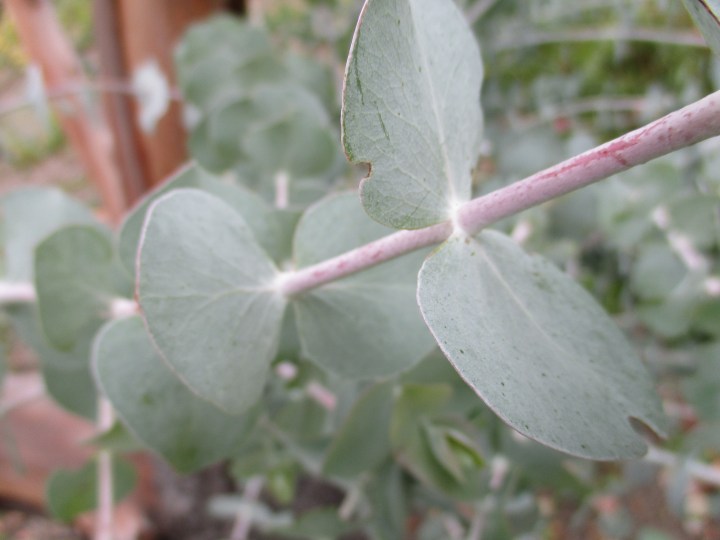
2. Lantana camara gets frosted to the ground where it is at. It might do better on a slope just a few yards away, or under the canopy of big trees nearby. It just happens to be in one of those cold spots where cold air settles on frosty nights. The dead stems get cut back at the end of every winter, and new growth regenerates just fine. However, by the time it starts to bloom nicely, it is already autumn!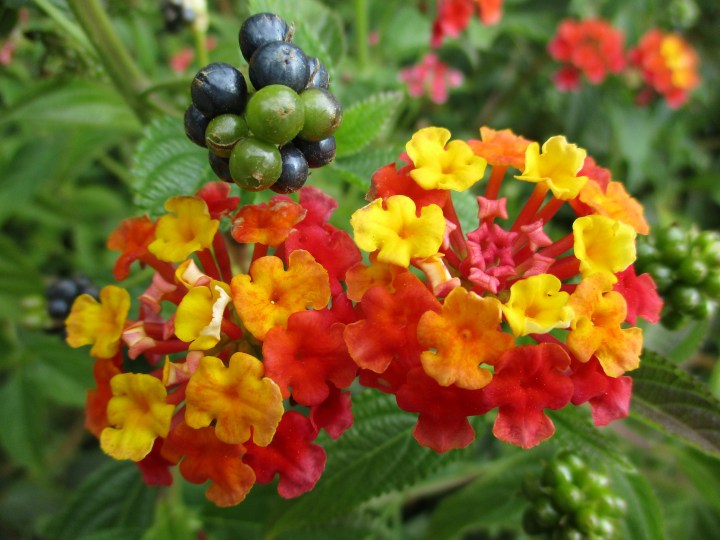
3. Cornus stolonifera is the only locally native dogwood. These pathetic blooms demonstrate why it is not more popular than it is. There are more individual flowers than other dogwoods get in each of their clustered blooms, but they bloom late in summer without the flashy bracts behind them. This dogwood is commonly known as red twig dogwood, but the twigs are not as colorful as those of another species of the same name.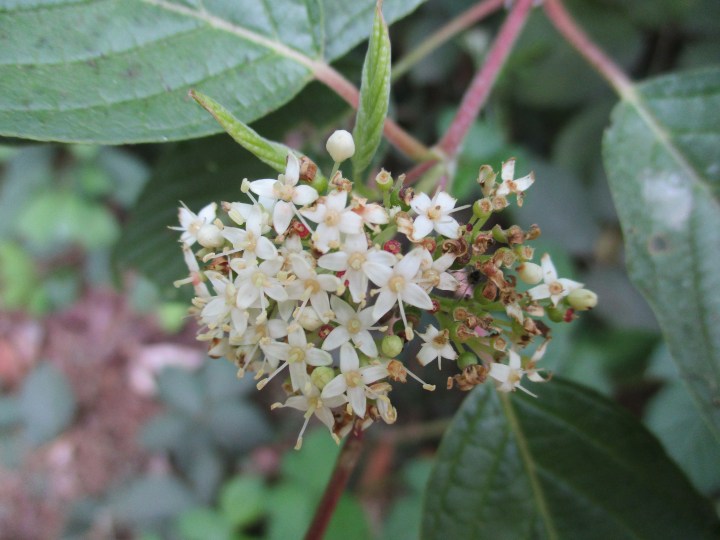
4. Rose, although planted, happens to be native to the region as well. I do not know the species of this particular rose. It is not much to look at, but it is worth growing in a landscape of natives. It does not get pruned like roses that are grown for their bloom. In fact, we do nothing to it. It just grows wild. Flowers are sporadic, starting late in spring, and continuing until frost.
5. Rose hips take a while to ripen. These were probably from the first flowers that bloomed months ago. Flowers that are blooming now may not produce hips at all, or if they do, the hips may never ripen. They just do not have enough time. Fortunately, there are enough to provide a bit of color while many of the plants in this spot defoliate through winter. They do not have great flavor alone, but are fine with other herbal tea.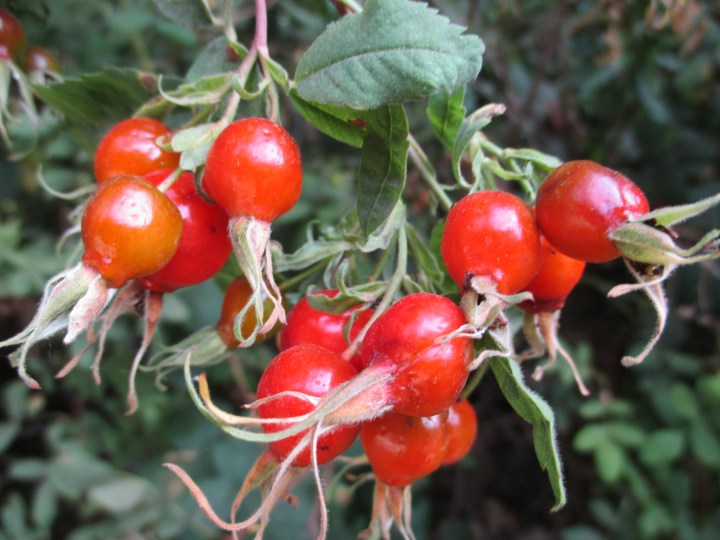
6. Gazania is related to the African daisy from last week. More gazanias will be shared next week. These were planted somewhat recently to replace English daisy that succumbed to a really bad infestation of rust, so have not bloomed as much as they might have liked to if they had gotten established earlier. They will continue until frost, and can bloom sporadically through winter, before resuming bloom as weather warms next spring.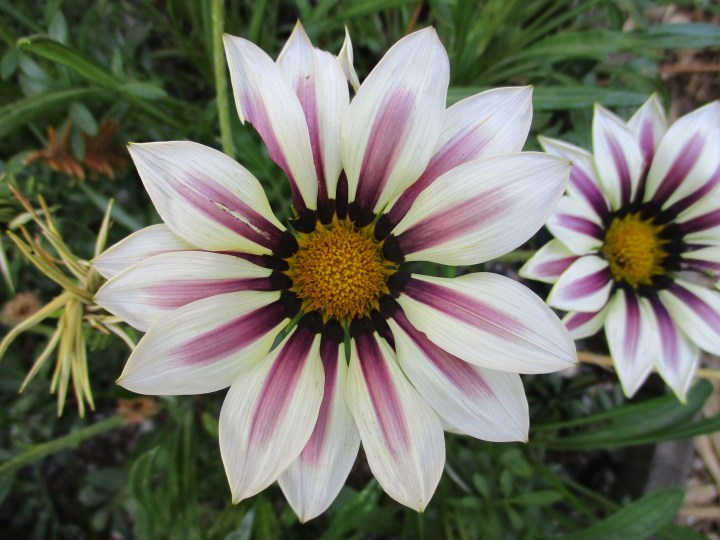
This is the link for Six on Saturday, for anyone else who would like to participate:
https://thepropagatorblog.wordpress.com/2017/09/18/six-on-saturday-a-participant-guide/
 Tony Tomeo
I have fallen in love with eucalyptus trees for years. It’s been a long time since I would like to have one in my garden (If you can advise me a variety that could resist in my zone (8a-8b) … that would be great! but I’m afraid it ‘s cold and wet in winter)
LikeLiked by 1 person
Many of the common eucalypti that live are remarkably tolerant of frost, but only to a point. Because I have not worked in harsher climates, I do not remember which ones are more tolerant of frost. Eucalyptus pulverulenta should be tolerant to frost, and it is not one of the ridiculously big trees, but it is not as graceful as more familiar type, and it gets a distended trunk. There are so many different specie that it would be difficult for me to recommend just a few for your area. I would recommend researching and inquiring with arborists who work in such climates. I is also helpful to know which specie are available. You would not want to find one that you like, only to find that it is not available.
LikeLiked by 1 person
Thank you. It’s a good start. I go online and get information from a local gardener, but rather when visiting gardens near my home because no local gardener knows and grows exotic plants. I had already asked but they didn’t know.
LikeLiked by 1 person
Because they are all so distinct, you should find pictures of the mature trees as well. Red gum is pretty tough, and grows all over the Sacramento Valley, but is a big and cumbersome tree that I would not recommend for a home garden!
LikeLiked by 1 person
Have you read Eucalyptus by Murray Bail? A novel set in Australia with a Eucalyptus thread running through.
Nice Gazinias
LikeLiked by 1 person
No. Although I have been writing for two decades, I do not read. Really, except for required reading in school, I have never read all the way through an entire novel.
LikeLiked by 1 person
Crikey. I cannot imagine a life without reading books. Writing is cool though
LikeLiked by 1 person
That is the typical reaction.
LikeLike
Gazania’s not familiar to me, but these certainly are beautiful. I read a bit about them, and decided they would do nicely on my balcony, in a pot. If I can remember until next year, I might give them a try.
The article I read noted that they enjoy the same conditions as lantana, so both can be combined in a pot.
LikeLiked by 1 person
Yes, they can work nicely together. However, I recommend looking at pictures and noticing the foliage. Some dislike the texture and slightly bronzed color. They are not really a pretty bronze, but are not exactly a bright green either.
LikeLiked by 1 person
I like them regardless.
LikeLiked by 1 person
I think wild roses are my favourite – possibly reminding me of when I was much much younger running around fields and woods…And their hips!
LikeLiked by 1 person
Many people like them for that reason. However, those of us from the Santa Clara Valley do not remember them growing wild. This happens to be one of those places in North America where wild roses, although native nearby (in at least one species), are uncommon.
LikeLike
My red twig dogwoods rarely bloom. I grow them for the foliage and stems in the winter.
LikeLiked by 1 person
Red twig dogwood are not supposed to bloom, and if they do, the bloom is not very impressive. Even the ornamental cultivars (of another species) lack the colorful bracts. If pruned aggressively to promote the most colorful vigorous new stems annually, they are deprived of old stems that bloom anyway.
LikeLike
Those rose hips are really beautiful. I have seen that red twig dogwood, but haven’t seen it bloom. Interesting.
LikeLiked by 1 person
The red twig dogwoods, including those with bright yellow or orange twigs, that are available in nurseries are cultivars of Cornus sericea. Our Cornus stolonifera is only available in nurseries that sell California native specie. It is not as pretty or colorful as the garden varieties, although it happens to work nicely for our applications. Quail really like it. I believe that both specie, and other similar specie, bloom similarly, but I really do not know.
LikeLiked by 1 person
I like those rose hips a lot, and what a lovely colour to have in the garden. I imagine they’ll be around for quite a while, if nothing eats them.
LikeLiked by 1 person
They do happen to stay for quite a while. I do not know why. You would think that there would be more competition for something that brightly colored. I mean, such bright color is typically an advertisement to ‘someone’ to come and take the fruit and deliver the seed elsewhere. Rats and squirrels eventually take them as they dry. They are used in tea, but not many people know that these roses are here.
LikeLike
I’ve been snipping red hips from my Rugosa that I dry then grind to a powder for teas — that great dose of Vitamin C is what I’m after. The gazanias are surreal! Pretty flashy stuff, Tony.
LikeLiked by 1 person
The vitamin C is why I am not concerned that our rose hips lack flavor. There are plenty of other herbs for flavor.
LikeLike