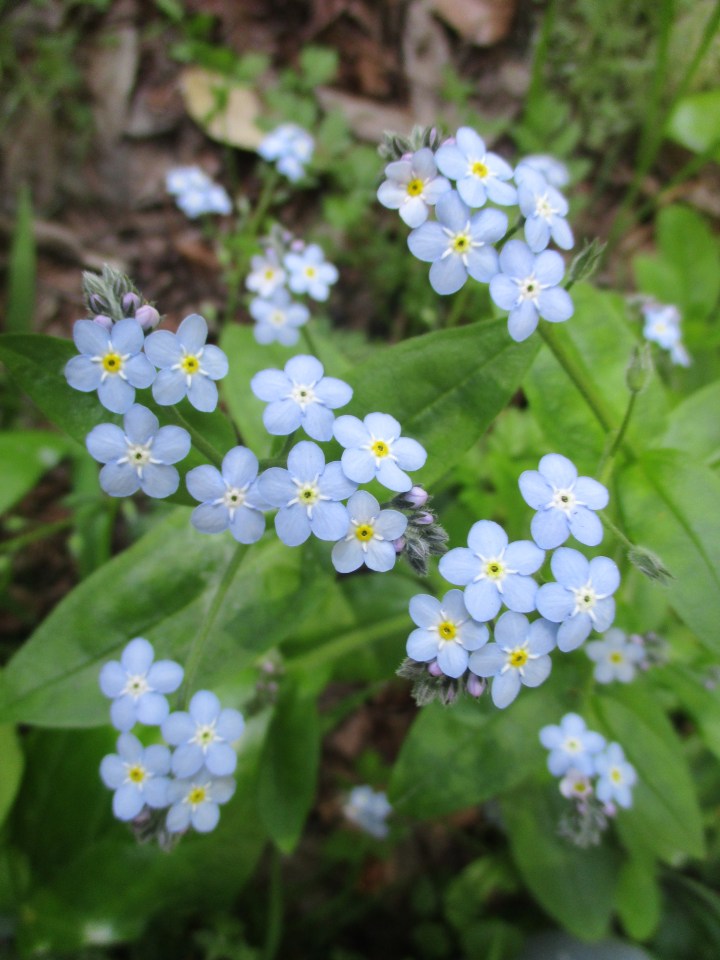
Alaska, the biggest state in America, claims one of the most diminutive state flowers; their native alpine forget-me-not, Myosotis alpestris. Common woodland forget-me-not, Myosotis sylvatica, is the more familiar species here. It is not as common as the name implies though. Where naturalized, it stays within riparian or coastal situations, where the soil does not stay too dry for too long.
Forget-me-not is not notably popular in home gardens nowadays either. Of course, that only means that it is not often planted intentionally. Like violets and alyssum, it can proliferate where it gets a bit of water. Those who recognize it as more than a weed often leave it to provide delightful sky blue bloom until it succumbs to the warmth of summer. It is pleased to toss seed for the next year.
Common woodland forget-me-not is an annual, or at most, a biennial. Self sown seed starts to germinate through autumn, and grows into plants that can bloom before the end of winter. Manually sown seed wants to be in the garden early too, even if it grows slowly. New plants are too delicate to be commonly available in nurseries. Mature plants are less than a foot tall and two feet broad.
 Tony Tomeo
In the 1950s, artificial forget-me-nots were commonly used as decoration on hats for both humans and dolls. I still can see the straw hat one of my dolls wore, with yellow, pink, and blue forget-me-nots on it. The flowers often were duplicated on decorative porcelain pieces, too. They were a little kitschy, but they sure were cute.
LikeLiked by 1 person
Oh gads, I remember those on an old porcelain vase. It was a bit frilly for my taste, but the vase was so old that I could not accidentally drop it onto the floor and then accidentally drop a bowling ball on top of the many broken pieces. (Not, I did not think about doing so . . . accidentally.) I do like the real flowers though.
LikeLiked by 1 person
They are such pretty little flowers. I have seen them in the northeast, but not here.
LikeLiked by 1 person
They so quite well in some spots, and can even become weedy, but are less prolific in exposed, warm or arid situations. I never saw it growing wild in the Santa Clara Valley, but see them commonly in the Santa Cruz Mountains just above the Valley.
LikeLiked by 1 person
Yes, they are very prolific. I like them but they tend to take over so have had to pull lots out unfortunately. But like to retain some in a restricted spot somewhere.
LikeLiked by 1 person
They are almost like that in some spots here. Fortunately for us, they are not invasive. I would feel badly about pulling them up.
LikeLiked by 1 person
Love this flower. Also the perennial False Forget-Me-Not, Brunnera macrophylla.
LikeLiked by 1 person
I am not quite sure that I have seen that one. I believe that what I saw in nurseries, and believed to be the native Cynoglossum grande, was actually Brunner macrophylla or related species. I never bothered to look at the label. It looked too fluffy to be the cynoglossum grande. It seems to be popular in other regions.
LikeLike
It’s other common name is Siberian Bugloss, which gives you an idea of the conditions it likes – more Vladivostock than LA.
LikeLiked by 1 person
Los Angeles is even more arid than here. It used to be classified as a desert climate, while ours is merely chaparral. (It might be classified as chaparral now too.) Yet, Siberian elm is about as weedy in landscape and riparian situations there as it is here. Bergenia crassifolia does well there too. Some species from Siberia do remarkably well if they get water there.
LikeLiked by 1 person