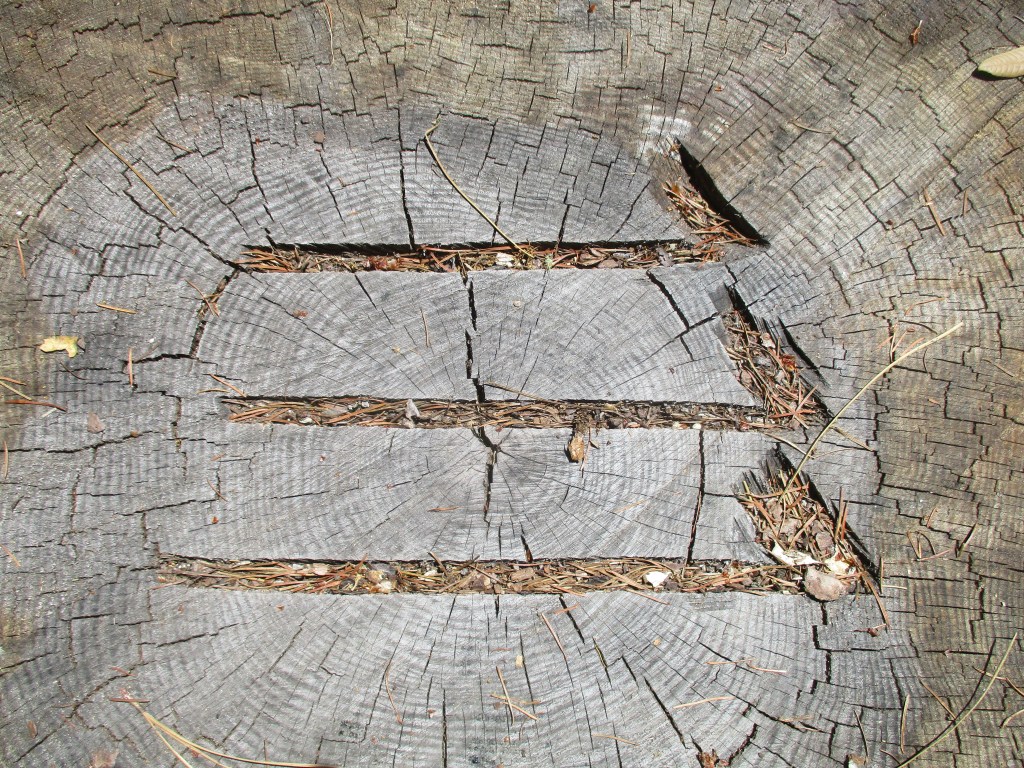
Trees of all sorts are among the most important features of most gardens, and are also the most substantial. Yet, in the end, whether they get too big, too crowded, too hazardous or simply succumb to old age, they eventually need to be removed.
Getting rid of the brush (foliage and smaller limbs) of smaller trees is generally not much of a problem, especially where greenwaste can be left at the curb for recycling. Larger limbs and trunks can be cut and split into firewood. The brush and wood of trees that are so large that they need to be removed by professionals typically gets taken away be the same professionals. The most difficult parts to remove though, are the stumps.
Professional tree services typically offer the option of stump grinding. This works well for the most obtrusive stumps that are accessible. Other stumps get left either because they are inaccessible, or because of the expense of grinding.
Stumps that are within ground cover or shrubbery often get obscured by the surrounding vegetation, and are never seen again. Others are not so easy to hide. Many refuse to die for several years, and may even try to grow back as new trees.
Coastal redwoods (but not giant redwoods), poplars, willows, privets, sycamores and camphors are notoriously difficult to kill. Their stumps can continue to sprout for years. Shoots that emerge away from the stump can certainly be left to grow into new trees if they happen to be where they will not soon become problematic. (Shoots that emerge directly from cut stumps will likely lack structural integrity.)
To kill stubborn stumps, shoots must be removed as they appear. Eventually, the stumps and roots below the ground exhaust all resources and die. Of course this sounds simple, but may take years to kill redwood stumps. Leaving shoots to grow prolongs the process by allowing replenishment of resources. A stump from a camphor tree that I cut down in about 1988 but did not regularly remove the shoots from lingered for about twenty years before finally succumbing in about 2008!
Once stumps die, they rot faster if buried or at least covered with other plant material. Less stubborn stumps that are not likely to sprout again, like those of pines, cypresses, cedars, birches and (solitary trunked) palms, can be buried or concealed immediately. Stumps that are not cut low to the ground are not so easy to conceal, but should still rot faster if covered with ivy. I prefer to plant either freshly divided lily-of-the-Nile shoots or geranium cuttings around the bases of stumps, because they obscure the stumps and also promote rot as they get watered and disperse roots into the decaying wood. They can be removed, if desired, as the stumps deteriorate.
 Tony Tomeo
I like to watch mushrooms grow on old stumps.
LikeLiked by 2 people
Well, that is one good use for them.
LikeLiked by 1 person