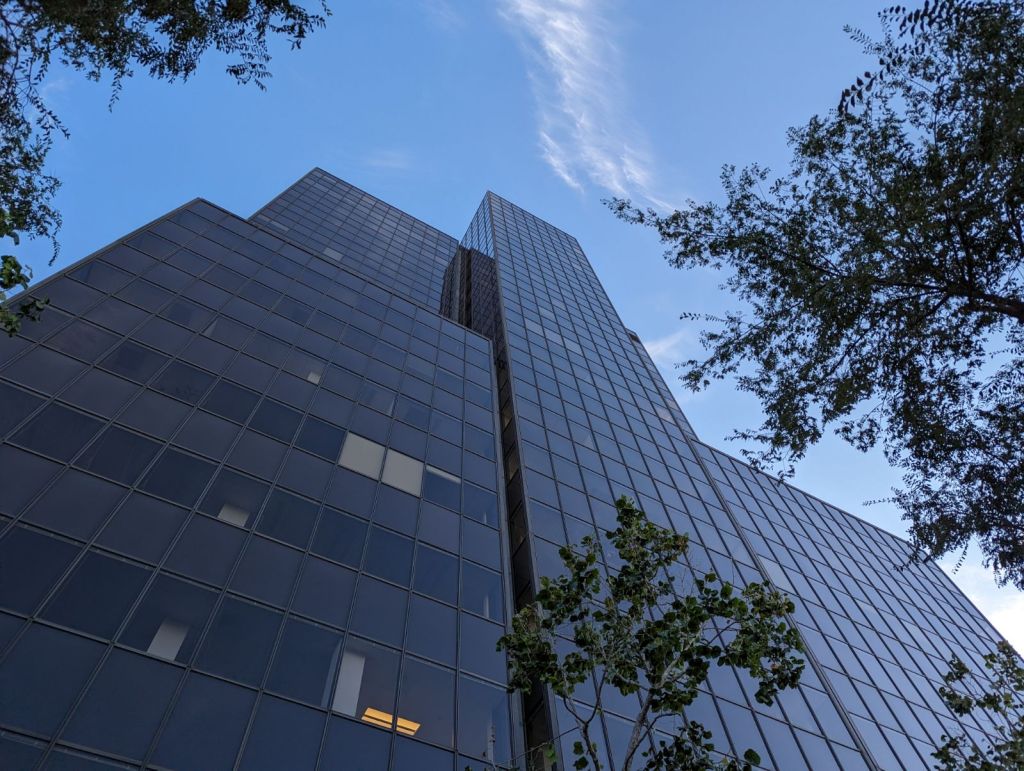
Ulmus parvifolia, Chinese elm extends most prominently into the picture from the right, with another bit from the left of the upper margin. Platanus X acerifolia, London plane extends into the picture from the right of the lower margin, with another minimal bit from the upper left. Otherwise, no other vegetation is visible. This is not exactly a horticultural topic.
The PruneYard Tower 1 is the big and dark skyscraper above the elms and planes. For a few years, it was the tallest skyscraper between San Francisco and Los Angeles. Like many major urban developments, it and its associated complex of buildings is named for what it displaced.
The PruneYard really was what its name describes, a large yard for drying prunes, as well as apricots, from the formerly vast orchards that surrounded it. Because the primary PruneYard complex of buildings is almost as old as I am, I can not remember it not being there. However, I can remember the ruins of some of the associated facilities nearby, as well as abandoned remnants of orchards. The stouter PruneYard Tower II was added in about 1976. The PruneYard Place was added in the early 1990s.
Nowadays, the name of the PruneYard must seem silly to those who are unaware of its history. Few are aware of the difference between prune and plum. Even those of us who can remember the last scraps of orchards find it difficult to believe that, not only were orchards here, but that they were formerly much more vast, and occupied most of the Santa Clara Valley. Just as tourists go to see the fall color of New England, tourists formerly came here to see the spring bloom. It is no wonder that the Santa Clara Valley was also known as the Valley of Heart’s Delight.
 Tony Tomeo
“No more prunes.” What a perfect caption for that building.
LikeLiked by 1 person
Its name made sense when it was new, but must seem silly nowadays.
LikeLike
How we keep going through hanges! The first time I saw Healdsburg, CA, was about March first of 1974. I had spent the winter in Montana.. Let me tell you how exciting it was to leave still-cold Montana, to cross the Sierras through deep snow, and then to descend into gardenofedengreengreengreen California springtime! On that magic day, Healdsburg’s valley was clouds of orchards with fruit trees in fullest blossom — peaches, plums, apricots, and who knows what else, in stratocumulan layers of whites, ivories, and pinks. I spent a few days there. We visited with some people who were (what???) planting grapes to make wine with. That was interesting to this eastern boy, about to return home after his winter in the West. Fast forward through a work life, a family life with three kids, and divorce and remarriage. Our first trip West together was…to her sister’s son’s place in…Healdsburg. A six-acre Vineyard. Throughout that valley, except for backyard trees and a fencerow here and there, the orchards had disappeared, replaced by grapes. Now the grapes are starting to yield to olives. Thankfully, not to skyscrapers! Rinse and repeat!
LikeLiked by 1 person
Not many places in America have changed as much as this region, particularly the Santa Clara Valley. Not many here are even aware that it is the Santa Clara Valley. (They consider it to be ‘Silicon Valley’, which natives find to be quite objectionable.) It is still an excellent place to be, but is excellent in different ways now.
LikeLike