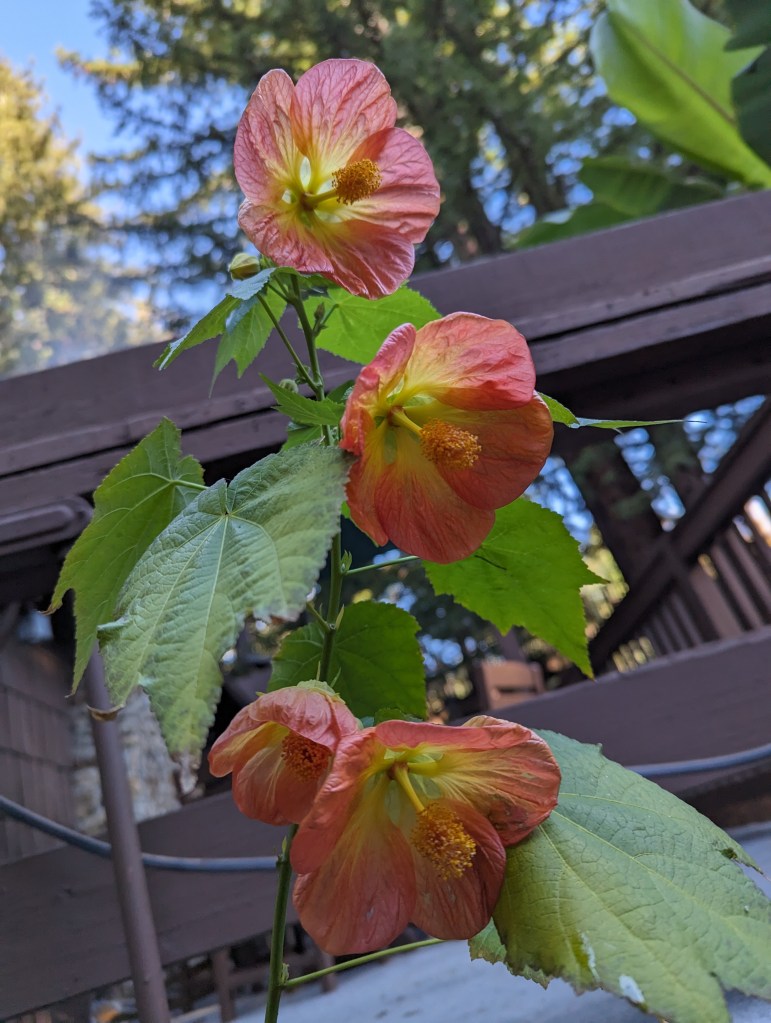
Abutilon X hybridum grows wild from seed within some of our landscapes. Although not prolific enough to be naturalized, dispersion of any viable seed seems odd for hybrids, since most hybrids are sterile. Of course, I do not know for certain if their ancestors were actually Abutilon X hybridum. They could have been other simple species of some sort. Besides, the name seems to apply to any cultivar of unknown parentage, including a few that are not actually hybrids.
Furthermore, even those that are generally sterile hybrids only needed to produce a single viable seed to start the process. Such a seed would likely grow into something that is more genetically stable, and therefore less sterile than its parents. Regardless of their supposed genetic stability, or because of their lack of it, their individual floral color is delightfully variable.
I am no more certain about the common name of this genus, species or group of hybris, which I know simply as flowering maple. Some know it as Chinese lantern. A few may know it as Indian mallow or parlor maple.
I am not so keen on the flowering maple, or whatever it is, for refined landscapes. However, the landscapes here are not so refined, and some are quite rustic. They benefit from the relaxed style, sporadic bloom, and open form of whatever this is.
Bloom is always sporadic, but is a bit more abundant during warm weather. Conversely, it can get scant while the weather is cool through winter. I am impressed by the few flowers that continue to bloom on this particular specimen. So are the hummingbirds. Bloom will likely become more scarce now that the first mild frost occurred last night. Also, foliage may get sparse until warmer weather next spring initiates regeneration to continue the seasonal cycle.
 Tony Tomeo
‘Abutilon’ caught my attention. I’ve found our native Indian mallow, Abutilon fruticosum, alongside highways west of here, south of San Antonio. It took me forever to identify it. This is certainly a pretty one.
LikeLiked by 1 person
That is a new one for me. I was not aware that the genus is native to North America. The hybrids that I work with are descendants of species that are mostly or exclusively native to South America. The few mallows that I encounter are of other genera. I sort of miss the tropical hibiscus that used to bloom so prettily in Southern California. Nowadays, so-called ‘gardeners’ shear them like everything else, so that they are unable to bloom.
LikeLiked by 1 person