Sunday Best – ‘Red Velvet Elvis’ Iris


Roses are in season and blooming now.
1. Color seems to be somewhat deficient with this first and the last of these Six. This rose is actually more butterscotch colored than pale yellow. It is probably the best performer.

2. This rose might be ‘Double Delight’. It looks like it at times, and is nicely fragrant. It is unfortunately the least florific, though. It may not bloom for the second half of summer.

3. Deer have access to these next four roses, so occasionally eat the buds before they can bloom. We appreciate what we can get when we get it. This one seems to be a floribunda.

4. Yellow is not a common color within our landscapes. This is the only rose that is plain yellow, and is not in a prominent situation. It is still recovering from relocation last year.

5. Does this one resemble ‘Seashell’? With so many cultivars available, it is impossible to know. I like to think that it is. I can remember when ‘Seashell’ was popular in 1976 or so.

6. Again, it is impossible to identify the unidentified roses that were recycled from other landscapes or home gardens. I like to assume that this one might be ‘Chrysler Imperial’.

This is the link for Six on Saturday, for anyone else who would like to participate: https://thepropagatorblog.wordpress.com/2017/09/18/six-on-saturday-a-participant-guide/
These are some of the flowers that I observed in bloom when Rhody and I returned from vacation in Washington. (Most bloomed last week.)
1. Rubus parviflorus, thimbleberry is actually not much to brag about. It just looks more impressive in a closeup picture. This flower is not much bigger than a blackberry flower.

2. Prunus serrulata ‘Kwanzan’ flowering cherry is sort of still blooming. Well, the bloom is really beginning to deteriorate. It is the last of all flowering cherry trees here to bloom.

3. Iris series Californicae, Pacific Coast iris blooms in various shades of blue, purple, red and yellow, and of course, white. A variety of this iris series might bloom apricot orange.

4. Clivia miniata, Kaffir lily got to bloom this year. The same specimen produced a floral stalk which got broken off last year. This particular cultivar has yellow foliar variegation.

5. Cymbidium spp., orchid is blooming even after some aggressive division. At least one of its seven pups also bloomed well. Prior to division, it bloomed with eight floral stalks!

6. Rosa spp. ‘Double Delight’ rose bloomed before the other roses in its garden, although other roses are blooming concurrently in another of our gardens about half a mile away.

This is the link for Six on Saturday, for anyone else who would like to participate: https://thepropagatorblog.wordpress.com/2017/09/18/six-on-saturday-a-participant-guide/
Skyler of Tangly Cottage Gardening invited Rhody and me back to tour her garden while Rhody and I were already vacationing in Washington. As usual, I left with a few goodies from the garden. Skooter was still confined to his home as he recovers from an earlier injury.
1. Euphorbia mellifera, honey spurge is my best guess for the identity of this perennial. I could have asked but did not think of it at the time. I am quite certain that it is a spurge.

2. Ficaria verna ‘Brazen Hussy’ lesser celandine is a relatively docile garden cultivar of a potentially weedy species. I can remember when it was popular in the 1990s and 2000s.

3. Tulipa spp., tulip was blooming next to the Canoe Garden. It seems to have a red edge or picotee. I took a picture of small cat tails in the Canoe Garden, but it was out of focus.

4. Muscari armeniacum, grape hyacinth is one of my favorite perennials. It is so reliable and resilient. Apparently, dwarf cat tails were not the only subject that was out of focus.

5. Narcissus spp., daffodil were probably the most prominent flowers while Rhody and I were here. I believe that this was the most abundant sort. Some bloomed in broad drifts.

6. Pulmonaria officinalis, lungwort of various cultivars was also abundant. I had already acquired blue, white and pink cultivars. Now I acquired this purple and pinkish cultivar.

This is the link for Six on Saturday, for anyone else who would like to participate: https://thepropagatorblog.wordpress.com/2017/09/18/six-on-saturday-a-participant-guide/


Fruit trees such as apricot, cherry, peach and plum, bloom about now. Some are already finished, while a few are just beginning. Apple and pear trees will bloom somewhat later. More colorfully, flowering or fruitless counterparts of such trees are on similar schedules. Flowering apricot has already finished bloom. Flowering crabapple will likely bloom last.
The difference between fruit trees and their flowering counterparts is not their bloom. It is their fruit or lack thereof. “Flowering” has become a euphemism for “fruitless”. Trees with such designation produce either no fruit or fruit of relatively inferior quality. Wildlife might enjoy some of any inferior fruit. Although, even inferior crabapples might make good jelly.
Purple leaf plums are probably the most popular of this type of flowering or fruitless tree. Flowering cherry is less common. Flowering peach is somewhat rare. Fruitless pear is a popular street tree, but may not bloom as profusely as the others. Also, it does not bloom quite as early. Flowering quince grows as shrubbery rather than trees with upright trunks.
While very closely related, fruiting trees and their fruitless counterparts are very different. Fruiting trees should obviously produce fruit. That is their primary purpose. Their fruitless counterparts are merely ornamental. The truly fruitless types grow and bloom where fruit would be a messy nuisance. For example, some perform well as small scale street trees.
Because they are fruitless, such trees do not require specialized dormant pruning. There is no need to prune to concentrate resources into developing fruit. Nor is there any need to prune to accommodate the weight of fruit. Fruitless trees can assume their natural form and scale instead. Although none are large trees, they can grow taller than fruiting trees.
Also because they are fruitless, their bloom is their priority. They bloom more abundantly than fruiting trees, and some bloom with double flowers. Floral color is more diverse too, ranging from bright white to rich rosy pink. Some flowering crabapple trees bloom nearly red. Since dormant pruning is unnecessary, blooming stems are splendid as cut flowers.

Between leaving on my trip and arriving, I neglected to get many pictures to select from for these Six. Actually, only two pictures are from the trip. I should take more pictures.
1. Prunus serrulata, flowering cherry of unidentified cultivar was featured in the garden column. It was the first to bloom. This picture was a bit too dark to use as an illustration.

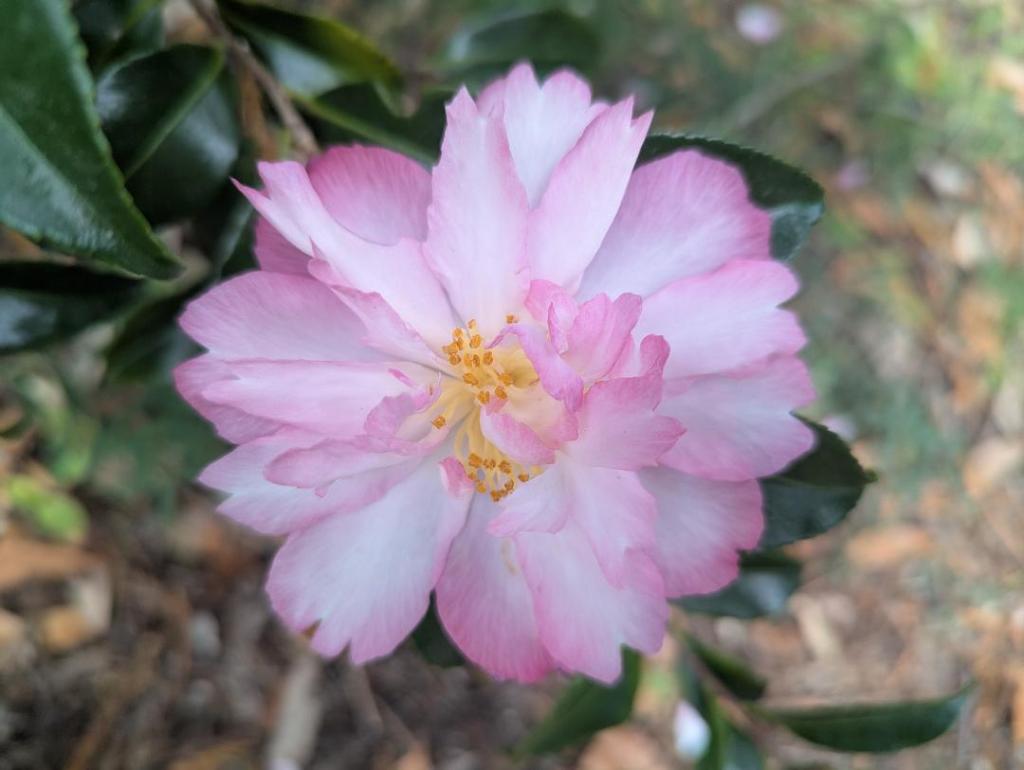
2. Camellia japonica, camellia looks like a fried egg with such a prominent yellow center surrounded by a white corolla. White camellia are prettier with less prominent stamens.

3. Camellia japonica, camellia seemed more red than this when I took its picture. It was still blooming adjacent to the white camellia above. It is as pretty in pink as it was in red.

4. Bellis perennis, English daisy is the only picture that I took in Oregon. I must be more diligent about taking pictures on the way back, even if I do not stop in Oregon too much.

5. Prunus spp., cherry understock is growing from the base of what was formerly a stone fruit tree of some sort on my Pa’s farm. It is cool and rainy here, but is obviously spring.

6. Rhody is a good sport on our trip. We left at midnight and, because of a few stops, we arrived after six in the evening. That is an eighteen hours drive, or a 126 dog hours drive.

This is the link for Six on Saturday, for anyone else who would like to participate: https://thepropagatorblog.wordpress.com/2017/09/18/six-on-saturday-a-participant-guide/

More flowers seem to be in order. The six that I posted pictures of last week got so much extra attention.
1. Gerbera jamesonii, Transvaal daisy, along with the columbine below, was observed in a nursery. It is a long story. To be brief, neither was within the landscapes or my garden.

2. Aquilegia X hybrida, columbine is the State Flower of Colorado, but also is the colors of the Flag of Greece. Perhaps that is too much trivia. It is elegant and pretty regardless.

3. Sisyrinchium angustifolium, blue eyed grass grows wild here. This one happens to be in my driveway. Its proliferation exceeds its intellect. It might otherwise soon be extinct.

4. Chaenomeles speciosa ‘Orange Storm’ flowering quince is appealing only because it is a flowering quince. I am unimpressed by its fancy breeding and orangish red garishness.

5. Prunus persica var. nucipersica ‘Fantasia’ nectarine is more respectable since it is not fruitless, and also since it is among the most popular cultivars of the Santa Clara Valley.

6. Prunus salicina ‘Satsuma’ plum is not as popular as ‘Santa Rosa’ plum is, but it is very traditional among those who are familiar with it. It is not quite as tart as ‘Santa Rosa’ is.

This is the link for Six on Saturday, for anyone else who would like to participate: https://thepropagatorblog.wordpress.com/2017/09/18/six-on-saturday-a-participant-guide/