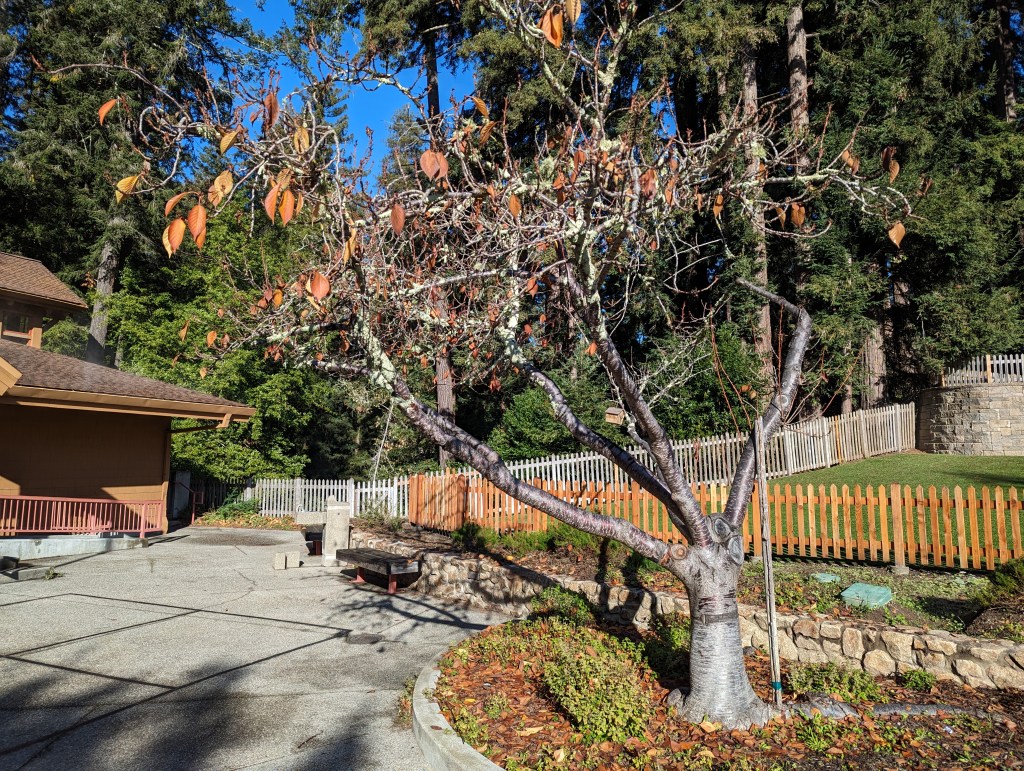
Kwanzan flowering cherry is spectacular as it blooms for early spring. Only one inhabits our landscapes, and of course, it is dormant and defoliated until next spring. I took these six pictures of it anyway, to demonstrate that it is deteriorating fast, but could be able to replace itself before it succumbs to decay completely. Unfortunately though, it will likely be removed before it is able to do so, so that we can install a purple leaf plum within this particular situation instead. I only assist with this self-replication process because of the very unlikely possibility that replacement with another different tree may never actually happen. It has been delayed for years.
1. This flowering cherry tree has been deteriorating for the past several years. Several big limbs have died, leaving its canopy disfigured and lopsided. Its right half is nearly gone.
2. Only shiners remain where some of the major limbs that died were removed from the trunk. If this tree were to survive any longer, these shiners would decay before they heal.

3. Incidentally, this tree is not grafted. Suckers from the roots are indistinguishable from growth of the canopy. Bark of exposed roots is indistinguishable from bark of the trunk.

4. Therefore, this sucker is genetically identical to the original tree. The roots have been generating suckers for several years. All but this one were removed. Instead, it is bound.

5. The binding stake is nailed to one of the major limbs of the original canopy, as well as to a big root below. Damage to the limb is unimportant. It will be removed soon anyway.

6. The bound sucker is now more than six feet tall. It could develop branches to begin to grow as a new tree next year. It could stay as a replacement after removal of the original.

This is the link for Six on Saturday, for anyone else who would like to participate: https://thepropagatorblog.wordpress.com/2017/09/18/six-on-saturday-a-participant-guide/
 Tony Tomeo
When I lived in Seattle, there was an uproar as University of Washington began cutting down the beloved flowering cherry trees. To the untrained eye they were still gorgeous, especially in spring, but alas, they were at end of life expectancy and beginning to decline. Sometimes one has to let go, but I like that yours id trying to reproduce itself with your help. My weeping cherry is very much grafted – I am loving it now that it is an adolescent but looking to grow out of its awkward stage. If I can keep the stupid Japanese beetles off of it…
LikeLiked by 1 person
This is not the weirdest of the techniques that I used to salvage old flowering cherries. I plugged rooted suckers of a pair of other flowering cherries within the hollow stumps of the original trees after I cut them down.
LikeLiked by 1 person
Sayonara to the Kwanzan. I love to look up into the canopy while they are in flower.
LikeLiked by 1 person
Although it is not my favorite cultivar of flowering cherry, I really like this particular specimen. It is in such a prominent location that it is impossible to ignore while in bloom.
LikeLiked by 1 person
Like a carnation tree.
LikeLiked by 1 person
Yes! That is how it is sometimes described.
LikeLike