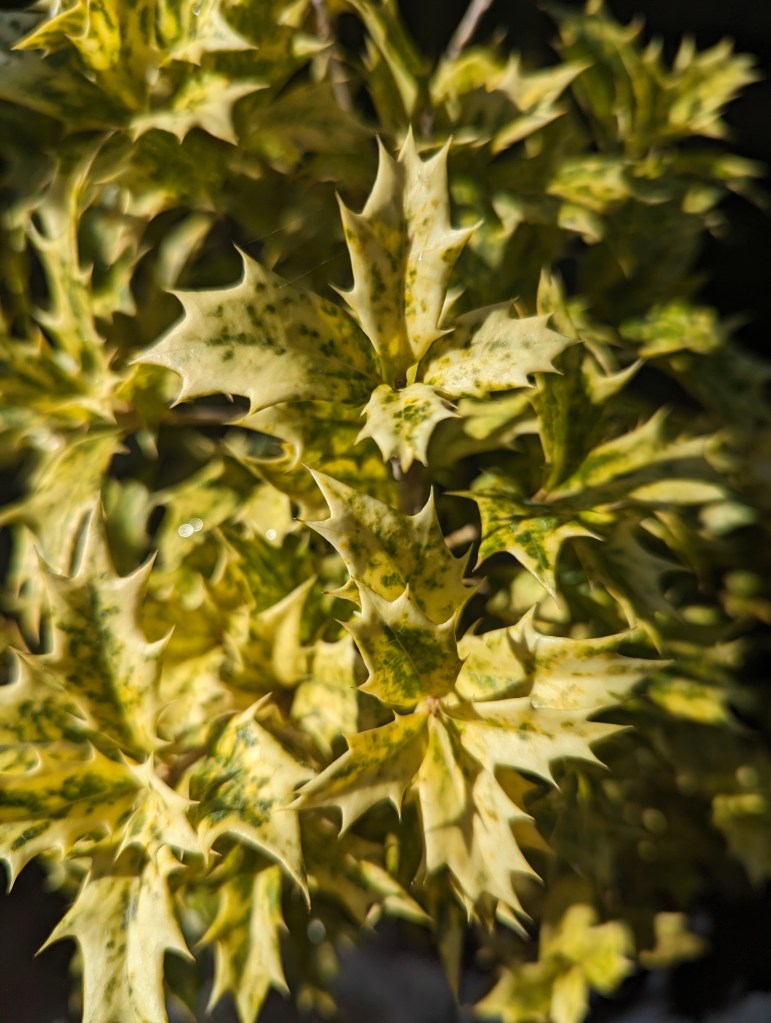
English holly provides traditional cut foliage, preferably with a few berries, for Christmas. It is annoyingly prickly, though. This is why holly olive, Osmanthus heterophyllus, is now a more docile option. Its foliar texture is very similar, but with slightly dulled foliar spines. It is gentle enough for corsages and boutonnieres. However, it generates no red berries.
Holly olive is popular as small and perhaps decorated potted plants for Christmas decor. Afterwards, it adapts to home gardens more efficiently than typical Holiday potted plants. Such potted plants should not retain any mylar wrapping for too long. It inhibits drainage. Also, any small decorations or fake berries should not remain as stems eventually grow.
Most popular cultivars of holly olive are variegated. ‘Goshiki’, with more yellow or creamy white blotches than green, is the most popular here. Unvariegated holly olive is a classic dark drab green. All cultivars work splendidly as formal hedges. Alternatively, they might slowly grow taller than fifteen feet. The evergreen foliage becomes less spiny higher up. Tiny flowers are sweetly fragrant.
 Tony Tomeo