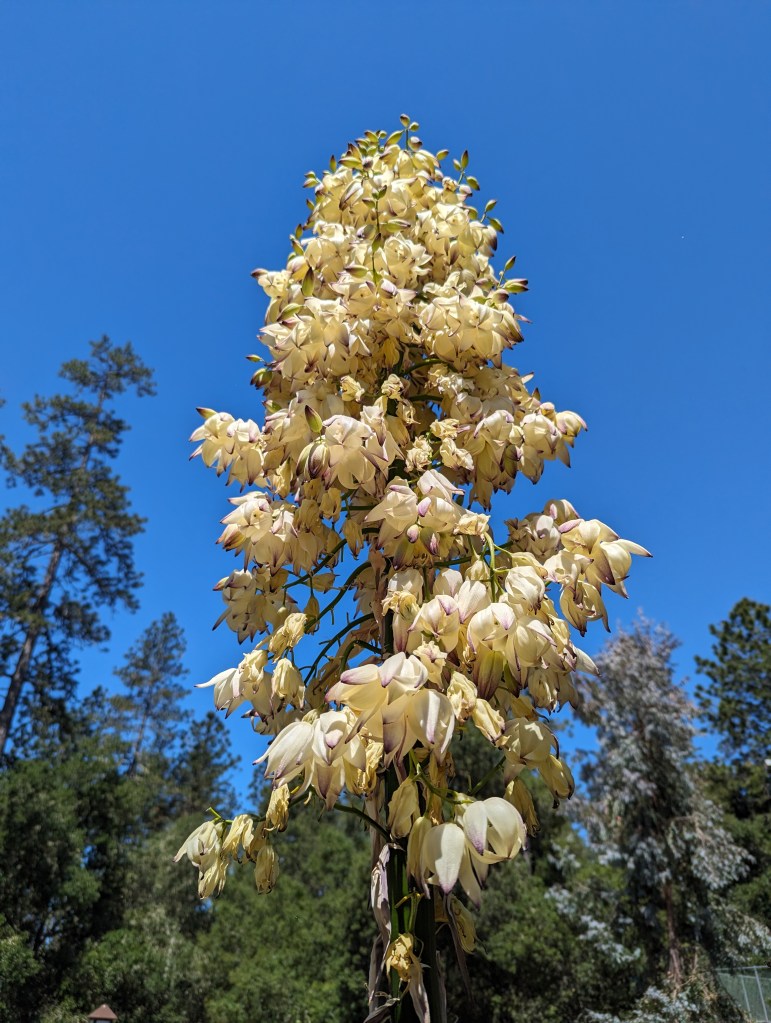
(Hespero)Yucca whipplei has an identity crisis. My contemporaries and I learned it as Yucca whipplei. Botanists now insist that it identifies as Hesperoyucca whipplei, although, like any and all other species of Yucca, it can hybridize with any and all other species of Yucca. (If it is a different species of the same genus, such hybrids would be interspecific hybrids. If it is a different genus, such hybrids would be intergeneric hybrids, which is even weirder.) Also, my contemporaries and I learned its common name as Spanish bayonet. Botanists prefer to designate it as chaparral yucca. It is alternately known as foothill yucca, Quixote yucca or our Lord’s candle. Because it was the only species of the genus that was locally native, we typically referred to it merely as yucca. Later, I learned that Spanish bayonet is a general designation for a few arboriform species of Yucca, which develop trunks and perhaps limbs, such as Yucca aloifolia, and that Spanish dagger is actually more commonly a generic designation for a few species that lack significant trunks or limbs, such as this particular species. Anyway, regardless of all this nonsense, I had been wanting to grow this species since encountering it while studying horticulture at California Polytechnic State University in San Luis Obispo, but could not find an appropriate situation in which to do so. It is too wickedly spiny for most landscapes. I was told that a specimen inhabited one of the landscapes at work, but because it did not look familiar, I was sceptical. It adapts so efficiently to whatever situation that it grows into, that its foliage here is somewhat different from how it develops in the wild around San Luis Obispo. Its impressively tall bloom is very familiar though, and is very distinctive of the species.
 Tony Tomeo
Occasionally you will see a yucca in someone’s garden here (I don’t know what sort) and although very striking, I have to say they look utterly ridiculous in a lush green garden planted full of flowering perennials! If they are in a driveway they look very nice, and are certainly always a converstion piece here. 😉
LikeLiked by 1 person
Of the fifty or so species of Yucca, only a few are popular for home gardening, and of these, some are not resilient to hard frost. Therefore, not many are available in your region. Variegated cultivars of Yucca filamentosa are likely the more common sort, and they commonly revert back to simple green. Yucca recurvifolia might also be available there. However, Yucca whipplei is probably unavailable there. Although native near here, it is rare in nurseries, likely because it is so unappealing within refined landscapes. It tolerates frost, but does not like long, cool and damp winters. I think that Yuccas should be more popular here because they are so undemanding.
LikeLiked by 1 person