Simply, these are six varieties of flowers. All but one bloomed last week. Half are hybrid cultivars of the same genus with two in the same picture. Six pictures of flowers with two varieties in one picture should include seven varieties of flowers. But of course, “mostly” indicates something that is not exclusive. Anyway, I should have gotten more pictures at work, since it was a rather fun week. Irrigation is getting more demanding, though, now that the weather is getting warmer. Because we need to delay renovation of a prominent landscape, we installed potted Canna onto the site. They are potted to facilitate removal when renovation resumes, but will be rad!
1. Lantana camara, which is known here simply as ‘lantana’, is too colorful to not share. Actually though, it is from three weeks ago, and west of Phoenix. Ours is more yellowish.

2. Rosa ‘Iceberg’ and ‘Burgundy Iceberg’ are grafted together on two old rose trees in the rose garden. I find multiple grafts to be annoying, but guests find them to be intriguing.
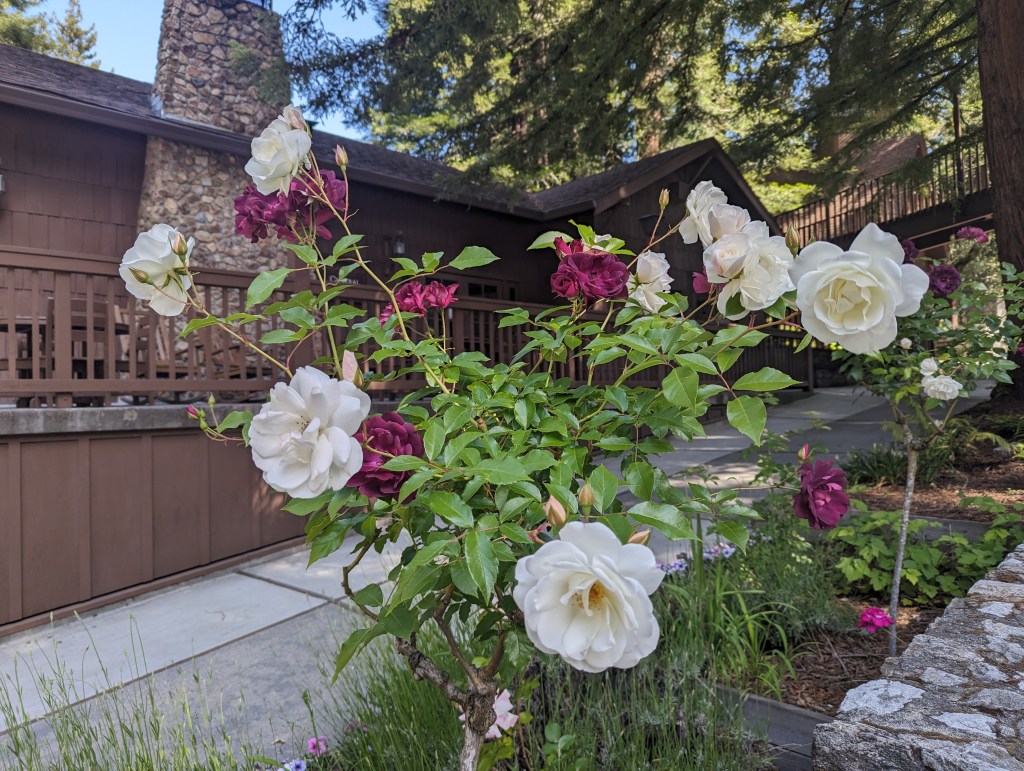
3. Rosa of an unidentified cultivar blooms better with better exposure, and also without the other cultivar that it was originally grafted with, but that was crowded out years ago.

4. Alstroemeria peruviana, Peruvian lily will not die. We removed large colonies at least twice from this location, but some always survive. They are yellow, orange, pink and red.

5. Lilium, which seems to be some sort of fancy Asiatic lily, was a gift from a neighbor. I did not expect them to perform so well, but after only four years, they should be divided.

6. Rhody is the only one of these six who is not a flower, although another type of flower is named after him. Morgan, his F250 who identifies as a Mercury, wants to get washed.

This is the link for Six on Saturday, for anyone else who would like to participate: https://thepropagatorblog.wordpress.com/2017/09/18/six-on-saturday-a-participant-guide/
 Tony Tomeo
A very colourful selection , our lantana over here is mainly yellow and a noxious weed in the bush. But I love that vibrant red one you have shown us
LikeLiked by 1 person
It is a cultivar. Its progeny would likely be progressively (from one generation to the next) more similar to the original (unimproved) species.
LikeLiked by 1 person
“…who identifies as…” LOLOL!
LikeLiked by 1 person
Well, yes. He is a bit more stylish than a typical Ford.
LikeLiked by 1 person
I love alstromeria as a cit flower. They seem to last forever in a vase. Interesting grafted rose. I have never seen that done before. It is kind of weird. My mom would have suggested just plant more roses – no reason to make one plant bear two different flowers when you can buy more roses. She had around 150 varieties and they were her pride and joy.
LikeLiked by 1 person
In the summer of 1986, I worked for a flower grower who grew alstroemerias, at the beginning of their popularity. They have become common since then.
I dislike multiple grafts because one cultivar is always dominant, and almost no one prunes them to accommodate such dominance. Eventually, the recessive cultivar gets displaced. I would only use multiple grafts to attach a small bit of a pollinator to a tree that benefits from it. For example, I could graft a pollinator onto a ‘Bing’ cherry rather than add another entire tree of a cultivar that I do not want much fruit from. Of course, I would maintain the pollinator so that it neither grows too large, nor gets crowded out. Horticulturists did that many years ago. So-called ‘gardeners’ often prune pollinators out of old trees that were so equipped because they do not know any better.
LikeLiked by 1 person
Intersting! I do like the idea of grafting your polinator directly onto the tree that needs it – elegant solution!
LikeLiked by 1 person
The technique was more common years ago than it is not. Nowadays, such grafting has become a weird and less utilitarian novelty.
LikeLike
Perhaps it’s just that I’ve not come across it before but that rose looks very wrong.
LikeLiked by 1 person
I agree. Its weirdness is what makes it popular, but no one maintains them properly, so eventually, one cultivar displaces the other. I would prefer to cut out the purple, but will not do so because guests like the weirdness.
LikeLike
I love Iceberg Roses. Oddly, Lantana is difficult to grow in my garden here, so I bought a native Lantana depressa which seems to be defying the odds so far! Woof to Rhody.
LikeLiked by 1 person
?! I thought that Lantana (of some sort) is an invasive exotic there.
LikeLiked by 1 person
The non sterile exotic Lantana reseed prolifically and are invasive. Oddly this native one also produces seed.. so it’s a mystery! I hope I think about cutting the flowers off before they go to seed.
LikeLiked by 1 person
Is it a mystery because it does not self sow?
LikeLike
That is a beautiful deep orange/red Lantana. Lantana are sold for summer containers here and I am tempted to buy one after seeing that photo! Love the lily too – I don’t grow them due to lily beetle but love seeing them in other people’s gardens. And of course, the photo of Rhody is so cute!
LikeLiked by 1 person
Is Lantana camara merely an annual for summer? That seems like a waste. Some do not start blooming until halfway through spring anyway.
LikeLike
Oh yes, !antana would not like a wet, dark, long and cold winter! I think they only withstand light frost. The nurseries sell them in flower in spring, so they have been given a headstart in a greenhouse somewhere. 😃
LikeLiked by 1 person
The few at work have been there for years. They were installed by a gardener who retired at least a decade ago. Because they bloom later than they do farther south, they would not bloom for long if they needed to be replaced annually. I mean that by the time they were mature enough to bloom, which would likely be later than for those that are already established, it would be half way through their bloom season.
LikeLiked by 1 person
I bought myself a small one yesterday for a summer container: L. ‘Bandana Rose’. It’s beautiful!
LikeLiked by 1 person
but, just as an annual?
LikeLike
I will try keeping it indoors over winter and see if that works.
LikeLiked by 1 person