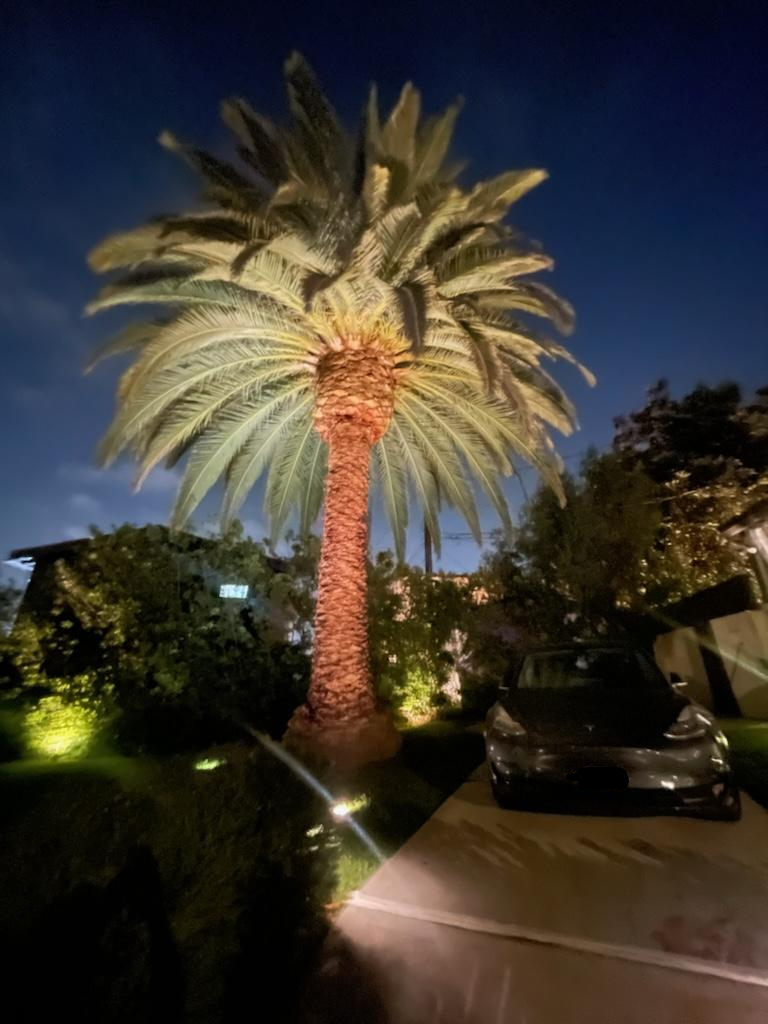
“Put your hands in the air!
That is what this uplit Canary Island date palm seems to be responding to. It seems to be surrounded by police, with their spotlights aimed at it as they proceed with an arrest. It actually seems to be guilty, although it might merely be humiliated.
Brent is a renowned landscape designer in the Los Angeles region. I know that I should not question his work. After all, aside from all the other unusual horticultural work that I do, my primary work is supposed to be on the farm. I merely grow the material that Brent’s crews assemble into their landscapes. I know that Brent knows what he is doing, and his clients appreciate it very much. I just do not quite get it.
Although I happen to be fond of Canary Island date palms in other peoples’ landscapes, I do not think that I would want one in my own garden. I would prefer a fruiting pair of date palms. Even that is a stretch. They occupy significant space, and probably would not produce good fruit here anyway. Even if such palms inhabited my garden, I know that I would not want them uplit like this. Such trees seem to be embarrassed or annoyed about being kept up late. They really deserve to get some sleep at night like everyone else.
Uplighting became popular in the 1970s. By the time that Brent and I were in school, and he was studying landscape design, lighting of various colors had become popular. I can remember a landscape in his Parents’ neighborhood that was done up like a horror movie with red lights. Another was done up like a circus with various tacky colors. Eventually, white lights became most popular, although colorful lights are not completely unpopular.


That’s interesting that you grow the things that his crews use for landscaping.
LikeLiked by 1 person
I said that wrong. I grow horticultural commodities, which is the plant material that landscapers use in their landscapes. Although Brent is a landscape designer, with a crew to install his landscapes, he does not use much of what I grow. That would be cost prohibitive, since we are hundreds of miles apart. I only grow a few odds and ends for him, that his suppliers can not be bothered with. For example, in the future, I would like to supply Tupidanthus calyptratus ‘Variegata’ because nurserymen in Southern California have difficulty propagating it.
LikeLiked by 1 person
Aha, I see. Shipping anything so far would be cost prohibitive. You sometimes speak Latin, and then I google. I think we would call that shiffeleria, or maybe it’s a cousin.
LikeLiked by 1 person
What is worse is that I delivered minor quantities of horticultural commodities myself, without shipping. That is why I considered replacing Morgan, the 1967 C10 who travels no farther than about twenty miles from home, with a pickup that is not so geriatric. I determined that, because I so rarely deliver significant volumes of produce, that it would be less expensive to rent a moving van when necessary. I brought about forty #5 Sequoia sempervirens to Los Angeles with Buster, a 1986 Taurus wagon. The following year, I brought more than sixty #5 Eucalyptus viminalis! Carson, the 1994 Roadmaster, brought back a #15 Tupidanthus calyptratus ‘Variegata’ stock plant, along with a trunkload of other goodies, when we returned a bit more than a month ago. Carson’s trunk is about as big as the bed of a small pickup. Anyway, Tupidanthus calyptratus is more commonly known by its botanical name, since it lacks a standardized common name. Some may know it as mallet flower. It is related to Schefflera, but is a different genus.
LikeLike