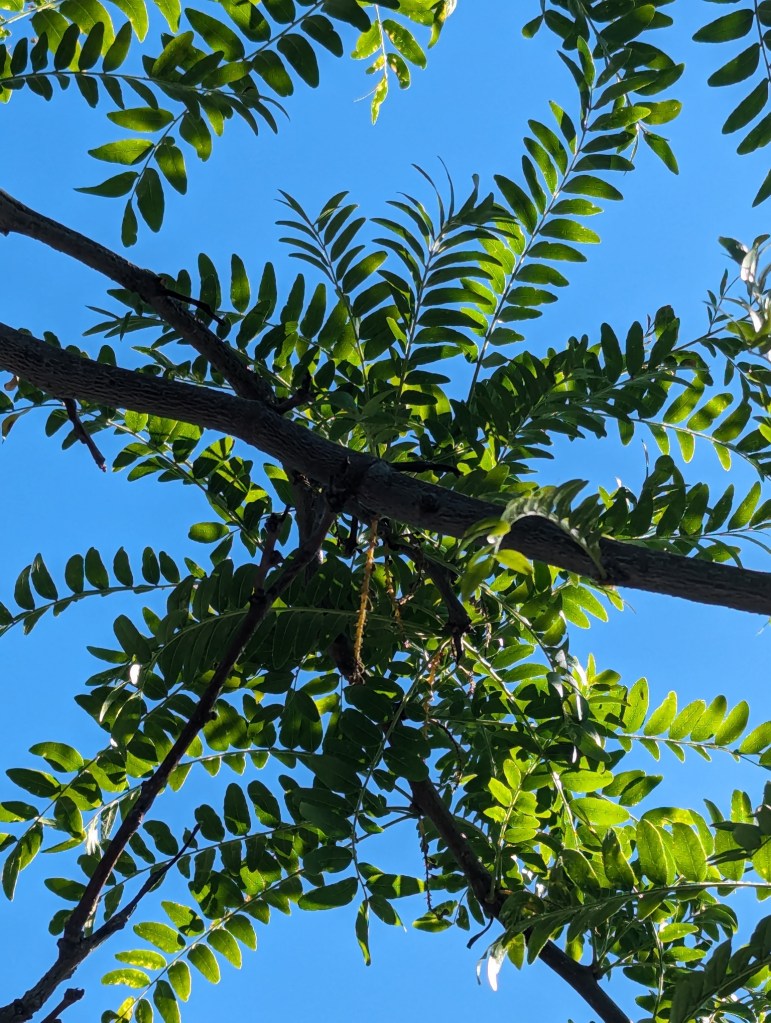
Within its native range, wild thorny honey locust, Gleditsia triacanthos, is a nasty tree! Its wicked thorns are typically as long as four inches but can be twice as long. Some branch into many thorns or thick clusters of thorns. Thickets of many trees can be impenetrable. Female trees produce a messy abundance of brown pods that are about half a foot long.
Fortunately, its cultivars are much more docile. Most are exclusively male, so produce no pods. Old fashioned cultivars that might produce pods as they mature are now rare. More importantly, cultivars are thornless. That is why their common name is now honey locust rather than thorny honey locust. They are as remarkably resilient as the simpler species.
Most cultivars of honey locust grow no taller or wider than fifty feet here. Some grow only half as tall. Some of the more popular cultivars are brightly yellowish green for spring. At least one is ruddy bronze for spring. The finely textured foliage provides dappled shade. Leaves are pinnately and bipinnately compound, and turn yellow for autumn defoliation. Individual leaflets are less than an inch long, so can be difficult to rake.
 Tony Tomeo
Do you know if this is related to our Robinia pseudoacacia, which we call false acacia? It grows wild here. I featured a flower in a vase just recently because it smells so good.
LikeLiked by 1 person
It is related, since both are leguminous, but its flowers are neither colorful nor fragrant.
LikeLiked by 1 person
I don’t think we have those here. After reading your description, that’s ok.
LikeLiked by 1 person
Cultivars are much nicer than wild trees. However, it might be native there.

LikeLiked by 1 person
Maybe I haven’t been out in the right woods.
LikeLiked by 1 person
or the wrong woods.
LikeLike