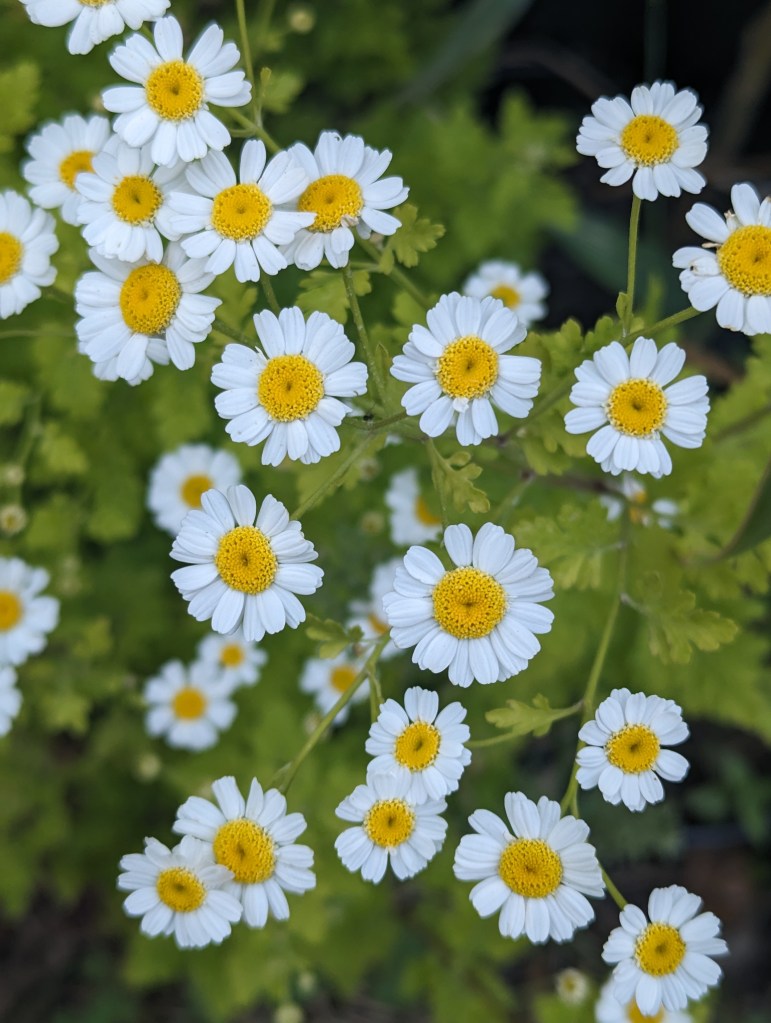
Historical herbal applications were the origin of its now silly name. Feverfew, Tanacetum parthenium, is a relative of chamomile. Its leaves are useful for herbal tea like floral buds of chamomile. Feverfew is delightfully aromatic, although some may disagree about how delightful it is. Some believe that it can repel unwanted insects, but may also repel bees.
Feverfew is likely more popular for its floral display than its aromatic foliage. Its abundant small composite blooms are very similar to those of chamomile. They are nearly as wide as three quarters of an inch. Their yellow centers are a bit flatter. Their ray florets (petals) are a bit wider. They bloom on open trusses that hover loosely above their basal foliage.
Feverfew has lime green foliage with a fine texture. It can stand almost two feet high with bloom standing a bit higher. It migrates slowly, but can slowly get where it should not be. Pruning scraps can root as cuttings. Feverfew prefers rich soil but does not need it. Good sun exposure and even watering are more important. ‘Aureum’ is bright greenish yellow.
 Tony Tomeo
I have it all over the garden now and have pulled a couple….may regret not pulling more but it looks quite wonderful. Would like to get the gold one again…
LikeLiked by 1 person
I did not bring any? I must remember that! For us, it is not so aggressive, so I do not mind moving bits of it around.
LikeLike
Wait a minute….you did bring a white leafed sage…it has kind of black flowers…having never seen the “smudging” white sage I didn’t realize it might be that one? I’ll have to look at it and then at pictures tomorrow.
>
LikeLiked by 1 person
Oh, I meant the feverfew. The cultivar that we have here is the common sort with that bright chartreuse foliage that is supposed to be ‘golden’.
The sage that I brought is merely Salvia clevelandii, Cleveland sage, which is also known as a black sage. It inhabits some of the landscapes at work. I like it because it smells something like Salvia mellifera, black sage, which is native to the Santa Clara Valley, and everywhere I have ever lived.
LikeLike
I think it’s good for headaches too.
Linda 🙂
LikeLiked by 1 person
My articles tend to neglect herbal applications of subject species because I know almost nothing about herbology. I might mention that a particular species has herbal application, but without mentioning much details. These articles are recycled from the gardening column, which has limited space. (It is one of two parts of a gardening article.)
LikeLiked by 1 person
It’s tricky too writing anything that might seem like medical advice; that’s best left to doctors… (but the tea has helped me). Here’s to growing your garden! xx
LikeLiked by 1 person
Mentioning herbal qualities is easier than mentional medicinal qualities, and most of my readers do not expect me to be completely accurate in regard to flavor and aroma anyway.
LikeLiked by 1 person
SO true! It’s a great blog (so much to read, so little time!)
LikeLiked by 1 person
Thank you.
LikeLiked by 1 person