All but two of the forty or so cultivars of citrus that I grew in the early 1990s were grafted onto the same dwarfing shaddock rootstock. Only ‘Meyer’ lemon and ‘Seville’ sour orange were not grafted, or ‘on their own roots’. ‘Meyer’ lemon naturally stays compact enough to not need a dwarfing rootstock. it was our most popular cultivar. ‘Seville’ sour orange supposedly grows about as large as the various dwarfed sweet orange with or without a dwarfing rootstock, as if the rootstock does nothing to limit its ultimate size. It was our least popular cultivar.
‘Eureka’ lemon, ‘Lisbon’ lemon and ‘Sanguinelli’ blood orange grow larger than any of the other grafted dwarf citrus that we grew. ‘Eureka’ lemon is actually a variant cultivar of ‘Lisbon’ that produces fruit throughout the year, which is a desirable attribute within home gardens. ‘Lisbon’ lemon may seem to be a bit more productive, but only because it produces all of its fruit within a more defined season, which can be a desirable attribute for orchard production. Otherwise, ‘Eureka’ and ‘Lisbon’ lemons are indistinguishable from each other, and grow quite tall. ‘Sanguinelli’ blood orange grows about as large, with a nearly identical upright form, but with a softer foliar texture.
Without dwarfing understock, ungrafted ‘Eureka’ and ‘Lisbon’ lemon trees can grow as big as small shade trees, and produce more fruit than they can support against gravity. Their broken limbs are a horridly thorny mess to clean up. ‘Sanguinelli’ blood orange trees can grow about as large, although they support the weight of their fruit more efficiently, and any debris that they generate, hopefully from pruning rather than breakage, is not so objectionable to handle.
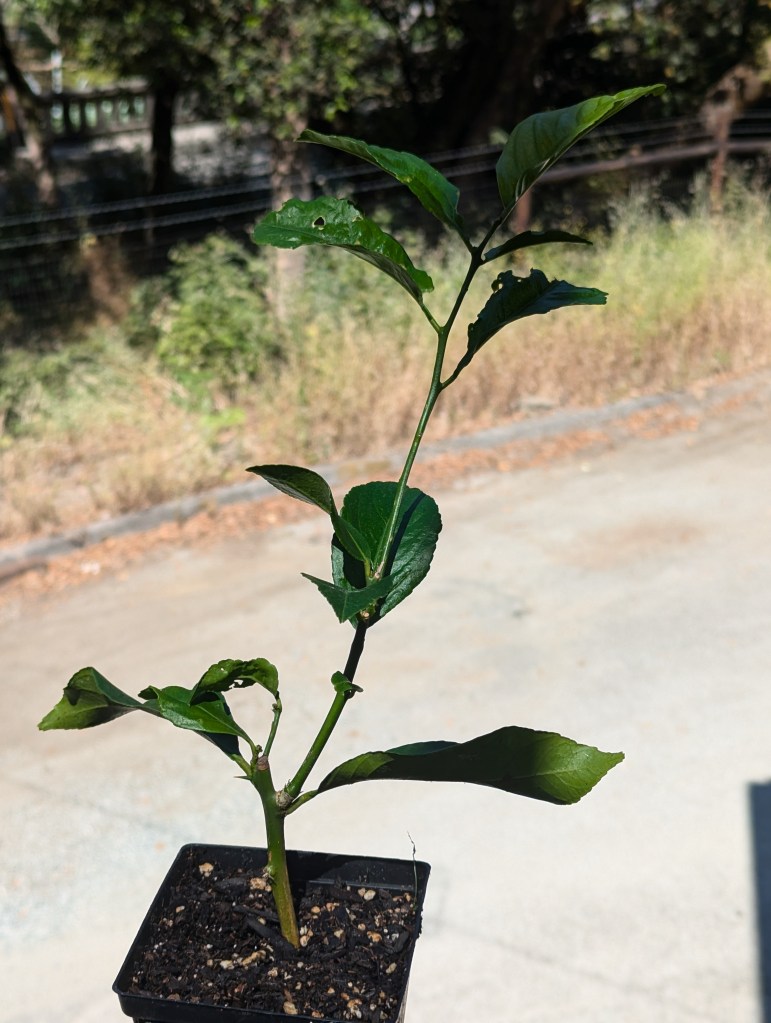
So, I should have known better than to plug a bunch of ‘Eureka’ lemon cuttings. As cuttings, they lack dwarfing understock. I shared more than half with neighbors, who have been warned. About fourteen remain. One is more than enough.
 Tony Tomeo