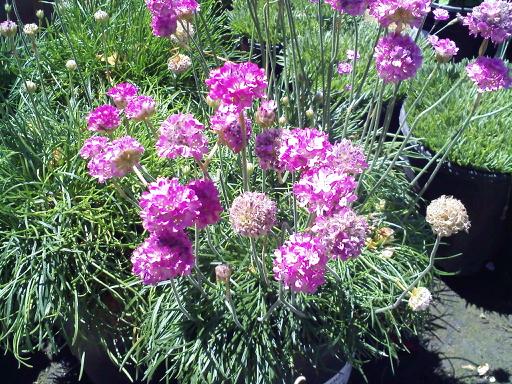
When I see common thrift, Armeria maritima, in nurseries now, I wonder what such a diminutive perennial would be useful for. Their densely compact mounds of narrow evergreen leaves rarely get more than four inches deep, and take their time spreading to less than a foot wide. Then I remember how thrift visually softened the straight edges of my father’s brick patio and retaining walls, and fit so nicely into the tight spots. If allowed to do so, thrift creeps slowly over edges of pavement and stepping stones, but is not too eager to overwhelm them.
If it eventually gets overgrown, thrift is easily cut back to the edge of pavement at the end of winter, and will green over its raw edge by spring. The bits and pieces that are left over from cutting back the edges can be plugged back into other areas and will eventually develop roots if initially watered regularly. Once established, thrift stays healthier if allowed to dry somewhat between watering. Bald spots that may naturally come and go as mature plants die out in the center and then regenerate fill in faster if outer edges get cut back.
The dense round clusters of tiny flowers stand above the foliage on bare stems about four to eight inches high. The flowers are almost always bright pink, but are sometimes white or reddish pink. Bloom is most profuse in spring and may continue sporadically all year.
 Tony Tomeo
Out here in the frozen north, I see this used in rock gardens and in trough gardens (which were a thing for awhile). It’s also useful for other kinds of special settings–I am thinking of the railway garden that we had at my old garden center. It would probably also thrive in the garden area around my pond which is surrounded by rocky beds–if I could keep the bears from trampling it. 🙂
LikeLiked by 1 person
Because I know it primarily from coastal climates, I tend to forget that it tolerates significant frost.
LikeLiked by 1 person
In the South Thrift is Phlox subulata..it is very similar though and great in the right place.
LikeLiked by 1 person
Phlox subulata is rare here. I can not remember the last time that I saw it. It might have been more popular when we were in school in the 1980s. Because it is so rare here, there is not much potential for confusion with names.
LikeLiked by 1 person