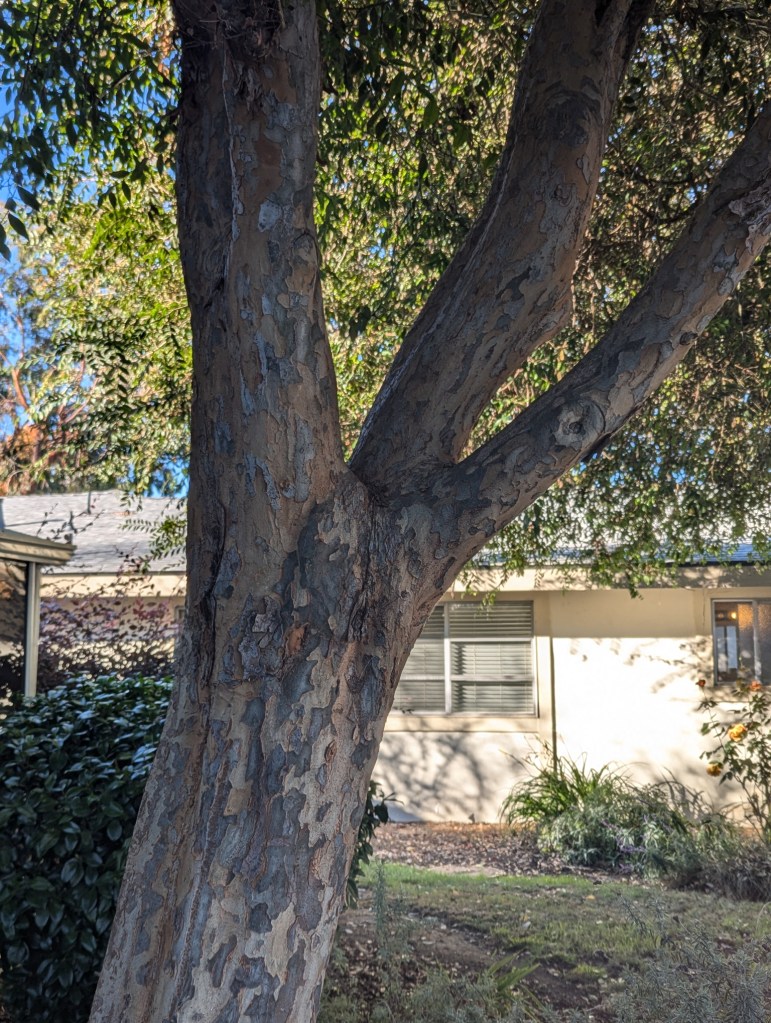
Dutch elm disease became a serious problem for American elms in the 1930s. However, it did not reach California until half a century or so later. Chinese elm, Ulmus parvifolia, is not very susceptible to the disease, but is a vector. In other words, it can survive infection to share it with other species of elm. Consequently, it became unavailable by the 1980s.
Some mature specimens of formerly common Chinese elm still inhabit older landscapes. Younger specimens in newer landscapes are mostly ‘Drake’ Chinese elm. They are a bit more upright, with more symmetrical form. More importantly, they are not vectors of Dutch elm disease. Other cultivars that are also resistant are rarely available at local nurseries.
Classic and formerly common Chinese elm can eventually grow more than fifty feet high. Some can grow thirty feet wide to shade an entire urban front lawn. Some cultivars might grow nearly as high, but are generally not quite as broad. Their blotchy gray and tan bark adorns curvaceous limbs. Their small deciduous leaves are not very colorful for autumn. They can be copious, messy and quite tedious to rake.
 Tony Tomeo
There was a Chinese elm in the front yard of my childhood home, along with two large maple trees. I didn’t know any of this interesting information about it, but I stilll can visualize and ‘feel’ the shape and texture of its leaves. Of course, they weren’t an annoyance to me, since I wasn’t the one doing the raking.
LikeLiked by 1 person
The old trees were more sculptural. I am not so impressed with the modern cultivars. I know that they have a lot of attributes, but their form is not as elegantly lanky.
LikeLiked by 1 person
Dutch elm disease changed the landscape in rural areas here too. I live near to the countryside Constable painted and the loss of the beautiful elms has changed it completely. And now we have a growing number of pathogens attacking trees such as oaks, ashes and horse chestnuts. I have never seen Chinese elms here, they do have beautiful bark.
LikeLiked by 1 person
Dutch elm disease was not nearly as devastating here because American elms and other species of elms were not so popular. The few old American elms on the Alameda from San Jose to Santa Clara survived until the eventually succumbed to old age only recently, and not all of them are gone yet. WIthout much host material, the disease did not proliferate. In my entire career, I encountered it only once, during my internship in 1988. I do not even know if it is still active here. The disease did more to change the landscape by outlawing the installation of new Chinese elms, but they were not very popular by that time anyway.
LikeLike
We have a beautiful semi- mature tree that provides much needed excellent part shade in our yard in Tucson Arizona. the Desert tortoises love to munch on the dried leaves like potato chips. We let the leaves decompose on the ground providing high quality mulch.
LikeLiked by 1 person
Is it a modern cultivar? Coincidentally, I happen to be just about two hours to the northwest, near Surprise, and several of a modern cultivar of Chinese elm that I can not identify are street trees right outside. I am impressed by how happy they seem to be in this climate, and while surrounded by pavement.
LikeLike
Not sure, but based on your description and the young age of the tree, I believe it is a “drake”. I will look into this more.
thanks for getting back to me.
I kind of figured you were in this general ecozone because of a lot of the plants you talk about, and the Suprise area is pretty close.
And thanks, I really enjoy your writings!
LikeLiked by 1 person
Oh, I am not in this ecozone at all! I just happen to be here now. I do most of my writing from the region of Santa Cruz County (in California rather than Arizona) and Santa Clara County, and for newspapers on the West Coast of California between San Francisco and Beverly Hills (in Los Angeles County).
If I were to guess which cultivar your elm is, I would guess that it is ‘Drake’ as well, just because almost all elms that are more than a few years old, but not older than 1980 are ‘Drake’. A few other cultivars that became available more than a decade ago became more popular during the past few years. ‘Drake’ really is an exemplary cultivar. My main objection to it is that it is not the familiar old fashioned Chinese elm that I remember as elegant street trees in San Jose.
LikeLike