Azaleas make it difficult to limit this post to only six pictures. So many cultivars are now in bloom. However, azaleas also make it easy to comply with suggestion #7 of the Six on Saturday participation guide, which suggests minimal verbiage. There is not much to say about them, since I do not know much about them, or even what cultivars they are. I can only guess the identities of half of them. Even if I could identify the cultivars, I could not identify the species. I only know that all azaleas are of the same genus of Rhododendron. I suppose that, in this regard, they could qualify as a few more of Rhody’s rhodies.
1. ‘Hino Crimson’ happens to look very much like this. The small leaves are dark, but not quite bronzed presently. They were bronzed, but only during the coldest winter weather.

2. ‘Coral Bells’ happens to look very much like this. It is the most common azalea within the landscapes at work, and is remarkably reliable with its remarkably abundant bloom.
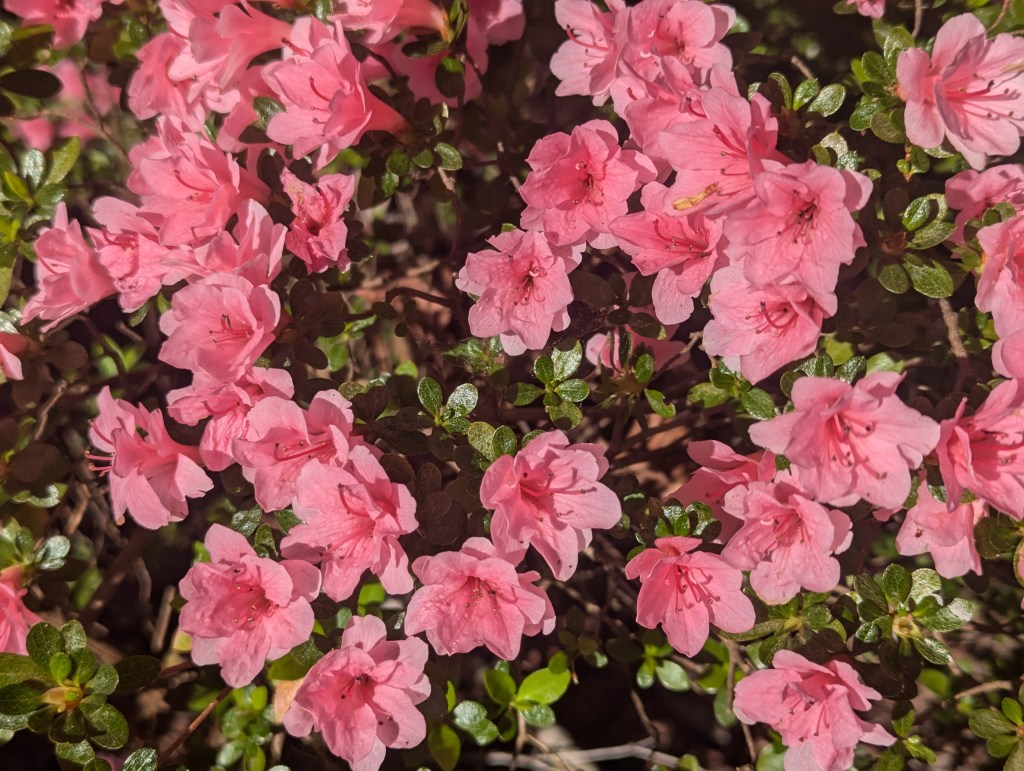
3. The bloom of this cultivar seems to be even more abundant because almost none of its foliage is visible beneath it. These flowers are little, but bigger than those of ‘Coral Bells’.
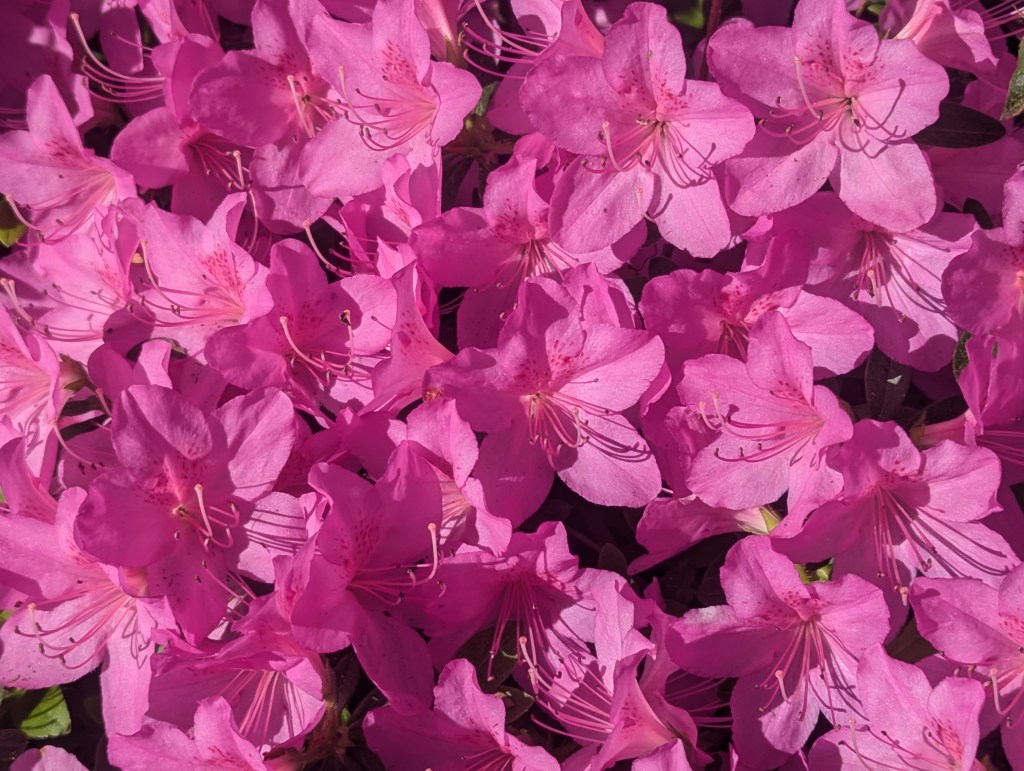
4. This azalea seems to be a ‘florist’ cultivar rather than a landscape cultivar. It was likely left by someone who worked in a nearby office years ago, and then found by a gardener.

5. Within the spacious landscapes here, each cultivar of azalea is installed in groups of at least a few individual specimens. Like the florist azalea, there is only one of this cultivar.

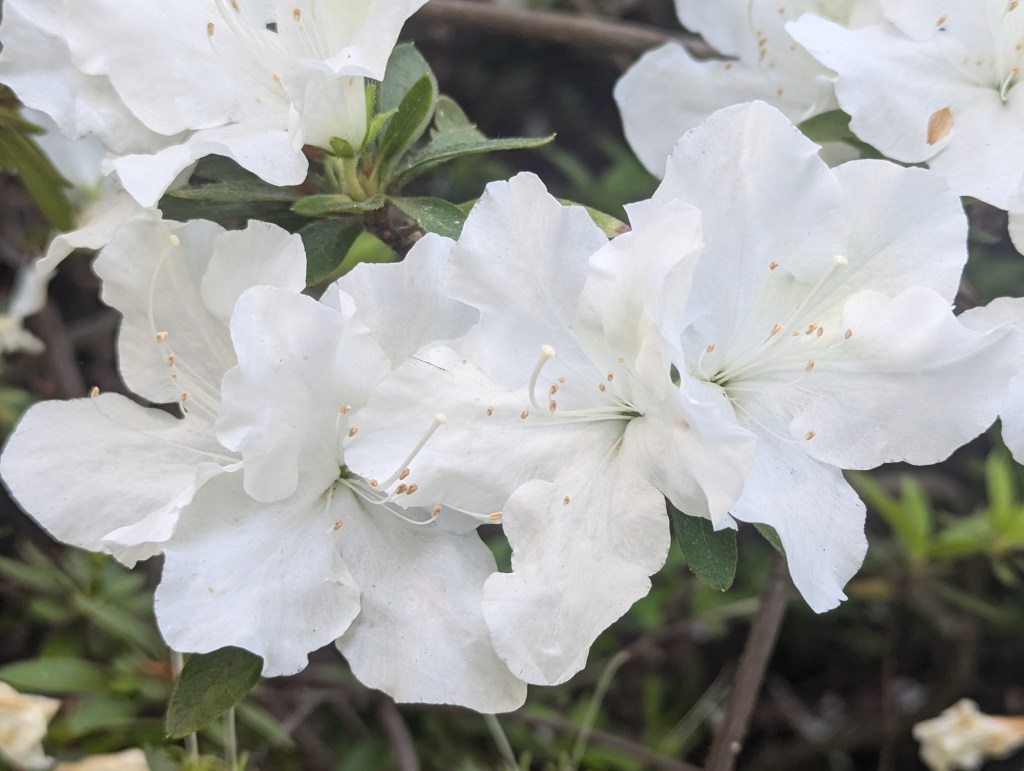
6. ‘Fielder’s White’, which is my favorite of the common azalea cultivars, happens to look very much like this. After restating this phrase thrice, I still can not identify any of these.
This is the link for Six on Saturday, for anyone else who would like to participate: https://thepropagatorblog.wordpress.com/2017/09/18/six-on-saturday-a-participant-guide/
 Tony Tomeo
Number 5 looks like a hibiscus, but I know it isn’t. They are all vibrant
LikeLiked by 1 person
Oh, it does! I did not think of it like that. This particular specimen happens to be on the edge of an outdoor seating area, so people see it up close, rather than at a distance. That is a good situation for it. So far, there are no hibiscus in the landscapes at work. I am growing cuttings of a simple red and a simple yellow tropical hibiscus, which could go into the landscapes later. Abutilon lives in at least one of the landscapes. It is sometimes mistaken for hibiscus.
LikeLiked by 1 person
Hibiscus says tropical to me
LikeLiked by 1 person
Tropical hibiscus are not as popular as they were years ago. Deciduous types are now more popular. I am not so keen on them because their foliage looks so bland. Tropical hibiscus are prettier.
LikeLiked by 1 person
Each and every one a beauty, no matter what their names are.
LikeLiked by 1 person
Yes, which is precisely why I should not care. Some could be old fashioned cultivars that are no longer commonly available anyway. If I ever want to add more to the landscape, I will need to try something different or even NEW. OH MY!
LikeLike
I miss the azaleas and rhododendrons that were so common in and around Seattle, Always a pop of color when the skies were still grey!
LikeLiked by 1 person
Azaleas and other rhododendrons are not as popular here as they are in the Pacific Northwest because they do not perform as well within most of the climates here. However, this happens to be one of those coastal situations in which they are quite happy.
LikeLike
Gorgeous, gorgeous! I’ve always loved them, and my mother had a cold-climate Rhododendron for many, many years. I’ve never grown Azaleas or Rhododendrons, myself, but I’ve always enjoyed seeing them in other gardens. Yours are certainly vibrant and beautiful!
LikeLiked by 1 person
Yes, and they are quite large. Most were installed in the 1970s. They are uncommon within most of California because there are not many climates here that they perform well in.
LikeLike
Well I like one and six. A rose by any other name…
LikeLiked by 1 person
#6 is my favorite! That is why I saved it for last. #1 has perfect red color. Those are good choices. What do you think of #4? I am not at all keen on its overly frilly form. The flowers are so heavy that they tend to flop downward when they get damp.
LikeLiked by 1 person
yes too frilly and not my preferred colour!
LikeLiked by 1 person
Many of these are common in the South. Coral Bells especially. Great photos.
LikeLiked by 1 person
Azaleas are uncommon here, but where they work, ‘Coral Bells’ can be a bit cliche. In landscapes where azaleas do not perform well, ‘Coral Bells’ remains after the others are gone.
LikeLiked by 1 person
They are a cliche in Atlanta! Old lady plant – but super hardy. My mother adored hers.
LikeLiked by 1 person