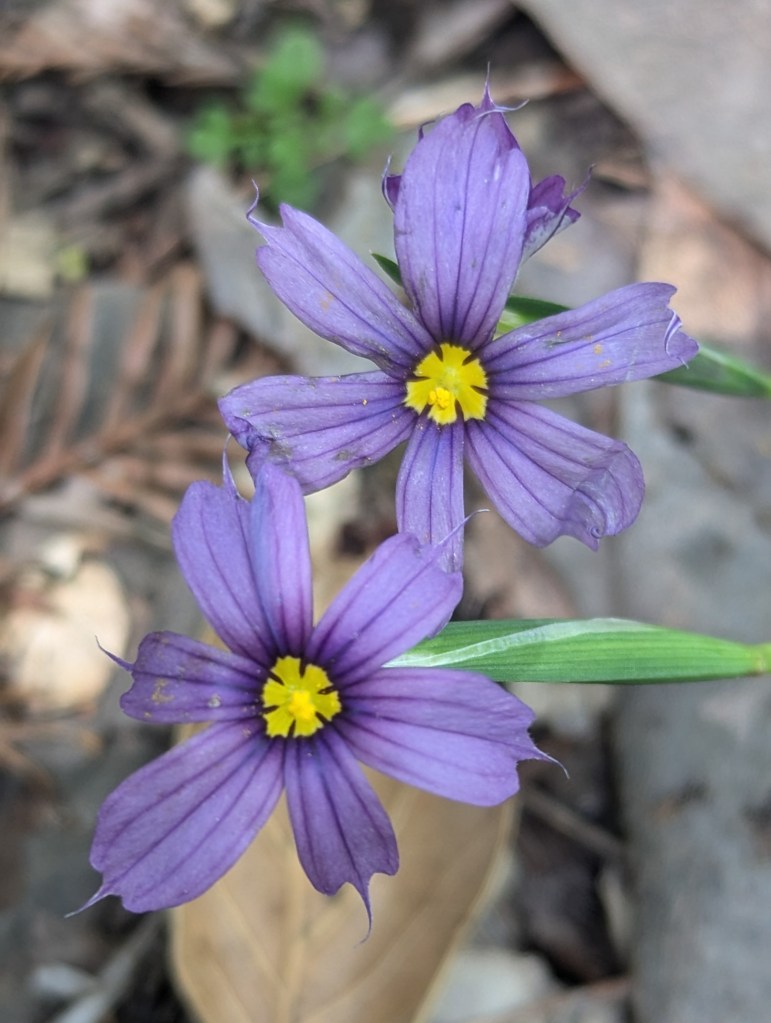
It is not a grass, and lacks eyes, but it is native to most of California and western Oregon. Blue-eyed grass, Sisyrinchium bellum, is related to iris, which actually sounds ocular. Its tiny flowers are typically rather purplish, but can be clear sky blue, or rarely white. Bloom continues through spring until summer dormancy. All foliage then dies back until autumn.
Blue-eyed grass develops small foliar tufts that expand quite slowly. It propagates easily from division of its thin rhizomes as it resumes growth in autumn. Plugging newly divided rhizomes adjacent to original foliar tufts accelerates expansion. Blue-eyed grass can self sow, but typically does so only sparsely. Its grassy foliage is typically less than a foot tall.
Although native and impressively resilient, blue-eyed grass appreciates a bit of moisture. However, it may never require irrigation, since it is dormant through the summer season. Irrigation might maintain foliage through much of summer, but if excessive, can cause rot. Blue-eyed grass prefers sunny and warm exposure, without contention from other plants.
 Tony Tomeo
We have several blue-eyed grass species in Texas, and every time I post a photo two of my California readers mention that they have the flower, too. Neither knew the exact species, but this may well be it. It’s both similar and different from ours, especially when it comes to the veins in the petals of yours, and the longer ‘pointy bits’ on each petal. They’re such pretty flowers; I’m always sorry to see them fade as the heat rises.
LikeLiked by 1 person
They grow so well in the wild, and right through my driveway. However, in landscapes, they typically rot out because so-called ‘gardeners’ give them too much water. Mine get in my way, but I hate to remove them since I know that they would not perform well if I plant them elsewhere.
LikeLiked by 1 person
Never heard of these before
LikeLiked by 1 person
They might not be refined enough to be popular outside of their native range. It is probably just as well if they are not there, since they could have potential to naturalize and become a detriment to some Australian ecosystems.
LikeLiked by 1 person