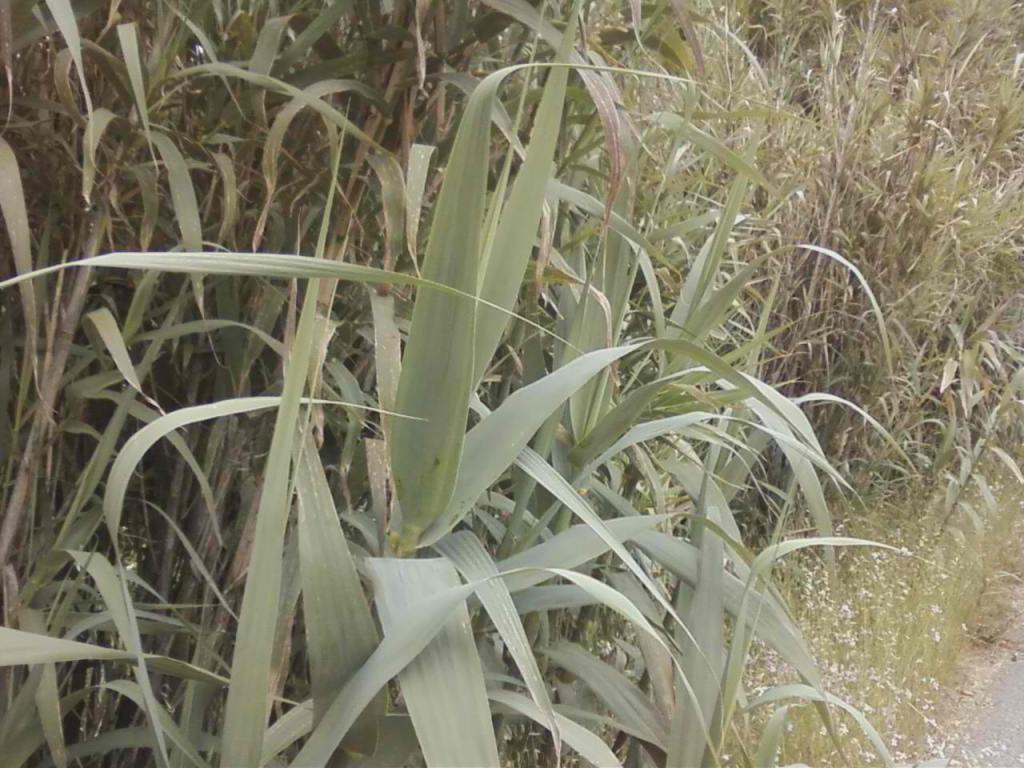
The earliest infestations of giant reed, Arundo donax, that clogged tributaries of the San Joaquin and Sacramento Rivers supposedly grew from pieces used as packing materiel for cargo from China. It was simply dumped into the rivers as cargo was unloaded in port cities like Stockton and Sacramento. How it got to China from its native range in the Mediterranean is unclear.
Because it is so aggressive and invasive, giant reed is almost never found in nurseries. In many rural areas, particularly near waterways, it is listed on the ‘DO NOT PLANT’ list. However, giant reed can sometimes be found in old landscapes where it was planted before it became so unpopular. It can also grow from seed in unexpected places.
Once established, giant reed can be difficult to eradicate or even divide. It spreads by thick rhizomes that resemble the stolons of bamboo, but not quite as tough. It is often mistaken for bamboo. Where it gets enough water, it can get nearly thirty feet tall, with leaves about two feet long.
Where it can be contained and will not become an invasive weed by seeding into surrounding areas, giant reed can provide bold foliage that blows softly in the breeze. ‘Versicolor’ (or ‘Variegata’) has pale yellow or white variegation, and does not get much more than half as tall as the more common green (unvariegated) giant reed. Incidentally, the canes of giant reed are used to make reeds for musical instruments.
 Tony Tomeo
Don’t think it is over here. Invasive things are so hard to get rid of.
LikeLiked by 1 person
You might recognize it if it was. It is not an easy one to ignore.
LikeLiked by 1 person
Hi Tony
We live in a landscape of ‘normal’ reeds. The reeds are harvested in February and exported to the Netherlands and Germany for roofing. Here in England there isn’t such a demand as thatching is very expensive, to do it and for the insurance. But we like it.
Our reed is a nuisance as well on waterways. It has a tendency to grow into the rivers and lakes and make them smaller.
Thanks for your info
The Fab Four of Cley
🙂 🙂 🙂 🙂
LikeLiked by 1 person
I tried to be polite for the gardening column, but giant reed is actually one of the two most problematic invasive exotic species within riparian ecosystems here. It is unfortunate. I happen to be fond of it also, but can not grow it in the ground or near the creek at home. I grow only a bit in large pots at work.
LikeLiked by 1 person