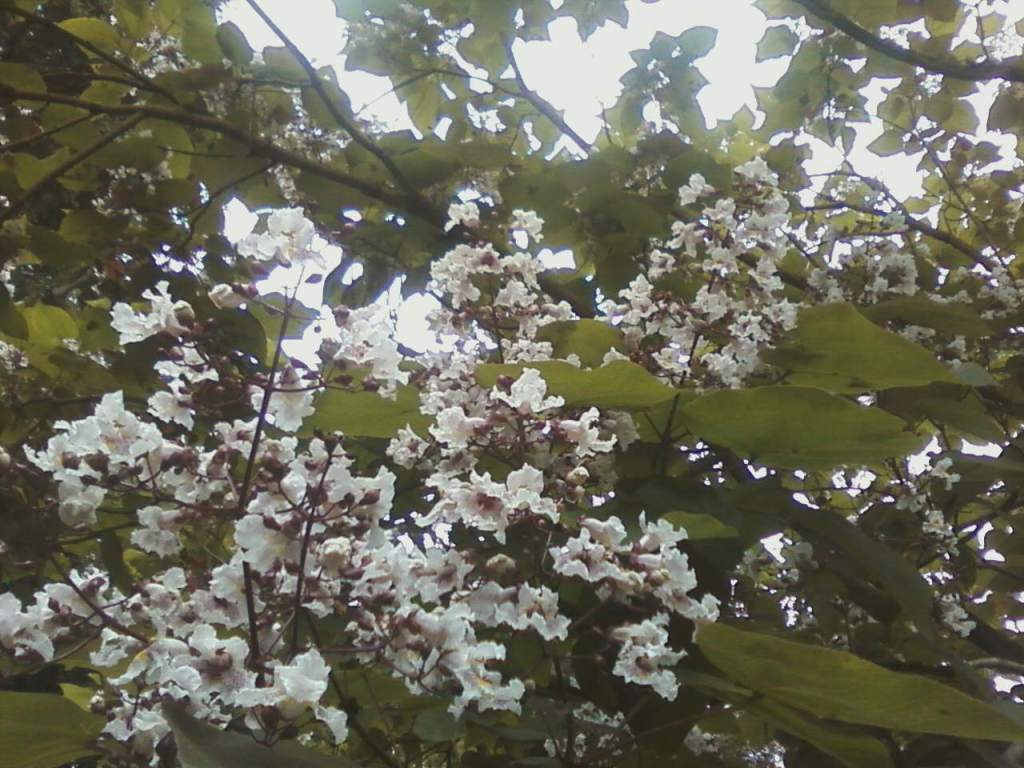
Those who know trees mostly agree that the more traditional catalpa, Catalpa speciosa, from the Midwest is the best catalpa, with soft leaves between half and a full foot long. In late spring or early summer, impressive upright trusses suspend an abundance of bright white, tubular flowers with yellow or tan stripes and spots at their centers. Individual flowers are as wide as two inches. Mature trees can be taller than forty feet and nearly as broad.
From the Southeast, Catalpa bignonioides, is a bit more proportionate to urban gardens though, since it only gets about seventy five percent as large, with leaves that are not much more than half as long. The flowers are also smaller, and not quite as bright white, but are more abundant than those of Catalpa speciosa are. The stripes and spots at their centers are slightly more colorful purplish brown and darker yellow.
Both catalpas can be messy as their flowers fall after bloom. Fortunately, the big leaves are easy to rake when they fall in autumn. Long seed capsules that look like big beans linger on bare trees through winter.
Catalpa speciosa is almost never seen in modern landscapes, and not exactly common even in older Victorian landscapes around downtown San Jose. A few remarkable specimens remain as street trees in older neighborhoods of Oakland, Burlingame and Palo Alto. Most young trees were not planted, but instead grew from seed from older trees that are now gone.
Catalpa bignonioides is actually quite rare locally. A few old but healthy specimens can be seen around downtown Felton, with a few younger trees that grew from seed around the edges of town. Trees in Golden Gate Park in San Francisco are not as happy because of cool and breezy summers and mild winters.
 Tony Tomeo
A friend outside Kerrville, Texas, has one of these trees, and when the flowers fall, it’s quite a sight. When I was a kid in Iowa, there was a catalpa across the street from my grandparents’ home, and the beans often were utilized as ‘weapons’ in our childhood war games.
LikeLiked by 1 person
It seems to be a traditional tree in much of America except for here. Catalpa is a common name for streets in many towns here, but most of us would not know a catalpa tree if we actually saw one. They are rare. I just happen to know a few locally. They are likely all descendants of the same old original tree.
LikeLiked by 1 person