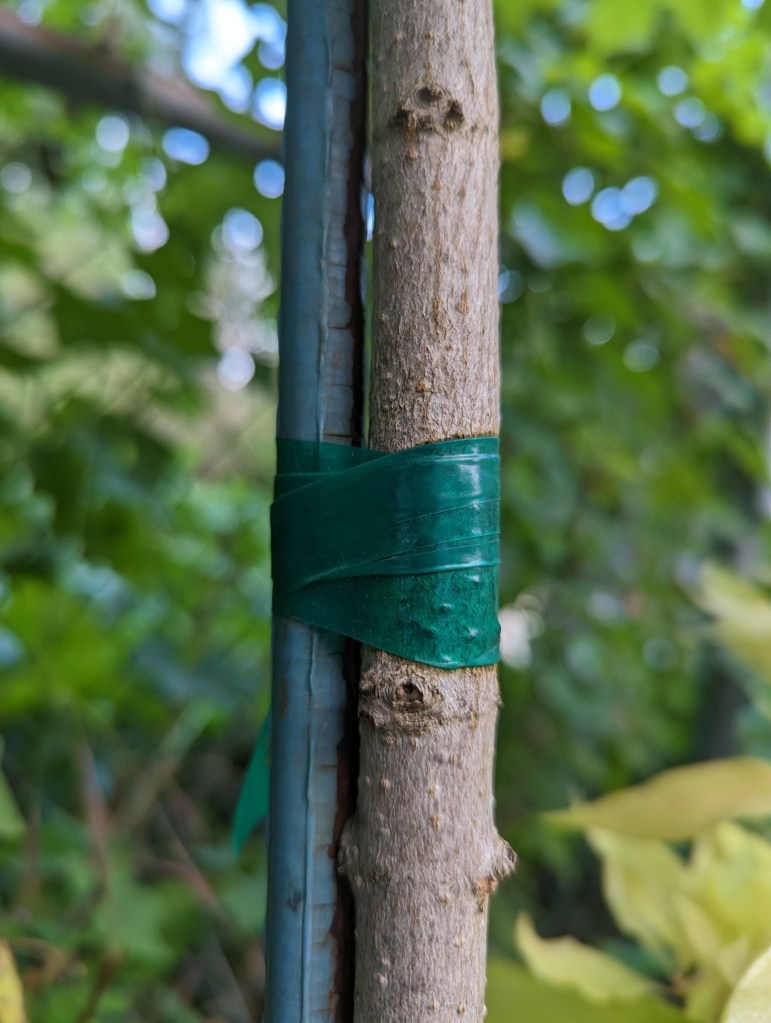
Staking is not quite the same as binding with stakes. It is more for the benefit of the roots than the trunks, which is what binding is for. Staking should support new trees only while such trees disperse roots for adequate stability. As trees do so, stakes become obsolete. Actually, stakes that remain for too long may be detrimental to healthy tree development.
Binding with stakes promotes straight trunk growth. It is particularly practical for trees that naturally develop crooked or multiple trunks. It is a technique that is quite common within nurseries, although not home gardens. However, many trees retain binding stakes when they arrive from nurseries. For a while after planting, some continue to benefit from them.
However, binding may be more detrimental than staking if it remains for too long. Trunks that become reliant on any sort of supportive stake remain weak or limber. Also, tape that binds trunks to stakes can become constrictive as trunks grow. It is important to remove it before it begins to interfere with trunk expansion. Looser tape can be useful if necessary.
For example, California pepper tree naturally develops a few irregular and limber trunks. To produce trees with single and straight trunks, nurserymen bind single trunks to stakes. They then prune out other trunks and low limbs until main trunks attain an optimal height. Because they are still limber, trees remain bound to their stakes while available for sale.
However, such stakes provide only support for trunks. They do nothing for stability while trees disperse roots into their new gardens. Additional staking with heftier stakes may be necessary for that. Such stakes must extend into undisturbed soil below the roots of such new trees. If possible, it is better to merely replace binding stakes with supportive stakes.
The next best option is to replace tape that binds young trunks to stakes with looser tape. This maintains the straight form of such trunks without inhibiting their growth. Supportive stakes, in addition to binding stakes, maintain their upright posture. Most trees need only supportive stakes, realistically. A few trees, especially new palms, need no stakes at all.
 Tony Tomeo
Thanks for this information. I’ve definitely used supportive stakes for some new trees and plants I’ve planted, but only had binding stakes when they’ve come with other new trees. And I’ve gradually removed them as the tree adjusted to its new home. Good to know I probably could remove them a little faster than I did.
LikeLiked by 1 person
Different trees have different personalities. Some are more reliant on their binding stakes for support than others are. Removal should not be rushed; although binding should not interfere with trunk development either.
LikeLike