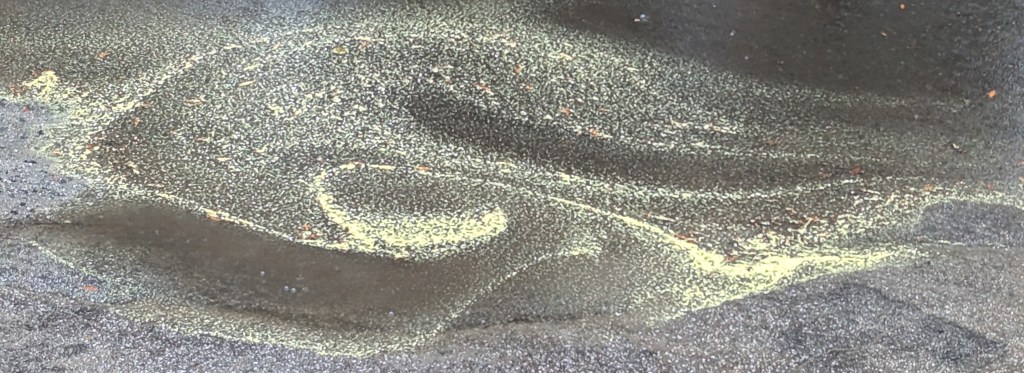
For urban areas, the first rain of the season is typically icky. It mixes with all the crud and filth that has accumulated since the last rinsing rain of the previous spring. Damp roads smell like a mix of automotive fluids and wet tires. Asphalt roofs smell like tar. Even urban trees can initially smell like damp dust. It takes a while and a bit of rain for the crud and filth to rinse away.
This is the second rain of the season, and in a less than urban area. It does not smell objectionable, and is not notably cruddy. However, it still flows with an abundance of pollen that had not rinsed away already. Perhaps this pollen accumulated just since the previous rain, although not much has been blooming visibly at this time of year. It is impossible to say even what species dispersed so much pollen. Nonetheless, here it is, floating in the first few puddles to accumulate. Yuck!
It is no wonder that pollen is as effective at pollination as it is. It is impressively abundant and permeating. It is also no wonder that it is such a pervasive problem for those who are allergic to it.
 Tony Tomeo
We see that quite frequently in the spring–and yes, it IS a misery for those of us who are allergic! Yet somehow it doesn’t keep me inside. The pandemic was a revelation–it taught me about gardening with a mask, at least when the trees are doing this type of pollenating.
LikeLiked by 1 person
Since posting this, I think I found that this particular pollen came from cedars. I forget that they do that at this time of year. Is an allergic reaction to pollen from all abundant pollen, or just certain types?
LikeLiked by 1 person
Ragweed can be troublesome, but in Texas it’s the Ashe juniper, aka mountain cedar, that’s the scourge. The sheriff in Kerr County recorded one memorable set of puffs a few years ago. When people talk about the cedars ‘popping,’ they’re right on target.
LikeLiked by 1 person
Oh! That is awful! Big redwoods do not make that much pollen!
LikeLiked by 1 person
I have heard about those notorious southwest cedars. Here, it’s our Eastern white pines. They also produce pollen like that, although I have never heard it called a puff (but the huge yellow clouds of it certainly could be!) I don’t know if anyone has ever photographed it–but again, it’s not the stuff we’re allergic to here in the East. Maple, birch and other hardwood trees are more bothersome to us–with much finer pollen grains.
LikeLiked by 1 person
Gee, I do not think of maple and birch as the sort that would produce problematic pollen; but of course, they are not such prominent trees here either. If they produce problematic pollen, there are not enough of them to produce enough pollen to be a major problem.
LikeLike
Ugh, yes, I have a whole mini forest of maples myself. They are just lovely most of the year but don’t talk to me about them in the spring. I probably have 6 different varieties on my property alone and multiples of several of them. And I have neighbors all around with more. It’s gorgeous this time of year. But spring is tough.
LikeLiked by 1 person