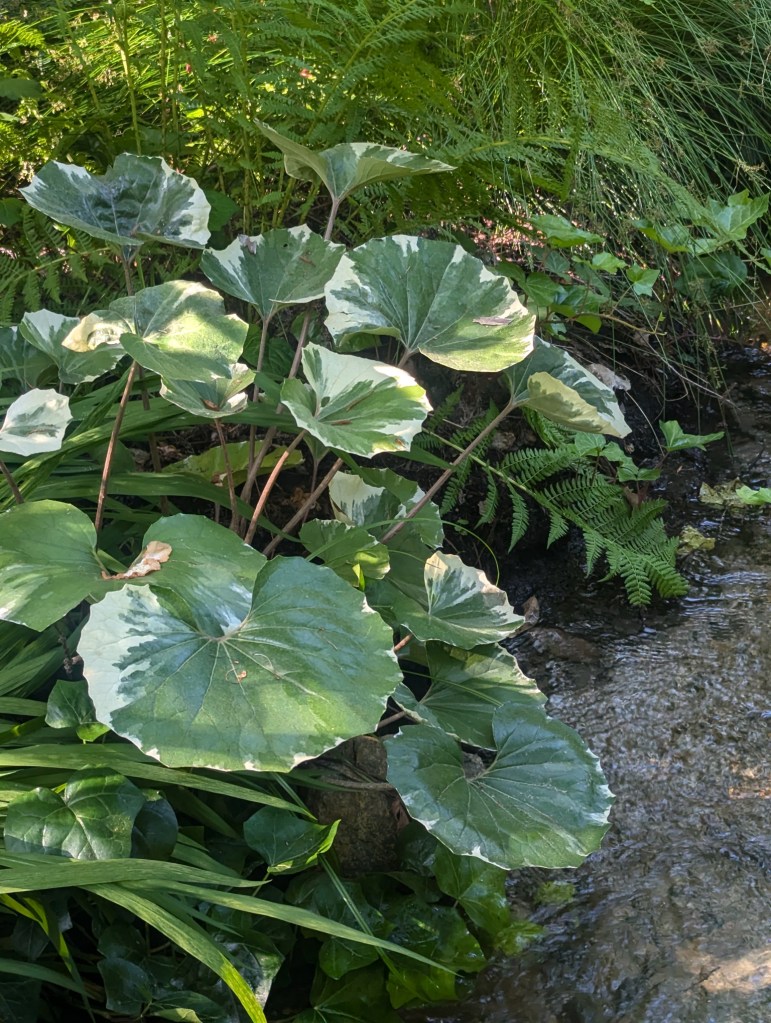
Not much can survive in the shade of broad eaves that extend over a northern exposure. With sufficient watering, that is where the leopard plant, Farfugium japonicum, can excel. It is naturally an understory species that prefers the shade of bigger vegetation. If it does not get too dry, it also performs well with full sun exposure. It enjoys organically rich soil.
Leopard plant is a striking foliar plant, but may also bloom for autumn or winter. Its bright yellow daisy flowers are about an inch wide, and bloom in loose trusses. The glossy and evergreen foliage might be foot and a half high. Some cultivars are more compact, while old cultivars may get slightly bigger. Individual leaves are about three to six inches wide.
Popular cultivars of leopard plant are notably diverse. Most are variegated with yellow or white spots, blotches, margins or irregular streaks. Some exhibit wavy, crinkly or convex foliar margins. Yet, the most popular is likely the old fashioned cultivar with simple, deep green foliage. Their subterranean rhizomes migrate, but rather slowly. Too much fertilizer can cause foliar burn or even inhibit bloom.
 Tony Tomeo
Ooh, I had forgotten about this plant. We can actually grow this here and my garden center had some spectacular old clumps planted around the grounds. It’s a great plant!
LikeLiked by 1 person
Although it has worked well for us, I was hesitant to write about it for the garden column, since I am uncertain of its adaptability to chaparral climates. I suspect that it appreciates humidity.
LikeLiked by 1 person
Well we certainly have the humidity! We used to grow it around the edges of some of the garden ponds. There were several ponds on the property and it did very well there.
LikeLiked by 1 person
I love the shape of the leaves on this plant. Amazing. It could reduce the use of Hosta here maybe…
LikeLiked by 1 person
Hosta has quite a following, though. It is even popular here, even though it does not perform very well.
LikeLike