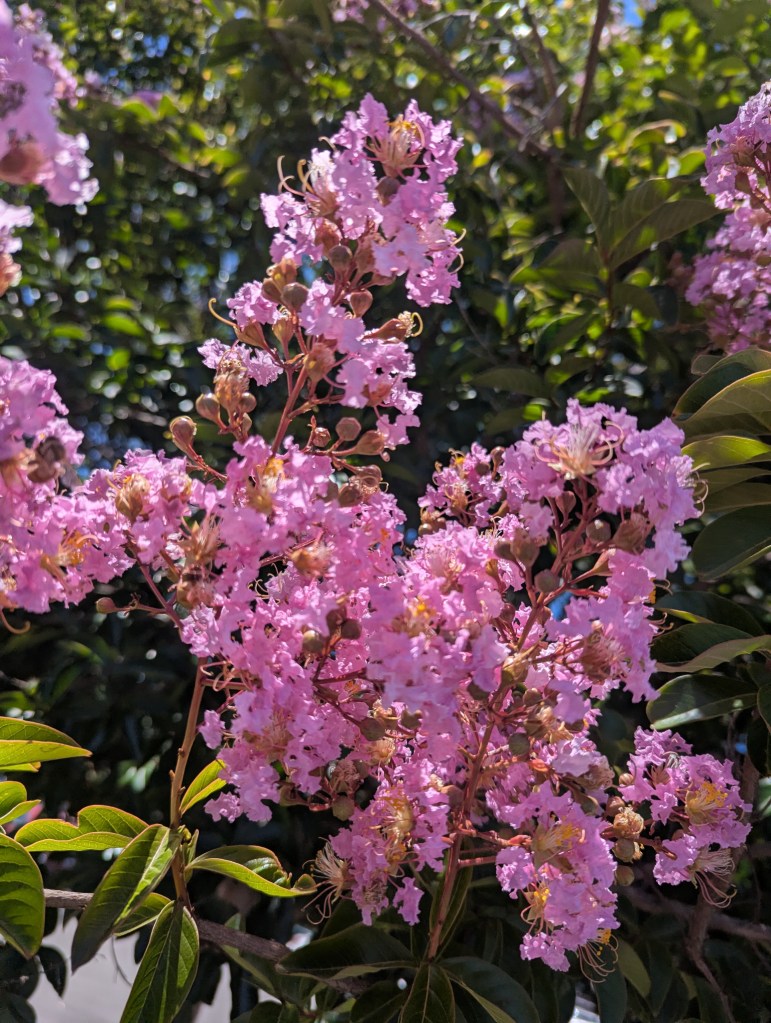
The popularity of crape myrtle, Lagerstroemia indica, is mostly justifiable. It is a compact tree, so is proportionate to small urban gardens. Its roots are very complaisant, so should not displace pavement. It blooms spectacularly for summer, and then develops fiery foliar color for autumn. Its only problem is that it is so popular that it has become too common.
The largest cultivars of crape myrtle do not grow much taller than twenty feet. Therefore, they are appropriate for utility easements with high voltage cables. Because of their very docile roots, they are popular as street trees. Although, they do not grow wide enough to provide much shade. Street trees should have single trunks. Others can have multiples.
Floral color is white, pink, red or mauve. Bloom can be very profuse and billowy. Autumn foliar color is bright yellow, orange and red before defoliation. The smooth bark is nicely mottled. Aggressive dormant pruning for winter delays bloom, but promotes bigger floral trusses. Crape myrtle enjoys warmth and full sun exposure. It does not need much water, once established.


The crape myrtles here have been unbelievably gorgeous this year: loaded with blooms, and with vibrant color after sustained rains. Many long-established trees are quite large, and impressive. Oddly, it’s the state shrub of Texas, despite being non-native. That fact brought quite a legislative kerfluffle. When it was over, a compromise was reached. The crape myrtle kept its status, but the native Texas sage (Cenizo, Leucophyllum frutescens) was named the Texas state native shrub.
LikeLiked by 1 person
Oh, I sort of prefer the native species for State Shrubs. While trying to select an Official Town Flower and Tree for Los Gatos my only requirements were that all candidates must be native or of cultural significance (such as orchard trees). People were suggesting tropical species that would not even survive here!
LikeLiked by 1 person
Great breakdown of facts. From a botanical standpoint, that striking, smooth peeling bark is always a dead giveaway for identification. It’s fascinating how many plants in our everyday landscapes have deeper historical uses than we realize!”
LikeLiked by 1 person
Presently, the flamboyant bloom is a dead giveaway.
LikeLike
Such a critical read. It really makes you pause and think about the reality behind high-demand crops, from deforestation to the human toll. Understanding the true journey of what we consume is so important for building a more sustainable relationship with plants.”
LikeLiked by 1 person
That is sort of why I am not so keen on crape myrtle. It has become too common within synthetic landscapes. I wrote about it only because it is so popular within home landscapes.
LikeLike
Such an important look at the ecological and social footprint of high-demand crops! From a sustainable apothecary perspective, one way we can combat the massive problem of agro-industrial avocado waste is by utilizing the discarded seeds. Avocado pits are incredibly rich in polyphenols and catechins, which carry deep antioxidant and anti-inflammatory properties. A fantastic upcycling DIY is grating the clean seed and infusing it into a carrier oil to create an antioxidant-rich topical body oil or scrub. Repurposing what the global market throws away is a small but powerful step toward a better relationship with plants.”
LikeLiked by 1 person
Well, I did not exactly get into the ecological and social aspects of crape myrtle. If I had, it would not have been such a polite article. I am not so keen on exotic species that become as common as crape myrtle is, although I try to appreciate the few that we have at work. Others like their bright color.
LikeLike
highly valued for its intense astringent properties, driven by its dense tannin and ellagitannin content. A classic, simple DIY remedy is using the dried bark or leaves in a strong topical decoction (simmered water extract). Because of those powerful tannins, it makes an incredible, soothing wash or compress for minor skin irritations and itchy rashes. It’s a wonderful reminder that medicine is often growing right in our front yards!”
LikeLiked by 1 person
Well, that makes me feel a bit better about its commonness. How does it compare to witch hazel?
LikeLike
My winters here are too severe for Crape Myrtles, but I certainly appreciate their beauty. When I think of Lagerstroemia, I think of Branson, Mo., because they were so prevalent and healthy there during a vacation years ago. They seemed so vibrant, despite the heat (high 90s) and lack of rain that summer (2012). I’m not sure I would plant one if I could, but they are lovely shrubs and trees.
LikeLiked by 1 person
I was not aware that they do not perform well where winters are cold. Perhaps that is why I do not remember seeing them in the Pacific Northwest. It does not get too cold here for species that dislike cold weather. Frost is minimal. Crape myrtle does appreciate warmth, though.
LikeLike